
Accounts Receivable Financing Options: A 2026 Business Guide
What if the invoices showing your business has earned revenue are also making it hard to cover expenses on time? When customer payments arrive later than payroll, inventory, or other obligations are due, standard financing may not match the cash-flow gap. The right accounts receivable financing options depend on more than how quickly you need capital. Invoice control, repayment capacity, and customer management all matter.
This guide compares common structures, including invoice factoring and receivables-backed financing, so you can assess how each handles payment risk, costs, and access to funds. You’ll also learn how recourse terms, customer creditworthiness, invoice eligibility, and concentration limits can affect a financing decision. Funding is not guaranteed. Funding is subject to lender underwriting, eligibility requirements, approval, and the applicant’s financial and credit profile.
Koval Investments is a consulting firm that connects businesses with lending partners and helps owners consider capital strategies based on their qualifications. Use the comparison to identify which terms and documentation matter for your business, and how customer communication could be affected before pursuing capital.
Key Takeaways
- Compare accounts receivable financing options by who controls collections, how repayment works, and whether you can select individual invoices.
- Understand the typical steps from invoice review to funding and settlement. Agreement terms determine eligibility and repayment duties.
- Use a practical checklist to assess invoice quality, customer payment patterns, cash-flow needs, and your ability to meet the full contractual obligations.
- Koval Investments is a consulting firm that connects clients with lending partners, not a lender, and helps businesses consider capital strategies.
- Funding is not guaranteed. Lender underwriting, eligibility requirements, and the applicant’s financial and credit profile affect approval.
What Are Accounts Receivable Financing Options, and When Do Businesses Consider Them?
A business can complete work, send an invoice, and still wait for cash while payroll, suppliers, or operating expenses come due. Accounts receivable financing options are built around this timing gap: they let a business seek capital based on eligible unpaid invoices rather than waiting for customers to pay. The structure, cost, and repayment responsibilities depend on the arrangement and its terms.
Accounts receivable financing is a way for a business to access capital against eligible unpaid invoices for goods or services it has already provided. Depending on the structure, a business may borrow against receivables or sell invoices to a financing company. These arrangements differ in collection control, customer involvement, and how the advance is settled. The broader category is also called debtor finance, also known as accounts receivable financing.
Think of it as a potential tool for a defined cash-flow need, not a universal solution. Lenders and financing companies set their own eligibility criteria and review details beyond an invoice’s face value. Funding is not guaranteed, and an invoice-backed arrangement may not suit every business or situation.
Which cash-flow problems can invoice-backed funding address?
Invoice-backed funding may help address a gap between completing work and collecting payment. This gap can affect businesses that pay labor or suppliers before customers settle invoices, particularly when the payment schedule is longer than the business’s expense cycle.
For example, imagine a commercial cleaning company finishes a large project and invoices its customer under agreed payment terms. The company needs to pay staff and buy supplies for the next job before the invoice is due. If the invoice qualifies and the terms fit the business, financing against it could provide working capital during the wait. Approval is not guaranteed, and financing won’t ensure future cash-flow needs are covered.
First identify what is causing the shortfall. A temporary mismatch between costs and customer payment dates differs from invoices that remain unpaid because of disputes, weak collection practices, or recurring expenses that exceed revenue. Financing may help bridge a timing gap, but it doesn’t make unprofitable work profitable or resolve a persistent collections problem. Review those issues alongside any financing decision.
What does the term accounts receivable include?
Accounts receivable are amounts customers owe a business for goods delivered or services completed, typically recorded as unpaid invoices. They represent earned revenue that hasn’t yet arrived as cash. An invoice for work not yet performed generally isn’t a receivable for completed services.
Not every outstanding invoice qualifies. A financing company may assess the invoice’s age and accuracy, the customer’s ability to pay, the nature of the transaction, and whether the receivable is disputed or subject to other claims. Some arrangements focus on business-to-business invoices and may limit financing when one customer accounts for too much of the receivables. Criteria vary by agreement.
Don’t assume the total invoice balance equals the amount available to the business. Eligibility, customer payment risk, advance terms, and other underwriting factors can affect a financing decision. Reviewing the receivables and the underlying cash-flow need together gives owners a more grounded starting point for comparing structures.
How Do Receivables Financing and Factoring Work?
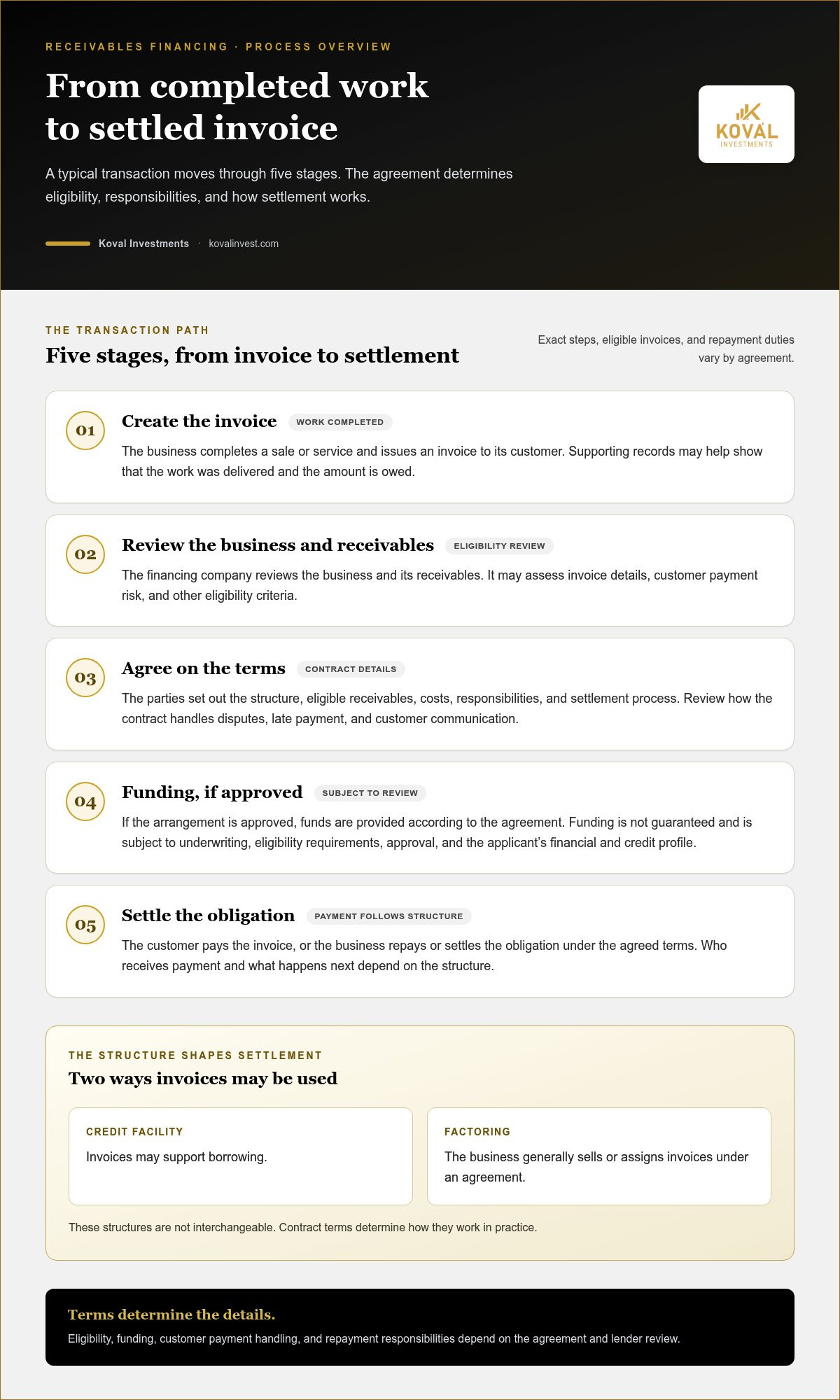
The process usually moves from documenting completed work to reviewing invoices, agreeing on terms, receiving funds, and settling the obligation. The key distinction is what happens to the receivable: with a credit facility, invoices may support borrowing; with factoring, a business generally sells or assigns invoices under an agreement. These accounts receivable financing options aren’t interchangeable, and contract terms determine how they work in practice.
A typical transaction follows these steps, though the exact process, eligible invoices, and repayment duties depend on the agreement:
- Invoice creation: The business completes a sale or service and issues an invoice to its customer. Supporting records may help show that the work was delivered and the amount is owed.
- Lender or factor review: The financing company reviews the business and its receivables. It may assess invoice details, customer payment risk, and other eligibility criteria.
- Agreement: The parties set out the structure, eligible receivables, costs, responsibilities, and settlement process. Review how the contract handles disputes, late payment, and customer communication.
- Funding: If the arrangement is approved, funds are provided according to the agreement. Funding is not guaranteed. Funding is subject to lender underwriting, eligibility requirements, approval, and the applicant’s financial and credit profile.
- Settlement: The customer pays the invoice, or the business repays or settles the obligation under the agreed terms. Who receives payment and what happens next depend on the structure.
How does an accounts receivable line of credit work?
An accounts receivable line of credit is a borrowing facility that may use eligible invoices as collateral. The business draws funds under the facility’s terms and repays according to the agreement. The contract defines how availability is calculated, when repayment is due, and what happens as invoices are collected or become ineligible. Don’t assume every invoice can support a draw or that the full invoice amount is available.
The borrower generally retains responsibility for repayment even if a customer pays late, but specific duties and remedies depend on the contract. Review how borrowing availability changes as receivables are paid, disputed, or aged, and whether the repayment mechanics fit the business’s cash-flow cycle.
How does invoice factoring differ in practice?
Factoring generally involves selling or assigning invoices to a factor, rather than borrowing against them through a credit facility. The factor provides funds under the agreement and collects payment from the customer, or the business may continue handling collections. Customer notification and day-to-day communication vary by arrangement, so determine who sends payment instructions and responds to questions.
Recourse factoring may leave the business responsible for invoices customers don’t pay, while non-recourse terms may transfer some defined nonpayment risk. The scope of that risk, exceptions, fees, and any remaining settlement amount are contract-specific. Don’t treat “non-recourse” as eliminating every payment obligation without understanding the agreement.
Before comparing structures, map the steps from invoice submission through final settlement. Note who controls collections, who bears nonpayment risk, and when funds must be repaid. Koval Investments is a consulting firm that connects businesses with lending partners, not a lender. Owners considering broader capital strategies can discuss business funding options with Koval Investments. Funding is not guaranteed.
How Do the Main Accounts Receivable Financing Options Compare?
The practical difference between structures is not just how funds are accessed. Consider who manages collections, whether customers know about the arrangement, how the obligation is settled, and whether the business can choose specific invoices. Use the comparison below as a starting point, not a promise of how a particular program will work. Contract terms and underwriting decisions determine the actual structure.
| Structure | Collections and customer visibility | Repayment or settlement | Invoice selection |
|---|---|---|---|
| Receivables-backed credit facility | The business may continue collecting payments; customer notification depends on the agreement. | The business borrows and repays under facility terms. Receivables may secure the borrowing. | Eligible receivables may support the facility, subject to lender rules. |
| Factoring | The factor may collect directly, or collection duties may be arranged differently. Customers may be notified of an assignment. | Invoices are generally sold or assigned; the agreement sets out fees, recourse, and settlement. | The agreement determines which invoices can be factored and whether a broader pool is required. |
| Selective invoice arrangement | Collection responsibility and customer communication depend on the arrangement. | Settlement follows the specific structure and contract, which may differ from a revolving credit facility. | May focus on chosen invoices rather than a larger receivables pool, if the offering allows it. |
These categories can overlap in how programs are structured. For example, “selective invoice financing” describes invoice choice, but doesn’t by itself establish whether the transaction is a loan, a sale, or an assignment. Read the agreement’s definitions and obligations rather than relying on a product label. No structure is universally best. The relevant question is which terms align with the business’s operating needs.
When might a receivables-backed credit facility fit?
A facility connected to eligible receivables may suit a business with recurring cash-flow needs that wants access to borrowing tied to its invoice base. Before comparing it with a one-time transaction, understand what counts as collateral, how borrowing availability changes as invoices are paid or become ineligible, and how repayment works. The lender sets eligibility and terms through underwriting, so invoice totals alone don’t determine availability.
When might factoring or selective invoice financing fit?
Factoring may be worth considering when a business is open to transferring invoice rights or collection responsibility under an agreement. A selective arrangement may suit a need related to particular invoices, if the program permits that choice. Compare who contacts customers, where payments go, and how disputes or late payments are handled. These details vary, as do recourse provisions and settlement obligations.
To match a structure to your priorities, rank the trade-offs: control over collections, customer visibility, predictable repayment, and flexibility in choosing invoices. Then review the full contractual obligations, including what happens if a customer pays late or disputes a bill. Funding is not guaranteed. Funding is subject to lender underwriting, eligibility requirements, approval, and the applicant’s financial and credit profile. This consistent lens makes accounts receivable financing options easier to assess without assuming that one label tells the whole story.
How Can You Assess Whether Receivables Financing Fits Your Business?
Start with the business need, then assess whether the receivables and contract terms support it. The goal isn’t simply to secure funds sooner. It’s to understand whether the financing addresses a defined cash-flow gap without adding obligations the business can’t manage if customers pay late.
Use this checklist to prepare:
- Cash-flow purpose: Identify the specific expense or documented business objective the funds would support, and when the cash is needed.
- Invoice quality: Review whether invoices are accurate, supported by completed work or delivered goods, undisputed, and within customer payment terms.
- Payment patterns: Compare invoice due dates with actual customer payment behavior. Note delays or disputes that could affect settlement.
- Customer concentration: See whether a large share of receivables depends on one customer. A financing company may apply concentration limits.
- Repayment capacity: Map expected customer receipts against existing obligations and any new repayment or settlement duties.
Then compare the full contract, not just the initial funding timing. Review fees and other charges, recourse provisions, collection responsibilities, reporting duties, and whether customers will be notified. Check how late payment, a dispute, or an ineligible invoice affects the business’s obligations. A structure that addresses this month’s gap may still create pressure if settlement depends on customer payments arriving later than expected.
What should a business review before comparing offers?
Put the receivables and obligations in one working file: invoices and due dates, customer concentration, disputed or past-due accounts, and existing debt or financing commitments. Match the requested capital to a specific operating expense or business objective. Compare each agreement’s repayment responsibilities and the consequences of late customer payment, rather than judging offers by speed alone.
What information may lenders request?
Documentation varies by lender and financing structure. Organize current financial records and receivables information so a funding assessment can be based on a clear picture of the business. Common documents may include:
- government-issued photo ID
- business formation documents
- EIN confirmation
- business bank account information
- recent bank statements
- proof of income (when applicable)
This is preparation, not a universal eligibility checklist. Providing documents doesn’t ensure approval, and lenders may request other information based on the application and proposed structure.
As you compare accounts receivable financing options, write down the cash-flow purpose, the invoices involved, and the obligations you could meet if customers pay more slowly than expected. Koval Investments is a consulting firm that connects businesses with lending partners. Discuss your business funding strategy with a team that can help consider capital approaches based on your qualifications. Funding is not guaranteed.
How Can Koval Investments Help You Consider Business Funding?
Receivables financing is one possible way to address a cash-flow need, but it may not be the only structure worth considering. Koval Investments is a consulting firm that connects businesses with lending partners, not a lender. It helps business owners consider capital strategies in light of their goals, financial picture, and qualifications.
Business Funding and Working Capital Solutions are broader capital areas to consider alongside accounts receivable financing options. The right direction depends on the business’s needs and profile, not invoice balances alone. Funding is not guaranteed. Any approval depends on lender underwriting, eligibility requirements, and the applicant’s financial and credit profile.
What happens during Koval Investments' funding process?
The process provides a structured path from an initial conversation to application guidance. Each step builds on the information reviewed before it, and the Funding Strategy is based on the applicant’s qualifications.
- Funding Consultation: discuss business, goals, desired capital amount.
- Funding Assessment: review business and financial profile.
- Funding Strategy: develop financing plan based on qualifications.
- Application & Funding: guide through application and documentation.
This approach frames the funding discussion around the business’s broader objectives, not just the immediate need for cash. It also sets realistic expectations: a strategy can identify potential financing paths, but a lending partner makes its decision through underwriting and its eligibility requirements.
What can you prepare for a funding discussion?
Start by outlining what the business needs capital for, the timing, and how the funds would support operations or a business objective. The first step is to schedule a complimentary consultation. Organizing key records can help make the conversation more focused, though documentation requirements vary and preparation doesn’t ensure funding or approval.
- government-issued photo ID
- business formation documents
- EIN confirmation
- business bank account information
- recent bank statements
- proof of income (when applicable)
Bring a clear picture of current cash-flow needs and any existing financing obligations. That context can help inform a funding strategy based on the applicant’s qualifications and clarify which broader capital areas may be relevant. The process is collaborative and focused on practical alignment, without treating any financing outcome as certain.
If you’re ready to discuss your business goals and potential capital strategies, schedule a complimentary consultation. Funding is not guaranteed. Any approval depends on lender underwriting, eligibility requirements, and the applicant’s financial and credit profile.
Take the Next Step With a Clear Funding Strategy
Turn a general need for capital into a decision grounded in your business goals. Before pursuing accounts receivable financing options, consider what the funds would support, how the arrangement could affect customer relationships, and whether the full obligations fit your plans. That perspective keeps financing decisions connected to the progress you want to make.
Koval Investments provides Strategic Funding Guidance and connects clients with lending partners. The process moves from Funding Consultation to Funding Assessment, then Funding Strategy and Application & Funding, with the strategy developed around your qualifications. This gives you a structured way to discuss potential capital paths without treating any one structure as the automatic answer.
Bring your goals and questions to a conversation about your business’s next stage. Schedule a complimentary consultation to discuss your business goals and funding strategy. A thoughtful next step can help you move forward with greater clarity and confidence.
Frequently Asked Questions
Is accounts receivable financing the same as invoice factoring?
No. Accounts receivable financing can describe borrowing secured by unpaid invoices, while factoring generally involves selling or assigning invoices under an agreement. For example, a business comparing proposals should identify whether it remains responsible for repayment or transfers invoice rights, not rely on a product’s name. Collection duties and customer communications also depend on the contract. Funding is not guaranteed and is subject to lender underwriting, eligibility requirements, approval, and the applicant’s financial and credit profile.
Can a business use accounts receivable financing for overdue invoices?
Possibly, but overdue invoices aren’t automatically eligible. A lender may consider how long an invoice has been outstanding, whether the customer disputes it, and the customer’s payment history. For instance, an invoice delayed by a documented billing correction may be assessed differently from one with unresolved delivery concerns. Before using a receivable in a funding plan, separate current invoices from overdue or disputed ones. Funding is not guaranteed and remains subject to lender review and approval.
How much can a business borrow against accounts receivable?
There’s no single amount that applies to every business or agreement. A lender determines which invoices qualify and what capital may be available after reviewing the application and the applicant’s financial and credit profile. An invoice balance or preliminary estimate isn’t a funding commitment. Review how the lender calculates availability and whether it can change as invoices are reviewed or paid. Funding is not guaranteed, and Koval Investments doesn’t guarantee a specific funding amount.
What happens if a customer does not pay an invoice used for financing?
The agreement determines what happens if a customer pays late, disputes the invoice, or fails to pay. Under recourse terms, the business may have to address an unpaid invoice; non-recourse terms may cover only specified circumstances. For example, a contract may distinguish customer insolvency from a commercial dispute. Review the exact definitions, notice requirements, and any buyback or repayment duties before signing. Collection and repayment responsibilities vary by financing structure and contract.
Will customers know if a business uses invoice factoring?
They might, depending on the arrangement. A factor may contact customers or provide payment instructions directing them to send funds to the factor. Other agreements may set out different communication and collection procedures. Consider how a change in payment instructions would fit the business’s customer relationships and invoicing workflow. Before agreeing, review the terms covering customer notice, payment destination, and who handles questions about invoices. Don’t assume factoring is invisible to customers.
Can a startup qualify for accounts receivable financing?
A startup may be considered, but eligibility depends on its receivables and the lender’s criteria, not simply its age. A newer company with few completed customer transactions may have less invoice history for review. Koval Investments notes that newer businesses may qualify for funding if other criteria are met, but that doesn’t guarantee receivables financing or approval.