
Best Ways to Build Business Credit Fast in 2026: A Realistic Roadmap
What if building business credit fast is less about finding a shortcut and more about making your business ready to be recognized by creditors and credit bureaus? The best ways to build business credit fast start with practical setup steps, but opening an account or starting a vendor relationship won’t create an established credit profile overnight.
It’s understandable to want a clear timeline, especially when bureaus track different information and vendor payment updates can take time to appear. You may also be concerned that a funding application could involve your personal credit as well as your business’s financial history. Those distinctions matter when you’re preparing for a funding conversation. Funding is not guaranteed; approvals are made by lending partners based on underwriting criteria.
This guide explains how to establish a credible business identity, open and use credit accounts responsibly, and understand why reporting timelines vary. You’ll learn how business credit bureaus and vendor tradelines fit into the process, which actions you can take promptly, and what usually takes longer. The goal is a clearer business credit and financial profile that can help you prepare for future funding discussions, without mistaking early progress for an instant score change or approval.
Key Takeaways
- The best ways to build business credit fast focus first on accurate business records and responsible credit activity, not instant score changes.
- Learn how Dun & Bradstreet, Experian Business, and Equifax Business can reflect different information about your business.
- Compare credit-building actions by what you control and what depends on creditors or bureau reporting cycles.
- Use a flexible 30-day plan to organize your business details, review accounts, manage payments, and monitor reports.
- See how business credit can fit into a broader funding-readiness assessment, without treating it as a promise of approval.
What it means to build business credit fast, and what can actually move quickly
Business credit is a profile formed from a company’s credit-related activity and the payment information creditors or suppliers report. It can help others assess how a business manages its obligations, but it doesn’t appear fully formed as soon as the business completes its paperwork. The best ways to build business credit fast move each stage forward without confusing progress on one stage for progress on all of them.
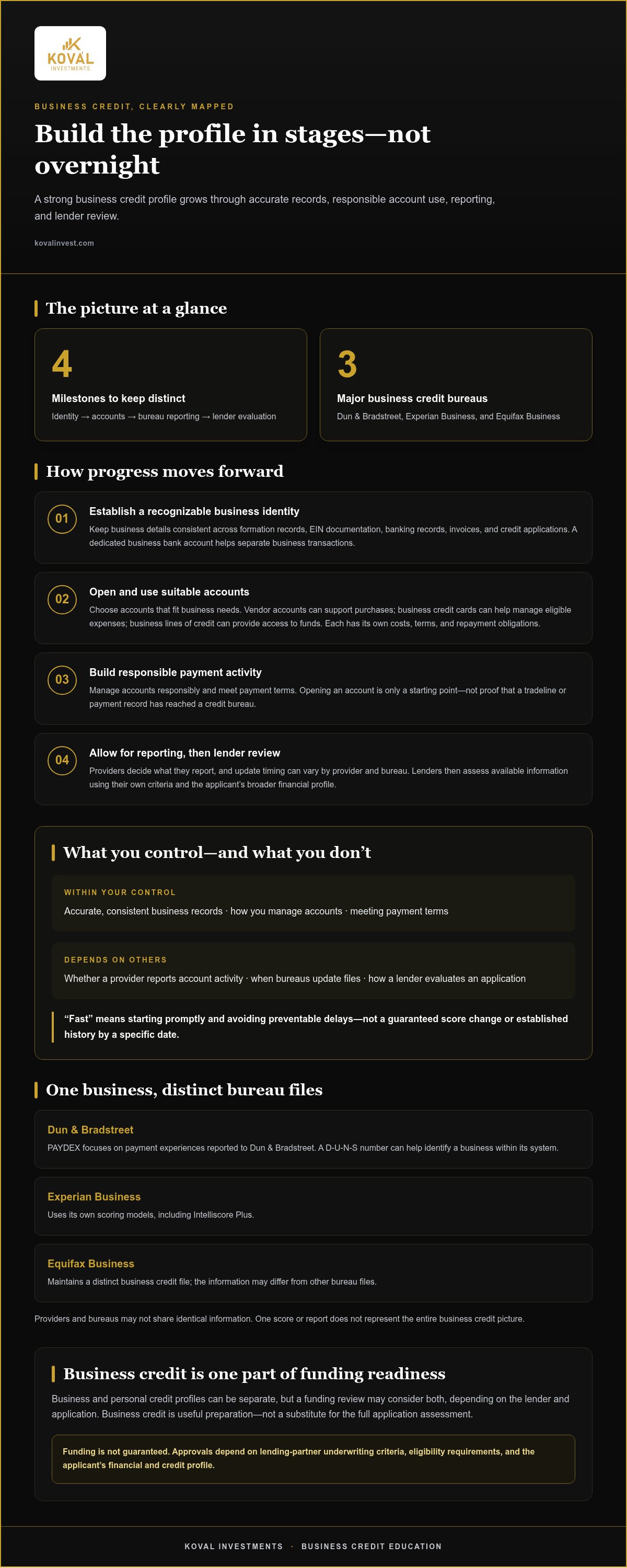
Think of the process as four milestones: establish a recognizable business identity, open and use suitable accounts, have account activity reported to credit bureaus, and then have a lender evaluate the available information. Owners can often complete administrative tasks promptly. Account history, bureau updates, and lender decisions depend on additional activity and the organizations involved.
Completed setup tasks make a business easier to identify; only reported, ongoing credit activity can help develop its business credit history. “Fast” means starting promptly and preventing avoidable delays, such as inconsistent business details. It doesn’t mean a score increase or established history is guaranteed by a particular date.
Business credit and personal credit are related, but not interchangeable
A business may have credit profiles separate from its owner’s personal credit reports. That separation doesn’t mean the two are always considered independently in a funding review. Depending on the lender and application, an owner’s personal credit and the business’s financial information may both be part of the broader assessment. Lenders don’t all use the same criteria or assign each profile equal weight, so building business credit is useful preparation, not a substitute for understanding the full application. Funding is not guaranteed; approval depends on lender underwriting, eligibility requirements, and the applicant’s financial and credit profile.
What can happen quickly, and what depends on reporting
Owners can take practical setup steps without waiting for a credit history to form. For example, make sure the business name and address are consistent across formation records, EIN documentation, banking records, and credit applications. You can also establish a business bank account and organize the information needed to open appropriate accounts. These steps support clear identification, but they don’t confirm that payment activity has reached a bureau.
Opening an account is a starting point, not proof of a tradeline or a reported payment record. Creditors and suppliers decide what account information they report, and reporting practices and update timing can vary by provider and bureau. A payment may be made before it appears in a credit file, while different bureaus may not display identical information.
- Setup: Confirm business identity details and organize banking records.
- Account activity: Use accounts responsibly and meet payment terms.
- Bureau reporting: Allow time for providers to report and bureaus to update files.
- Lender evaluation: Recognize that a lender considers its own criteria and the applicant’s broader financial profile.
This sequence helps set realistic expectations. You control the accuracy of your records and how you manage accounts. You don’t control a provider’s reporting practices, a bureau’s update cycle, or a lender’s final assessment. Keep those milestones distinct as you move into the practical steps that follow.
How business credit is built: identity, accounts, payments, and bureau reporting
Once your business is identifiable, its credit profile can develop through account use and reported payment activity. The process depends on accurate records, appropriate accounts, and information reaching the bureaus. Each step plays a different role, so opening accounts alone won’t establish a complete credit history.
Set up a consistent business identity before applying
Start with consistent records. Use the same legal business name and address on formation documents, EIN records, bank accounts, invoices, and credit applications. A dedicated business bank account helps keep business transactions separate and provides a clear record of activity. A D-U-N-S number can help identify a business within Dun & Bradstreet’s system, but no single identifier is a universal requirement for every bureau or lender.
The major business credit bureaus include Dun & Bradstreet, Experian Business, and Equifax Business. They maintain distinct files and may receive different information, so a business could have a profile with one bureau that looks different from its file with another. Dun & Bradstreet’s PAYDEX score focuses on payment experiences reported to it, while Experian Business uses its own scoring models, including Intelliscore Plus. Don’t assume one score or report represents the entire business credit picture.
Choose accounts for responsible use and verified reporting
Accounts can serve different operating needs. Vendor accounts may support regular purchases of supplies or services. A business credit card can help manage eligible expenses, while a business line of credit can provide access to funds for business needs. Each account has its own costs, terms, and repayment obligations, so choose based on what the business can manage, not simply on the desire to add a tradeline.
Before relying on an account to build a bureau file, find out whether the provider reports business payment activity and which bureau or bureaus may receive it. Reporting participation can vary, and a provider may not furnish information to every bureau. Even where reporting occurs, the timing and details recorded depend on the provider’s practices and the bureau’s update cycle.
Reported payment history depends on the creditor furnishing information to a bureau. That’s why responsible use matters more than opening many accounts quickly. Make payments according to the account terms, keep records of due dates and balances, and review business credit reports for accounts that appear under the correct business identity. If you’re also preparing for future funding, funding-readiness planning can help connect your credit profile with the broader financial picture lenders may assess. Funding is not guaranteed; any approval depends on lender underwriting, eligibility requirements, and the applicant’s financial and credit profile.
Which business credit-building moves deserve priority?
The best ways to build business credit fast are the steps that improve accuracy and support responsible, reportable activity. Prioritize what you can control first, then account for what depends on a provider or bureau. A new identifier or account can help organize a file, but neither automatically creates a strong credit profile.
| Action | Owner control | Reporting dependency | Main consideration |
|---|---|---|---|
| Keep business records consistent | High | Low | Use matching legal name, address, EIN, and banking details where requested. |
| Open a manageable vendor account | Moderate | High | Review invoice terms and whether the provider reports business payment activity. |
| Use a business credit card | Moderate | High | Choose an account the business can repay under its terms; reporting practices vary. |
| Use a business line of credit | Moderate | High | Understand draw, repayment, and account terms before borrowing. |
| Review business credit reports | High | Moderate | Check for accuracy and allow for differences between bureaus and update cycles. |
Account types serve different purposes. A business card generally supports eligible purchases through revolving credit, with repayment governed by the card agreement. Vendor accounts may allow the business to buy supplies or services and pay invoices later. A line of credit provides access to funds that the business can draw on and repay according to its terms. These tools can contribute to a credit history only when relevant account activity is furnished to a bureau and appears in a report.
Choose for fit, not account count
Before opening an account, consider whether it supports a real business need, whether payments fit the cash flow, and whether the provider reports business activity. Don’t assume reporting to one bureau means reporting to all. Terms, reporting practices, and lender criteria differ, so a useful account for one business may not suit another.
Fast applications can create risk without speeding up credit history
Applying for several accounts at once doesn’t guarantee faster reporting or a stronger profile. Each approved account can add repayment obligations, and borrowing more than the business can comfortably repay creates avoidable pressure. Missed payments can weaken the business’s financial position and undermine readiness for future funding. An application also isn’t proof that an account will report or that a bureau will update a file on a particular schedule.
Keep the goals separate. Building credit means developing accurate, responsible, reportable account history over time. Seeking funding is a separate decision that depends on the business’s needs and broader financial profile, as well as lender criteria. Funding is not guaranteed; approvals are subject to lender underwriting, eligibility requirements, and the applicant’s financial and credit profile. Prioritize reliable records, sustainable account use, on-time payments, and regular report review. Those actions create a sounder foundation, even though they can’t guarantee a specific score or funding outcome.
A practical business credit action plan for the next 30 days
Use this four-week plan to organize what you can control and track what depends on outside reporting. The best ways to build business credit fast begin with accurate records and deliberate account management, not a promise of a stronger score within 30 days. Treat the calendar as a starting framework. Bureau updates may not arrive during this period, and a report or score change isn’t guaranteed.
Week one and two: establish the business identity and review records
Gather your business formation records, EIN details, business banking information, and current contact details. Compare the legal name and address across documents and accounts. Correct inconsistencies in records you control, and keep copies of changes or confirmations so you can refer to them later.
Check the business credit reports that are available to you. A new business may not have a report with every bureau, or may not have a file available yet. If you find a mismatch or an account you don’t recognize, note the bureau, item, and date you found it, then follow the bureau’s process for addressing report information. Checking a report is an owner-controlled step; whether a change appears later depends on the relevant reporting and update process.
Week three and four: manage activity and check for updates
If an account fits your operating needs, use it only for planned business purchases the company can repay under its terms. Record the purchase, statement balance, due date, and payment. Keep payment confirmations and account statements together. These habits are within your control. Whether the account provider furnishes activity, when it does so, and when a bureau updates a file are not.
Review available reports again as a monitoring step, not as a deadline for a score change. If no new account appears, check your records and note the date for a future review. A lack of a visible update within this plan doesn’t by itself establish that an account was reported or that a payment wasn’t made.
Use a simple tracker to keep actions and external updates distinct:
| Item to track | Record | What it helps you monitor |
|---|---|---|
| Application date | Date submitted and account status | Your application timeline |
| Account terms | Repayment terms and reporting notes | Obligations and expected account use |
| Payment dates | Due date, payment date, confirmation | Whether you paid according to terms |
| Report checks | Bureau and review date | Information visible at each check |
At the end of the month, you should have a clearer record of completed setup work, account activity, and report checks. That’s useful progress, even if bureau files haven’t changed yet. If you’re preparing for a future financing decision, explore business funding guidance to understand how credit preparation can fit into broader funding planning. Funding is not guaranteed; approval depends on lender underwriting, eligibility requirements, and the applicant’s financial and credit profile.
How Koval Investments can connect credit preparation to funding planning
A business credit profile can inform a funding discussion, but it’s only one part of the financial picture. Lending partners may also consider business performance, cash flow, personal credit, and other application details. Building credit doesn’t establish eligibility on its own. Funding is not guaranteed; approvals are made by lending partners based on underwriting criteria and the applicant’s financial and credit profile.
Koval Investments is a consulting firm that helps business owners assess funding readiness and connects them with lending partners. It isn’t a lender. Its services include Business Funding, Business Consulting, and the 0% Interest Funding Solution, along with SBA Financing, Working Capital Solutions, and funding for residential and commercial real estate investing. The funding process follows four steps:
- Funding Consultation: discuss business, goals, desired capital amount.
- Funding Assessment: review business and financial profile.
- Funding Strategy: develop financing plan based on qualifications.
- Application & Funding: guide through application and documentation.
This sequence helps separate preparation from approval. A consultation or funding strategy can clarify next steps, but neither guarantees a lender’s decision or a particular funding result. Funding is subject to lender underwriting, eligibility requirements, approval, and the applicant’s financial and credit profile.
What to prepare for a funding conversation
Having key records organized can make it easier to discuss the business accurately. Common required documents: government-issued photo ID, business formation documents, EIN confirmation, business bank account information, recent bank statements, proof of income (when applicable). Keep the information consistent and ready to review. Additional requirements can depend on the application and lender.
A newer business may qualify if other criteria are met, but time in business alone doesn’t determine approval. An applicant’s personal credit may also be part of the broader review. A personal credit score of approximately 680 or higher is a guideline, not a hard cutoff; lending partners set their own criteria and consider the overall applicant profile. Funding is not guaranteed.
How credit optimization fits into a broader funding strategy
If your credit profile needs attention, Koval Investments offers a Credit Optimization Program for clients with less-than-perfect credit. It can be considered as part of a broader funding-preparation discussion, but it doesn’t promise a score increase, lender approval, or a specific funding amount. Keep building responsible business credit, but evaluate funding readiness across the full financial profile rather than relying on one score or newly opened account.
Use the complimentary consultation to discuss your goals, available records, and potential next steps. Any funding remains subject to lender underwriting, eligibility requirements, approval, and the applicant’s financial and credit profile.
Turn early progress into a stronger business foundation
Building business credit is most useful when it becomes part of how you manage the company, not a last-minute task before applying for capital. Keep records organized, review financial commitments as the business changes, and revisit your funding plans when your needs or capacity shift. The best ways to build business credit fast can help you get started, but sustainable progress comes from choices you can maintain.
If you’re considering funding, Koval Investments can connect credit preparation with a broader assessment through Funding Consultation, Funding Assessment, Funding Strategy, and Application & Funding. Koval Investments works with lending partners, and funding is not guaranteed. Approval depends on lender underwriting, eligibility requirements, and the applicant’s financial and credit profile.
Take the next step with a clearer view of your goals and current position. Schedule a complimentary consultation to discuss your funding plans and possible next steps.
Frequently Asked Questions
How long does it take to build business credit?
There’s no single timeline for developing a business credit history. Setup can move quickly, but a file develops as account activity is reported and recorded over time. The best ways to build business credit fast are to make your information accurate, manage accounts responsibly, and track which accounts appear on reports. Treat your first report check as a baseline, not a deadline for a particular score or profile.
Can a new business build credit without an established operating history?
Yes. A new business can begin establishing credit activity before it has a long operating history, though the available accounts and terms may depend on the provider. Start by organizing the company’s identity and financial records, then consider only accounts that suit its current cash flow. Newer businesses may qualify for funding if other criteria are met, but funding is not guaranteed and depends on lender underwriting and the applicant’s profile.
Is a D-U-N-S number required to build business credit?
No single identifier is required for every bureau or lender. A D-U-N-S number is relevant to Dun & Bradstreet business identification, but it doesn’t establish payment history by itself or automatically create a complete file elsewhere. If you obtain one, keep the associated business details consistent with the information you use on banking and credit records. That can help reduce confusion when information is matched to the company.
Do all vendors report payments to business credit bureaus?
No. A vendor account may be useful for purchasing, but that doesn’t mean its payment activity will appear on a business credit report. Before relying on an account for credit-building, review its terms or reporting information to understand whether business payment activity is furnished and to which bureau. Keep invoices and payment confirmations so you can document your payment record if an account detail needs follow-up.
Can I build business credit without using a personal guarantee?
Sometimes, but it depends on the account provider, product, and business qualifications. A personal guarantee is distinct from a lender reviewing an owner’s personal credit, so avoiding one doesn’t necessarily mean personal credit won’t be considered. Read the guarantee and repayment terms before accepting an account. If a guarantee is required, weigh the obligation against the business’s expected use and ability to repay.
Will checking my business credit report affect my credit?
Checking your own business credit report is generally a review, not a new credit application. Still, business reporting and scoring practices vary, so distinguish a self-check from a lender’s inquiry connected to an application. Keep a record of when you review each bureau’s file and note any unfamiliar accounts or inaccurate details. Regular reviews help you spot changes without assuming every bureau displays identical information.
Can I apply for business funding while building business credit?
Yes, you can explore funding while your business credit history is developing. A lending partner may consider other parts of the application, including business finances and the owner’s personal credit, so a short business credit history doesn’t tell the whole story. Koval Investments connects business owners with lending partners and helps assess funding readiness. Funding is not guaranteed; approval depends on lender underwriting, eligibility requirements, and the applicant’s financial and credit profile.