
Company Valuation: Maximize Your Exit Value in 2026
What if the number on your valuation report isn’t the price a buyer will pay? For company valuation for sale, standard methods provide a useful baseline, but buyer interest, deal structure, and the quality of your financial records can all affect the final offer.
If you’re concerned your business could be undervalued, or unsure why different methods produce different results, start by looking at what each method measures and what evidence supports your figures. Buyers also want to understand how earnings are calculated, which adjustments are reasonable, and whether the business can operate without relying entirely on you. Preparing this information makes your company’s value easier to assess.
This guide explains the core valuation methods, including earnings-based approaches and market multiples, and how to choose among them. You’ll also find practical steps for documenting earnings, reviewing debt and working capital, and preparing for buyer scrutiny. We cover how financial readiness and M&A guidance can support the move from valuation to sale. The aim is a realistic view of what your company may be worth to a buyer, along with a clear plan for improving your position before you go to market.
Key Takeaways
- Compare asset-based, market-based, and income-based methods to see which approaches fit your company’s assets, earnings, and growth prospects.
- Treat company valuation for sale as a starting point, then assess how buyer priorities and deal terms could affect the proceeds you receive.
- Strengthen your position before a sale by documenting earnings, improving operations, and reviewing debt and working capital.
- Prepare clear, consistent financial records so buyers can understand the company’s performance and evaluate its risks.
- Plan for the transaction as well as the valuation, including how M&A consulting can help organize the process and prepare sale materials.
The Fundamentals of Company Valuation for Sale
A business valuation estimates the economic value of a company as an operating business. It looks beyond the assets on the balance sheet: earnings, risks, growth prospects, customer relationships, and intangible assets can all affect what a buyer may pay. The fundamentals of business valuation include three broad approaches: income-based, asset-based, and market-based methods.
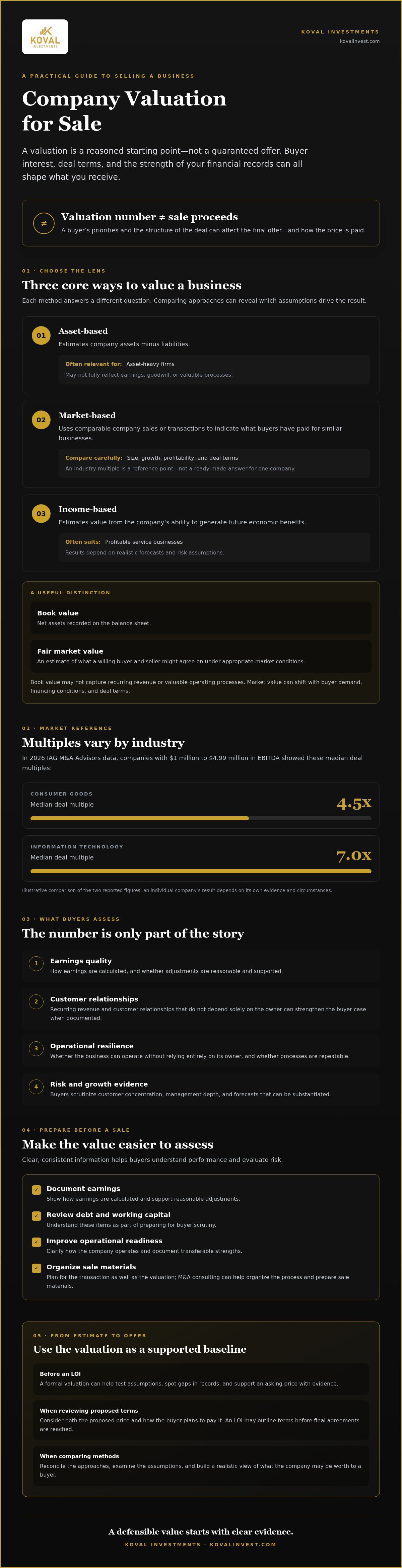
Book value and fair market value answer different questions. Book value reflects the net assets recorded on the balance sheet. Fair market value estimates what a willing buyer and seller might agree on under appropriate market conditions. Book value may not capture recurring revenue or valuable operating processes. Market value can change with buyer demand, financing conditions, and deal terms.
A formal valuation before you entertain a letter of intent (LOI) gives you a reasoned baseline for assessing an offer, rather than relying on a personal estimate or the buyer’s opening figure. It can also help you test assumptions, spot gaps in your records, and support your asking price with evidence. An LOI may outline proposed terms before final agreements are reached, so review both the proposed price and how the buyer plans to pay it.
Why Owners Often Undervalue Their Own Success
Sweat equity can distort expectations in either direction. Years of effort may lead an owner to value personal sacrifice rather than transferable earnings. Conversely, an owner may overlook strengths that seem routine because they built them. A repeatable proprietary process, dependable recurring revenue, or customer relationships that don’t depend solely on the owner can strengthen a buyer case when they are documented. Strategic business planning can help identify these value drivers and show how the company could grow beyond its current operations.
The 2026 Market Outlook for Business Exits
Financing conditions influence what buyers can afford and how they assess risk. As of September 2026, Lendio and Bay Street Lending reported variable SBA 7(a) rates capped at 10.00% to 13.50%. Higher borrowing costs can put pressure on buyer budgets, making stable cash flow and well-supported forecasts especially important.
Acquisition interest is uneven: the 2026 research brief describes stronger activity among large deals, while smaller-deal volume remains below long-term norms. Buyers are scrutinizing earnings quality, customer concentration, and management depth, and favoring resilience over growth claims that are difficult to substantiate. SBA financing can affect the pool of qualified buyers, but eligibility and loan terms determine whether it is a workable option. A professional company valuation for sale helps you frame your value in this market. Careful preparation gives buyers fewer reasons to discount it.
The 3 Core Methods to Value a Business
No single formula fits every company. A manufacturer with substantial equipment and inventory presents a different valuation question than a service firm whose value depends on client relationships and repeat revenue. Professionals typically compare three approaches: asset-based, market-based, and income-based. Using more than one can reveal a reasonable valuation range and show which assumptions drive the result. Harvard Business School Online outlines these business valuation methods, including discounted cash flow analysis.
- Asset-based: Estimates the value of the company’s assets minus its liabilities. It can be especially relevant for asset-heavy firms, though it may not fully reflect earnings, goodwill, or valuable processes.
- Market-based: Uses comparable company sales or transactions to indicate what buyers have paid for similar businesses. Comparisons are more useful when differences in size, growth, profitability, and deal terms are taken into account.
- Income-based: Estimates value from the company’s ability to generate future economic benefits. This approach often suits profitable service businesses, but results depend on realistic forecasts and risk assumptions.
For example, the 2026 IAG M&A Advisors data for companies with $1 million to $4.99 million in EBITDA showed median deal multiples ranging from 4.5x in consumer goods to 7.0x in information technology. These figures illustrate why an industry multiple is a reference point, not a ready-made answer for an individual company. A professional business valuation can reconcile different methods, explain the assumptions, and support a defensible figure for company valuation for sale.
Discounted Cash Flow Analysis
Discounted cash flow (DCF) analysis projects future cash flows and discounts them to present value to account for risk and the time value of money. It can be useful for businesses with predictable earnings and a well-supported growth outlook. The result depends heavily on assumptions, especially terminal value, which represents value beyond the detailed forecast period. Small changes in long-term growth or discount rates can materially change the estimate, so test a range of reasonable scenarios.
Market Comparables and Precedent Transactions
Market comparables look at similar companies, while precedent transactions examine completed acquisitions. Private-sale information can be incomplete or difficult to compare. Where available, use reputable transaction databases, industry reports, and experienced M&A professionals. Check whether reported figures reflect enterprise or equity value, and account for differences in business size, profitability, growth, and transaction structure.
For a valuation grounded in your company’s specific facts, explore professional business valuation support.
Why Market Value Differs from Your "Calculated" Value
A valuation model may suggest one figure while buyer offers come in lower. That doesn’t automatically mean the model is wrong. The model’s assumptions, a buyer’s risk assessment, financing options, and strategic goals may differ. A calculation estimates value under defined assumptions; an offer reflects what a specific buyer is willing and able to pay under proposed terms.
Look beyond the headline price. An all-cash offer and a larger offer with an earn-out are not equivalent: earn-out payments depend on future performance and the terms used to measure it. Compare how much is paid at closing, what conditions apply to deferred payments, and how much uncertainty you’re accepting. M&A consulting can help sellers assess these differences, manage buyer discussions, and consider terms that align with their goals.
The Risk Premium: What Scares Buyers Away
Buyers may discount value when earnings appear vulnerable. If a large share of revenue comes from one customer, losing that account could materially affect performance. If key relationships or operating knowledge rest with the owner, a buyer may question whether revenue will continue after the transition. Document customer diversity, repeat business, and processes that others can run to help address these concerns.
Financial discrepancies can create similar doubts. Inconsistent records, unexplained transactions, or unresolved credit issues may prompt additional scrutiny and reduce a buyer’s confidence in the information presented. Review records early, correct errors, and seek appropriate credit repair support when needed. The goal is a clear, substantiated picture of the business, not simply a more favorable number on paper.
Strategic Synergy: Why Some Buyers Pay More
Financial buyers generally assess a company based on earnings, risks, and potential returns. A strategic buyer may also see value in combining your customer base, capabilities, or operations with its existing business. That potential synergy can support a stronger offer, but it isn’t automatic. The buyer needs to see a credible fit and a practical path to realizing the value.
Positioning your company as a “bolt-on” means showing how it could complement a buyer’s existing platform. For example, a specialized service provider may bring established customer relationships or expertise that fills a gap in a larger firm’s offering. Strategic planning can help identify likely buyer priorities and build evidence of how your business supports them.
To bridge the gap between a model and an offer, compare assumptions, identify the specific risks buyers cite, and separate proceeds paid at closing from contingent value. A well-supported company valuation for sale gives you a negotiation reference point. Thoughtful preparation and M&A guidance can help you explain the company’s strengths and assess trade-offs with greater clarity.
Strategic Steps to Increase Your Valuation Before Sale
A valuation isn’t a static score. Buyers assess the business you can demonstrate today, so improvements made before a sale can strengthen the evidence behind your earnings and reduce concerns about risk. Focus on changes that support sustainable performance, not short-term adjustments that obscure the company’s true financial position.
Start with EBITDA, or earnings before interest, taxes, depreciation, and amortization. Review operating costs, pricing, staffing, and processes to identify inefficiencies without weakening service or growth capacity. Document each improvement and ensure your records support the results. A clear, consistent financial history helps buyers distinguish repeatable earnings from one-time changes.
Next, review the balance sheet and working capital needs. Assess debt obligations and consider whether refinancing high-interest debt is appropriate for your circumstances. Capital procurement may also help fund planned improvements or maintain operations before a sale. A 0% interest funding solution could support short-term working capital, but review its terms and fit carefully. Additional capital doesn’t automatically create value, and buyers will want to understand the related obligations and how the funds were used.
Financial Housecleaning: Credit and Debt
Reconcile accounts, resolve unexplained entries, and prepare consistent, well-supported financial statements. GAAP-compliant reporting or an audit may be relevant depending on the company and transaction, but don’t assume every sale requires an audit. Ask appropriate financial professionals what level of reporting buyers are likely to expect. Review business credit records and correct inaccuracies early. Credit repair can help address issues, but no single “saleable risk score” determines a buyer’s decision or guarantees financing.
Operational Scalability and Documentation
Write down core operating procedures, assign responsibilities, and train team members to handle work that currently depends on the owner. Track revenue by customer and develop a plan to diversify where practical. These steps help buyers assess whether the business can continue operating through a transition and whether its earnings are resilient.
Goodwill is the value attributed to intangible strengths, such as brand reputation and customer relationships, beyond the identifiable net assets of a business.
- Track EBITDA improvements and keep supporting documentation for each adjustment.
- Review debt, working capital, and credit records before buyer diligence begins.
- Document processes and reduce reliance on the owner for routine operations.
These actions can make your company valuation for sale more credible by connecting the numbers to operational evidence. For guidance on valuation, capital strategy, and exit preparation, explore strategic planning and business valuation support.
Navigating the Exit: M&A Consulting and Final Steps
A sound valuation is a starting point, not an exit plan. Selling a business also requires coordinated communication among the owner, financial and tax professionals, potential buyers, and other deal participants. M&A consulting can help organize the process, keep information moving, and connect the valuation to decisions that shape a transaction.
One key sale document is the Confidential Information Memorandum (CIM). It presents the business to qualified buyers and typically covers its operations, financial performance, customer base, market position, and growth opportunities. The CIM should align with the records buyers will review. Clear, supportable claims help build confidence; unsupported projections can invite harder questions.
Due diligence is where buyers test the story behind the numbers. They may examine financial statements, contracts, customer concentration, operations, debt, and historical credit information. New findings can lead them to revisit assumptions, request clarification, or propose different terms. A well-prepared company valuation for sale is more useful when the supporting evidence is organized and ready for review.
The Due Diligence Survival Guide
Prepare a secure data room with organized financial, tax, legal, and operational records. Work with qualified professionals to determine which documents are appropriate and to handle legal matters. If past credit reports contain errors, gather records showing what happened and any steps taken to address the inaccuracies. During a sale process that may span 6 to 12 months, assign someone to respond to buyer requests while maintaining attention to customers, staff, and daily performance.
Choosing the Right Advisory Partner
An effective advisory partner should understand how valuation assumptions connect to buyer questions, transaction terms, and capital needs. Ask how the advisor will coordinate with your existing professional team, explain their role, and structure compensation. A success-based compensation arrangement can tie some fees to a completed transaction, but clarify the terms and responsibilities before engaging.
Koval Investments provides business valuations, M&A consulting, strategic planning, and capital procurement support. This range of services can help owners consider how valuation, financial readiness, and working capital fit together. A 0% interest funding solution may be relevant if additional working capital supports a specific readiness goal, but weigh its terms and obligations carefully. New funding alone doesn’t guarantee a higher sale price or buyer financing.
For guidance through the transition, explore mergers and acquisitions consulting and discuss how valuation and capital procurement can fit your exit objectives.
Prepare Your Business for a Stronger Exit
A successful sale depends on more than a valuation figure. The methods you choose help establish a credible range, while clear financial records, dependable operations, and a well-managed transaction help buyers understand the value behind it. Your company valuation for sale is most useful when it guides practical decisions before negotiations begin, not just when an offer arrives.
Koval Investments brings business valuations, M&A consulting, and capital procurement together to help owners plan for an exit. Its strategic planning and credit services can also help owners assess financial preparation and capital needs as they work toward a transition.
If you’re ready to assess your business and plan your next steps, contact Koval Investments about a professional business valuation.
Frequently Asked Questions
How long does a professional business valuation take?
The timeline depends on the valuation’s scope, the complexity of the business, and how quickly complete records are available. A valuation based on organized financial statements and straightforward operations may require less analysis than one involving multiple business lines, unusual assets, or inconsistent records. Ask the valuation professional what information they need, what the engagement includes, and when you can expect findings. There’s no single turnaround time that applies to every company.
Can I use an online calculator for a company valuation for sale?
An online calculator can provide a rough starting point, but it can’t capture every factor that affects a company valuation for sale. Its result depends on the inputs and assumptions you provide, and it may not account for customer concentration, owner dependency, intangible assets, or deal terms. Use it to organize initial questions, not as a substitute for professional analysis when setting expectations or assessing an offer.
What is the most common valuation multiple for small businesses in 2026?
There isn’t one multiple that applies to every small business. Acquisition Ace reported that many Main Street businesses typically trade within a range of 2.0x to 4.5x Seller’s Discretionary Earnings (SDE) in September 2026. That range is a reference, not a promised sale price. The appropriate multiple depends on factors such as industry, earnings quality, growth, customer concentration, and how much the business relies on its owner.
How does my personal credit score affect my business valuation?
Your personal credit score doesn’t directly determine what the business is worth, but it may matter to financing or transition planning, depending on the transaction and the lender’s assessment. Buyers focus on the company’s financial performance, assets, risks, and future prospects. If personal or business credit records contain errors, address and document them early. Keep valuation separate from financing eligibility, since they answer different questions.
What is the difference between an equity valuation and an enterprise valuation?
Enterprise value estimates the value of the company’s operations for all capital providers, before accounting for how the business is financed. Equity value represents the value attributable to shareholders after considering debt, cash, and other relevant balance-sheet adjustments. The two figures can differ materially. When reviewing an offer, confirm whether it states enterprise or equity value and clarify how debt, cash, and working capital affect the amount you may receive.
Should I get a valuation if I am not planning to sell for two years?
A valuation can be useful even if a sale is not immediate. It can establish a baseline, reveal issues to address, and help you set priorities while there’s time to act. Treat it as a snapshot based on current information, not a guarantee of what a buyer will pay two years later. Business performance, market conditions, and buyer demand can change, so consider updating the analysis closer to a potential sale.
Does 0% interest funding impact my business valuation positively?
Not automatically. Funding may support working capital or a planned business improvement, but the valuation depends on whether the investment strengthens sustainable earnings or reduces a meaningful operating risk. Buyers will also review the funding terms and related obligations. Consider how the capital will be used, whether it supports a clear business goal, and how it will appear in the financial records. Additional funding alone doesn’t guarantee a higher valuation.
What documents do I need to provide for a professional valuation?
Start with recent financial statements, tax records, balance sheets, and supporting details for revenue, expenses, debt, and one-time adjustments. You may also be asked for customer and supplier information, major contracts, asset records, and an overview of operations and management responsibilities. The exact list varies with the company and valuation purpose. Ask the valuation professional for a tailored document checklist, and organize records so figures can be traced to supporting information.