Comprehensive Guide to Business Valuation in 2026
What if the number you think your business is worth is significantly different from what the market would actually pay for it? For many business owners, that gap isn't just a surprise; it's a costly one that shapes every major financial decision they make, from securing capital to planning an exit.
If you've ever felt uncertain about how to determine your company's true worth, or found yourself lost in a maze of financial metrics and conflicting methodologies, you're not alone. Business valuation is one of the most consequential processes an entrepreneur can undertake, yet it's also one of the least understood.
This guide is designed to change that. You'll gain a clear, practical understanding of the core valuation methods used by financial professionals, learn how to apply them with confidence, and discover the common pitfalls that lead business owners to inaccurate conclusions. Whether you're preparing for a merger, seeking funding, or simply want a sharper picture of where your business stands, what follows gives you the tools to move forward with clarity and purpose.
Key Takeaways
- Business valuation is a foundational process that influences every major financial decision, from securing capital to planning a successful exit strategy.
- The three primary valuation methods - income-based, market-based, and asset-based - each serve distinct purposes, and knowing when to apply each one is critical to reaching an accurate figure.
- Many business owners operate on flawed assumptions about what drives value; this guide separates the most persistent myths from the realities that actually move the needle.
- An accurate business valuation directly improves your position when pursuing funding, whether through SBA loans, working capital solutions, or investment partnerships.
- Emerging technologies and evolving market conditions are reshaping how valuations are conducted, and understanding these trends gives you a meaningful competitive advantage.
What is Business Valuation and Why is it Important?
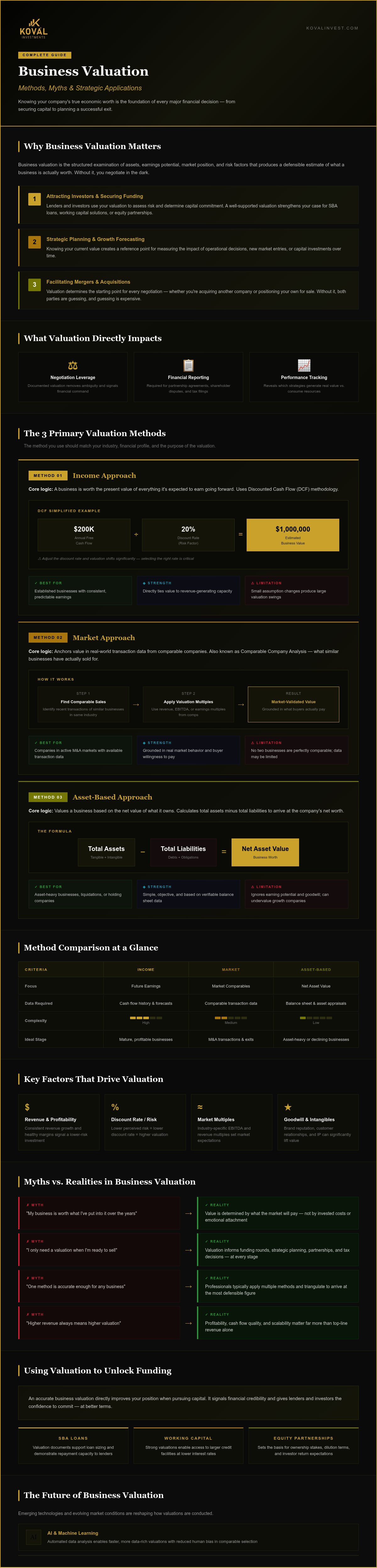
Business valuation is the process of determining the economic worth of a company using a combination of financial analysis, market data, and qualitative assessments. It's not a single number pulled from a formula; it's a structured examination of assets, earnings potential, market position, and risk factors that together produce a defensible estimate of what a business is actually worth. The result informs decisions that can shape a company's trajectory for years.
Think of it as a financial baseline. Without one, you're negotiating in the dark, whether you're approaching a lender, entertaining an acquisition offer, or mapping out a five-year growth plan. Owners who understand their valuation enter those conversations with a measurable advantage.
Key Reasons for Valuing Your Business
The circumstances that make a formal valuation necessary are more varied than most owners expect:
- Attracting investors and securing funding: Lenders and investors use your valuation to assess risk and determine how much capital they're willing to commit. A well-supported valuation signals financial credibility and strengthens your case for SBA loans, working capital solutions, or equity partnerships.
- Strategic planning and growth forecasting: Knowing your current value creates a reference point for measuring the impact of operational decisions, new market entries, or capital investments over time.
- Facilitating mergers and acquisitions: Whether you're acquiring another company or positioning your own for sale, valuation determines the starting point for every negotiation. Without it, both parties are guessing, and guessing is expensive.
Understanding the Impact of Business Valuation
Valuation does more than set a price. It directly shapes your negotiation leverage. A business with a thoroughly documented valuation commands more respect at the table because it removes ambiguity and signals that the owner understands the numbers behind their company.
From a financial reporting perspective, accurate valuations are often required for partnership agreements, shareholder disputes, and certain tax filings. They provide an objective foundation that protects all parties involved.
As a performance measurement tool, valuation is equally powerful. Tracking how your company's worth changes over time reveals which strategies are generating real value and which are consuming resources without a return. That kind of clarity is what separates reactive business owners from deliberate ones.
For owners looking to pursue any of these goals with confidence, working with an experienced advisory firm, one that understands both the financial mechanics and the strategic context, makes a material difference in the quality and credibility of the outcome.
Common Business Valuation Methods Explained
Not every business is valued the same way, and that's by design. The method you use should match your industry, your financial profile, and the purpose of the valuation itself. Financial professionals rely on three primary frameworks: the income approach, the market approach, and the asset-based approach. Each one tells a different story about your company's worth, and knowing which story applies to your situation is half the battle.
Income Approach: Cash Flow and Discount Rates
The income approach values a business based on its ability to generate future cash flows. The core logic is straightforward: a business is worth the present value of everything it's expected to earn going forward. The most common application is the Discounted Cash Flow (DCF) method, which projects future earnings and then applies a discount rate to account for risk and the time value of money.
Here's a simplified example. Suppose your business generates $200,000 in annual free cash flow, and a qualified analyst determines an appropriate discount rate of 20% based on your industry risk profile. Using a capitalization formula, your estimated value would be $200,000 divided by 0.20, which equals $1,000,000. Adjust the discount rate up or down, and the valuation shifts accordingly. That sensitivity is exactly why selecting the right rate matters so much.
- Best used for: Established businesses with consistent, predictable earnings histories
- Strength: Directly ties value to revenue-generating capacity
- Limitation: Projections are inherently uncertain; small assumption changes produce large valuation swings
Market Approach: Comparable Company Analysis
The market approach anchors value in real-world transaction data. You identify comparable businesses in your industry that have recently sold, then apply their valuation multiples to your own financial metrics. The most common multiple is EV/EBITDA (Enterprise Value to Earnings Before Interest, Taxes, Depreciation, and Amortization).
For example, if comparable businesses in your sector are selling at 4x EBITDA, and your business produces $300,000 in annual EBITDA, your estimated market value is $1,200,000. The challenge lies in finding truly comparable companies; differences in size, geography, and growth trajectory all affect how cleanly a multiple transfers from one business to another.
- Best used for: Businesses in active industries with sufficient transaction data
- Strength: Grounded in actual market behavior rather than projections
- Limitation: Comparable data can be limited, especially for niche or private businesses
Asset-Based Approach: Evaluating Tangible and Intangible Assets
This method calculates value by tallying a company's total assets and subtracting its liabilities. Tangible assets include equipment, inventory, real estate, and cash. Intangible assets, which are often underestimated, encompass intellectual property, brand equity, customer relationships, and proprietary processes.
Consider a manufacturing company with $800,000 in tangible assets, $150,000 in documented intangible assets, and $300,000 in liabilities. Its asset-based value would be $650,000. This method tends to undervalue high-growth or service-oriented businesses where earnings potential far outweighs the balance sheet, so it's most appropriate for asset-heavy industries or businesses being wound down.
- Best used for: Asset-heavy businesses, holding companies, or liquidation scenarios
- Strength: Provides a clear floor value based on verifiable assets
- Limitation: Often fails to capture the full earning power of a going concern
In practice, a credible business valuation rarely relies on a single method. Experienced advisors triangulate across two or three approaches to produce a range that reflects both the numbers and the market context. If you're unsure which framework fits your situation, working with a firm that offers professional business valuation consulting ensures the methodology matches your goals from the start.
Myths vs. Realities in Business Valuation
Misconceptions about business valuation don't just cause confusion; they lead to decisions that cost owners real money. Whether it's walking away from a deal that was actually fair, or accepting terms that undervalue years of work, the gap between myth and reality has measurable consequences. Two misconceptions, in particular, surface consistently and deserve a direct response.
Myth 1: Valuation is Just About Numbers
It's easy to assume that valuation is purely a financial exercise: pull the revenue figures, run the formulas, and arrive at a number. That assumption is wrong, and it's an expensive one to hold.
Qualitative factors carry genuine weight in any credible business valuation. Consider how a potential acquirer evaluates your business. They're not only reviewing your income statements; they're assessing your customer concentration risk, the strength of your management team, your competitive positioning, and whether your revenue would survive your personal exit from the company. These factors don't appear on a balance sheet, but they directly influence what a buyer will pay.
A practical example illustrates this clearly. Imagine two businesses in the same industry with identical EBITDA figures. One has a diversified customer base and documented operational systems. The other relies on a single client for 60% of its revenue and depends entirely on the owner's relationships to retain that client. A purely numerical analysis might value them equally. An informed buyer won't. The second business carries substantially more risk, and the valuation should reflect that, often resulting in a lower multiple or a deal structure weighted toward earnouts rather than upfront payment.
Market conditions matter just as much. An otherwise strong business valued during a period of sector-wide contraction will attract different offers than the same business brought to market during a growth cycle. Ignoring that context doesn't make the risk disappear; it just means you're unprepared for it.
Myth 2: Only Professionals Can Value a Business
Professional valuations are essential for formal purposes, but that doesn't mean owners should remain passive observers in the process. Building a working understanding of valuation concepts puts you in a stronger position, whether you're reviewing a professional's report or preparing for an investor conversation.
Several accessible resources can help you develop that foundation:
- Small Business Administration (SBA) resources: The SBA publishes guidance on financial benchmarking and business performance that supports preliminary self-assessment.
- Industry association reports: Many trade organizations publish transaction multiples and financial benchmarks specific to their sectors.
- Financial modeling tools: Spreadsheet-based DCF templates and comparable company databases allow owners to build rough estimates before engaging an advisor.
Think of a professional valuation as a second opinion that validates and refines your own understanding, not a black box you hand off and wait on. Owners who arrive at that process already familiar with the core concepts ask better questions, catch assumptions that don't fit their business, and ultimately get more value from the engagement. Firms like Koval Investments approach this collaboratively, ensuring that clients understand the reasoning behind the conclusions, not just the final figure.
Utilizing Business Valuation for Funding and Growth
A credible business valuation doesn't just tell you what your company is worth today. It actively improves your position when you're pursuing capital, because lenders and investors use that figure to assess risk before they commit a single dollar. Owners who arrive at funding conversations with a documented, defensible valuation shorten the approval process and negotiate from a position of clarity rather than guesswork.
Types of Funding Linked to Business Valuation
Different funding sources weight your valuation differently, and understanding that distinction helps you target the right capital for your situation:
- SBA loans: These government-backed loans require lenders to evaluate your business's financial health and repayment capacity. A thorough valuation supports that review by demonstrating stable earnings, documented assets, and manageable debt levels. Businesses that present clean, well-supported financials tend to move through underwriting faster and with fewer requests for additional documentation.
- Working capital solutions: Short-term capital providers assess your operational cash flow and asset base. A valuation that clearly separates revenue-generating capacity from fixed assets gives these lenders the snapshot they need to structure terms that fit your cash cycle.
- Equity financing: Investors taking an ownership stake use your valuation to determine what percentage of the business their capital should represent. Without a documented figure, that negotiation defaults to whoever has more leverage in the room, and it's rarely the business owner.
- Real estate investment funding: For businesses with property holdings, an asset-based valuation component strengthens collateral positions and can unlock financing structures tied to underlying real estate value.
Each of these funding types responds differently to the same underlying business. Matching your valuation methodology to the funding source you're pursuing is a practical step that many owners overlook.
Negotiating with Investors: Valuation as a Tool
Preparation is everything in an investor meeting. Walking in with a completed business valuation signals that you understand your own numbers, which immediately raises your credibility. But the valuation itself is only part of the story you need to tell.
Effective communication means translating financial data into a narrative that connects your current value to your future trajectory. Highlight the specific drivers behind your valuation, whether that's recurring revenue, a scalable operational model, or a defensible market position. Investors aren't just buying today's number; they're buying confidence in where that number is headed.
A few practical strategies that strengthen your position:
- Prepare a concise summary of the methodology behind your valuation so investors understand the logic, not just the conclusion.
- Anticipate questions about assumptions, particularly around growth projections and discount rates, and have data-supported responses ready.
- Know your floor. Understanding the minimum valuation you can accept, and why, keeps you from making concessions under pressure that you'll regret later.
Owners who approach this process with a strategic advisor have a measurable advantage. The right partner helps you not only produce a credible valuation but also frame it in terms that resonate with the specific type of capital you're pursuing. Connect with Koval Investments to see how a professional business valuation can strengthen your next funding conversation.
The Future of Business Valuation: Trends and Considerations
The way businesses are valued is changing faster than most owners realize. Advances in technology, shifts in market structure, and the growing availability of real-time financial data are collectively reshaping what a credible business valuation looks like and how quickly one can be produced. Staying ahead of these changes isn't just an academic exercise; it has direct implications for how you position your company when capital or exit opportunities arise.
The Role of Technology in Valuation
Artificial intelligence and machine learning are moving from experimental tools to practical fixtures in the valuation process. These technologies can analyze large volumes of financial data, identify patterns across comparable transactions, and flag anomalies that a manual review might miss. The result is faster analysis with fewer human errors in the data-processing phase.
For business owners, the practical benefit shows up in two ways. First, software platforms now allow preliminary self-assessments that were previously only accessible through expensive engagements. Second, when you do work with an advisory firm, AI-assisted tools can compress timelines and sharpen the comparables analysis that underpins market-based valuations. That efficiency doesn't replace professional judgment; it supports it.
Data analytics is playing an equally significant role. Analysts can now incorporate non-traditional data points, including customer retention rates, digital revenue trends, and supply chain stability metrics, into valuation models. Businesses that maintain clean, structured data across these dimensions are better positioned to benefit from these methods, because the quality of the output depends entirely on the quality of the input.
Preparing for Market Changes: Adaptive Valuation Strategies
Markets don't stay static, and neither should your approach to understanding your company's worth. Businesses that treat valuation as a one-time event rather than an ongoing strategic input tend to be caught off guard when conditions shift. A sector that commands strong multiples today may face compression within two to three years due to regulatory changes, new competitors, or macroeconomic pressure.
The most resilient owners treat valuation as a living reference point. Practically, that means:
- Reviewing your valuation annually or whenever a significant operational change occurs, such as a new revenue stream, a key hire, or a major contract win
- Monitoring industry transaction data through trade publications and M&A databases to understand how multiples in your sector are trending
- Stress-testing your assumptions by modeling how your valuation changes under different revenue or margin scenarios, not just the optimistic case
Consider a business that used consistent valuation tracking to identify that its customer concentration risk was suppressing its market multiple. By deliberately diversifying its client base over 18 months, it improved its risk profile before going to market, resulting in a materially stronger offer than an earlier sale would have produced.
That kind of strategic foresight is what separates owners who extract full value from their businesses from those who leave it on the table. Working with an experienced partner like Koval Investments ensures that your valuation strategy keeps pace with both your internal growth and the external market conditions shaping what buyers and investors are willing to pay.
Take Control of Your Business's Financial Future
Understanding your business valuation isn't a one-time task; it's an ongoing strategic advantage. Throughout this guide, you've seen how the right valuation method can sharpen your funding conversations, how qualitative factors carry real weight alongside the numbers, and how staying ahead of market trends protects the value you've built over time.
The owners who benefit most from this process are those who treat business valuation as a living part of their growth strategy rather than a box to check before a transaction. That shift in perspective is what moves a business from reactive to deliberate.
Koval Investments brings expert consulting, strategic planning support, and access to 0% interest funding options to help you move from insight to action. Whether you're preparing for a major financial decision or simply want a clearer picture of where your business stands, you don't have to figure it out alone.
Contact Koval Investments for expert business valuation services today and take the first confident step toward a stronger financial position.
Frequently Asked Questions About Business Valuation
What is the purpose of business valuation?
Business valuation determines the economic worth of your company to support informed decision-making across a range of situations. These include selling or acquiring a business, securing funding, resolving shareholder disputes, and guiding long-term strategic planning. Without a documented valuation, you're making consequential financial decisions without a reliable reference point, which consistently puts you at a disadvantage in negotiations and capital conversations.
How often should a business be valued?
Most businesses benefit from a formal valuation at least once a year, and additionally whenever a significant operational change occurs. Launching a new revenue stream, losing a major client, bringing on a key hire, or entering a new market all shift your risk profile and earning potential in ways that a prior valuation won't capture. Treating business valuation as an annual practice rather than a one-time event keeps your financial picture current and your strategic decisions grounded in accurate data.
What factors can impact my business valuation?
Several variables influence your final valuation figure. Revenue consistency, profit margins, customer concentration, management team depth, and competitive positioning all carry weight. Industry conditions matter too; sector-wide growth or contraction directly affects what buyers and investors are willing to pay. Intangible factors like brand reputation, proprietary processes, and contract quality also affect the outcome, sometimes significantly, depending on the methodology your advisor applies.
Can I perform a business valuation myself?
You can develop a working estimate using publicly available tools, industry benchmarks, and financial modeling templates, and doing so builds useful familiarity with the concepts. However, a self-conducted valuation isn't suitable for formal purposes like securing funding, M&A negotiations, or legal proceedings. For those situations, a credentialed professional is necessary. The practical approach is to build your own baseline understanding first, then engage an advisor to produce a defensible, documented valuation that holds up to scrutiny.
What are the costs associated with getting a business valuation?
Valuation costs vary based on the complexity of your business, the depth of analysis required, and the purpose of the engagement. A straightforward small business valuation will typically cost less than a comprehensive report prepared for an M&A transaction or litigation. Rather than quoting a specific range, which can be misleading without knowing your situation, we'd recommend speaking directly with a valuation advisor to understand what scope of work your circumstances actually require before committing to an engagement.
How does business valuation affect my ability to secure funding?
A documented business valuation directly strengthens your funding applications by giving lenders and investors a clear, credible picture of your company's financial position and risk profile. For SBA loans, it supports the underwriting review by demonstrating repayment capacity. For equity financing, it establishes the baseline from which ownership percentages are negotiated. Businesses that arrive at these conversations with a professionally supported valuation consistently move through the process more efficiently than those without one.
What documents do I need to provide for a business valuation?
A thorough business valuation typically requires three to five years of financial statements, including income statements, balance sheets, and cash flow statements. You'll also need recent tax returns, a current list of assets and liabilities, details on any outstanding debt, and information about key contracts or customer agreements. If your business holds intellectual property or has made recent capital investments, documentation supporting those values is equally important. Having these materials organized before your engagement begins reduces delays and improves the accuracy of the final report.