
How Much Is My Business Worth? The Strategic Guide to Business Valuation in 2026
If you’re asking “how much is my business worth,” the answer is rarely one simple multiple. Your business’s value can vary with its earnings, industry, growth prospects, and the quality of its financial records. A buyer or lender may not see the value you’ve built if your numbers aren’t organized to support your case.
This guide explains how professionals estimate business value, when they use Seller’s Discretionary Earnings (SDE) or EBITDA, and why industry benchmarks are only a starting point. You’ll learn how to build a grounded estimate, identify factors that may influence it, and use valuation as part of a strategic growth plan.
We’ll also explain how a defensible valuation can inform capital planning, including exploring 0% interest funding options. These offers are uncommon and may come with specific conditions, so review the requirements rather than assume eligibility. Clear financial records and an accurate credit profile can help you prepare to connect your business’s value with its next growth opportunity.
Key Takeaways
- Estimate your business’s value by matching the right valuation approach to its size, earnings, and industry.
- Compare income, market, and asset-based methods to understand what each reveals about your business’s value.
- Assess how recurring revenue, proprietary systems, and other intangible strengths may influence an industry multiplier.
- Organize three years of financial statements and recast earnings to present a clearer picture of profitability.
- Use a professional valuation to inform growth funding decisions, while checking the specific conditions attached to any 0% interest funding option.
Why Knowing Your Business Worth is the Foundation of Strategic Growth
Business valuation is the process of estimating the economic value of an entire business or a specific company unit. Asking “how much is my business worth” matters beyond preparing for a sale. A well-supported valuation gives you a baseline for decisions about investment, financing, ownership changes, and long-term growth.
That baseline can also help you communicate your company’s financial position when exploring SBA loan assistance. It doesn’t guarantee approval or determine a lender’s decision, but it can clarify the business’s earnings, assets, and growth potential. Revisit the valuation as your strategy develops and compare results over time to see whether changes in operations and financial performance are strengthening the business.
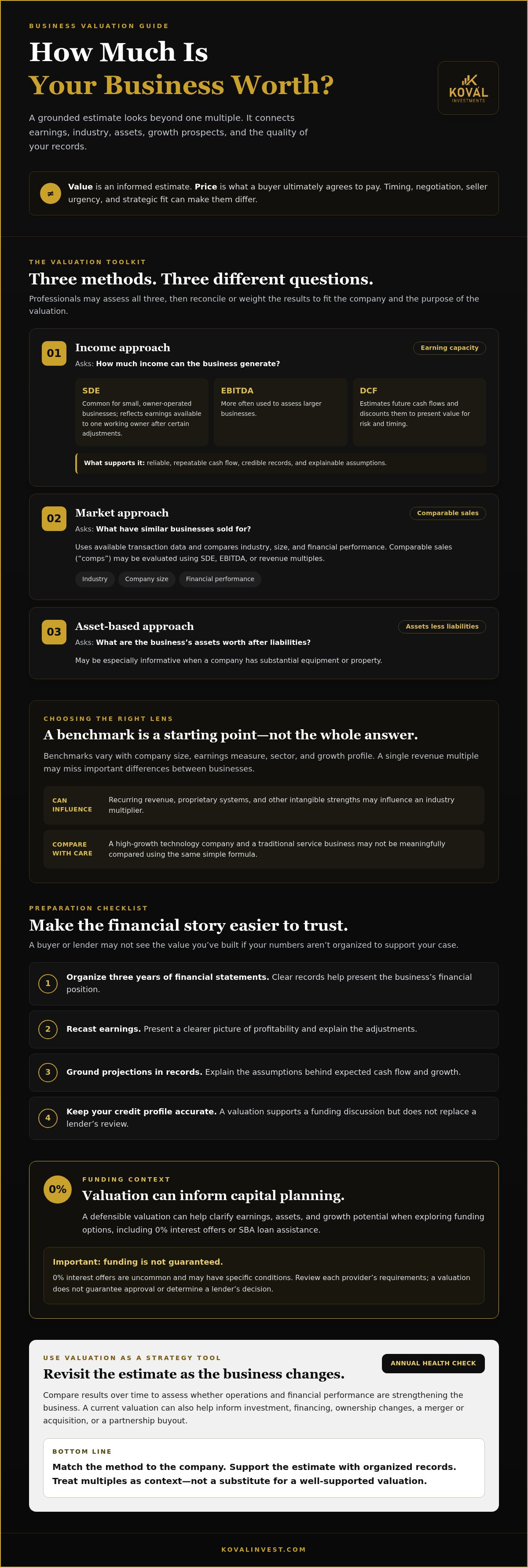
A single revenue multiple can’t capture the full picture in 2026. Benchmarks vary by company size, earnings measure, sector, and growth profile. For example, small owner-operated businesses are generally assessed using SDE, while larger businesses are often assessed using EBITDA. Sector valuations can also vary widely. A high-growth technology company and a traditional service business may not be meaningfully compared using the same simple formula.
Professionals may assess a company through income, market, and asset-based approaches. This overview of business valuation methods provides useful background on those approaches. In practice, the right analysis considers the company’s circumstances and the purpose of the valuation, rather than relying on a headline multiple alone.
The Difference Between Price and Value
Value is an informed estimate of what a business is worth. Price is the amount a buyer ultimately agrees to pay. They can differ because of timing, negotiation, a seller’s urgency, or a buyer’s strategic fit with the company. Data-backed business valuation services can help owners understand the basis for an estimate and assess an offer with clearer expectations.
When Should You Value Your Business?
Make valuation part of an annual business health check. Comparing estimates over time can help you evaluate whether strategic planning is improving performance and returns. A current valuation can also support preparation for a merger or acquisition, a partnership buyout, or a funding application where the lender needs a clearer view of the business. If you’re exploring alternative business funding solutions, an up-to-date valuation can provide useful context, though each provider sets its own requirements.
The Three Primary Business Valuation Methods Used by Professionals
Each valuation method answers a different question: How much income can the business generate? What have comparable businesses sold for? What are its assets worth after liabilities? Professionals may assess all three and reconcile or weight the results based on the company and the purpose of the valuation. No single formula fits every business. For an overview of how these approaches estimate the economic value of a business, see the U.S. Chamber of Commerce’s guide.
The method also shapes how your financial story is presented during capital procurement. An income-based analysis can show earning capacity, while an asset-based analysis may be more informative for a company with substantial equipment or property. A valuation can support a funding discussion, but it doesn’t determine eligibility or replace a lender’s review of credit and other requirements.
The Income Approach: Profit Potential and Cash Flow
The income approach focuses on the earnings a business can produce. For small, owner-operated businesses, professionals commonly use Seller’s Discretionary Earnings (SDE), which reflects earnings available to one working owner after certain adjustments. Larger businesses are more often assessed using EBITDA, or earnings before interest, taxes, depreciation, and amortization. Discounted Cash Flow (DCF), often considered a gold-standard method for growth-stage companies, estimates future cash flows and discounts them to present value to account for risk and timing.
Reliable, repeatable cash flow is central to this analysis because it helps show whether the company can sustain operations and fund its plans. Projections carry more weight when they’re grounded in credible records and supported by explainable assumptions.
The Market Approach: Real-World Comparables
The market approach compares a business with similar companies that have sold, using available transaction data, industry, size, and financial performance to guide the estimate. Comparable sales, or “comps,” may be evaluated using SDE, EBITDA, or revenue multiples, depending on the type and scale of the business. In 2026, broad market movement and diverging sector performance make careful comparison especially important. Smaller owner-operated firms and high-growth technology companies, for example, can fall into very different valuation ranges. A multiple from another sector may mislead rather than clarify.
The Asset-Based Approach: Calculating Net Worth
This method adds up business assets, such as equipment and real estate, then subtracts liabilities. It can be useful for asset-heavy companies or when assessing liquidation value. Its limitation is that it may not fully capture goodwill, customer relationships, or brand equity, which can contribute to the value of an operating business.
To estimate how much your business is worth, match the method to your company’s earnings, assets, and valuation purpose. If you want support assessing the right approach, explore professional business valuation services.
Multipliers, Intangibles, and Industry Benchmarks in 2026
A multiplier applies a factor to a financial measure, such as SDE, EBITDA, or revenue, to estimate a business’s value. It isn’t a fixed score for an industry. Buyers also weigh growth, risk, customer retention, management depth, and how reliably the company can generate future earnings. That’s why answering “how much is my business worth” requires more than finding a sector average and multiplying.
2026 benchmarks reflect a market where high-growth and lower-growth companies can receive very different valuations. Higher interest rates can make future earnings less valuable in today’s terms, while strong growth prospects and dependable revenue may support stronger multiples. Use benchmarks as a starting point, not a promised outcome.
- Service businesses: Small businesses in retail, service, and food are generally valued at 2 to 3 times SDE.
- Technology: High-growth technology and SaaS companies can reach up to 25 times EBITDA. For pre-profit SaaS businesses, revenue multiples of 5 to 10 times may be more relevant.
- Manufacturing: The available 2026 benchmarks don’t establish one typical multiple for manufacturing as a whole. As a narrow example, semiconductors were reported at 15.70 times EV/Sales, a measure that shouldn’t be applied to all manufacturers.
The Power of Recurring Revenue
A subscription-based $1 million in revenue may be viewed differently from $1 million in one-off sales because renewals can make future income more predictable. But recurring revenue doesn’t automatically earn a premium. Buyers will also look at retention, contract terms, margins, and customer acquisition costs. Build repeatable sales and service processes, track renewals, and reduce reliance on a few large accounts. Customer concentration can increase perceived risk if losing one client would materially affect earnings.
Intangible Assets: Brand, Talent, and IP
Goodwill captures advantages that aren’t easily separated into physical assets, including reputation and customer loyalty. A capable management team can reduce dependence on the owner and help operations continue through a transition. Documenting processes and protecting intellectual property can make these strengths easier to demonstrate. Their effect on value depends on evidence: buyers need to see that relationships, know-how, and systems can endure beyond the current owner.
To build a stronger valuation case, connect each claimed advantage to records, contracts, operating procedures, or customer data. A professional valuation can help assess how those factors fit your industry, earnings, and growth plans.
Preparation: How to Audit and Optimize Your Financial Profile
A valuation is only as useful as the information behind it. Before asking “how much is my business worth,” organize the records that support your earnings, assets, liabilities, and credit standing. A clear financial profile helps a valuation professional assess the business on its merits and gives buyers or lenders a more reliable basis for review.
- Clean up three years of statements. Review your profit and loss statements and balance sheets for missing entries, inconsistent categories, unreconciled accounts, or unexplained changes. Check that the figures align with supporting records.
- Recast earnings carefully. Identify potential add-backs, such as an owner’s salary above a market replacement level, documented non-recurring expenses, or personal perks paid through the business. Keep receipts and explanations. An adjustment isn’t automatically accepted just because it benefits the owner.
- Review business credit. Check reports for errors, outdated details, or accounts that don’t belong to the company. A weak or inaccurate profile can affect how lenders assess risk, even though it doesn’t by itself determine the business’s value.
- Run a mock valuation. Test the available information against the methods relevant to your company. Gaps in documentation, inconsistent earnings, or owner dependence can then be addressed before a sale or funding application.
The Role of Credit in Business Worth
Business credit can shape a lender’s view of risk and may influence financing terms, which can affect future expenses and net earnings. Depending on the financing, lenders may also review the owner’s credit profile alongside business performance and valuation. Correcting report errors can help ensure decisions rely on accurate information, but it doesn’t guarantee lower borrowing costs or a higher valuation. For support reviewing this area, explore business credit repair services.
Recasting Financials for Maximum Impact
Recasting presents normalized earnings: a view of ongoing profitability that separates ordinary operating costs from unusual or owner-specific items. For example, a one-time expense may be considered for adjustment if it’s clearly documented and unlikely to recur. A buyer will also consider the cost of replacing the owner’s role, so don’t treat all owner compensation as an add-back. Transparency matters. Provide a clear schedule showing each adjustment, its supporting record, and why it belongs in the analysis.
Use the mock valuation to turn findings into a practical improvement plan. Correct bookkeeping issues, address credit report inaccuracies, and document earnings adjustments before seeking capital or entering negotiations. To assess your financial profile and valuation preparation, explore professional business valuation support.
Leveraging Your Valuation to Secure 0% Interest Funding and SBA Capital
A professional valuation can help turn your growth plan into a clearer case for capital. It documents the company’s earnings, assets, and business prospects, giving lenders useful context as they assess a request. Treat it as supporting evidence, not a guarantee of approval: lenders also consider credit, cash flow, repayment ability, and their own underwriting criteria. A valuation alone doesn’t secure funding or make a business eligible.
For owners asking “how much is my business worth,” the next question is how that estimate supports a specific growth objective. A valuation can help frame the capital needed for expansion, acquisition, or equipment investment. Koval Investments connects professional business valuations with strategic planning and capital procurement, helping owners consider how their financial profile and funding goals fit together.
Valuation as a Tool for Capital Procurement
A high valuation may strengthen the overall funding discussion, but it doesn’t automatically reduce a lender’s perceived risk or serve as collateral for unsecured funding. Unsecured options generally aren’t backed by pledged assets, and providers set their own criteria. A credible valuation can still help explain the business’s position alongside cash flow, credit history, and a clear use of funds.
Explore 0% interest business funding as one possible part of a capital strategy, not a guaranteed or universally available option. These offers are uncommon and may involve specific, restrictive conditions, so review eligibility, repayment obligations, and terms carefully. Koval Investments offers capital procurement support to help owners consider funding options in light of their goals and financial profile.
Valuation can also help owners prepare a reasoned request for SBA capital. The SBA 7(a) and 504 loan programs serve different financing needs, so the right fit depends on the project and lender review. A valuation may provide context for the business’s financial capacity, but it doesn’t justify a larger loan by itself or replace underwriting.
Strategic Planning for a Future Exit
Capital can support improvements that may strengthen a business before a sale, such as expanding capacity or pursuing an acquisition. For example, working capital for business acquisition may be one strategy to evaluate, subject to available options and lender requirements. Mergers and acquisitions consulting can help owners assess strategic fit, prepare for a transaction, and plan for a smoother transition. Revisit the valuation as the business changes to track progress rather than relying on an outdated estimate.
For a professional business valuation and funding strategy, contact Koval Investments.
Turn Your Valuation Into a Clear Growth Plan
Knowing how much is my business worth starts with more than applying an industry multiple. A useful estimate considers earnings, assets, market context, and the quality of your financial records. Clean statements and a transparent view of profitability help you make a stronger case to buyers and lenders.
Use your valuation as a working benchmark, not just an exit figure. It can help you track strategic progress, assess capital needs, and prepare for expansion or a future transaction. Funding options, including 0% interest solutions, have specific conditions and aren’t guaranteed, so review eligibility and terms carefully.
Koval Investments brings together professional valuation and M&A consulting with strategic planning and capital procurement. Its services can help connect your business’s value with funding options and long-term goals.
Get your professional business valuation and funding strategy today, and take a practical next step toward your business’s future. With clear records, a grounded estimate, and a plan you can measure, you’ll be better positioned to build on the value you’ve created.
Frequently Asked Questions
How much does a professional business valuation cost in 2026?
There isn’t one standard price for a professional business valuation in 2026. The fee can depend on the business’s size and complexity, the valuation’s purpose, the records available, and the scope of analysis. Because Koval Investments offers business valuations, contact the firm directly for current pricing rather than relying on a general estimate. Before engaging any provider, confirm what the valuation includes and how it will be used.
Can I value my business based on revenue alone?
No. Revenue alone doesn’t show how much profit the business generates, what assets and liabilities it holds, or how much risk is involved in sustaining sales. Professionals may examine earnings, comparable transactions, assets, customer concentration, and growth prospects. Revenue multiples can be useful in some sectors, including certain pre-profit SaaS businesses, but they’re not a universal shortcut. A more useful estimate matches the method to the company and valuation purpose.
How does my personal credit score affect my business's worth?
Your personal credit score doesn’t directly determine the business’s market value, which is based on factors such as earnings, assets, and market conditions. It may affect a lender’s assessment of financing eligibility or terms, particularly when the owner is part of the credit review. That can influence the cost of capital, but it doesn’t automatically change the valuation. Keep personal and business credit information accurate, and review the lender’s criteria for each funding option.
What is the most common reason for a business being undervalued?
One frequent risk is financial information that doesn’t clearly support the business’s earnings. Incomplete statements, inconsistent bookkeeping, or undocumented adjustments can make it difficult for a buyer or valuation professional to verify profitability. Owner dependence and customer concentration may also raise concerns. Prepare clear financial records, document any proposed earnings adjustments, and show how the company operates. These steps help others assess the business using evidence rather than assumptions.
How long does the business valuation process typically take?
The timeline varies with the business’s complexity, the purpose of the valuation, and how complete its records are. A straightforward company with organized financial statements may require less analysis than one with multiple entities, unusual assets, or unclear earnings adjustments. The valuation professional may also need time to review supporting documents and clarify questions. Ask about the expected process and required information at the outset, but don’t rely on an assumed standard turnaround.
Is an SBA loan valuation different from a market valuation?
They can serve different purposes. A market valuation estimates a business’s value in a potential sale, based on relevant financial and market evidence. A lender considers information that supports its underwriting decision, which may include business value but also repayment capacity, credit, and the proposed use of funds. Requirements depend on the loan and lender. A market valuation can inform a financing discussion, but it may not replace the lender’s own analysis.
Can I use a business valuation to get 0% interest funding?
A valuation may help explain your business’s financial position, but it can’t secure 0% interest funding or guarantee eligibility. Providers set their own criteria, and 0% interest offers are uncommon and may include specific, restrictive conditions. Review the full terms, qualification requirements, repayment obligations, and any fees before deciding. Treat the valuation as one part of a broader funding application, alongside accurate financial records, credit information, and a clear plan for how funds will be used.
What industry has the highest valuation multipliers right now?
There isn’t one highest-multiple industry across every valuation measure. In 2026, high-growth technology and SaaS companies can reach up to 25 times EBITDA, according to the available industry benchmarks. That figure applies to qualifying high-growth businesses, not every technology company. For pre-profit SaaS, revenue multiples may be more relevant. Multiples vary with growth, earnings quality, and risk, so compare businesses using the same metric and similar circumstances.