
How to Establish Business Credit for a New LLC in 2026
Building business credit starts with reliable records, not borrowing. If you’re learning how to establish business credit for a new LLC, start with this distinction: forming an LLC creates a legal business identity, but it doesn’t automatically create a meaningful credit history. That history develops when business information and payment activity are reported to credit bureaus.
Registrations and accounts can help establish a credit profile, but taking on debt isn’t the goal. You can create a clear business identity, organize financial activity, and assess credit accounts carefully before deciding whether they fit your operations.
This guide covers a practical sequence: set up your LLC’s core business details, obtain an EIN, open a dedicated business bank account, and use accounts that report payment activity to business credit bureaus. You’ll also learn how to monitor your profile, correct inaccurate information, and prepare for future financing conversations. Building a stronger financial profile takes time, but consistent steps can help you make informed decisions along the way.
Key Takeaways
- Learn how to establish business credit for a new LLC by creating a consistent business identity before applying for credit.
- Choose accounts for their business purpose and reporting practices, not simply to create a score.
- Review business credit files regularly to catch identity errors and see which accounts appear.
- Keep records of payments and bureau follow-ups so you can track changes over time.
- Organize financial records for future financing, and remember that credit history is only one part of a lender’s assessment.
Why a New LLC Should Establish Business Credit Early
Forming an LLC establishes a legal business entity under state rules. Business credit is different: it refers to the company’s credit-related history and profile, including information about accounts and payment activity that business credit bureaus may collect. Registration is a starting point, not a record of how the company manages credit.
It helps to distinguish three parts of the picture. Business identity records are details such as the LLC’s legal name and address. A bureau file is a record a credit bureau maintains about the business, if one exists. A credit score is a calculation based on information available to a scoring model. A new LLC’s file may be sparse, and a score may not be available.
Consistent information gives lenders, suppliers, and bureaus a clearer basis for matching records. Use the same legal business name, address, and other identifying details across applications and accounts. For example, switching between an abbreviated name and the full legal name can make it harder to determine whether records refer to the same business. Careful recordkeeping helps you spot mismatches before they complicate a future review.
- Identity: Details that identify the business.
- Credit file: Bureau-held information about the business’s credit activity.
- Score: A model’s assessment of available credit information.
Does forming an LLC automatically create business credit?
No. State formation creates the LLC as a legal entity, but it doesn’t automatically establish a complete bureau file, reported accounts, or a lender-ready payment history. A bureau may have limited information about a new business, and a score or tradeline may not appear immediately. Learning how to establish business credit for a new LLC means treating formation and credit building as separate steps, then keeping business details aligned as you open accounts.
Why can business credit matter as the company grows?
A business credit profile may matter when a supplier considers payment terms or a lender reviews an application for credit or financing. It’s only one part of the assessment. Depending on the product and the company’s circumstances, a lender may also review cash flow, time in business, and owner information. Some financing for a new LLC may involve a personal guarantee, so the owner’s credit and liability can remain relevant. A more complete business profile can help you prepare, but it doesn’t guarantee approval, a particular limit, or specific terms.
Set Up Your New LLC’s Business Identity Before Applying for Credit
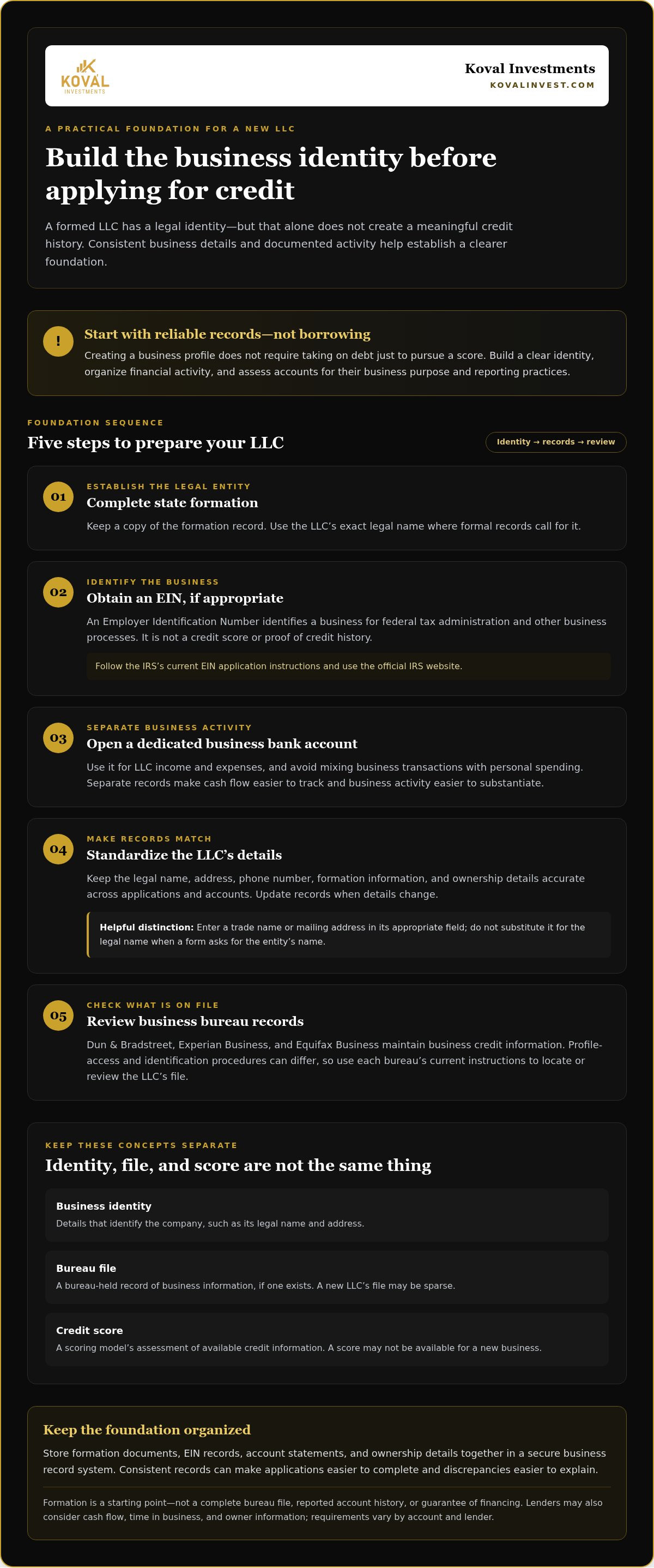
Before applying for a business credit account, make the LLC easy to identify and its financial activity easy to document. These steps create a consistent foundation, but they aren’t a universal lender checklist. Requirements vary by account and lender, so treat any additional application documents as specific to that review.
- Complete the LLC’s state formation. Keep a copy of the formation record and use the entity’s exact legal name where formal records call for it.
- Apply for an EIN, if appropriate. An Employer Identification Number identifies a business for federal tax administration and other business processes. It isn’t a credit score or proof of credit history. Follow the IRS’s current EIN application instructions and use the official IRS website.
- Set up a dedicated business bank account. Use it for LLC income and expenses, and avoid mixing business transactions with personal spending. Separate records make it easier to track cash flow and substantiate business activity.
- Standardize the LLC’s details. Keep its legal name, address, phone number, formation information, and ownership details accurate across applications and accounts. Update records when details change.
- Review business bureau records. Dun & Bradstreet, Experian Business, and Equifax Business maintain business credit information. Their profile-access and identification procedures can differ, so follow each bureau’s current instructions to locate or review the LLC’s file.
What business information should an LLC keep consistent?
Use the legal name shown on formation records when a formal application asks for the entity’s name. Keep a reliable reference copy of the LLC’s address, business phone, formation details, and ownership information so you can enter them consistently. If a form asks for a trade name or mailing address, provide that information in the appropriate field rather than substituting it for the legal name. Mismatches can complicate identity checks, though they don’t automatically determine a credit score.
How do EIN and business bureau profiles fit into the process?
An EIN helps identify the business; it doesn’t create a bureau file or guarantee that an account will appear in one. A bureau file contains reported business information, while a score, if available, is a separate assessment. The Forbes guide Building Business Credit from Scratch also discusses foundational steps such as registration and business credit accounts. Use it as general context, then rely on current IRS and bureau instructions for specific procedures.
Keep formation documents, EIN records, account statements, and ownership details together in a secure business record system. This makes it easier to complete applications accurately and explain discrepancies if records don’t match. It also helps distinguish general preparation from a lender’s requirements, which may include additional information about the business or its owners.
A practical answer to how to establish business credit for a new LLC begins with clean, consistent records, not the assumption that one registration creates credit. Koval Investments’ credit repair services identify and dispute credit report inaccuracies, helping clients strengthen their financial profiles as they prepare for future capital needs. Learn about credit-profile optimization support.
Build Business Credit Without Borrowing Just to Create a Score
You don’t need to take on debt simply to pursue a business credit score. The goal is to build a record of real business activity and responsible payments, not to open accounts that don’t support your operations. Before applying, consider whether the account meets a business need, what it costs to maintain, how repayment works, and whether the LLC can meet its obligations from expected cash flow.
Which business accounts may contribute payment history?
Supplier accounts, business credit cards, and other credit products may create payment activity that appears in a business credit file. Supplier terms, sometimes called Net-30, can suit recurring purchases if they fit your buying cycle. A card may help manage routine expenses, but check its fees, repayment terms, personal guarantee requirements, and whether applying may involve a personal credit check.
- Supplier accounts: Useful for planned purchases from a vendor, but an account won’t build a bureau record if the vendor doesn’t report its payment history.
- Business credit cards: May support regular expenses, but require careful balance management and a clear repayment plan.
- Other credit products: Consider these only when they meet an operating need and their obligations fit the business’s financial capacity.
Reporting isn’t automatic or universal. A creditor may report to one business bureau, several, or none, and an account won’t necessarily appear on every bureau file. Review current creditor documentation for its reporting practices and note which bureau receives information. Even after an account is opened, allow time for activity to show. New tradelines and payment history can take 60 to 90 days to appear.
How should a new LLC manage its first credit accounts?
Start with a limited number of accounts tied to actual business spending. Read each agreement so you understand due dates, fees, repayment terms, and any personal guarantee before committing. Then build payment reminders into your bookkeeping routine. Paying according to the stated terms helps keep the account in good standing, while planning expenses makes it easier to avoid commitments the LLC’s cash flow can’t support.
- Choose an account for a specific, recurring business expense rather than for the score alone.
- Record the due date and payment terms, then schedule payments around expected cash inflows.
- Review statements and confirm that payments are processed and reported as described.
For example, if an LLC regularly buys supplies from one vendor, a reporting supplier account may fit an existing expense. Opening several accounts at once just to create more activity could add repayment obligations without improving the business’s ability to operate. A measured approach is easier to manage and creates a clearer record of how the company handles the credit it uses.
In practice, how to establish business credit for a new LLC is less about accumulating accounts and more about choosing carefully, paying reliably, and confirming what gets reported. If an account doesn’t serve the business or strains cash flow, the potential credit history may not justify the added obligation.
Track Reports and Strengthen Your LLC’s Credit Profile Step by Step
Opening an account is only the start. To find out whether it contributes to your LLC’s credit history, review the business credit files and keep a record of what you find. Dun & Bradstreet, Experian Business, and Equifax Business may hold different information, and their scoring approaches can differ. A profile may not include every account, and there isn’t one universal score that tells the whole story.
How can an LLC check whether its credit activity appears?
Use each bureau’s current process to locate or access the LLC’s file. Compare the business name and other identifiers with your records, then review reported accounts, balances, and payment details. A missing account doesn’t automatically mean something is wrong, but it’s a reason to check the creditor’s reporting practices and note when the account was opened.
Make the review repeatable. Keep a dated log of the bureau reviewed, the date, the accounts listed, and any issue that needs follow-up. Save relevant statements and payment confirmations with the log. This timeline can help if information appears later or you need to explain a difference between a creditor’s records and a bureau file.
- Review each available file. Follow the current access instructions of Dun & Bradstreet, Experian Business, and Equifax Business.
- Confirm identity details. Compare the LLC’s identifying information with its formation and account records.
- Inspect reported accounts. Check whether the account and payment details match your statements.
- Record follow-up. Note what you queried, when you submitted it, and any response received.
What should an owner do about inaccurate business-credit information?
Start with the specific entry, not a general complaint. Record the bureau showing it, the account or detail involved, why it appears inaccurate, and what documentation supports your position. Follow that bureau’s current dispute process, provide relevant evidence, and keep copies of your submission and later correspondence. For guidance on addressing business credit report errors, Koval Investments’ credit repair services help identify and dispute credit-report inaccuracies.
Keep the explanation factual and the evidence organized. For example, if a listed payment date conflicts with an account statement, identify both dates and include the statement that supports your records. Check an unfamiliar account against the LLC’s documentation before assuming it’s an error. If the bureau requests more information, add it to your dated follow-up log.
Business credit profiles develop through reported information and account management over time. Checking files regularly helps you spot inconsistencies and understand what’s being recorded, but it can’t guarantee a score or financing outcome. Koval Investments’ credit repair services can help you identify and dispute inaccuracies as part of preparing your financial profile.
Prepare Your New LLC for Future Financing With a Stronger Credit Foundation
A useful business credit profile is part of financial readiness, not a shortcut to financing. Consistent company information helps keep records aligned. Accounts chosen for real operating needs can create a payment history when creditors report them, while timely payments and regular file reviews help you understand what’s being recorded. Together, these habits make it easier to present a clear picture of the LLC as it grows.
Keep that foundation in perspective. A lender may consider business credit alongside financial records, cash flow, time in operation, and information about the owners. The mix of factors depends on the lender and financing product. A solid credit history may support a financing review, but it can’t promise approval, a particular credit limit, or specific terms. Building a profile and deciding whether to pursue a product are separate decisions.
What else may a lender review alongside business credit?
Organized financial records help explain how the company earns and uses money. Cash-flow information can provide context about its ability to manage obligations, while time in operation and application details help describe the business and its owners. Requirements vary, so prepare accurate information without assuming one checklist applies to every financing option. If you’re researching an SBA loan, review SBA loan assistance as a separate step in evaluating that route.
Before applying, align the records with the purpose of the request. For instance, make sure your financial statements and account activity tell a consistent story about business income and expenses. Keep ownership and company details current, and be prepared to explain the business need behind the financing. This preparation doesn’t replace a lender’s review; it helps you approach the conversation with a clearer view of the LLC’s position.
When can professional credit-profile support be useful?
Support can be useful if you find unfamiliar accounts, inconsistent company details, or information that appears inaccurate. Gather the relevant report, account records, payment confirmations, and other documentation. A dispute should identify the specific item and follow the bureau’s current process. Clear records help you explain the concern, track correspondence, and understand what has changed without assuming a dispute will produce a particular score or financing result.
The practical answer to how to establish business credit for a new LLC is to build a reliable financial record, then keep it accurate as the company’s needs evolve. Credit history is one part of that record. Purposeful account use, sound cash-flow management, and organized application materials all contribute to a more informed financing discussion.
Koval Investments offers credit repair and capital procurement services, including 0% interest funding solutions, SBA loans, and working capital. These services can support your financial profile and capital planning as your business grows.
Make Your Next Financing Conversation More Informed
Think of credit preparation as an ongoing business practice, not a finish line or a promise of approval. As the LLC’s plans change, revisit whether its financial profile reflects the business accurately and whether its next capital decision fits its operating needs. That perspective keeps the question of how to establish business credit for a new LLC connected to a larger goal: making deliberate choices as the company grows.
If inaccurate credit information or future funding needs make your next step harder to assess, Koval Investments provides credit repair and capital procurement support nationally. Its credit repair services identify and dispute credit-report inaccuracies, while its funding solutions include 0% interest funding, SBA loans, and working capital. Financing outcomes depend on the business’s circumstances and the lender’s review.
Explore Koval Investments’ credit and funding services to discuss a practical next step for your business.
Frequently Asked Questions
Does forming an LLC automatically establish business credit?
No. Forming an LLC creates a legal entity, but it doesn’t create a record of borrowing or payments. A bureau file may be absent or contain limited information until data is reported. For example, a business could have state formation documents and an EIN but no reported credit accounts. Treat legal formation and credit history as separate milestones, and check bureau files rather than assuming a profile or score already exists.
How long does it take to establish business credit for a new LLC?
There’s no fixed timeline for establishing a complete profile because it depends on whether creditors report and how quickly bureaus process information. A newly reported tradeline and its payment history typically take 60 to 90 days to appear, so an account may not show up right away. Check the relevant bureau file after allowing time for reporting, and keep dated statements and payment records to help investigate missing information.
Can I build business credit without using a business credit card?
Yes. A business credit card isn’t the only possible source of reported payment activity. A supplier account used for routine purchases may contribute history if the creditor reports to a business bureau. Before relying on an account for that purpose, review the creditor’s current reporting information. Choose the account because it supports an actual business need, not simply because it might create a credit record.
Do I need an EIN to establish business credit for my LLC?
An EIN is commonly used to identify an LLC on business account applications, but requirements can vary by creditor and product. It’s an identifier, not a credit score or a guarantee that a bureau file exists. Apply through the IRS using its current instructions, and keep the EIN information consistent with the LLC’s legal records. Don’t mistake receiving an EIN for having established payment history.
What happens if a vendor does not report payments to business credit bureaus?
If a vendor doesn’t report an account, paying it on time may still help maintain a good supplier relationship, but that payment activity may not appear in a business credit file. The account can remain useful for operations without contributing bureau-reported history. Review the vendor’s current account information and check your reports before assuming a payment will build credit. Reporting may also differ from one bureau to another.
Does business credit affect my personal credit score?
Business credit files and personal credit reports are distinct, but they can connect through an application or personal guarantee. A lender may review an owner’s personal credit when assessing a new LLC, and a personal guarantee makes the owner responsible under the agreement if the business doesn’t repay. Some business credit products may also involve a personal credit check. Read the application and account terms to understand the potential personal-credit and liability implications.
How can I check my new LLC’s business credit reports?
Check the current file-access process with Dun & Bradstreet, Experian Business, and Equifax Business, since procedures can differ. Search using the LLC’s legal name and identifying details, then compare any listed accounts with your statements. Save dated copies or notes from each review. If a file is missing or an account isn’t listed, first confirm whether the creditor reports that activity and to which bureau.
Can a new LLC qualify for a business loan without established credit?
Possibly, but a limited business credit history doesn’t ensure approval or rule it out. A lender may weigh other factors, such as cash flow, time in operation, financial records, the owner’s credit, and any guarantee or other application requirements. For instance, clear revenue records may provide useful context when the LLC has few reported accounts. Criteria vary by lender and financing product, so review the specific requirements before applying.