
How to Get Business Funding Without Investors in 2026
What if you could fund your next stage of growth without giving up ownership or control? Investors are one source of capital, but choosing an alternative takes careful thought. Learning how to get business funding without investors means weighing what the money will support against its cost, repayment obligations, and potential personal exposure.
If you’re unsure whether a grant, loan, or other funding route fits your business, compare each option against your specific need. Eligibility factors and trade-offs differ, and a financing choice that works for one business may put too much pressure on another. Start with a clear view of your cash flow, funding purpose, and ability to meet any obligations.
This guide compares practical non-investor funding options, explains what providers may assess, and outlines how to prepare an application. You’ll also find a checklist for organizing financial information and evaluating terms. The goal is to help you identify a realistic next step and choose capital that aligns with your business needs and capacity to repay.
Key Takeaways
- Learn how to get business funding without investors by matching the funding route to your business need, timing, and repayment capacity.
- Compare term loans, lines of credit, SBA-backed financing, and working capital by how the funds can be used and what obligations come with them.
- Use written offer documents to compare financing terms, rather than relying on headline claims alone.
- Prepare a more organized application with requested financial statements, cash-flow forecasts, tax records, and ownership details.
- Explore how Koval Investments may help you assess funding pathways, including 0% interest funding solutions, SBA loans, and working capital.
How to Get Business Funding Without Investors: Understand the Trade-Off
If you want capital while keeping ownership and decision-making authority, that goal shapes how to get business funding without investors. Rather than exchanging a share of the company for capital, you can consider funding routes that leave your ownership intact. Each still comes with conditions, costs, or responsibilities to assess.
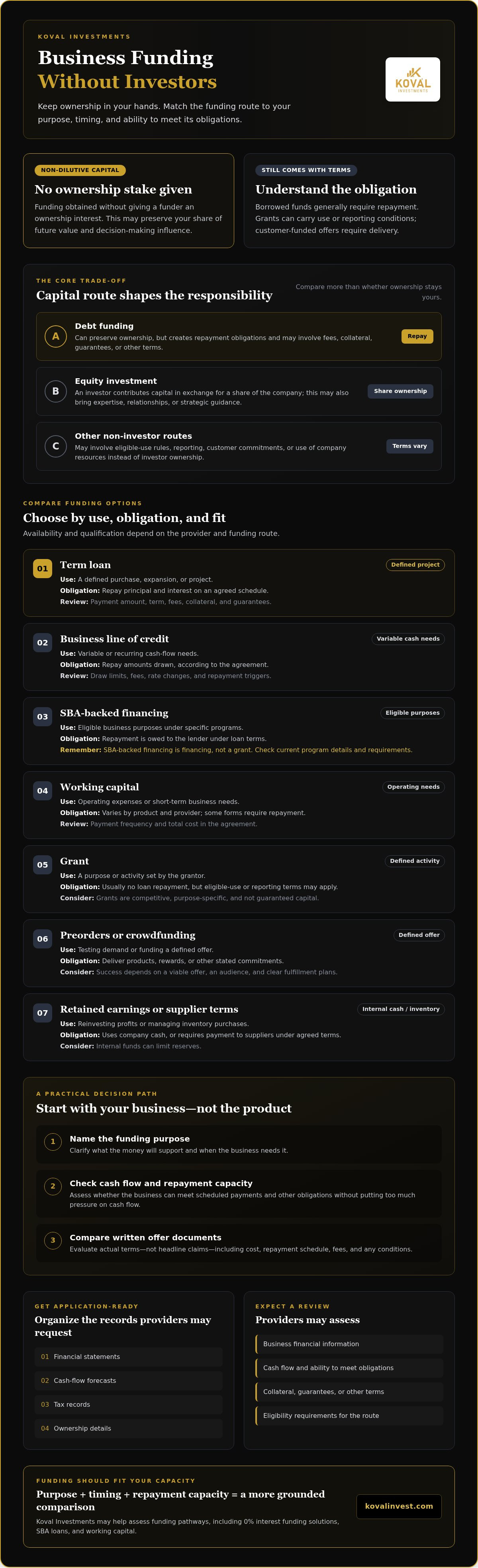
Non-dilutive funding is capital a business obtains without giving a funder an ownership stake. That distinguishes it from equity investment, where an investor contributes capital in exchange for a share of the company. Non-dilutive doesn’t mean obligation-free. Borrowed funds generally require repayment, and lenders may review financial information or require collateral, guarantees, or other terms. Grants may have use or reporting conditions, while customer-funded approaches depend on delivering what customers paid for.
What does business funding without investors mean?
Borrowing creates a debt obligation; equity financing gives an investor an ownership interest, which can come with influence over business decisions. Other possibilities include grants, advance customer payments, or reinvesting company resources. Some owners also explore alternative financing channels, a broad category that includes methods such as crowdfunding and peer-to-peer lending. These options differ in access, cost, and obligations, so don’t assume any route is free or readily available.
Why do owners prefer to retain ownership?
Keeping equity can preserve a founder’s share of future value, governance influence, and flexibility to set the company’s direction. It may also avoid adding an investor whose priorities differ from the owner’s. Equity can bring more than capital, though: an investor may contribute expertise, industry relationships, or strategic guidance. The decision depends on what the business needs and what the owner is willing to exchange.
Compare the trade-offs against your goals and timeline. A loan may preserve ownership but require scheduled payments that put pressure on cash flow. An equity investment may avoid loan repayments, but it shares ownership and may affect future decisions. Before choosing, consider whether retaining control is essential, when the business can use the capital, and which obligations it can realistically manage. That assessment is the starting point for comparing funding options.
Compare Business Funding Options That Do Not Require Equity Investors
Once you know how much capital you need and what it will support, compare options by more than whether they preserve ownership. Consider how funds are accessed, what you must repay or deliver, and whether the terms fit your cash flow. Availability and qualification depend on the provider and funding route.
| Option | Typical use | Repayment or delivery obligation | Key consideration |
|---|---|---|---|
| Term loan | A defined purchase, expansion, or project | Repay principal and interest on an agreed schedule | Check payment amount, term, fees, and any collateral or guarantees. |
| Business line of credit | Variable or recurring cash-flow needs | Repay amounts drawn, according to the agreement | Review draw limits, fees, rate changes, and repayment triggers. |
| SBA-backed financing | Eligible business purposes under specific programs | Repayment is owed to the lender under loan terms | It is financing, not a grant. Check current program details and requirements through the SBA’s information on SBA-guaranteed loans. |
| Working capital | Operating expenses or short-term business needs | Obligations vary by product and provider; some forms require repayment | Read the agreement carefully, including payment frequency and total cost. |
| Grant | A defined activity or purpose set by the grantor | Usually no loan repayment, but terms may require eligible use or reporting | Grants are competitive, purpose-specific, and not guaranteed capital. |
| Preorders or crowdfunding | Testing demand or funding a defined offer | Deliver products, rewards, or other stated commitments | Success depends on a viable offer, an audience, and clear fulfillment plans. |
| Retained earnings or supplier terms | Reinvesting profits or managing inventory purchases | Uses company cash, or requires payment to suppliers under agreed terms | Internal funds can limit reserves; supplier terms depend on vendor approval and conditions. |
When might debt-based funding fit?
Debt may suit a defined need when projected cash flow can support payments during slower periods as well as stronger ones. A term loan offers a set repayment schedule, while a line of credit can provide access to funds as needs arise, subject to its limit and agreement. Before borrowing, model the payments alongside existing expenses and expected revenue. SBA-backed loans are made through participating lenders, not issued as direct government grants, and program details can change.
When might non-loan funding or internal capital fit?
Preorders and crowdfunding can help finance an offer when customers understand its value and the business can fulfill its commitments. Grants may suit eligible projects, but consider the application effort and competition. Retained earnings avoid external borrowing, yet using cash for growth can reduce operating reserves. Supplier terms may ease purchase timing, but only if the vendor agrees and the payment schedule is manageable.
There’s no universal best route. Koval Investments can help you explore capital pathways, including SBA loans and working capital. Review funding options with Koval Investments as one step in assessing what may fit your needs.
How to Choose Funding Without Investors That Fits Your Business
The right option depends on more than whether it avoids equity dilution. To decide how to get business funding without investors, assess the purpose of the money, when you need it, how repayment fits your cash flow, and which obligations you’re willing to accept. An option that looks affordable at first may still be a poor fit if its payment schedule conflicts with your revenue cycle.
Match the source to the use of funds
Start with the business need. A short-term working capital gap may call for a different structure than equipment, expansion, or property investment. Estimate when the spending will occur and when it could generate revenue or savings. Then consider whether that benefit can reasonably support the repayment schedule, including during slower periods. Confirm permitted uses directly with the provider, since restrictions can vary by offer.
- Purpose: What specific expense or project will the capital cover?
- Timing: When must funds be available, and when might the business benefit from them?
- Repayment capacity: Can cash flow support payments without weakening essential operations or reserves?
- Acceptable obligations: Are you comfortable with fees, collateral, guarantees, frequent payments, or limits on how funds are used?
Assess cost, control, and repayment exposure
No equity dilution doesn’t mean no financial risk. A loan can preserve ownership while creating repayment pressure; some agreements may also involve collateral or a personal guarantee. Compare written offers side by side, not just advertised rates or “starting at” claims. Check the total amount repayable, payment frequency, fees, term, rate changes, draw conditions, and consequences of missed payments.
Promotional or interest-free offers need the same scrutiny. A stated 0% rate may depend on eligibility, a limited promotional period, payment conditions, or other terms in the agreement. Review the full offer and confirm current terms rather than assuming the headline applies throughout the funding period. A detailed 0% interest business funding guide can help you identify questions to ask before accepting an offer.
Use a consistent comparison: estimate payments against a cautious cash-flow forecast, note obligations that continue if revenue falls short, and set aside offers whose terms remain unclear. If contract language is difficult to interpret, consider asking an independent qualified professional to review it. This isn’t legal advice, but getting clarity before signing can help you make a more informed decision.
How to Prepare and Apply for Business Funding Without Investors
A well-prepared request helps a provider understand what you need and how the business may manage the obligation. As you decide how to get business funding without investors, follow a consistent process and use each provider’s document checklist. Requirements vary, so don’t assume every lender or program asks for the same records or follows the same timeline.
- Define the funding need. Set a specific amount, explain what it will pay for, and identify when the business needs the funds. Separate essential costs from optional spending.
- State the business objective. Describe what the funding is intended to achieve, such as purchasing equipment or supporting a defined expansion. Use measurable outcomes where possible, without promising more than your projections support.
- Build realistic financial projections. Prepare cash-flow forecasts showing how expected revenue, expenses, and potential payments fit together. Document your assumptions and consider how the business would manage a slower-than-expected period.
- Organize requested records. Depending on the provider, gather business financial statements, tax records, ownership details, and other requested documents. Keep current versions together and ask for the provider’s checklist before submitting an application.
- Check credit information for accuracy. Review relevant personal and business credit reports for errors before applying. Some providers may consider business credit records, including information associated with Dun & Bradstreet, but evaluation methods differ. Confirm what each provider reviews and how it handles reported inaccuracies.
- Compare written offers. Evaluate the full terms side by side before accepting capital. Ask providers to clarify anything you don’t understand.
Build a credible funding request
Make the request easy to assess: state the amount, intended use, timing, and expected business objective. Connect your projections to supporting records and explain the assumptions behind them. A forecast should be a planning tool, not just an optimistic sales estimate. Provider requirements vary, so verify whether it wants specific financial statements, tax records, ownership information, or business credit details.
Compare offers before accepting capital
Check the repayment schedule, total fees, collateral requirements, guarantees, and consequences of missed payments. Compare offers using the same assumptions, such as the amount borrowed and repayment period. For promotional or interest-free options, review the conditions and full written terms. A focused 0% interest business funding guide can help you identify questions to ask as you evaluate an offer.
If a term remains unclear, request an explanation from the provider before signing. To assess funding pathways and readiness, explore business funding options with Koval Investments. This can help you consider possible next steps, but it doesn’t guarantee approval or specific terms.
When Koval Investments Can Help You Explore Business Funding
After comparing funding routes and preparing your records, you may want help assessing which paths are worth exploring. Koval Investments supports businesses with capital procurement across 0% interest funding solutions, SBA loans, and working capital. Its services can help you consider options in light of your funding need and financial profile, without promising approval or particular terms.
What a funding-readiness conversation can cover
A discussion can start with your business goals, intended use of funds, timing, and ability to manage potential repayment obligations. It may also include reviewing your financial profile and considering which capital pathways could align with your needs. If you’re learning how to get business funding without investors, a structured assessment can help turn broad possibilities into questions to verify with each relevant provider.
Eligibility, approval decisions, and terms depend on the provider and the specific funding option. Review any 0% interest funding solution for current availability, eligibility, conditions, and written terms before proceeding. Confirm SBA program details and application requirements against current official guidance as well. Koval Investments does not offer direct consumer banking or legal representation.
Koval Investments also offers credit repair services focused on identifying and disputing inaccuracies in credit reports. That work is distinct from removing accurate negative information, which should not be represented as a credit repair outcome. Reviewing reports for errors may be one part of preparing your financial profile, but it doesn’t guarantee a particular credit score, funding limit, or approval.
Choose a next step that fits your situation
Before an initial conversation, write down the amount you’re seeking, what it would fund, when you need it, and how the business expects to manage any payments. Gather relevant financial statements, cash-flow forecasts, tax records, ownership details, and credit reports if available. This gives you a clear starting picture for discussing readiness and identifying what information a provider may still require.
If report accuracy is a concern, learn more about business credit repair and the role of disputing inaccuracies. Keep expectations measured: correcting an error may support a more accurate profile, but it doesn’t ensure a funding outcome. Compare provider requirements and offer terms directly before making a commitment.
If you’d like support assessing potential capital pathways and funding readiness, discuss your objectives with Koval Investments and consider whether its capital procurement or credit repair services fit your situation. Bring your questions, review the terms carefully, and choose a next step based on your business’s needs and capacity.
Choose Capital That Supports Your Next Step
Finding out how to get business funding without investors starts with matching capital to a clear business need and a repayment plan the business can manage. Loans, grants, customer funding, and internal resources come with different conditions, so compare written terms rather than relying on headline claims. Retaining ownership can preserve control, but it doesn’t remove financial obligations or risk.
Preparation matters too. Define the amount and intended use, organize requested financial records, check credit reports for inaccuracies, and compare offers carefully before committing. These steps can help you approach funding decisions with more clarity, even though eligibility and terms depend on the provider.
Koval Investments helps businesses explore capital procurement options, including 0% interest funding solutions, SBA loans, and working capital. Its credit services focus on reviewing and disputing report inaccuracies, and the firm also offers strategic business advisory. Review current terms and eligibility for any funding option before moving forward.
Discuss your business funding goals with Koval Investments to consider whether its services fit your objectives. Bring a clear funding need and compare obligations carefully before deciding on a next step.
Frequently Asked Questions
Can I get business funding without investors?
Yes, businesses can seek capital without selling ownership to investors. Options may include loans, lines of credit, SBA-backed financing, grants, customer preorders, crowdfunding, supplier terms, or reinvesting company earnings. Each has different eligibility requirements and obligations, and none is right for every business. To understand how to get business funding without investors, start with your funding purpose, timing, cash flow, and willingness to take on repayment or delivery commitments.
What are the best ways to fund a business without giving up equity?
The best fit depends on what you’re funding and what obligations your business can manage. Loans or lines of credit may suit needs supported by reliable cash flow. Grants can fit eligible, purpose-specific projects but are competitive and not guaranteed. Preorders or crowdfunding depend on a viable offer and audience, while retained earnings avoid external debt but may reduce reserves. Compare written terms and confirm that funds can be used for your intended purpose.
Can a startup get funding without investors or revenue?
It may be possible, but options can be more limited without revenue or a track record. A startup might explore grants for eligible purposes, customer preorders, crowdfunding, owner contributions, or other funding routes where it meets the provider’s requirements. Lenders may assess repayment capacity and other financial information, so approval isn’t assured. Prepare a clear business plan, realistic cash-flow projections, and a specific explanation of how the capital will support the business.
Do I have to repay business funding if I do not use investors?
It depends on the funding type. Loans and many forms of working capital require repayment under agreed terms, while grants generally don’t function as loans but may have use or reporting conditions. Customer preorders and crowdfunding can require you to deliver products, rewards, or other commitments. Review the agreement before accepting funds, including payment schedules, fees, conditions, and what happens if you can’t meet an obligation.
Can I get business funding with bad credit and no investors?
Possibly, but approval and terms depend on the provider, funding option, and overall business profile. Check personal and business credit reports for inaccurate information, and dispute errors with the relevant reporting agency. Koval Investments’ credit repair services focus on identifying and disputing report inaccuracies, not removing accurate negative information. Before applying, ask providers what they assess and review repayment obligations carefully. Credit work doesn’t guarantee funding approval or particular terms.
Are SBA loans considered funding without investors?
Yes. SBA-backed loans are debt financing, not equity investment, so borrowers don’t exchange company ownership for the funds. The loan is made through a lender, and the business must meet the applicable requirements and repay it under the agreement. Program details and application requirements can change, so check current guidance from the SBA and confirm terms directly with the lender before applying.
How do I choose the right funding option for my business?
Start by defining the amount, intended use, and timing. Then assess whether projected cash flow can support repayment, and decide which obligations, such as fees, collateral, guarantees, or delivery commitments, are acceptable. Compare written offers on consistent terms rather than headline claims. Confirm allowed uses and provider requirements, and consider how the option affects cash reserves and operations. Choose a route that supports the business objective without creating unsustainable pressure.