
Scaling a Small Business Plan: A Strategic Guide to Funded Growth in 2026
Only 42% of small business applicants received all the financing they sought, according to a recent Federal Reserve survey. If growth has stalled because capital is limited or borrowing options feel uncertain, your operating plan may need to evolve into a funding-ready roadmap. A scaling a small business plan should connect each expansion decision to the capital, credit profile, and operational capacity needed to carry it out.
This guide explains how to make that shift with a measured approach. You’ll learn how to identify a lower-risk path to expansion, prepare your credit profile, and assess funding strategies that may include 0% interest funding or SBA loans. You’ll also see how strategic planning can support stronger operations and help you understand business value over time.
Start by clarifying your growth priorities, then align financing with practical milestones. From credit repair to capital choices and long-term value planning, the goal is a roadmap built for sustainable growth, not expansion for its own sake.
Key Takeaways
- Distinguish scaling from general growth by examining whether revenue can rise faster than operating costs.
- Use your credit profile as a starting point when assessing financing readiness and potential borrowing terms.
- Compare funding approaches against your expansion milestones, including whether 0% interest funding could support a planned investment.
- Build a scaling a small business plan that connects growth decisions with operational capacity and long-term business value.
- Use strategic planning, business valuations, and M&A consulting to inform a growth roadmap with future exit options in mind.
Scaling vs. Growing: Defining Your Small Business Expansion Plan
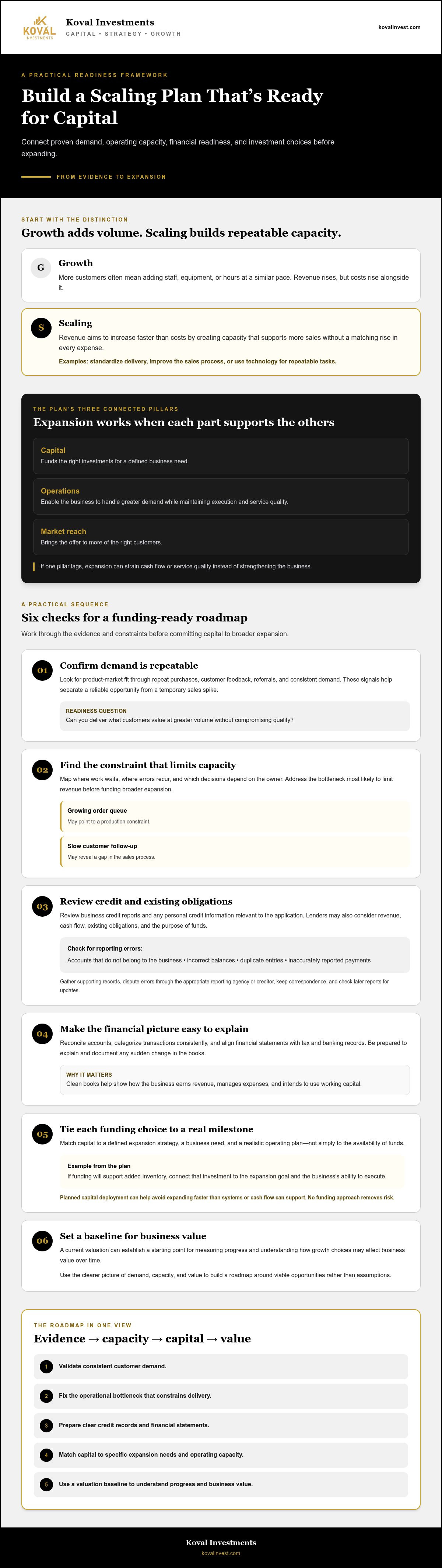
Growth and scaling both move a business forward, but they place different demands on finances and operations. Growth is often linear: serving more customers requires adding staff, equipment, or hours at a similar pace. Scaling aims to increase revenue faster than costs by building capacity to support more sales without a matching rise in every expense. That could mean standardizing delivery, improving a sales process, or using technology to handle repeatable tasks.
A scaling plan is a blueprint for increasing revenue while aligning capital, operations, and market reach. These three pillars need to work together. Capital funds the right investments, operations enable the business to handle greater demand, and market reach brings the offer to more of the right customers. If one pillar lags, expansion can strain cash flow or service quality instead of strengthening the business.
The Core Differences Between Growth and Scaling
Consider a service business that takes on more projects by adding an employee each time demand increases. Revenue may rise, but costs rise alongside it. If the company instead improves scheduling, documents its delivery process, and equips its existing team to serve more clients, revenue may grow faster than overhead. Scaling depends on repeatable capacity, not simply a larger workload.
The need for a new plan becomes clear when the current one no longer explains how to meet demand without creating bottlenecks, weakening margins, or overloading the owner. A standard business plan may describe customers, products, and forecasts, yet leave unanswered how the company will fund added capacity or maintain execution as volume rises. A scaling a small business plan turns those assumptions into staged decisions: what to invest in, what must change operationally, and which market opportunity to pursue first.
Funded growth means matching capital to a defined expansion strategy rather than borrowing simply because funds are available. Tie each investment to a business need and a realistic operating plan. No funding approach removes risk, but planned capital deployment can help owners avoid expanding faster than their systems or cash flow can support.
Assessing Your Current Scaling Readiness
Start with evidence of product-market fit. Review repeat purchases, customer feedback, referrals, and the consistency of demand. These signals help distinguish a reliable market opportunity from a temporary sales spike. Before committing capital, identify what customers value and whether the business can deliver it at greater volume without compromising quality.
Next, map operational constraints. Track where work waits, where errors recur, and which decisions depend on the owner. A growing order queue may point to a production constraint, while slow follow-up may reveal a sales-process gap. Address the bottleneck most likely to limit revenue before funding broader expansion.
A current valuation can establish a baseline for measuring progress and understanding how growth choices may affect business value. Koval Investments’ business valuation services can help owners assess that starting point as they plan future investment. With a clearer picture of demand, capacity, and value, you can build a roadmap around viable opportunities rather than assumptions.
Optimizing the Financial Foundation for Scale
Expansion plans depend on more than a strong sales forecast. Lenders also assess whether a business and, in some cases, its owner present a reliable credit and repayment profile. Credit history can affect which funding options are accessible and the terms a lender may offer. It isn’t the only factor: revenue, cash flow, existing obligations, and the purpose of the funds also matter.
That makes credit readiness a strategic part of scaling a small business plan. Addressing credit concerns before seeking capital can help owners present a clearer financial picture and avoid building an expansion timeline around funding that may not materialize. Professional credit repair can help identify report inaccuracies and organize a response, rather than leaving credit concerns until the application stage.
Leveraging Professional Credit Repair for Capital Access
Start by reviewing business credit reports and any personal credit information relevant to the application. Look for accounts that don’t belong to the business, incorrect balances, duplicate entries, or payments reported inaccurately. Gather supporting records and dispute errors through the appropriate reporting agency or creditor. Keep copies of correspondence and check that updates appear on later reports.
Also review debt obligations against available cash flow. Lenders may consider how existing payments affect the business’s ability to take on additional debt, so don’t assume that a single ratio or score guarantees approval. A structured review can reveal opportunities to address reporting errors, manage outstanding obligations, and strengthen the overall application. Koval Investments’ business credit repair services can make this work part of a deliberate capital-readiness strategy.
Preparing Your Financial Statements for Investors or Lenders
Clean books make it easier to explain how the business earns revenue, manages expenses, and intends to use working capital. Reconcile accounts, categorize transactions consistently, and make sure financial statements align with tax and banking records. If the books show a sudden change, be prepared to explain it with context and documentation.
Strategic planning connects those records to the expansion goal. If funding will support added inventory, for example, the plan should show how the purchase relates to expected sales, cash needs, and repayment timing. Financial statements that reflect the company’s actual performance give a lender a stronger basis for assessing the proposal than an unsupported growth forecast.
SBA lenders review applications under the requirements of the relevant loan program and lender. The SBA Loans for Small Business Funding page outlines available programs. Applicants should be prepared to explain their financial position, repayment capacity, and intended use of funds. Koval Investments provides SBA loan assistance to help business owners organize a funding strategy around those needs.
Credit readiness and reliable financial records work together. Owners planning their next financing step can explore Koval Investments’ credit repair and funding strategy support as part of preparing for growth.
Funding the Plan: Comparing Capital Procurement Strategies
Capital should fit the job it needs to do. A term loan may suit a defined, long-lived investment, while working capital can address a shorter-term need such as purchasing inventory ahead of a busy period. Look beyond the amount available: compare the cost of capital, repayment structure, timing, eligibility, and how repayments could affect cash flow if sales take longer than expected to increase.
Traditional bank loans can offer structured repayment terms, but approval depends on the lender’s review of the business, its credit profile, and its ability to repay. Other funding can be structured differently and may address needs that don’t align neatly with a conventional loan. Costs and repayment conditions vary, so review the full agreement before committing. For a scaling a small business plan, choose an option that supports a specific growth lever without placing unnecessary strain on day-to-day operations.
The Power of 0% Interest Funding Solutions
When the structure fits the business, 0% interest funding can be a source of capital for scaling. It may help fund planned marketing campaigns, inventory purchases, or other growth activities without the interest expense associated with an interest-bearing loan. The exact terms matter, so assess repayment obligations and any conditions alongside the headline rate. Koval Investments’ 0% interest funding solution can be considered as one option within a broader capital strategy.
Zero-interest capital may help preserve cash flow during the scaling phase by avoiding interest charges, leaving more operating cash available for payroll, inventory, and other business needs. It doesn’t remove repayment obligations or the risk of an investment underperforming. Match the funding to a clear use and track whether the investment produces the expected business result.
When evaluating any funding, distinguish the funding’s terms from the fees and terms of the services involved in arranging it. Review the full details before deciding, and consider how the proposed capital fits your operating plan and repayment capacity.
SBA Loans vs. Working Capital: Which Fits Your Plan?
SBA 7(a) and 504 loans can support different long-term expansion needs. The 7(a) program offers a broad loan framework for eligible business purposes, while 504 financing is associated with major fixed assets such as real estate or equipment. The SBA’s program information can help owners compare uses and requirements. Koval Investments provides SBA loan assistance to help business owners consider funding options for their plans.
Working capital may be a better fit for a near-term opportunity, such as replenishing stock to meet confirmed demand. By contrast, financing a facility or major equipment purchase with short-term funds could create repayment pressure before the investment has time to support revenue. Match the capital’s duration and repayment demands to the useful life and timing of the growth lever.
Before choosing, write down the planned use, expected business benefit, repayment source, and fallback if results are slower than forecast. Koval Investments can help align capital procurement with strategic planning through funding strategy and advisory services.
Strategic Advisory: Building a Scaling Roadmap with Exit Value in Mind
Expansion is not valuable simply because a business gets larger. The quality of growth matters: stronger margins, dependable revenue, capable management, and processes that can operate without constant owner intervention can all contribute to a more resilient business. A scaling roadmap should consider both what growth may deliver now and how it could affect future business value. A valuation provides a benchmark for that conversation, not a promise of a particular sale price.
Without that broader view, owners can fall into the over-scaling trap: adding locations, people, or debt faster than demand and operations can support. Strategic planning can help test assumptions, prioritize investments, and set review points so owners can adjust before expansion creates unnecessary strain. That discipline keeps the scaling plan connected to the company’s financial position and possible long-term transition.
Integrating Mergers and Acquisitions into Your Scaling Plan
Acquiring a business can add customers, capabilities, or market access more quickly than building them from scratch. But the purchase price is only one part of the decision. Assess how the target’s revenue, costs, customer relationships, operations, and outstanding obligations fit with your company, then plan for integration. Koval Investments’ M&A consulting can help owners evaluate strategic fit and work through the acquisition process.
Working capital may support eligible acquisition-related business needs, such as maintaining normal operations during a transition, but it should not be treated as a substitute for a complete acquisition financing strategy. Using working capital for a business acquisition requires careful alignment between the funds’ intended use, repayment demands, and expected benefits. Owners considering acquisition-led growth can also include Koval Investments’ capital procurement services in the funding plan.
Think about exit value during expansion, not only when preparing to sell. Document processes, reduce dependence on individual owners, and monitor the performance of acquired operations. These steps can make the business easier to assess and transition while also supporting day-to-day execution.
The Importance of Regular Business Valuations
A valuation can serve as one KPI for scaling success, alongside revenue, profitability, cash flow, and customer retention. Compare valuations over time using consistent assumptions, and investigate what is driving a change rather than treating a higher estimate as proof that every growth decision worked. Professional valuations can also give potential funders and partners a clearer view of the business’s financial position and growth rationale.
Market conditions and company performance can shift, so revisit strategic priorities when a valuation indicates that expected progress has stalled or risk has increased. A valuation is an informed assessment, not a guarantee of what a buyer or funder will offer. For owners refining a scaling a small business plan around long-term value, Koval Investments’ business valuation and strategic planning services can help connect growth choices with future goals.
Executing the Scaling Plan with Koval Investments
A sound growth strategy needs more than a funding decision. It requires coordinated work across credit readiness, capital procurement, and long-term planning. Koval Investments offers these services to help business owners consider funding options alongside the goals those funds are meant to support.
The firm’s capital services include 0% interest funding solutions, SBA loans, and working capital. Each option serves different needs, so match potential capital sources to the business’s expansion priorities and financial position. Funding has its own terms and obligations. A strategic review helps owners make informed decisions rather than treating capital as an automatic outcome.
Consider the cost and terms of both the funding and related services as part of your decision. Clear expectations help owners assess potential benefits alongside the responsibilities involved, without assuming that financing will be approved or that a growth investment will succeed.
Our Three-Step Approach to Scaling Your Business
Organize the work into three connected steps. Each builds on the last, helping owners prepare before pursuing capital and keep future business value in view.
- Strengthen credit and financial readiness. Review relevant credit information, address inaccuracies, and organize financial records. A clearer financial picture can support funding discussions and help identify issues to address before an application.
- Assess funding options against the plan. Consider 0% interest funding or SBA loans in relation to the intended investment, repayment obligations, and business capacity. Evaluate options that fit the scaling plan rather than assuming every source suits every business.
- Connect execution to long-term value. Use strategic planning to track progress, revisit assumptions, and consider how operating decisions may affect valuation and future exit potential.
This sequence creates a practical structure for scaling a small business plan: improve readiness, align capital with its intended use, and keep strategic outcomes measurable as the business advances.
Why a Strategic Partner Beats a Traditional Lender
A lender primarily evaluates a financing request. A strategic advisor can also help the owner consider how the request fits the broader growth roadmap. That perspective is useful when a business is weighing competing priorities, such as adding capacity, entering a market, or preparing for acquisition-led growth. The aim is to bring financing and strategic planning into the same conversation while keeping the owner’s judgment central.
A clear-eyed assessment can surface questions before they become expensive distractions. If the timeline is aggressive, the funding need is unclear, or operational capacity may limit results, revisit those assumptions before committing. That can mean adjusting the pace or sequence of expansion.
To align capital options with strategic planning, connect with Koval Investments to discuss the next steps for your growth roadmap.
Turn Your Growth Ambition into a Clear Next Step
The next stage of your business doesn’t need to begin with a major commitment. Start by choosing one growth objective, setting a practical milestone, and deciding what evidence will show whether the plan is working. That discipline keeps your scaling a small business plan focused as opportunities and priorities change.
Koval Investments offers 0% interest funding solutions, SBA loan assistance, credit repair, and strategic advisory services. Business valuation and M&A consulting can also help owners consider how today’s growth decisions may shape future options. Funding has its own terms and obligations, so evaluate each opportunity in light of your business’s goals and capacity.
If you’re ready to explore a funding strategy aligned with your growth plans, discuss 0% interest funding and your next scaling steps with Koval Investments. Start with a clear objective and a plan that fits your business.
Frequently Asked Questions
How is scaling a business plan different from a startup business plan?
A startup plan tests whether a business can establish customers and generate reliable revenue. A scaling plan addresses how an operating business can expand without losing control of costs, service, or cash flow. It should use actual performance as a baseline. For example, an established company can compare customer acquisition costs across sales channels and prioritize expansion where demand and margins are already demonstrated.
What credit score is needed to secure funding for scaling a small business?
There isn’t one credit score that guarantees approval across all lenders and funding options. Requirements can vary with the program, lender, business finances, time in operation, and whether personal credit is considered. Before applying, review relevant credit reports for errors and organize records that explain revenue, debts, and repayment capacity. A stronger credit profile can improve eligibility, but lenders assess the full application.
Can I scale my business using 0% interest funding if I have credit issues?
Possibly, but credit issues may affect eligibility, available terms, or the application process, and no funding outcome is assured. First identify whether a report contains inaccurate information or whether existing obligations are weighing on your profile. Addressing those concerns and preparing clear business financials can help you understand your position before pursuing funding. Koval Investments’ credit repair services help identify and dispute credit report inaccuracies.
How much working capital do I need to begin a scaling phase?
Estimate the amount from your specific expansion budget, not a generic industry figure. List one-time setup costs, added payroll or inventory, and the time between paying expenses and receiving customer revenue. Then build a cash-flow forecast that tests a slower-sales scenario. If a new sales channel takes longer to produce orders, for example, the forecast should show whether the business can still cover routine obligations.
Is an SBA loan the best option for scaling a small business plan in 2026?
Not automatically. An SBA loan may suit a business with a defined financing need and a repayment plan, while another capital source may better match a shorter-term opportunity or different use. Compare the proposed loan’s purpose, repayment obligations, eligibility requirements, and timing with your growth milestones. For major equipment or property needs, assess the relevant SBA program alongside other options rather than choosing by name alone.
How often should I update my scaling plan and business valuation?
Review the plan whenever a major assumption changes, such as a new product launch, a shift in customer demand, or a material cost increase. A quarterly review can help owners spot differences between forecast and actual performance, then adjust budgets and milestones. Consider obtaining an updated valuation when preparing for a sale, acquisition, financing discussion, or major ownership change, since each may require a current view of business value.
What are the biggest risks of scaling a small business plan too quickly?
Moving too quickly can leave a business with costs it can’t support, strained staff, inconsistent customer service, or inventory that doesn’t sell as forecast. Growth can also expose weak processes when more orders arrive than the team can fulfill. Reduce these risks by expanding in stages, setting measures such as delivery times and available cash, and pausing to reassess if performance falls short of the plan.