
0% Interest Business Funding: A Practical Guide for 2026
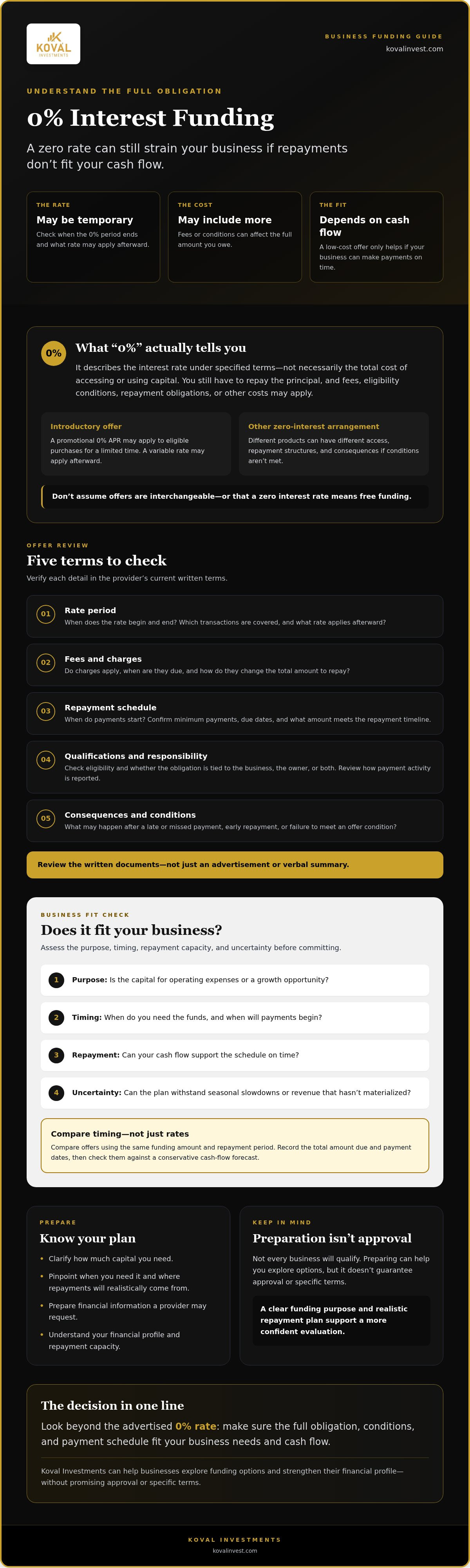
A 0% rate can still strain your business if the repayment schedule doesn’t match your cash flow. That’s the key trade-off when exploring 0% interest business funding: the advertised rate may be temporary, and fees or repayment conditions can affect the full cost.
The appeal is clear. Capital with no interest during a stated period could help cover operating expenses or support a growth opportunity while keeping borrowing costs down. But not every business will qualify, and even a low-cost offer only helps if your business can meet the payments on time.
This practical guide explains what 0% interest business funding can mean, how introductory offers differ from other zero-interest arrangements, and which terms to review before committing. You’ll learn how to compare costs and repayment schedules, test whether payments fit your cash flow, and prepare the financial information a provider may request. Start with a clear funding purpose, a realistic repayment plan, and an understanding of your financial profile so you can evaluate options more confidently.
Key Takeaways
- Understand what “0%” may describe and why the advertised rate doesn’t reveal the full financial obligation.
- Use a checklist to compare the rate period, fees, repayment schedule, qualifications, and consequences in the provider’s current written terms.
- Assess whether 0% interest business funding fits your purpose, timing, repayment capacity, and tolerance for uncertainty.
- Clarify how much capital you need, when you need it, and where repayments will realistically come from. Preparation can help you explore options, but it doesn’t guarantee approval.
- Learn how Koval Investments can help businesses explore funding options and strengthen their financial profile, without promising approval or specific terms.
What Does 0% Interest Business Funding Actually Mean?
0% interest business funding is an arrangement that charges no interest under specified terms, but may still involve fees, repayment obligations, eligibility conditions, or other costs. The phrase describes the interest rate, not necessarily the total cost of accessing or using capital. Review the provider’s written terms to confirm what you’ll owe, when you’ll owe it, and which conditions apply.
The details depend on the product and provider. A promotional rate on a business credit card differs from a loan or another capital product with zero-interest terms. These options aren’t interchangeable: they can differ in how you access funds, how you repay them, and what happens if you miss a payment or don’t repay within a stated period. The general concept of 0% financing can provide context, but the offer’s own disclosures determine its actual terms.
How can business funding have a 0% interest rate?
Some offers set the interest rate at 0% for a defined promotional period. For example, a business credit card may apply an introductory 0% APR to purchases for a limited time, after which a variable rate may apply. Other funding products can have different structures and conditions. Check the offer for its exact duration, eligible transactions, qualification requirements, and post-promotion terms.
Is 0% interest the same as free business funding?
No. A zero-interest rate doesn’t remove the obligation to repay the principal, and it doesn’t mean the funding has no other costs. Depending on the product, charges may apply, including fees or costs tied to specific conditions. Review the disclosures to see what applies to the offer rather than assuming charges are or aren’t included.
Pay close attention to what happens if you carry a balance beyond a promotional period, make a late payment, or don’t meet another condition. The rate or other consequences depend on the offer, so don’t assume every provider handles them the same way.
Before comparing offers, confirm:
- When the 0% rate starts and ends, and which uses of the funds it covers.
- Whether fees or other charges apply, when they’re due, and how they affect repayment.
- The payment schedule, total repayment obligation, and consequences of missed or late payments.
- Whether a later interest rate applies and how it’s calculated.
When considering 0% interest business funding, the practical question isn’t only whether the interest rate is zero. Check whether the full obligation, conditions, and repayment schedule fit your business’s needs and cash flow.
How to Evaluate the Full Terms of 0% Interest Business Funding
The advertised rate alone doesn’t establish the total cost of financing. For a useful comparison, review each offer’s current written terms and consider the full repayment obligation, timing, and consequences, not just the rate shown in an advertisement.
Use the checklist below to organize your review. Labels and conditions can vary by provider, so verify every detail in the actual offer documents.
| Term to check | What to confirm |
|---|---|
| Rate period | When the rate begins and ends, which transactions it covers, and what rate applies afterward. |
| Fees | Whether charges apply, when they’re due, and how they affect the total amount to repay. |
| Repayment schedule | When payments start, the minimum payment, due dates, and the amount needed to meet the repayment timeline. |
| Qualifications | Eligibility requirements and whether the obligation is tied to the business, the owner, or both. |
| Consequences | What may happen after a late or missed payment, early repayment, or failure to meet an offer condition. |
Which terms should a business owner review first?
Start with the rate period, repayment start date, and payment schedule. Then check fees, minimum payments, missed-payment consequences, and any conditions for paying early. Confirm whether the agreement creates a business or personal credit obligation, and how the provider reports payment activity. When written documents are available, use them to verify the terms rather than relying on a verbal summary or general marketing language.
How can you compare funding options fairly?
Compare offers using the same funding amount and repayment period. Record the total amount due and when each payment falls, then compare those dates with a conservative cash-flow forecast. Use realistic revenue assumptions, account for seasonal slowdowns, and don’t rely on sales that haven’t materialized. If a payment plan works only under an optimistic forecast, it may put pressure on operations.
Include relevant alternatives instead of comparing only offers advertised at 0%. For example, the SBA Microloan program may be worth reviewing alongside SBA loans or working capital options. It isn’t automatically a lower-cost fit, so compare current terms, repayment requirements, and eligibility for each option.
A side-by-side review can help you identify which structure aligns with your capital needs and cash flow. If you want support assessing funding options and your financial profile, Koval Investments’ funding support can help you clarify questions and next steps. Approval and terms depend on the provider and applicant.
Does 0% Interest Business Funding Fit Your Business?
A zero-interest offer can still be a poor fit if its payment schedule strains cash flow. The question isn’t simply whether your business can access 0% interest business funding. Consider whether the funding purpose, timing, repayment source, and conditions align with your business’s operating reality.
Weigh the potential benefit, such as reducing interest charges during a stated period, against the constraints. Promotional terms may expire, access may be limited to certain uses, and repayment obligations remain. No funding option suits every business, so assess the offer against your plans and capacity.
When might a 0% offer support a business goal?
A 0% offer may be worth considering for a planned expense when you know when the funds are needed and can identify a realistic repayment source. For example, an owner might map scheduled payments to existing cash reserves or receivables with reasonably predictable timing. That differs from relying on hoped-for sales. Test the plan against conservative cash-flow estimates that account for slower revenue and regular operating costs.
Compare the repayment period with the life of the expense as well. Short-term promotional terms may be a poor match for a long-term project or one with uncertain returns. If repayment depends on a project succeeding quickly, consider what the business would do if it takes longer than planned.
When should a business owner consider another option?
Pause if you can’t name a credible repayment source, cash flow is already tight, or the offer’s key conditions aren’t clear. Uncertainty about when funds will be available or when payments begin can also create a mismatch. A zero rate doesn’t protect your business from missed-payment consequences or a revenue shortfall.
Other capital routes may suit different needs, but each requires its own review. SBA loans and working capital options have distinct terms, eligibility requirements, and repayment structures. Compare the written details rather than assuming one is automatically more suitable. For a broader view of funding paths, see this guide to alternative business funding solutions. If an SBA route may be relevant, review the separate SBA loan assistance guide.
Before deciding, ask whether the funding supports a defined business goal, whether the timing works, and whether payments remain manageable under a conservative forecast. If any answer is uncertain, compare alternatives or revisit the funding plan before committing.
How to Prepare Before Applying for 0% Business Funding
Preparation can help you explain your request clearly and understand what a provider may ask for. It can’t guarantee approval, a particular rate, or access to funding. Requirements differ by provider and product, so confirm the specific application requirements before submitting information.
Use these steps to organize your funding request and identify questions to resolve before applying:
- Define the funding purpose. State what the capital will pay for and how it supports a specific business need. Estimate the amount based on that purpose rather than choosing an amount before you know what the expense requires.
- Set a realistic timeline. Identify when you need the funds and check whether the provider’s application and funding process can meet that timing. Confirm timing directly instead of relying on assumptions.
- Map a repayment source. Identify the business income, receivables, or available cash expected to support payments. Test the plan against conservative cash-flow projections that account for operating costs and slower-than-expected revenue.
- Organize relevant records. Gather current financial statements, cash-flow forecasts, and other records relevant to the request. Check the provider’s list for any additional documentation.
- Review credit information. Check business and personal credit reports where they may be relevant to the specific offer. Note possible inaccuracies and keep documents that support any correction or explanation.
What information should a business organize?
Prepare a concise summary of the funding purpose, requested timing, and planned repayment source, along with current financial records. A clear forecast helps you explain how payments could fit into expected cash flow, while supporting records help you answer follow-up questions consistently. Keep figures aligned across documents, and be ready to explain unusual changes in revenue or expenses.
How does credit readiness affect funding discussions?
Providers may review credit and financial information differently, and exact criteria depend on the offer. Check which reports or records are relevant before applying. If you find a potential reporting error, gather supporting documentation and follow the appropriate dispute process. For more on preparing your credit profile, read this business credit repair and optimization guide.
Before exploring 0% interest business funding, prepare a defined funding purpose, requested timing, current financial records, relevant credit information, a conservative cash-flow forecast, and a realistic repayment source. Having these items ready can make it easier to discuss eligibility and next steps, but only the provider can confirm its requirements and decision. To review your funding goals and financial profile, discuss your funding preparation with Koval Investments.
Explore 0% Interest Funding with a Clear Business Plan
A sound funding decision starts with a defined business goal, not the appeal of a zero-interest rate. Before moving forward, make sure you can explain why you need capital, what the written terms require, how much you’ll repay in total, and whether the payment schedule fits your cash flow. Compare relevant alternatives too. This checklist can help you decide whether 0% interest business funding aligns with your plans or whether another route deserves consideration.
- Purpose: Is the funding tied to a specific business need?
- Written terms: Have you confirmed the rate period, conditions, fees, and consequences with the provider?
- Total obligation: Do you understand the full amount and schedule you may need to repay?
- Repayment fit: Can the business manage payments using realistic cash-flow assumptions?
- Alternatives: Have you compared other funding routes on their own terms?
What can a funding conversation help clarify?
A discussion with a funding professional can help organize your capital objective, timing, financial profile, and repayment considerations. Koval Investments provides capital procurement and financial optimization support to help businesses explore potential funding routes, without guaranteeing a particular option, approval, or terms. Bring specific questions about the provider, eligibility, process, written terms, and any applicable engagement conditions. Clear answers can help you decide what to investigate next.
What should you do next?
Review your records and cash-flow forecast, then write down anything you still need clarified about the proposed offer. Consider whether credit repair or broader financial optimization is relevant to your readiness. If you’re unsure, use a conversation to assess fit and clarify next steps, not as a promise that funding will be available.
Koval Investments helps businesses explore its 0% interest funding solution alongside other capital options. If you’d like to discuss your business goals and funding needs, share what you’re working toward and which questions you want answered. A conversation can help clarify possible next steps, while the relevant provider confirms any specific terms and eligibility.
Make Your Next Funding Decision with Confidence
0% interest business funding can be worth exploring, but the advertised rate is only one part of the decision. Review the written terms, total repayment obligation, and payment schedule, then compare them with a realistic view of your business’s cash flow. If the timing or repayment source remains uncertain, consider other capital options before committing.
Preparation matters too. A clear funding purpose, relevant financial records, and an understanding of your credit profile can help you have a more productive funding discussion. These steps don’t guarantee approval or particular terms, but they can help clarify your needs and next questions.
Koval Investments supports capital procurement and funding exploration, alongside credit repair and financial optimization services. A useful next step is to discuss your goals, financial profile, and potential options, with eligibility and terms confirmed through the relevant provider.
Discuss your business funding goals with Koval Investments and take a measured step toward a funding plan that supports your business.
Frequently Asked Questions
Is 0% interest business funding really interest-free?
It may mean no interest applies under specific terms, but that doesn’t automatically make the funding cost-free. You still need to repay the amount borrowed, and an offer may include fees, conditions, or a rate change after a promotional period. Review the provider’s current written disclosures to confirm which transactions qualify, how long the rate applies, and what other costs or obligations may arise.
Can a startup qualify for 0% interest business funding?
A startup may qualify for some offers, but eligibility depends on the provider and funding product. There isn’t one qualification standard for every option. Providers may review credit or financial information, and some may have requirements a newer business hasn’t yet established. Before applying, check the offer’s criteria and prepare a clear funding purpose, relevant records, and a realistic repayment plan.
How does 0% interest business funding work?
0% interest business funding can refer to different products, so first identify the structure being offered. For example, a business credit card may have a promotional 0% APR for a stated period, while other funding arrangements may have different repayment terms. Check when repayment begins, which uses qualify, whether fees apply, and what happens after the stated period. The provider’s written offer controls the details.
What happens when a 0% interest promotional period ends?
After a promotional period ends, the offer may apply a standard interest rate to any remaining balance. The exact rate and how it applies depend on the provider’s terms. Before using the offer, check the end date, the rate that may follow, and the payment needed to repay the balance on time. Build a repayment plan that doesn’t rely on being able to refinance later.
Does 0% interest business funding have fees?
It can, but fees aren’t the same as interest, and they vary by product and provider. Check the written disclosures for any charges, when they apply, and whether conditions can trigger additional costs. Also account for the amount you must repay and the payment schedule. Don’t assume an offer has no fees just because its advertised interest rate is 0%.
Can business credit affect eligibility for 0% interest funding?
Yes, credit information may affect eligibility, but providers assess applicants differently. Depending on the offer, a provider may consider business credit, personal credit, or other financial information. Confirm what the specific provider reviews before applying. Check relevant reports for possible inaccuracies and keep documentation that supports any dispute or explanation. A stronger, accurate financial profile may help clarify your funding options, but it doesn’t guarantee approval.
Is 0% interest funding better than an SBA loan?
Neither option is automatically better. A 0% offer may have a limited rate period or specific conditions, while SBA loans have separate eligibility, repayment, and cost terms. The SBA generally guarantees a portion of loans made by participating lenders rather than lending directly to businesses. Compare current written terms, total repayment obligations, timing, and fit with your business’s cash flow before choosing a route.