
Alternative Business Funding Solutions: A Strategic Guide for 2026
Securing capital from a traditional bank in 2026 often feels like trying to win a race while wearing a lead vest. You're likely familiar with the frustration of navigating slow approval processes and restrictive credit score thresholds that don't reflect the true health of your operations. It's a common struggle, but it doesn't have to be your reality. As the global alternative lending market expands toward a projected $556.45 billion this year, savvy leaders are turning to alternative business funding solutions to maintain their momentum without the burden of excessive collateral or opaque lending terms.
We believe that access to capital should be a catalyst for growth, not a source of operational stress. This guide will help you discover the most effective capital sources beyond the big banks and show you how to optimize your financial profile for the best possible terms. We'll explore strategic options like 0% interest funding and revenue-based financing, providing you with a clear path to fast working capital and lower interest rates through a more intentional, partnership-focused approach to lending.
Key Takeaways
- Understand how non-depository institutions bridge the "credit gap" left by traditional banks to provide more accessible capital.
- Discover how to evaluate and select the right alternative business funding solutions based on your specific operational needs and growth objectives.
- Understand the mechanics behind 0% interest funding and why it represents the strategic gold standard for business capital.
- Identify the common profile inaccuracies that lead to automatic denials and learn how credit optimization can significantly increase your funding limits.
- Explore the benefits of a success-based advisory model that aligns a consultant's incentives with your long-term business results.
What Are Alternative Business Funding Solutions?
At its core, the term refers to capital provided by non-depository institutions. Unlike traditional banks that rely on customer deposits to fund their lending activities, these alternative financial channels utilize private investment, institutional capital, and specialized credit lines to support growing companies. This distinction is vital because it removes many of the regulatory hurdles that often slow down the funding process. These solutions have evolved from a niche backup plan into a primary strategic tool for owners who prioritize agility and precision over traditional institutional relationships.
The growth of alternative business funding solutions is largely a response to a persistent "credit gap." As the global alternative lending market moves toward an estimated $556.45 billion in 2026, it's clear that traditional banking models haven't kept pace with the needs of modern, fast-moving enterprises. Modern alternative underwriting leverages AI-driven platforms and open banking APIs to analyze real-time data. This allows lenders to evaluate the actual health of your cash flow and operational performance rather than relying solely on static, historical balance sheets. The result is a system characterized by speed of delivery, flexible approval criteria, and specialized structures tailored to specific industry cycles.
Why Traditional Banks Say No
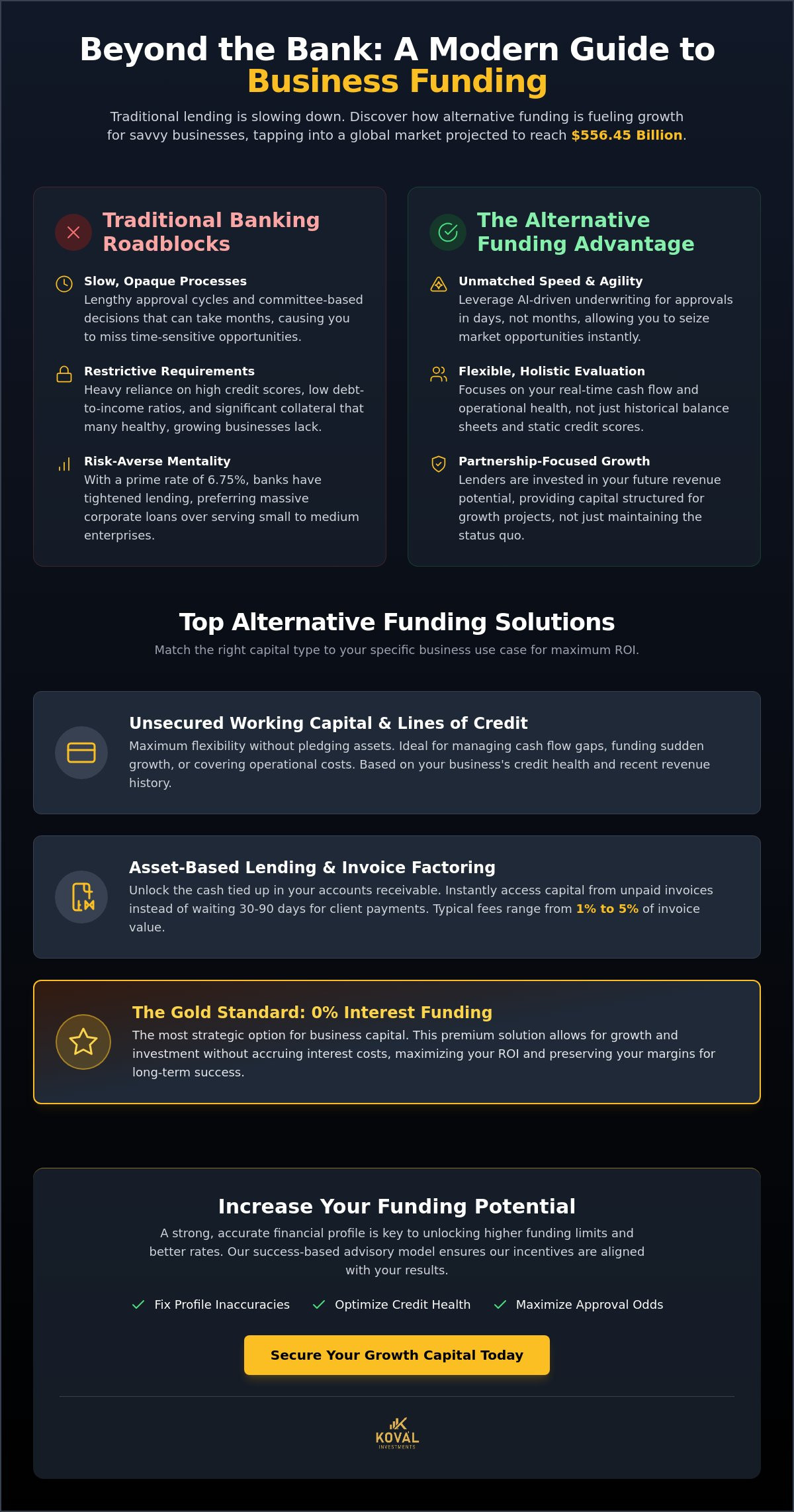
Traditional lenders often operate with a "one size fits all" mentality that doesn't account for the nuances of rapid growth. They frequently lean on restrictive debt-to-income ratios and rigid collateral requirements that can disqualify even profitable companies. This creates the "Small Business Gap," where banks prefer the lower administrative overhead of massive corporate loans over the more detailed attention required by small and medium enterprises. In June 2026, economic volatility and a prime rate of 6.75% have made traditional banks even more risk-averse. They've tightened their credit thresholds, making it difficult for anyone without a near-perfect profile to secure the capital they need to scale.
Alternative vs. Traditional: A Strategic Choice
Choosing between a bank and an alternative lender is often a matter of timing and intent. Alternative capital provides a significant speed-to-market advantage. If you're facing a short-term opportunity, such as a sudden bulk inventory discount or a time-sensitive real estate acquisition, waiting months for a bank's committee to meet isn't feasible. Alternative lenders view risk differently; they're often more interested in your future revenue potential than your past assets. This makes alternative business funding solutions an ideal choice for funding growth-oriented projects without the long-term burden of restrictive bank covenants. It's a partnership focused on momentum rather than just maintaining the status quo.
A Roundup of Top Alternative Funding Options in 2026
The market for alternative business funding solutions is remarkably diverse in 2026. Choosing the right path requires more than just looking for the lowest rate. You need to match the capital type to your specific use case. For example, using a long-term loan for a 30-day inventory gap is inefficient. Conversely, using a high-cost advance for long-term expansion can drain your margins. Successful owners now look at the total cost of capital, which includes factor rates and origination fees, to ensure the investment generates a positive return.
Unsecured Working Capital and Lines of Credit
Unsecured lines of credit offer maximum flexibility because they don't require you to pledge specific machinery or real estate as collateral. These working capital funding solutions rely heavily on your recent cash flow history and business credit health. This approach allows for rapid draws during lean months or sudden growth spurt. While banks are tightening their belts, these alternative lines often provide draw periods that align better with your actual operational cycle.
Asset-Based Lending and Invoice Factoring
For B2B companies, your balance sheet holds hidden liquidity in the form of accounts receivable. Invoice factoring allows you to unlock this value immediately rather than waiting 60 or 90 days for client payments. In June 2026, typical factoring fees range from 1% to 5% of the invoice value per 30 days. It's a powerful tool, but you must decide between recourse factoring, where you remain liable if a client doesn't pay, and non-recourse factoring, which offers more protection at a slightly higher cost. Following SBA funding guidance can help you determine if your assets are better suited for traditional or alternative routes.
Revenue-Based Financing and MCAs
Revenue-based financing is currently the fastest-growing segment in the market, with a predicted CAGR of 27.26% through 2031. This model is built for the digital age, where payments fluctuate based on your daily sales. If you have a slow week, your payment drops proportionally. Merchant Cash Advances (MCAs) operate similarly but are often used for extreme speed. These products use factor rates, typically between 1.20 and 1.50, rather than a traditional APR. If you're unsure which structure fits your current trajectory, consulting with a strategic partner can clarify your best move.
The 0% Interest Funding Solution: A Strategic Premium
While we've explored various alternative business funding solutions that trade cost for speed, there's a specific tier of capital that stands apart as the strategic gold standard. Interest-free capital allows you to scale without the persistent drag of debt service on your monthly cash flow. In an environment where the prime rate sits at 6.75%, accessing capital at zero percent interest isn't just a convenience; it's a massive competitive advantage. This model utilizes strategic credit-based procurement to secure high-limit lines that carry no interest for an introductory period, often ranging from 6 to 18 months.
Savvy 0% interest business funding seekers understand that this isn't a traditional term loan. It's a sophisticated method of leveraging other people's money to fund inventory, marketing, or equipment acquisitions. While SBA-guaranteed loan programs provide vital support for many, they still come with variable rates that can currently reach 13.25%. By contrast, a well-executed 0% strategy preserves your margins entirely during the most critical phases of a growth project.
How 0% Capital is Facilitated
This solution works through a process known as credit stacking. We help you identify and apply for multiple business credit lines simultaneously to maximize your total liquidity. Banks offer these introductory rates to attract high-quality business clients they hope to retain for the long term. The key is managing the transition once the introductory period ends. By then, the capital should've already generated enough ROI to either pay down the balance or transition into a more permanent, low-interest structure.
Who Qualifies for Zero-Interest Capital?
Qualification for this premium tier depends less on your current revenue and more on your credit hygiene. Lenders look for a "fundable" profile, which typically requires a strong personal credit score as the foundation. Because these lines are often unsecured, your personal-to-business credit bridge must be spotless. This means low utilization, no recent late payments, and a history of responsible limit management. Even if your business is relatively young, a pristine credit profile can unlock significant capital that traditional banks would typically reserve for established corporations.
Optimizing Your Profile for Approval and Better Rates
While alternative business funding solutions offer a lifeline when traditional banks hesitate, they aren't a free pass for poor credit hygiene. Many founders mistakenly believe these lenders are "credit-blind." In reality, your credit profile is the primary lever that determines your interest rates and your total funding limit. A lower score doesn't always mean a denial, but it almost certainly means more expensive capital. By treating your profile as a strategic asset, you can shift from high-interest advances to premium, low-cost credit lines that support long-term stability.
Building a robust business credit profile requires a proactive approach. It's about more than just paying bills on time; it's about how your business appears to automated underwriting systems. These systems look for consistency across public records, trade references, and banking data. If your information is fragmented or outdated, you're seen as a higher risk. Strategic optimization ensures that when a lender pulls your report, they see a company that's prepared for the capital it's requesting.
The Power of Professional Credit Restoration
Inaccuracies are surprisingly common in the world of commercial credit. Simple errors, such as an outdated business address or a satisfied lien that still shows as active, can sink an application before a human ever reads it. Utilizing professional business credit repair services allows you to identify and remove these barriers systematically. This process involves more than just disputing errors. It includes strategic profile building to ensure your personal and business credit work in harmony. Credit optimization is the key to unlocking 0% funding.
Financial Hygiene for the Modern Founder
Modern lenders move fast. They expect you to do the same. Having your tax returns and P&L statements organized for rapid underwriting can mean the difference between getting funded in 48 hours or two weeks. Your debt-to-credit ratio also plays a significant role in alternative lending decisions. Lenders want to see that you have room to breathe, not that you're maxed out and desperate. During the initial inquiry, look for partners who utilize a "soft pull" to protect your score while providing a preliminary offer. This allows you to shop for the best terms without damaging the very profile you've worked to build.
If you're ready to see how a polished profile can transform your capital options, contact us today for a comprehensive strategic planning session.
Choosing Your Strategic Funding Partner
In the current financial climate, capital isn't just a commodity; it's a strategic resource. While many "loan mills" focus on high-volume transactions, a true partner looks at how alternative business funding solutions fit into your three-year growth plan. You don't just need a lender who can wire funds; you need a strategic growth consultant who understands the nuances of your industry. This shift from transactional to advisory ensures that your capital acquisition strengthens your balance sheet rather than simply providing a temporary cash infusion.
Our philosophy is rooted in a "win-win" mentality. We believe that a success-based advisory model is the only way to truly align incentives between an advisor and a business owner. Unlike fee-based models that charge upfront regardless of the outcome, a success-based approach means we're equally invested in your approval. It creates a low-pressure environment where our goals are identical to yours: securing the best possible terms with the lowest long-term risk. When your consultant's compensation is tied to your results, you've found a partner who values quality over transaction volume.
Red Flags in Alternative Lending
The alternative market moves quickly, which unfortunately opens the door for predatory practices. One major red flag is "stacking," where a lender encourages you to take multiple high-interest loans simultaneously. This often leads to a debt spiral that can cripple your cash flow and operational flexibility. Transparency is non-negotiable. If a provider can't clearly explain the total cost of capital or how their funding impacts your future valuation, they aren't a partner; they're a risk. You should also be wary of lenders who don't ask about your exit strategy, as the wrong debt structure can complicate a future sale or merger.
The Koval Investments Approach
At Koval Investments, we move beyond the limitations of traditional "brokerage." We guide you through a collaborative journey that begins with Credit Repair Services and ends with strategic capital procurement. While we specialize in our 0% Interest Funding Solution, we also provide comprehensive SBA loan assistance for those requiring larger, long-term structures. This hybrid approach allows you to benefit from the speed of alternative business funding solutions while maintaining the stability of government-backed programs.
We act as your "insider" mentor, navigating the complexities of the 2026 financial landscape alongside you. By combining high-level financial strategy with the day-to-day realities of business ownership, we ensure your business doesn't just survive, but scales intentionally. It's a steady-handed approach designed for founders who value thoroughness and long-term success over quick, superficial wins.
Securing Your Path to Strategic Growth
The transition from traditional banking to alternative business funding solutions represents more than just a change in capital source; it's a strategic evolution for your company. By prioritizing agility, leveraging 0% interest opportunities, and maintaining a fundable credit profile, you position your business to capitalize on market shifts without the drag of restrictive institutional debt. Success in 2026 requires a steady hand and a partner who views your growth as a shared objective rather than a simple transaction.
Since 2018, Koval Investments has acted as a trusted advisor for founders seeking a sophisticated edge. Our comprehensive suite of services, including credit repair and business valuations, is designed to prepare you for the most favorable terms possible. Because we operate on a success-based philosophy, there's no financial risk to you. We're committed to a win-win engagement where our rewards are tied directly to your results. It's time to move beyond the limitations of standard lending and unlock the capital your vision deserves.
Secure your strategic funding consultation with Koval Investments and let's build your financial momentum together.
Frequently Asked Questions
What is the most common alternative business funding solution?
Revenue-based financing is currently the most common and fastest-growing segment of the alternative market. This model allows you to repay capital based on a percentage of your daily or weekly sales, providing a flexible structure that aligns with your actual revenue patterns. While traditional term loans remain popular, the adaptability of revenue-linked payments makes this a preferred choice for businesses with fluctuating cash flows or seasonal cycles.
Can I get alternative funding with a low credit score?
You can secure capital even with a lower credit score because alternative lenders prioritize your business's cash flow and real-time performance over static credit reports. While a lower score might lead to higher factor rates or shorter repayment terms, it doesn't automatically result in a denial. We often recommend using these funds for immediate ROI projects while simultaneously working on profile optimization to unlock better terms in the future.
How fast can I receive capital through alternative lending?
You can typically receive capital within 24 to 48 hours of your application being approved. Unlike traditional bank processes that can take weeks or even months, alternative lenders use AI-driven underwriting and open banking APIs to make rapid decisions. This speed makes alternative business funding solutions an essential tool for owners who need to act quickly on time-sensitive opportunities or manage urgent operational gaps.
Is alternative business funding more expensive than a bank loan?
Alternative capital generally carries a higher total cost than a traditional bank loan in exchange for increased speed and lower qualification barriers. While banks might offer lower APRs, their rigid requirements often make that capital inaccessible to growing companies. You should evaluate the cost of capital against the potential return on investment. If the funding allows you to secure a major contract or inventory discount, the higher rate is often a strategic trade-off.
What is 0% interest business funding and how does it work?
This solution involves securing multiple business credit lines with 0% introductory interest periods, a process often called credit stacking. These periods typically last between 6 and 18 months, allowing you to use other people's money at no cost for growth projects. It's a premium strategy that requires a strong personal-to-business credit bridge, but it represents the most cost-effective way to scale without the burden of monthly interest payments.
Do alternative funding solutions require a personal guarantee?
Many unsecured alternative options require a personal guarantee, though some asset-backed structures do not. A personal guarantee provides the lender with an added layer of security, which is often why they can offer capital without requiring physical collateral like real estate. For businesses with significant accounts receivable or inventory, invoice factoring or asset-based lending can sometimes provide a path to funding that limits personal exposure.
How does credit repair help me get a business loan?
Credit restoration directly impacts your fundability by removing inaccuracies and building a profile that meets higher-tier lending criteria. When your credit report is clean and optimized, you qualify for higher funding limits and significantly lower interest rates. This transition is vital for moving away from high-cost cash advances and into premium products like 0% interest lines, making it a foundational step in any long-term financial strategy.
What documents are required for most alternative funding applications?
Most applications require three to six months of recent business bank statements, your most recent tax returns, and a basic profit and loss statement. Because alternative lenders focus on your current operational health, they prioritize seeing consistent cash flow and revenue trends. Having these documents organized and ready for submission is the best way to ensure a smooth underwriting process and a faster funding decision.