
2026 Guide to Small Business Working Capital Financing
More than half of small businesses that sought financing did so to cover operating expenses, according to the Federal Reserve Banks’ 2026 Report on Employer Firms. But filling a cash gap is only part of the decision. The repayment schedule must also fit the cash flow the funding is meant to support. This guide to working capital financing small business owners can use starts with a practical question: which option meets the need without making future obligations harder to manage?
When payroll, inventory, or routine bills come due before revenue arrives, the pressure is real. It’s also easy to compare financing by headline rates alone and overlook repayment timing, total obligations, and business readiness.
In this 2026 guide, you’ll learn how to identify the timing and type of cash-flow need, compare common financing structures by repayment fit, and prepare a realistic funding plan. We’ll also cover how financial records and credit profile can shape funding readiness. Koval Investments helps business owners consider working capital and SBA loan options in light of their goals and financial profile. A careful comparison helps you understand the obligations before choosing a path.
Key Takeaways
- Separate near-term operating cash needs from long-term asset or expansion plans to clarify what kind of funding to consider.
- Compare a line of credit, term financing, invoice factoring, and SBA-backed financing by repayment pattern, trade-offs, and fit.
- For working capital financing small business owners should estimate when funds are needed and whether projected cash flow can support repayment.
- Prepare by forecasting cash flow, gathering financial records, and reconciling revenue, receivables, payables, and existing debt.
- Koval Investments helps business owners explore capital options in light of their goals and financial profile, with credit repair services to address report inaccuracies.
What Is Working Capital Financing for a Small Business?
Working capital financing is funding a business uses to meet near-term operating cash needs, such as paying employees, buying inventory, or covering supplier bills while revenue is still on the way. It can help manage the timing between cash going out and customer payments coming in. That makes it different from long-term funding intended to purchase major assets or support a large expansion project.
Working capital itself is an accounting measure, commonly calculated as current assets minus current liabilities. It helps show a business’s short-term financial position, but it isn’t the same as cash available in the bank. For a foundational explanation of the concept and its calculation, see What is Working Capital?
Working capital is not profit, and it is not simply the cash balance; it reflects how short-term assets and obligations relate to one another. A profitable business can still face a cash shortage if invoices remain unpaid while payroll and other bills are due. Conversely, having cash today doesn’t necessarily mean the business is profitable or has enough resources to meet upcoming obligations.
What business needs can working capital financing support?
Working capital financing may help cover a specific operating expense when business cash inflows and outflows don’t line up. For example, a retailer may need to purchase seasonal inventory before its busiest sales period. A service business may need to meet payroll while waiting for a customer to pay a large invoice. A company may also need to pay suppliers according to agreed terms before collecting revenue from completed work.
These situations can create temporary pressure even when the business expects revenue to arrive. The useful questions are what expense the funds will cover and how incoming cash is expected to support repayment. Financing is better suited to a defined operating need than to covering losses that continue month after month.
When is a cash-flow gap temporary, or a sign of a deeper issue?
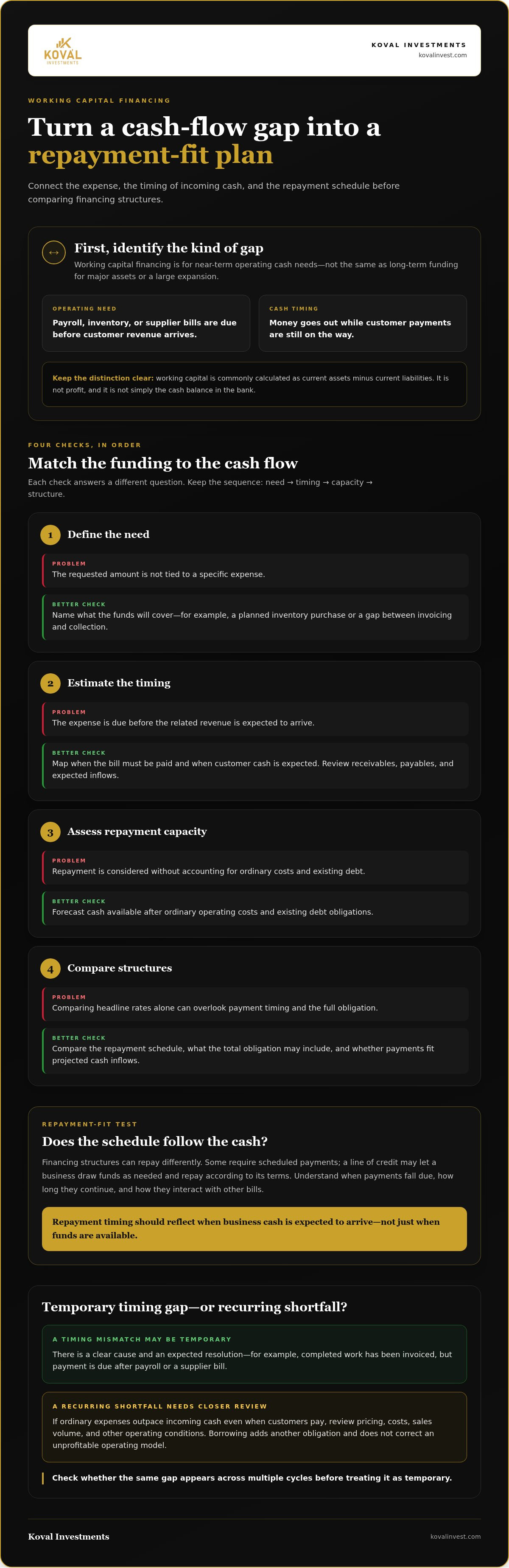
A timing mismatch has a clear cause and an expected resolution. For instance, a business might have completed work and issued an invoice, but the customer’s payment date falls after payroll or a supplier bill is due. If the payment arrives as expected, the gap may be temporary. Seasonal demand can create a similar pattern, with costs rising ahead of a predictable period of sales.
A recurring shortfall calls for a closer review. If the business regularly lacks enough incoming cash to cover ordinary expenses, even when customers pay, the issue may relate to pricing, costs, sales volume, or other operating conditions. Borrowing may provide cash for a time, but it doesn’t correct an unprofitable operating model and adds another obligation to manage.
Before treating a shortfall as temporary, review receivables, payables, and expected cash inflows. Note when customers are likely to pay, when bills are due, and whether the same gap appears across multiple cycles. This can help determine whether working capital financing small business owners consider addresses a timing need or postpones a problem that requires an operational response.
How Working Capital Financing Works: Amount, Timing, and Repayment
Financing decisions become clearer when you connect the amount requested to a specific cash need and a realistic repayment plan. Start by defining the expense, then check when the cash will be needed, estimate how the business can repay, and compare financing structures. Each step helps prevent a short-term gap from becoming a larger obligation than the business can support.
- Define the need. Identify the expense the funds will cover, such as a planned inventory purchase or a gap between invoicing and collection.
- Estimate the timing. Map when the expense must be paid and when related revenue is expected to arrive.
- Assess repayment capacity. Forecast cash available after ordinary operating costs and existing debt obligations.
- Compare structures. Consider how repayment is scheduled, what the total obligation may include, and whether that schedule fits projected cash inflows.
Repayment can follow different patterns depending on the financing structure. Some arrangements require scheduled payments, while a line of credit may let a business draw funds as needed and repay according to its terms. Understand when payments fall due, how long they continue, and how they interact with other bills. Repayment timing should reflect when business cash is expected to arrive, not just when funds are available.
How do lenders and funding sources assess a business?
Funding sources may review revenue patterns, time in business, credit profile, existing obligations, and financial records. These details help show how the business operates and whether projected cash flow can support repayment. No single factor determines every decision. Requirements and terms vary by source and application, so a factor that matters in one review may be considered differently in another.
For example, a business with seasonal revenue can make that pattern easier to understand by showing how sales and expenses change through the year. SBA-backed funding is one option to explore. The SBA 7(a) Loan Program page outlines program information and eligibility, which can help frame a comparison. Eligibility and approval depend on the program and application.
How should owners estimate a responsible funding amount?
Start with documented expenses and the length of the cash gap. Separate the immediate operating need from optional growth spending, then total the expenses the financing is intended to cover. A basic cash-flow forecast can test the plan: list expected receipts and payments by date, include existing debt payments, and add the potential new repayment obligation.
Check whether the forecast still leaves room for ordinary expenses if customer payments arrive later than expected. A working capital financing small business request should be grounded in the amount needed and the business’s capacity to repay, not simply the largest amount available. Koval Investments helps owners consider capital options in light of their goals and financial profile through a guided capital procurement process.
Which Small-Business Working Capital Financing Option Fits?
The right structure depends on the cash-flow problem, not just the amount available. A revolving facility may suit uneven needs, while a fixed borrowing arrangement may fit a known expense. Receivables-based funding connects access to outstanding invoices. Compare how each structure provides funds, how repayment works, and what obligations remain if expected revenue is delayed.
| Option | Possible use case | Repayment pattern | Trade-offs and fit |
|---|---|---|---|
| Business line of credit | Recurring or fluctuating short-term expenses | Draw funds as needed and repay under the facility’s terms; available credit may revolve as amounts are repaid. | Flexible access can help with changing cash needs, but fees, access conditions, and repayment obligations depend on the agreement. |
| Term financing | A defined purchase or one-time operating need | Receive a set amount and repay according to a schedule stated in the agreement. | Predictable scheduled payments can help with planning, but the business owes repayment even if projected revenue arrives late. |
| Invoice factoring | Businesses with unpaid customer invoices | A business sells or assigns eligible receivables to a factoring company for an advance, with the arrangement’s terms determining how collections are handled. | Funding is connected to invoices, not simply general cash flow. The business gives up some control over receivables and must account for the transaction’s costs and obligations. |
| SBA-backed financing | Eligible operating needs or broader financing purposes, depending on the program | Repayment follows the loan agreement made with a participating lender. | Program requirements and application steps can differ from other structures. The business must assess eligibility, documentation, and payment fit. |
Line of credit, term financing, or invoice factoring?
A line of credit offers revolving access, which can suit a business that faces repeat cash-flow swings and wants to draw only what it needs. Term financing provides a fixed borrowing structure that may suit a known expense with a clear repayment plan. Factoring uses outstanding invoices as the basis for funding, which may be relevant when customers pay later than suppliers are due. Costs, eligibility, and obligations depend on the specific terms, so compare total repayment and timing, not access alone.
Merchant cash advances work differently from conventional installment financing. A provider advances funds in exchange for repayment tied to future business receipts, often through an agreed collection method. Because payments may move with sales, the effective cash burden can vary as receipts change. Review how collections are calculated, what happens during a slow period, and the total obligation before deciding whether the structure fits.
When might SBA-backed financing enter the comparison?
SBA-backed loans are made through participating lenders, not directly by Koval Investments. Compare the program’s purpose and application requirements with the business’s funding need, then test the proposed repayment against projected cash flow. Owners considering SBA options can explore this SBA loan assistance guide. For longer-term or asset-related needs, the SBA 7(a) and 504 comparison can help frame further research.
For working capital financing small business owners should weigh the structure against the timing and reliability of incoming cash. Koval Investments helps business owners consider working capital and SBA options in light of their goals and financial profile. The funding source and application determine the available terms.
How to Prepare for Working Capital Financing
A strong funding plan starts before an application. It should show what the money will cover, when the business needs it, and how repayment could fit alongside ordinary expenses. Preparing this information gives you a clearer basis for comparing options and explaining the request. It can also reveal whether financing addresses a temporary need or could add pressure to an already tight cash position.
- Define the use. Name the expenses the funds would cover and separate essential operating needs from optional growth spending.
- Forecast cash flow. Map expected receipts and payments over the period when the funding would be used and repaid.
- Gather records. Organize financial statements, bank activity, receivables, payables, and information about current debt.
- Compare obligations. Review payment timing and total repayment obligations alongside the forecast, not in isolation.
Reconcile the numbers before applying. Match recorded revenue to deposits and outstanding invoices, check that receivables reflect expected collection dates, and confirm upcoming payables and existing debt payments. Then build a conservative forecast that allows for slower customer payments or lower-than-expected receipts. If a new payment would leave too little room for routine costs under that scenario, reconsider the amount or timing instead of relying on an optimistic projection.
Which records help clarify the funding need?
Gather recent balance sheets, income statements, cash-flow statements, and relevant bank activity. Add an up-to-date view of customer receivables, supplier payables, and existing financing obligations. Document the intended use of funds and when each expense is due. Requirements differ among funding sources and applications, so an organized picture supports planning without assuming every source requests identical documents.
How can credit profile and repayment fit affect readiness?
Funding sources may consider business credit, an owner’s credit, or both, and the approach can vary. Review relevant credit reports for inaccuracies before applying, and keep supporting records for any errors you identify. Addressing report inaccuracies may support funding readiness, but it can’t guarantee a particular decision or terms. Owners working through credit-profile concerns can use this business credit repair guide as a starting point.
Use your forecast to test the proposed repayment against a cautious view of incoming cash. Include existing obligations and ordinary operating expenses, then check whether the business can meet payments if revenue arrives later than planned. That stress test can help distinguish a manageable financing plan from one that could deepen a cash squeeze. For working capital financing small business owners should prepare for the full obligation, not only the funds received.
Koval Investments helps business owners consider working capital and other capital options in light of their goals and financial profile. Explore working capital financing support as part of a more informed funding plan.
How Koval Investments Supports Small-Business Capital Procurement
Choosing a funding path involves more than identifying a cash need. Business owners also need to consider how a potential obligation fits their goals, financial profile, and expected cash flow. Koval Investments facilitates access to working capital, SBA loans, and other capital sources, helping owners consider possible pathways and their repayment implications.
What can a capital-procurement conversation help clarify?
A focused discussion can connect the business goal to the timing and scale of the cash need. An owner might be managing a temporary operating gap, planning an inventory purchase, or considering a broader project. Clarifying the purpose helps frame which types of capital may be relevant and what repayment implications deserve attention.
Comparing potential pathways can also make trade-offs easier to see. Owners can consider how a structure aligns with projected cash inflows, what obligations it may create, and whether the funds support an immediate need or a longer-term objective. Koval facilitates access to capital sources and helps business owners evaluate options in light of their circumstances. The applicable funding source conducts its review, and its decision and terms depend on that review and the application.
How can credit optimization complement a funding plan?
A funding plan can include a review of the financial profile, including credit information where relevant. Koval Investments’ credit repair services focus on identifying and disputing inaccuracies in credit reports. Reviewing reports and addressing inaccuracies may support funding readiness, but an improved profile does not guarantee approval, a particular funding amount, rate, or timeline. Credit considerations and their weight can vary by source.
Owners exploring this area can also read Koval’s 0% interest business funding guide for a separate overview of that funding topic. Keep any potential option in context: review its terms and repayment demands against the business’s own financial plan rather than assuming a specific result.
For working capital financing small business owners should approach capital procurement as a considered process: define the business objective, understand the cash-flow need, and compare potential obligations against a realistic forecast. Koval Investments facilitates access to capital options while taking the business’s goals and financial profile into account. The funding source makes the lending decision, and eligibility and terms depend on its review.
If you’re weighing possible funding pathways, discuss your business funding goals with Koval Investments and take a measured next step toward a plan aligned with your needs.
Make Your Next Funding Decision With Clarity
A funding decision can shape more than the next few weeks of cash flow. Treat it as part of a broader plan: define the business outcome you want, consider how new obligations could affect future choices, and revisit the forecast as conditions change. This turns working capital financing small business owners consider into a deliberate planning decision, rather than a reaction to immediate pressure.
Koval Investments helps business owners consider capital pathways alongside their financial profile and longer-term objectives. The goal is a more informed next step, not a promise of a particular funding decision or outcome.
If you’re ready to discuss how potential funding could fit your plans, discuss your working capital goals with Koval Investments.
Frequently Asked Questions
Can a small business get working capital financing with bad credit?
Possibly, but available options and terms depend on the funding source and the business’s full financial profile, not one credit factor alone. A useful first step is to review relevant credit reports and gather records that show revenue, expenses, and existing obligations. If you find inaccuracies, documenting and disputing them may help address your credit profile. Preparation or credit repair can’t guarantee approval, a particular funding amount, or specific terms.
How much working capital financing should a small business request?
Calculate the documented operating expenses the funds will cover and the period those expenses span. Separate essential costs, such as an upcoming supplier invoice, from optional spending that could wait. Then test potential repayment against conservative cash-flow projections, including existing debt and ordinary bills. For working capital financing small business owners should avoid relying on a universal formula: the appropriate request depends on the actual cash need, forecast, and terms available.
Is a business line of credit better than a term loan for working capital?
Neither option is universally better. A line of credit may suit recurring or variable needs because the business can draw funds as required, subject to the facility’s terms. Term financing provides a defined amount with a structured repayment obligation, which may fit a known expense. Compare access rules, payment timing, total obligations, eligibility, and your cash-flow forecast. A structure that appears flexible can still strain cash flow if repayment terms don’t fit.
Can working capital financing be used for payroll and inventory?
Working capital funding is commonly associated with near-term operating expenses, including payroll and inventory purchases. Whether a particular financing arrangement permits a specific expense depends on its agreement. Before applying, identify what the funds would pay for and when the expense is due. Review the actual use-of-funds terms rather than assuming every financing product allows the same expenses. Clear documentation also helps keep the funding request aligned with the business need.
How quickly can a small business receive working capital financing?
Timing varies with the funding source, application completeness, review process, and the business’s circumstances. An incomplete or inconsistent application may require follow-up, while different sources can have different review steps. Keep financial records accurate and current, reconcile key figures, and write a clear use-of-funds plan to make the application process more organized. Don’t build a cash plan around an assumed funding date; consider how the business would manage if funds take longer than hoped.
Does working capital financing require collateral or a personal guarantee?
Collateral and personal guarantee requirements vary by lender, financing product, and applicant profile. Before proceeding, read the proposed agreement carefully and identify any assets pledged, guarantees required, repayment duties, and conditions that could apply if the business can’t pay as planned. Don’t assume that one funding structure has the same requirements as another. Understanding the obligations in writing helps you assess the business and personal implications before accepting financing.