
Asset-Based Lending for Small Business Cash Flow and Growth
Strong sales don’t always mean cash is available when bills come due. Asset-based lending for small business uses eligible assets, such as accounts receivable, inventory, equipment, or real estate, as collateral for a loan or line of credit. The lender assesses the collateral to determine how much the business may borrow, helping bridge the gap between delivering work and receiving payment.
That timing gap can make it harder to cover operating costs or pursue growth, even when a business owns valuable assets. The right financing structure depends on what the business owns, how it will use the funds, and whether it can meet the lender’s collateral and reporting requirements.
This article explains how asset-based lending works, its benefits and trade-offs, and how it compares with other credit options. You’ll learn how businesses can use asset-backed financing to manage cash flow and support growth, plus what to consider when evaluating funding choices.
Key Takeaways
- Identify which business assets may support borrowing and how lenders assess their eligible value.
- Weigh the flexibility of asset-backed financing against collateral requirements and ongoing reporting.
- Match the financing structure to your cash flow cycle, funding purpose, and growth plans.
- Consider how a business valuation can inform funding and strategic decisions.
What is Asset-Based Lending?
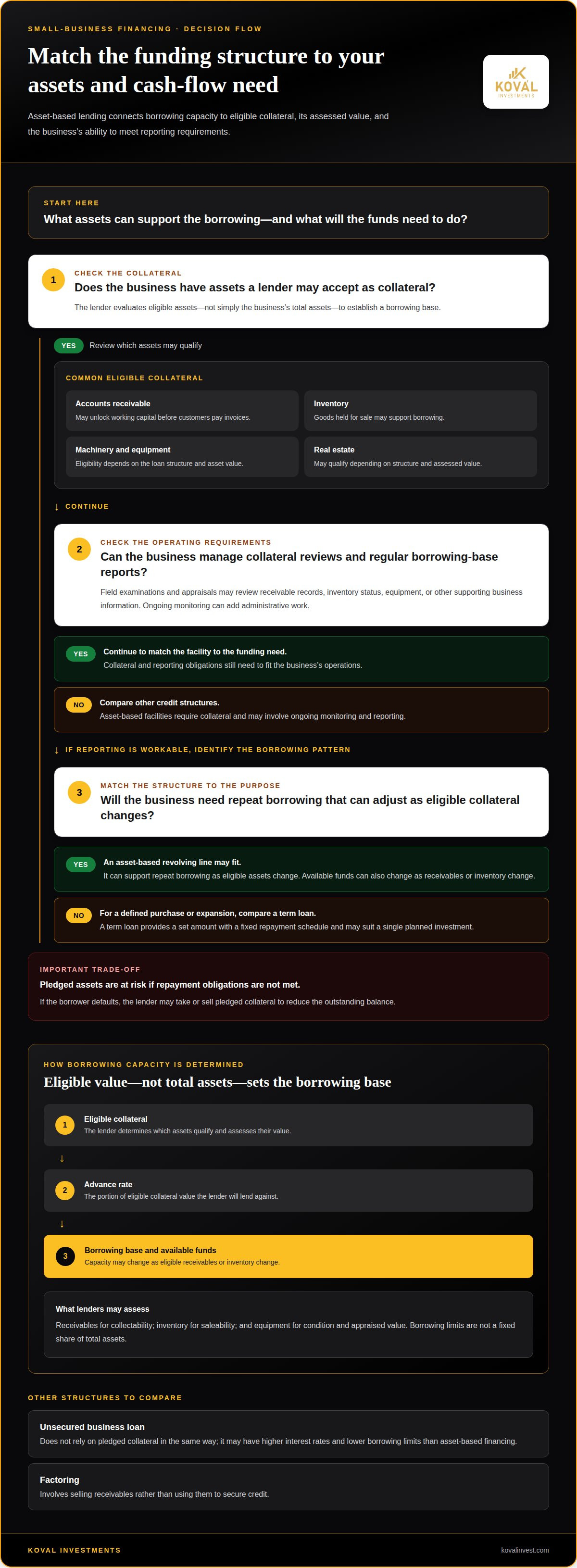
Asset-based lending for small business uses business property as collateral for a loan or revolving line of credit. The lender calculates a borrowing base from eligible assets and sets borrowing capacity according to their assessed value.
Asset-Based Lending Definition
An asset-based loan gives a business access to capital by granting the lender a security interest in specific assets. The borrowing base ties the amount available to eligible collateral, rather than treating all business assets as equally lendable. Check which assets support borrowing and whether the facility is a revolving line or a term loan. If the borrower defaults, the lender may take or sell the collateral to pay the outstanding balance.
Eligible Business Collateral
Common collateral includes accounts receivable, inventory, machinery, equipment, and real estate. Receivables can help a business access working capital before customers pay invoices, while inventory may support borrowing against goods held for sale. Equipment or real estate may also qualify, depending on the loan structure and asset value. Lenders typically assess receivables and inventory closely because eligibility affects the borrowing base.
An advance rate is the portion of eligible collateral value a lender will lend against. The lender assesses receivables, inventory, and equipment separately, considering factors such as collectability, saleability, condition, and appraised value. Eligible collateral value and the advance rate determine borrowing capacity.
Collateral Reviews and Appraisals
Field examinations and inventory appraisals help lenders evaluate which assets qualify and how much borrowing they support. A review may cover receivable records, inventory status, and supporting business information; an appraisal assesses relevant property or equipment. Asset-based loans require collateral and may involve ongoing monitoring, including regular borrowing-base reports. This process can add administrative work to daily operations.
The main risks are pledging assets the business may need and keeping up with reporting as collateral changes. If the borrower doesn’t meet repayment obligations, the lender may take or sell pledged collateral to reduce the outstanding balance.
Loan Rates, Fees, and Borrowing Limits
Because they’re secured, asset-based loans may have lower interest rates than unsecured loans, though rates and fees depend on the structure, collateral review, and monitoring requirements. Borrowing limits aren’t a fixed share of total assets: they reflect eligible collateral values and the lender’s advance rates. As receivables or inventory change, the borrowing base and available funds can change too. Compare repayment terms and reporting demands with the working capital the business needs.
Benefits of asset-based loans
Asset-backed financing can align borrowing with business assets and changing operational needs. Its advantages become clearer when compared with unsecured credit and fixed-term financing.
Comparison With Unsecured Business Loans
An unsecured business loan doesn’t rely on pledged collateral in the same way, but it may carry higher interest rates and offer lower borrowing limits. Asset-based financing may provide greater borrowing capacity when a company has eligible receivables or inventory. The trade-off is that the business pledges collateral and may need to report on it regularly. Consider whether the potential access to working capital justifies those obligations.
Comparison With Term and Traditional Loans
A term loan provides a set amount with a fixed repayment schedule, making it suitable for a defined purchase, such as equipment, or an expansion project. An asset-based revolving line can adjust with eligible collateral and support repeat borrowing as the business’s assets change. This flexibility may help with seasonal cash flow, while a term loan may better match a single planned investment. Compare the funding purpose and repayment structure.
For businesses with growing accounts receivable or inventory, borrowing capacity may grow alongside those assets. That can help cover operating needs before customers pay invoices. A revolving facility also lets a company draw funds as needed rather than taking one fixed amount. However, collateral eligibility and monitoring still matter, so available credit may change as assets change.
In the United States, asset-based commercial lenders and business finance firms offer these loans. Minimum requirements vary, but traditional financing options usually require two years in operation, while an asset-based lender may approve a business with one year; minimum revenue requirements are generally about half those for unsecured loans, though they vary by lender.
If you’re weighing financing structures, compare collateral-based borrowing with SBA loan options against the project’s purpose, repayment needs, and operating cash flow.
Asset-based lending compared with revolving lines of credit
Asset-based lending often takes the form of a revolving line, with collateral determining its borrowing base. A conventional business line may assess creditworthiness and repayment capacity differently.
The better option depends on the funding need. A revolving asset-based line can suit borrowing that adjusts with eligible collateral; a term loan fits a defined investment, while factoring involves selling receivables rather than using them to secure credit.
Suitability for Asset-Rich Companies
Companies with substantial receivables or inventory may find that asset-based credit ties access to capital to their operating assets. As eligible assets grow, borrowing capacity may increase. This can help asset-rich businesses manage working capital when invoice payments lag behind expenses. The key is not total assets alone, but which assets qualify and how their value supports the borrowing base.
Eligibility for Highly Leveraged Companies
Existing debt doesn’t by itself determine whether an asset-based loan fits. Asset-based lenders generally place greater emphasis on collateral coverage than on a proven record of predictable cash flow. A business with significant leverage should understand how eligible receivables and inventory support the proposed funding. Collateral requirements and ongoing asset reporting remain part of the arrangement.
Unlike factoring, asset-based lending lets the business retain ownership of its receivables and use them to secure a revolving line of credit. Factoring involves selling receivables. The distinction is whether the business wants secured borrowing while retaining its invoices, or a sale of those invoices. That choice affects how it accesses capital and manages customer payments.
To qualify, a small business needs eligible assets a lender can assess as collateral, along with the ability to meet the facility’s borrowing-base criteria and reporting requirements. The lender evaluates collateral coverage and value to determine available credit. The right fit depends on the funding purpose, asset quality, and whether a revolving facility or fixed-term loan matches the cash flow need.
Asset-based lending for cash flow management and growth
Asset-backed financing can connect available liquidity to operating assets, helping address timing gaps and fund expansion. Its value depends on matching the collateral, repayment capacity, and use of funds.
Consider a distributor that must pay suppliers before customers settle invoices. A revolving facility secured by eligible receivables can provide working capital in the meantime. The lender determines availability from the borrowing base, while scheduled payments and reporting affect day-to-day cash flow. This structure may support operations without waiting for every invoice to clear.
Receivables eligibility matters to timing. Lenders typically consider accounts receivable less than 90 days from invoice date. Older or ineligible invoices may not support borrowing, which can reduce liquidity even when sales remain strong. A business should model collections alongside payroll, supplier obligations, and debt payments. That forecast shows whether borrowing bridges a temporary gap or covers a recurring shortfall.
Growth plans require a separate assessment. If larger orders increase inventory and receivables, borrowing capacity may move with those assets. A company planning equipment purchases or a facility expansion may instead compare a secured term loan, which provides fixed-term funding. Real estate can also serve as collateral in some structures, with the lender’s assessment of eligible value determining its role.
Before drawing funds, map the cash cycle: expected invoice collections, operating outflows, and repayment timing. Then decide whether a revolving line supports recurring needs or a term facility fits a defined project. Include reporting and collateral monitoring in the operating plan. Asset-based lending is most useful when collateral supports the facility and the business can manage its obligations; it may be a poor fit when assets are limited or repayment depends on uncertain growth alone.
For property-led expansion, consider how real estate investment funding aligns with project plans.
Koval Investments: Business Valuations
Koval Investments offers business valuations to help owners understand their company’s value when weighing financing and growth decisions. A valuation can provide useful planning context, but it doesn’t replace a lender’s assessment of specific collateral, such as receivables, inventory, equipment, or real estate.
Consider this service when you’re evaluating a funding strategy, preparing for a major business decision, or seeking a clearer view of the company’s financial position. That perspective can help frame discussions about potential financing options, including SBA Loans or a 0% Interest Funding Solution, alongside your business goals and repayment needs.
To discuss whether a business valuation fits your planning needs, contact Koval Investments.
Set a Clear Funding Direction
Before pursuing asset-based lending for small business, define the outcome the funding should support. A planned purchase, an operating cash gap, and a growth initiative each call for a different financing approach. Set out the purpose, expected repayment source, and effect on day-to-day operations. This framework helps keep borrowing connected to a practical business objective.
Koval Investments can help business owners consider financing paths aligned with their broader financial position. Its offerings include a 0% Interest Funding Solution, Credit Repair Services, and SBA Loans. The appropriate path depends on the business’s priorities and financing needs, so a focused discussion can help clarify which options warrant consideration.
Bring your goals and key financing questions into the conversation, then take the next step at a pace that fits your plans. Contact Koval Investments to discuss financing and move forward with a clearer direction.
Frequently Asked Questions
How Does ABL work?
Asset-based lending works by linking a business’s borrowing capacity to collateral the lender considers eligible. The lender assesses the assets, establishes a borrowing base and credit limit, then allows the business to request funds within that limit. The borrower grants a security interest in the collateral. Depending on the facility, asset reports and examinations help the lender track changes that could affect available credit.
What are considered assets?
For asset-based financing, assets are business-owned resources a lender may evaluate as security for borrowing. Examples include unpaid customer invoices, goods held for sale, machinery, equipment, and real estate. Lenders assess each type differently. A company’s accounting value alone doesn’t determine borrowing capacity; the lender considers the collateral’s lendable value within the loan structure.
What type of assets do I need to apply?
A business needs assets that a lender accepts as collateral, but there’s no single required combination for every facility. A business relying on invoices may present its receivables, while a company holding goods for sale may use eligible inventory. Lenders may use field examinations or appraisals to assess assets. Organized invoice and inventory records can help clarify what the proposed collateral includes.
Who is ABL Typically a Good Fit For?
Asset-based lending can suit a business with valuable eligible assets that needs working capital before customers pay. For example, a growing wholesaler may have substantial inventory and outstanding invoices while facing supplier expenses. This structure may also suit a company whose collateral offers stronger repayment support than predictable cash flow. It’s less suitable for businesses without assets a lender can use.
What is asset-based lending for small businesses?
Asset-based lending for small businesses is financing secured by company assets. Rather than relying only on cash flow, the lender assesses collateral to determine how much the business may borrow. A small company might use eligible invoices or inventory to support a revolving facility for operating needs. The lender’s collateral assessment, along with the business’s ability to meet reporting and repayment terms, shapes the arrangement.
Which assets can be used as collateral for asset-based lending?
Common collateral includes accounts receivable, inventory, machinery, equipment, and real estate. The lender determines which assets qualify and how their assessed value supports borrowing. For instance, invoices may be evaluated for collectability, while inventory may be reviewed through an examination or appraisal. Receivables and inventory can support working capital, but lender eligibility criteria determine whether specific assets count toward the borrowing base.