
Business Financing for Minority Owners: 2026 Guide
What if the best funding option isn’t simply the one with the lowest rate, but the one your business can qualify for and repay with confidence? Choosing business financing for minority owners can feel difficult when loans, credit, grants, and other forms of capital have different requirements. If your credit history is limited or your records are incomplete, it may be hard to know where to start.
Look beyond the funding amount. The right path depends on what your business needs, its financial profile, its ownership structure, and its capacity to manage repayment. This guide compares financing options, explains what lenders and programs may review, and outlines how to prepare an application strategy for 2026.
We’ll cover SBA loans, working capital, grants, and other funding routes, along with common eligibility factors and the documents to organize before applying. You’ll also see how credit readiness and strategic planning fit into the process. Koval Investments supports business owners with capital procurement, credit repair, and advisory services, bringing funding needs and growth plans into one considered strategy.
Key Takeaways
- Match the funding type to the business need, then weigh repayment obligations against the potential benefit.
- Business financing for minority owners can include loans, credit, grants, or investment, each with its own structure and requirements.
- Evaluate lender underwriting separately from ownership certifications and program-specific eligibility.
- Organize financial statements, tax records, business documents, and ownership information before applying.
- Coordinate capital procurement and credit optimization with your business’s growth plans to build a more focused funding strategy.
Business financing for minority owners: start with the business need
Capital needs vary by business stage, timing, and financial readiness. A startup may need funds before revenue is steady, while an established company may need working capital to bridge a seasonal gap. When considering business financing for minority owners, first define what the money will accomplish, when it’s needed, and how the business can manage the cost.
Financing can mean borrowed capital, such as a loan or line of credit, which must be repaid under agreed terms. Grants generally don’t require repayment, but may come with eligibility, use, and reporting conditions. Investment provides capital in exchange for an ownership stake or another agreed return. Each route has different implications for the business.
Business financing is capital selected for a defined business purpose, based on eligibility, timing, and the company’s capacity to repay or meet other funding terms. Use that definition to focus on fit, not just the amount offered.
What financing can support at different business stages
For each potential expense, consider when the funds are needed, how they may affect cash flow, and what outcome they’re intended to support:
- Startup costs: Cover launch needs before revenue is established. Estimate how long the funds must last and when sales may begin.
- Operating needs: Working capital can help manage routine expenses or gaps between bills and customer payments. Check how repayment would fit alongside ongoing costs.
- Expansion: Funding for added capacity, hiring, or a new market should support a clear growth plan and realistic expectations for future cash flow.
- Equipment: Consider when the asset is needed, how it will support operations, and whether its useful life aligns with the financing timeline.
- Real estate: Property funding is a longer-term business commitment. Assess the purchase timeline, operating impact, and role of the property in the company’s plans.
A written use-of-funds plan helps separate essential needs from optional spending. It also gives you a practical basis for comparing funding structures and repayment obligations.
How minority ownership relates to financing access
Minority ownership may connect a business with relevant networks, technical assistance, or programs, but ownership alone doesn’t guarantee funding, favorable terms, or eligibility. Lenders apply their own underwriting criteria. Certifications and targeted programs may have separate requirements for ownership, control, business size, and documentation. Review each opportunity on its own terms.
The Minority Business Development Agency (MBDA) was established to support the growth and competitiveness of minority-owned businesses, including access to capital and market opportunities. Its resources and service availability can change, so confirm current offerings through official MBDA or government channels before including them in a funding plan. Consider ownership-related support as one possible resource alongside a clear business need and an honest assessment of financial readiness.
Compare financing options for minority-owned businesses
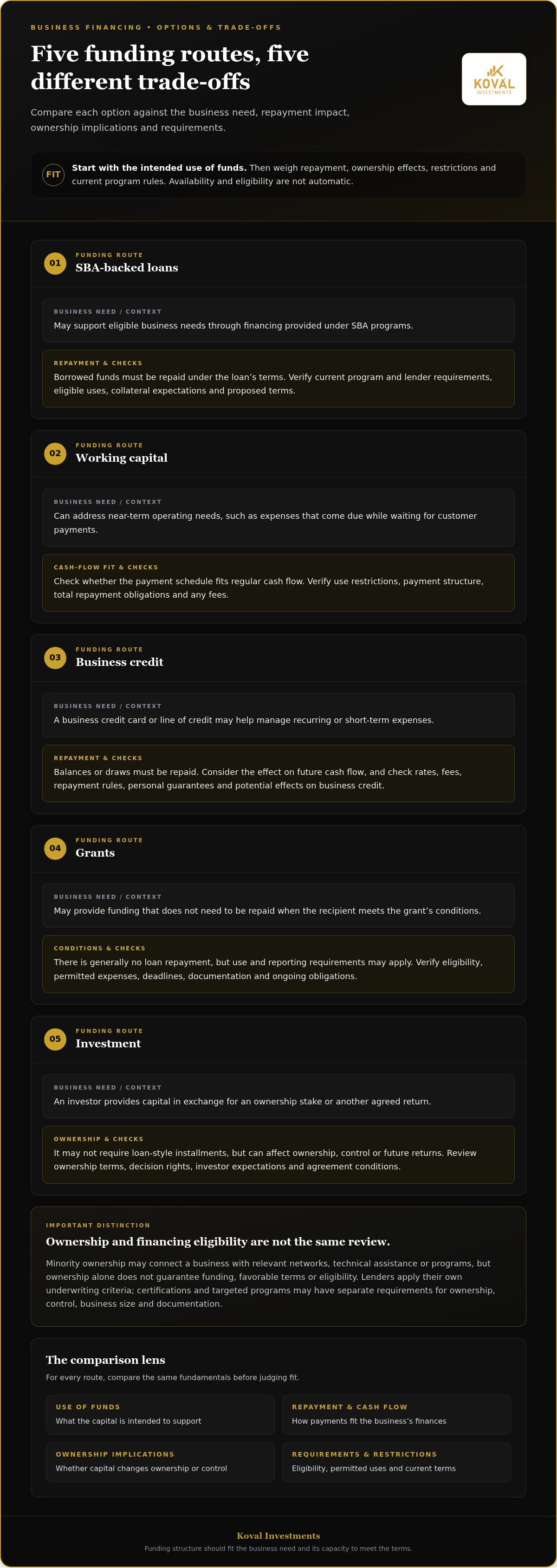
Each funding route has a different structure and effect on cash flow. Start with the intended use of funds, then compare repayment, ownership implications, restrictions, and current program rules. These options may be available to eligible businesses, but none is automatic.
| Option | Potential purpose and structure | Repayment considerations | What to verify |
|---|---|---|---|
| SBA-backed loans | May support eligible business needs through financing provided under SBA programs. | Borrowed funds require repayment under the loan’s terms. | Current program and lender requirements, eligible uses, collateral expectations, and proposed terms. |
| Working capital | Can address near-term operating needs, such as covering expenses while waiting for customer payments. | Check how the payment schedule fits the business’s regular cash flow. | Use restrictions, payment structure, total repayment obligations, and any fees. |
| Business credit | A business credit card or line of credit may help manage recurring or short-term expenses. | Balances or draws must be repaid. Terms vary, so consider how borrowing may affect future cash flow. | Rates, fees, repayment rules, personal guarantees, and how the account may affect business credit. |
| Grants | Funding may not need to be repaid when the recipient meets the grant’s conditions. | There’s generally no loan repayment, but use and reporting requirements may apply. | Eligibility, permitted expenses, deadlines, documentation, and ongoing obligations. |
| Investment | An investor provides capital in exchange for an ownership stake or another agreed return. | It may not require loan-style installments, but can affect ownership, control, or future returns. | Ownership terms, decision rights, investor expectations, and the agreement’s conditions. |
When an SBA loan, working capital, or business credit may fit
Longer-term projects, such as expansion or major equipment purchases, may call for financing that aligns with the project’s timeline. For short-term operating gaps, compare working capital and business credit, paying close attention to repayment timing. SBA-supported financing has program and lender requirements that can change. The Small Business Administration (SBA) resources for minority businesses offer a government starting point for exploring funding and business-growth resources. Koval’s SBA loan assistance guide provides additional context on this financing route.
How to assess grants, investment, and 0% interest offers
Grants differ from debt because they may not require repayment, but are often restricted to certain applicants or uses. Investment exchanges capital for an agreed stake or return. A 0% interest offer also needs careful review: check how long the rate applies, whether fees apply, and what conditions could change the cost. Koval’s guide to 0% interest business funding can help clarify what to examine. For help aligning capital options with business goals, see Koval Investments’ funding strategy support.
Does minority-owned business financing come with special eligibility rules?
Minority ownership may make a business eligible for certain support programs, but it doesn’t automatically qualify the company for a loan, grant, or special terms. Eligibility depends on the specific lender or program. A certification may establish ownership status for a particular purpose, while a lender separately evaluates whether the business can meet the financing terms.
Eligibility for business financing depends on current program rules and the individual business’s ownership, financial profile, funding purpose, and readiness. Treat each opportunity as a separate assessment rather than assuming one qualification applies everywhere.
What lenders may review beyond ownership status
Underwriting criteria vary, but a lender may examine time in business, revenue, credit history, existing debt, available cash flow, and the proposed use of funds. These details help show the business’s financial position and whether its expected cash flow can support repayment.
Both personal and business credit profiles may be relevant, particularly when a company has a limited credit history. A credit issue doesn’t automatically determine the outcome, but reviewing reports and correcting errors can help you understand what an application may show. Organized revenue records, bank statements, financial statements, and a clear explanation of how funds will be used also help present the business’s position.
- Credit: Review personal and business credit information for accuracy and outstanding obligations.
- Cash flow: Be ready to explain how revenue comes in, what expenses are due, and how existing debt affects available funds.
- Business records: Keep financial statements, tax records, and ownership documents consistent and accessible.
- Funding purpose: Tie the requested capital to a specific business need and explain the intended outcome.
Certification and support resources are not loan approval
Certification and financing eligibility serve different purposes. A certification may document ownership or help a business pursue certain contracting or support opportunities. It doesn’t, by itself, satisfy a lender’s underwriting criteria or ensure financing approval.
Programs such as SBA 8(a) have their own eligibility requirements, while the availability and scope of Minority Business Development Agency (MBDA) resources can change. Before relying on either, review current program rules, application details, and service availability through official channels. Support resources may help owners understand requirements and strengthen planning, but they can’t guarantee a lender’s decision.
For business financing for minority owners, keep three questions separate: Does the business meet the lender’s underwriting standards? Does it qualify for a particular certification or program? Do the funding terms fit its cash flow and plans? Answering each independently can help you identify gaps and choose a practical next step.
Prepare a stronger business financing application
A strong application starts with a defined need, not a guess at the largest amount the business might request. For business financing for minority owners, preparation means connecting the request to a specific business outcome and showing how the company can manage the proposed obligations. Organized records help make that case, but don’t guarantee approval.
Build a clear funding request and supporting records
Follow a deliberate sequence, adapting your records to the financing route and the lender’s or program’s requirements.
- Define the need. Identify the expense, when it’s due, and the business outcome it supports.
- Calculate the request. Estimate the amount from documented costs and avoid borrowing beyond the actual need.
- Assess repayment capacity. Use current cash-flow projections to account for revenue, operating expenses, existing debt, and the proposed payment. Test whether repayment still appears manageable if revenue or expenses change.
- Assemble supporting information. Organize relevant financial statements, business tax records, bank statements, formation and ownership documents, and details of existing obligations. Requirements vary by financing route.
- Explain the plan. Prepare a concise business plan, projections, and a clear explanation of how the funds will be used and what result they’re intended to support.
- Review proposed terms. Before accepting an offer, understand the full repayment obligation, fees, payment timing, collateral requirements, and consequences of default.
Review credit and financing terms before committing
Review personal and business credit reports before applying. Look for inaccurate accounts or payment details, and address verified errors through the appropriate reporting process. A limited business credit history may make personal credit relevant to an assessment, depending on the lender and financing structure. Koval’s business credit repair and optimization guide offers further context on preparing a credit profile.
Compare the complete terms, not just the payment amount. Consider total repayment, fees, when payments begin and how often they’re due, collateral or guarantee requirements, and what the agreement says about missed payments or default. Get an explanation of any unclear term before committing.
Application readiness checklist
- The funding purpose and requested amount are tied to specific business needs.
- Financial statements, tax records, business documents, and ownership information are organized.
- Cash-flow projections reflect existing obligations and the proposed repayment.
- Credit reports have been reviewed for errors.
- The proposed terms and potential risks have been examined.
For support aligning credit readiness with a funding plan, explore Koval Investments’ business credit and funding support.
How Koval Investments can support a funding strategy
Once you’ve defined the need, compared funding types, and assessed financial readiness, coordinated support can bring those pieces together. Koval Investments works with business owners on capital procurement and financial optimization, connecting potential funding routes with the company’s current profile and broader objectives. The aim is a considered strategy, not a promise of approval or particular terms.
Align funding support with business goals
Koval’s funding support includes SBA loans and working capital, alongside its 0% Interest Funding Solution. The suitable route depends on the purpose of the funding, the business’s financial profile and repayment capacity, and the terms available for consideration. A 0% interest offer shouldn’t be assumed to apply universally. Review its duration, fees, conditions, and other applicable terms before deciding.
Strategic planning can connect an immediate capital need with longer-term goals. For example, an owner considering expansion can assess how the investment fits projected cash flow and broader growth plans before deciding how to pursue funding. Koval Investments supports business owners through capital procurement, credit repair, and strategic advisory, bringing funding and readiness into the same discussion.
What to prepare before discussing financing
A focused conversation starts with a clear picture of the business. Before discussing options, outline what the funds will support, when they’re needed, and how the business expects to manage repayment. Summarize current revenue, regular expenses, existing debt, and any cash-flow projections that inform the decision. A useful starting point helps identify priorities and questions.
- Purpose: Describe the expense or project the capital would support.
- Timing: Explain when the funds are needed and how that timing relates to the business plan.
- Financial position: Gather current statements, debt details, and cash-flow projections.
- Credit readiness: Note any credit-report inaccuracies or gaps you want to understand.
Koval also provides credit repair services focused on report inaccuracies and financial-profile optimization. This support can be considered alongside capital planning, without treating credit work as a guarantee of funding or a particular outcome. The goal is to understand the business’s position and identify practical next steps.
If you’re ready to discuss your priorities, discuss your business funding goals with Koval Investments. A clear view of your needs and financial position can help make that conversation focused and productive.
Turn your funding priorities into a clear next step
A strong funding strategy starts with a defined business need, then matches it to an option the company may qualify for and manage responsibly. Loans, grants, credit, and investment have different terms and obligations, so compare the full structure rather than focusing only on the amount offered. Ownership status may connect a business with relevant support, but eligibility depends on the specific program and the business’s circumstances.
Before applying, organize financial and ownership records, review credit information, and use current cash-flow projections to assess repayment capacity. These steps can make your financing plan more focused, even though preparation can’t guarantee approval.
Koval Investments provides capital procurement, credit repair, and strategic business advisory. If you’re ready to explore a funding approach that considers both your business goals and financial readiness, discuss a funding strategy aligned with your business goals.
With a clear purpose and practical plan, you can approach business financing for minority owners with greater confidence and make informed decisions about what comes next.
Frequently Asked Questions
Can minority-owned businesses qualify for SBA loans?
Yes, a minority-owned business may qualify for an SBA-backed loan if it meets the applicable program and lender requirements. Minority ownership alone doesn’t determine approval. Lenders may assess the business’s finances, credit profile, time in operation, debt obligations, and intended use of funds. SBA rules can change, so review current requirements and application details before choosing a loan path.
Are there grants for minority business owners?
Yes, grants may be available through government, nonprofit, corporate, or community programs, but each opportunity sets its own eligibility and application rules. Some are designed for particular business types, owners, industries, or projects. Grant funds may also be restricted to specific uses or require reporting. Unlike a loan, a grant generally doesn’t require repayment, but understand its conditions before relying on it in a business plan.
What financing options are available to minority business owners?
Options may include SBA-backed loans, working capital, business credit, grants, and private investment. Loans and credit require repayment under agreed terms, while grants may have restrictions without loan-style repayment. Investment can provide capital in exchange for ownership or another agreed return. The best fit depends on the intended use, timing, cash flow, eligibility, and the business’s willingness to take on debt or share ownership.
Does minority ownership automatically qualify a business for special financing?
No. Minority ownership may connect a business with targeted support resources or programs, but it doesn’t guarantee a loan, grant, preferential terms, or program eligibility. Lender underwriting and program-specific qualifications are separate assessments. A certification may document ownership for a particular purpose, but it doesn’t replace a lender’s review of credit, revenue, debt, documentation, and repayment capacity. Review the current rules for each opportunity you’re considering.
How can I improve my chances of getting business financing?
Start with a specific funding purpose and calculate a request based on the business’s actual need. Organize financial statements, tax records, ownership documents, and relevant bank statements. Use current cash-flow projections to assess whether the business can manage proposed payments alongside existing obligations. Review personal and business credit reports for errors, and prepare a concise explanation of how the funds support business goals. These steps improve readiness, but can’t guarantee approval.
How much financing can a minority-owned business get?
There’s no single amount available to every minority-owned business. Potential financing depends on the selected program or lender, the business’s financial position, the purpose of the funds, and its capacity to meet the proposed terms. Rather than starting with a maximum, document the actual expense and request an amount tied to it. Compare the full repayment obligations or other conditions before deciding whether the funding fits the business.
Can business credit repair help with financing eligibility?
Credit repair may help identify and address inaccuracies in credit reports and support efforts to optimize a financial profile. Koval Investments provides credit repair services focused on report inaccuracies and financial optimization. A more accurate profile may help lenders assess an application, but credit repair doesn’t guarantee eligibility, approval, or particular terms. Review both personal and business credit information, since the relevance of each can vary by lender and financing route.
What should I check before accepting a 0% interest business funding offer?
Review how long the 0% interest period lasts, whether fees apply, and what conditions could change the offer or its cost. Check the total repayment obligation, payment schedule, collateral requirements, and consequences of missed payments. Read the agreement carefully and make sure the terms fit projected cash flow. A 0% interest claim doesn’t mean funding is free or universally available, so assess the complete structure before committing.