
Business Financing for Women Entrepreneurs: A 2026 Guide
The best source of business financing for women entrepreneurs may not be a women-focused program. A grant, loan, line of credit, or investment can serve a different purpose, and the right fit depends on your business’s stage, cash flow, and goals. Start by identifying what the money needs to accomplish, then compare the costs, eligibility rules, and obligations of each option.
This guide will help you compare the main funding routes, understand where women-focused support may be relevant, and prepare a stronger application. You’ll also learn how to assess what the capital needs to accomplish before taking on repayment obligations or exchanging ownership.
We’ll cover grants, SBA loans, working capital, equity, and other financing options, along with their trade-offs. You’ll find practical steps for organizing financial documents, reviewing credit readiness, and matching a funding path to your business’s needs, rather than choosing an option just because it’s labeled for women.
Key Takeaways
- Start by defining what the capital will fund, then size the request around that need and your ability to repay.
- Compare loans, credit lines, grants, and investment by how you’ll use the funds, repayment expectations, and trade-offs.
- Women-owned status alone doesn’t guarantee financing. Distinguish certification requirements from a lender’s eligibility criteria.
- Strengthen your business financing for women entrepreneurs application by organizing financial statements, projections, tax records, and a business plan.
- Align your funding path with your goals and financial profile. Capital procurement and credit-profile preparation can help inform that strategy, but neither guarantees approval or particular terms.
Business Financing for Women Entrepreneurs: Start With the Funding Need
Business financing for women entrepreneurs works best when the capital matches a defined business purpose and the business can manage its repayment or other obligations. Start with the decision the funding will make possible, not with a particular loan or program. A new venture may need funds to open its doors, while an established company may need to bridge a seasonal cash-flow gap or buy equipment to support planned growth.
A grant generally provides funds that don’t require repayment; a loan provides capital repaid under agreed terms; credit-based financing lets a business access funds up to a limit and repay what it uses. Each option has different eligibility requirements, obligations, and costs. Compare them based on what the business needs, when it needs it, and what its finances can support.
Which business milestones may require financing?
At startup, a founder may need to budget for initial inventory, supplies, technology, licenses, or the cost of preparing a workspace. If the business doesn’t yet have operating revenue, the funding plan should account for setup expenses and the time it may take to generate dependable cash flow.
An operating business may need working capital to cover routine expenses while customer payments arrive, or financing for a specific growth move. That could mean hiring staff, purchasing inventory ahead of a busy period, upgrading equipment, entering a new market, or acquiring another business. These needs aren’t interchangeable. Short-term cash-flow support, for example, serves a different purpose from capital for a long-lived asset.
Before researching options, write down the intended use, estimated amount, timing, and expected business benefit. A defined use helps narrow the search and makes it easier to explain how the funds fit the company’s plans. It also gives you a practical way to assess whether the expected benefit and repayment schedule make sense together.
What does women-focused business support mean?
Women-focused support can mean several things, and not all of it provides capital. Certifications may help eligible businesses access particular contracting opportunities. Mentoring and business counseling can offer guidance or help owners strengthen their plans. Grants and loans are funding sources, each with its own criteria and application requirements.
These resources can complement mainstream financing rather than replace it. A woman-owned business can explore general lending, working capital, and other funding routes while researching targeted programs that fit its ownership, size, industry, stage, and intended use of funds. Women-owned status alone doesn’t guarantee a grant, loan approval, or favorable terms.
Before investing time in an application, review the program’s current rules through the official organization administering it. Confirm who qualifies, what expenses the funds may cover, what documents are needed, and whether the opportunity is a grant, loan, certification, or advisory support. Requirements differ by program and may change, so use current official guidance rather than an old summary or a program label.
This first step turns a broad search into a funding plan. Once you know the purpose and constraints, you can compare options based on fit, preparation, and the effect each may have on cash flow.
Compare Financing Options for Women-Owned Businesses by Purpose
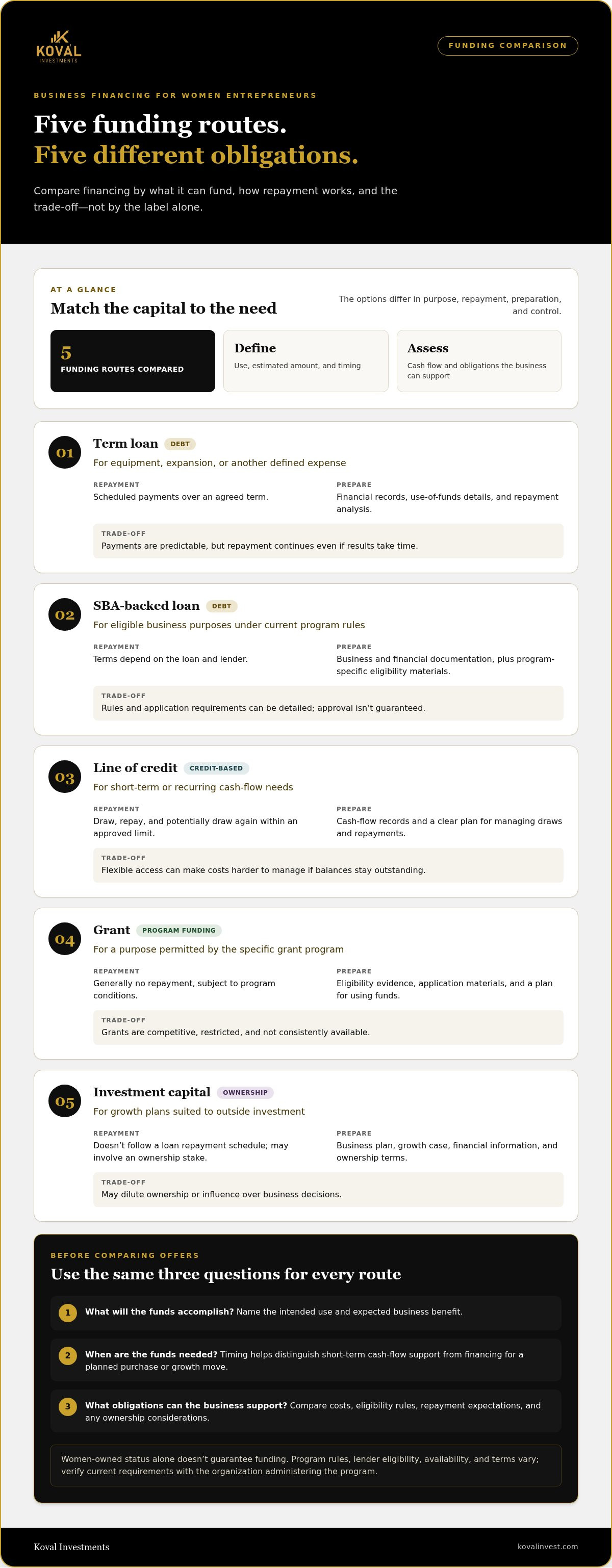
Once you’ve defined the business need, compare capital by how it works, not just by the amount available. A term loan may suit a planned purchase with a clear repayment horizon; a line of credit may help manage recurring cash-flow swings. Grants and investment capital work differently from debt, with their own restrictions or ownership considerations. Rates, terms, qualification criteria, and availability vary by lender and program.
| Option | Purpose | Repayment structure | Typical preparation | Key trade-off |
|---|---|---|---|---|
| Term loan | Equipment, expansion, or another defined expense | Scheduled payments over an agreed term | Financial records, use-of-funds details, and repayment analysis | Predictable payments, but repayment continues even if results take time |
| SBA-backed loan | Eligible business purposes under current program rules | Repayment terms depend on the loan and lender | Business and financial documentation, plus program-specific eligibility materials | Rules and application requirements can be detailed; approval isn’t guaranteed |
| Line of credit | Short-term or recurring cash-flow needs | Draw, repay, and potentially draw again within an approved limit | Cash-flow records and a clear plan for managing draws and repayments | Flexible access can make costs harder to manage if balances stay outstanding |
| Grant | A purpose permitted by the specific grant program | Generally no repayment, subject to program conditions | Eligibility evidence, application materials, and a plan for using funds | Competitive, restricted, and not consistently available |
| Investment capital | Growth plans suited to outside investment | Doesn’t follow a loan repayment schedule; may involve an ownership stake | Business plan, growth case, financial information, and ownership terms | May dilute ownership or influence over business decisions |
When might debt, a grant, or investment capital fit?
Debt is repayable capital, so test the expected payment against realistic cash flow, including slower sales periods. A grant may reduce repayment obligations, but it comes with program-specific purposes, eligibility rules, and application requirements. Investment capital can support a growth plan, but understand the ownership and decision-making implications before accepting it. Compare the full obligation, not only the amount of money received upfront.
How do SBA programs and mission-focused lenders fit?
SBA-backed financing is provided through participating lenders and remains subject to current SBA program rules and lender underwriting. CDFIs are mission-oriented financial institutions, but their products and criteria vary, so review current official information. SBA Women’s Business Centers offer counseling and support, not a funding guarantee. The SBA’s resources for women-owned businesses can help you explore available support.
For a closer look at SBA financing and its application considerations, read this SBA loan assistance guide. A clear comparison can help you assess business financing for women entrepreneurs without assuming a women-focused label is the best fit. Koval Investments provides capital procurement support to help business owners evaluate funding paths in light of their needs and financial readiness. Approval and particular terms aren’t guaranteed.
Address the Biggest Concern: Does Women-Owned Status Guarantee Funding?
No. Women-owned status alone doesn’t guarantee a grant, loan, financing approval, or favorable terms. A lender evaluates the application against its underwriting standards and the requirements of any relevant program. Treat ownership status as one possible eligibility factor, not a substitute for a clear funding purpose, financial records, or repayment capacity.
Certification may establish eligibility for specific opportunities; it is not a financing product and does not guarantee lender approval. Keeping these processes separate helps you avoid assuming that certification automatically qualifies your business for a loan or grant. The rules for each program still apply.
What can women-owned certification do, and what can it not do?
Certification can matter for certain contracting opportunities and targeted support. For example, SBA Women-Owned Small Business certification is intended for eligible businesses seeking access to specified federal contracting opportunities. As of October 2026, the SBA’s WOSB criteria include at least 51% ownership and control by women who are U.S. citizens, plus meeting applicable small-business size standards. Requirements can change, so use current SBA guidance when assessing eligibility.
Certification doesn’t itself provide capital. It also doesn’t replace the separate requirements for a lender, grant, or other funding program. Before applying, confirm what the opportunity offers and which criteria apply. Some programs provide training or mentoring rather than funds. Others may offer capital but restrict eligibility or how recipients can use it.
How can business and personal credit affect an application?
Lender requirements differ. Depending on the financing and business profile, an application may be assessed using business credit, an owner’s personal credit, or both. Lenders may also review cash flow, time in business, collateral, existing obligations, and the company’s ability to repay. Strong credit alone doesn’t ensure approval, but unresolved reporting errors can complicate a review.
Before submitting applications, review relevant credit reports for inaccurate accounts, balances, or payment history. Keep supporting records for any errors you identify. Koval Investments provides credit repair services that focus on identifying and disputing credit-report inaccuracies. This work may support financial readiness, but it doesn’t guarantee approval or particular financing terms. This business credit repair guide explains why careful review can be part of funding preparation.
Women-focused funding resources can still be worth exploring, but review each program’s current purpose, rules, and application details. The small business grants for women overview can help you identify opportunities to research. Treat each listing as a starting point and verify requirements with the organization offering the grant. For business financing for women entrepreneurs, consider relevant certification while evaluating the business against the criteria for the specific capital source.
Prepare a Stronger Financing Application With a Practical Readiness Plan
A clear application connects the business need to the requested capital, supporting records, and a realistic repayment plan. Preparing these elements before applying helps you spot missing information and compare options on consistent terms. Use this sequence to turn a broad search for business financing for women entrepreneurs into a focused funding request.
- Define the use. State what the capital will pay for and how the expense supports business operations or growth. Separate one-time costs from recurring needs.
- Calculate the request. Build the amount from documented expenses, expected timing, and a reasonable contingency. Avoid requesting an unexplained figure or borrowing more than the plan requires.
- Organize records. Gather financial statements, cash-flow information, projections, tax records, a business plan, ownership details, and operating history. Make sure figures and dates are consistent across documents.
- Review credit. Check relevant business and personal credit reports for errors, and gather records that support any corrections. Understand current debts and payment obligations before assessing additional financing.
- Compare options. Evaluate potential payments, repayment periods, fees or other costs, collateral requirements, and conditions. Requirements vary, so prepare to tailor documents to each lender or program.
What information should an entrepreneur organize?
Make the funding request easy to follow: document the amount, intended use, timing, and expected business impact. Organize current financial statements, tax records, cash-flow projections, a business plan, ownership information, and a concise history of operations. If the request supports a purchase or expansion, include relevant estimates or planning details. Lender and program documentation requirements differ, so treat this file as a preparation base and then match it to the specific application.
How can founders assess affordability before applying?
Compare expected payments with dependable cash flow, not an optimistic sales forecast. Include existing debt, payroll, rent, inventory, taxes, and other operating obligations in the same view. Then test a slower-sales scenario or delayed customer payments. If repayment becomes difficult under modest pressure, revisit the amount, timing, or funding structure before taking on a new obligation.
Review the full terms, including how payments are calculated, when repayment begins, and what conditions apply. A lower initial payment may not tell the whole story if the balance or total obligation changes over time. Koval Investments’ alternative business funding guide can help you consider options beyond conventional loans as part of that comparison.
Preparation also helps protect flexibility. Keep a short summary of your assumptions and the records behind them, so you can explain how the request fits the business plan. Koval Investments provides capital procurement support to help assess funding paths in relation to your goals and financial readiness. No preparation can guarantee approval or particular terms, but a well-supported request gives decision-makers a clearer picture of the business case.
Build a Funding Strategy With the Right Capital Partner
A useful funding strategy connects four decisions: what the capital will support, which type of financing fits that purpose, how the business’s financial profile may affect its options, and whether repayment fits expected cash flow. Looking at these factors together can help you avoid choosing financing based only on an advertised feature or funding label. The goal is a path that supports business progress without placing unnecessary strain on operations.
Koval Investments provides capital procurement support to help business owners evaluate funding pathways, including SBA loans, working capital, and 0% interest funding solutions. A 0% interest option may suit some businesses, but qualification, availability, and applicable terms depend on the funding opportunity. No funding amount, approval, or particular terms are guaranteed. Consider the full structure and obligations of any option before deciding how it fits your plan.
How can funding and credit preparation work together?
Accurate financial records and credit reports can help create a clearer picture of funding readiness. Review reports for errors, organize current business financials, and understand existing debt and payment obligations. This preparation can help you identify questions to resolve and present your financial position consistently. It doesn’t guarantee approval or favorable terms, but it supports a more informed funding discussion.
Koval Investments’ credit repair services focus on identifying and disputing inaccuracies in credit reports. This work can be one part of a broader preparation process alongside capital procurement and financial optimization. It doesn’t promise a score increase, approval, a specific funding amount, or a particular timeline. It addresses reported inaccuracies and helps inform the assessment of possible funding paths based on the business’s circumstances.
What should the next step look like?
Start with a short funding brief. Note your business stage, intended use of funds, target timing, and estimated amount. Add a concise view of revenue patterns, existing obligations, and any credit or documentation issues you’re already addressing. This gives a capital partner a practical starting point for considering which paths may align with your goals and repayment capacity.
Koval Investments can help evaluate capital options and relevant financial preparation as part of a tailored procurement process. The right route may involve one source of capital or a comparison of several, depending on the intended use, financial profile, and available terms. Take time to understand the obligations before moving forward. A considered plan is more useful than a rushed application.
If you’re ready to discuss your business’s needs, stage, and intended use of capital, Discuss your business funding goals with Koval Investments.
Make Your Next Funding Decision With Confidence
Your financing plan doesn’t have to be permanent. As your business changes, revisit whether the capital still supports your priorities and whether its obligations fit your operating plans. Set a regular review point, especially before a major investment or shift in direction. That gives you room to adjust thoughtfully instead of making financing decisions under pressure.
Approach business financing for women entrepreneurs as part of the company’s broader growth strategy. A useful next step could be refining your funding goals, organizing the questions you want answered, or assessing how a potential financing decision fits your longer-term plans.
Koval Investments can work with you to evaluate funding pathways and financial readiness in relation to your business goals. Discuss a funding strategy for your business and take the next step with a plan built around where you want the business to go. Progress starts with a clear purpose and a considered decision.
Frequently Asked Questions
Are there grants specifically for women entrepreneurs?
Yes, some organizations offer grants for women entrepreneurs, but each opportunity sets its own eligibility rules, permitted uses, deadlines, and application process. Treat a grant listing as a lead to investigate, not a promise of funding. A grant might support a defined business purpose or a particular founder group. Confirm current details with the organization administering it, and consider grants alongside other business financing for women entrepreneurs.
Can a woman-owned business qualify for an SBA loan?
Yes. A woman-owned business can apply for SBA-backed financing if it meets the applicable SBA program rules and lender requirements. As of October 2026, the research for this guide reports that SBA loan eligibility requires all business ownership to be held by U.S. citizens or nationals. A lender also reviews the application, so ownership alone doesn’t establish eligibility or ensure approval. Check current SBA guidance before applying.
What is the difference between women-owned certification and a business loan?
Certification verifies that a business meets defined ownership and control criteria for specified opportunities; a loan is capital that the business borrows and repays under agreed terms. Certification may be relevant when pursuing certain contracting opportunities, while a loan application focuses on program rules and repayment assessment. They serve different purposes. Pursuing certification doesn’t replace a separate financing application or determine its outcome.
How can women entrepreneurs improve their chances of financing approval?
No preparation can ensure approval, but a well-supported application can make the business case easier to assess. Reconcile accounting records with bank activity, explain unusual changes in revenue, and account for current debt in cash-flow projections. If the business has seasonal sales, show how it manages slower periods. Apply for an amount tied to a specific plan, and make sure every figure and supporting document tells a consistent story.
Can a startup get business financing without revenue?
Possibly, but having no revenue can narrow the financing paths available and make evidence of future repayment more important. A startup may need to show a credible operating plan, realistic projections, founder investment, purchase orders, or other evidence relevant to the specific funding source. Grants and investment capital have different criteria from debt. Before applying, estimate when revenue may begin and how the business will meet obligations if sales take longer than planned.
Is 0% interest business funding available to women entrepreneurs?
Potential 0% interest funding solutions may be available, but access depends on qualification and the applicable terms. The label alone doesn’t establish the total cost or repayment conditions. Review the written offer carefully, including any fees, repayment schedule, and conditions that could affect the cost. Koval Investments facilitates access to 0% interest funding solutions, but eligibility, approval, funding amounts, and terms aren’t guaranteed for any applicant.
What documents are commonly needed to apply for business financing?
Requirements differ, but an application may request recent business tax returns, profit-and-loss statements, a balance sheet, bank statements, cash-flow projections, and details of existing debts. Lenders or programs may also ask for formation records, ownership information, customer contracts, or vendor estimates tied to the requested funds. Keep digital copies clearly labeled by period, and check that dates and figures match across records before submitting them.