
Business Loan for Purchasing Inventory: Costs and Uses
The stock you’re buying may help secure the financing to pay for it. A business loan for purchasing inventory is often backed by some or all of that inventory. Lenders generally finance only part of its value, so the business must contribute the rest. Because the goods serve as collateral, unsold inventory may be at risk if the business cannot repay.
Inventory financing can be useful when cash is tied up in stock, a busy season is approaching, or a larger order comes with favorable supplier pricing. But financing the purchase is only part of the decision. Repayment timing and the business’s other cash needs matter too.
This guide explains how inventory loans and lines of credit work, which costs and repayment structures to consider, and how businesses use working capital beyond stock purchases. You’ll also learn when financing tied specifically to inventory may fit, and when broader working capital may better suit expenses such as payroll, marketing, or operating costs.
Key Takeaways
- An inventory loan provides funds upfront, while a line of credit can be drawn on again as borrowed funds are repaid.
- Lenders may weigh inventory marketability alongside business revenue, operating history, credit, and the ability to manage and sell the stock.
- Financial statements, sales history and projections, cash-flow information, and an inventory management system can help demonstrate the business’s readiness.
- According to the U.S. Small Business Administration, the SBA 7(a) and Microloan programs are possible sources of short-term business funding for inventory purchases.
- When funding needs extend beyond stock purchases, working capital may help cover broader business expenses.
How does inventory financing work?
Inventory financing uses stock as collateral for a loan or credit line. A business loan for purchasing inventory can help bridge a seasonal cash-flow gap, but repayment should align with when the goods are expected to sell.
Loan and Credit Line Structures
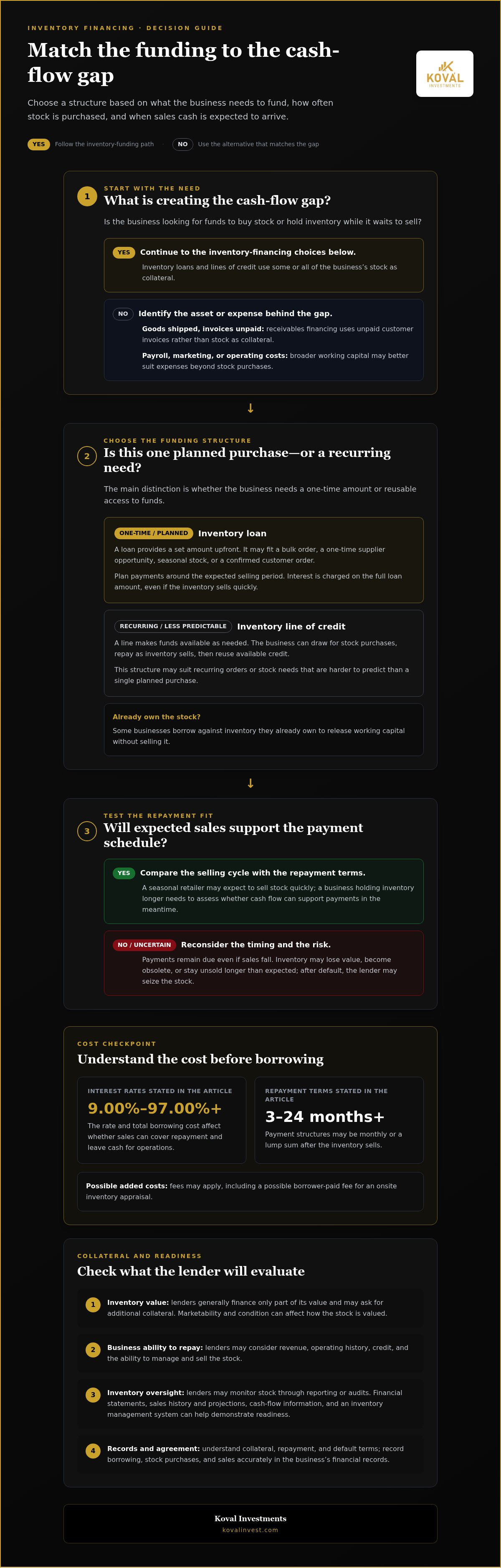
Inventory financing is an asset-based business loan or line of credit secured by some or all of a business’s inventory. The structure determines when funds arrive and how the business repays them. A loan provides a lump sum upfront, while a line of credit makes funds available as needed. Some businesses also borrow against stock they already own to release working capital without selling it.
For example, a retailer ordering stock before a busy season might use a lump sum for the purchase, then repay as sales come in. A wholesaler placing recurring orders may prefer a reusable line of credit. In either case, lenders generally finance only part of the inventory’s value and may ask for additional collateral. The inventory secures the borrowing, so unsold goods can be at risk if the business defaults.
Advantages and Disadvantages
The main advantage is access to capital tied directly to inventory, which can preserve cash for other operating needs. Financing may also help a business buy larger quantities when a supplier offers favorable pricing. Because stock acts as collateral, inventory financing may be easier to obtain than an unsecured loan. This can help a retailer or wholesaler whose funds are tied up in goods awaiting sale.
The trade-off is that inventory can lose value, become obsolete, or remain unsold longer than expected. Payments remain due even if sales fall, and the lender may seize the stock after a default. Lenders may also monitor inventory through reporting or audits. Before borrowing, compare the expected time to sell the goods with repayment obligations, especially for perishable or customized products.
Inventory Financing Versus Receivables Financing
Inventory financing uses stock as collateral, while accounts receivable financing uses unpaid customer invoices to access funds. The distinction matters because each asset becomes available at a different point in the sales cycle. A business buying products before selling them may need inventory financing. A business that has shipped goods but is waiting for customers to pay may have receivables to finance.
For example, a wholesaler could finance stock for an upcoming order, then consider receivables financing after delivering the order and issuing invoices. Inventory value depends on factors such as marketability and condition. Receivables depend on outstanding invoices and expected customer payments. Match the asset to the cash-flow gap: borrowing against stock will not directly resolve a delay in invoice collection.
Borrowing Costs and Repayment Terms
Inventory financing interest rates can range from 9.00% to 97.00% or more, and repayment terms typically range from three to 24 months or longer. The rate and total borrowing cost affect whether sales can cover repayment while leaving cash for operations. Some inventory loans use monthly payments; others require a lump sum after the inventory sells. Fees can also apply, including a possible borrower-paid fee for an onsite inventory appraisal.
Tax and legal considerations include recording the borrowing and inventory accurately, and understanding the agreement’s collateral, repayment, and default terms. Keep loan records separate from sales transactions, and record stock purchases and sales in the business’s financial records.
Choose financing around the sales cycle, not just the purchase date. A retailer expecting to sell seasonal goods quickly may need repayment aligned with that selling period; a business holding stock longer needs to assess whether cash flow can support payments meanwhile. According to the U.S. Small Business Administration, the SBA 7(a) and Microloan programs are possible sources of short-term business funding for inventory purchases.
What Is an Inventory Loan vs Inventory Line of Credit?
An inventory loan provides a set amount upfront, while an inventory line of credit allows repeated draws. The right structure depends on whether purchases are planned, occasional, or recurring.
Financing Planned Bulk Purchases
An inventory loan can fund a planned bulk order with one lump sum, which can help when a supplier offers volume pricing. The business receives the funds upfront and repays them over an agreed term. This structure may suit a retailer forecasting seasonal demand or a wholesaler preparing for a large customer order.
Before borrowing, compare the order size with expected sales and the loan payment schedule. A bulk discount improves margins only if the stock sells before financing costs and storage expenses erode the savings.
Financing One-Time Purchases
A fixed inventory loan can cover a one-time stock purchase without setting up an ongoing credit facility. It may suit a business responding to a specific opportunity, such as a limited supplier offer or a confirmed customer order. The fixed amount also makes it easier to plan repayments around that purchase.
For a single order, estimate when the goods are likely to sell and how revenue will cover payments. Inventory loans charge interest on the full loan amount, even if the business sells the inventory quickly. That timing can affect the total financing cost.
An inventory line of credit is designed for recurring or less predictable stock needs. The business draws funds as purchases arise, repays as inventory sells, then may reuse available credit. For example, a line tied to inventory valued at $100,000 could have a $50,000 credit limit. After a wholesaler spends $30,000 in the first month, $20,000 remains available.
A line of credit can support replenishment without requiring a separate loan for each order. However, the borrowing limit may depend on the appraised inventory value, and lenders may require ongoing inventory reporting or audits. Compare how often the business needs to purchase stock with the line’s monitoring and repayment requirements.
Other funding addresses different needs. Working capital may suit a business whose cash gap includes supplier payments alongside payroll or operating costs. An equipment loan, by contrast, is intended for machinery or other business equipment, not ordinary inventory. A retailer replacing a delivery vehicle and buying seasonal stock may need to assess those as separate funding needs.
Match the structure to the sales cycle: choose a fixed loan for a defined purchase and consider a reusable line for repeated replenishment. If the funding need extends beyond inventory, explore working capital options alongside inventory-specific borrowing.
Business eligibility requirements
U.S. banks, credit unions, and online lenders offer inventory financing, but each sets its own criteria. Some look for six months to one year in business, annual revenue of at least $100,000, and personal credit scores of 670 or higher; some private lenders accept scores as low as 500.
Business and Lender Eligibility
Eligibility depends on the business’s financial profile and the lender’s risk standards, so the same applicant may receive different decisions from different lenders. Revenue, time in operation, and personal credit can each affect whether a business can borrow and the interest rates or loan structure offered.
Reported sales thresholds vary: some lenders look for annual sales of $30,000 to $240,000, while inventory loan eligibility may include at least $100,000 in annual business revenue. These figures describe different lender criteria, not a single nationwide rule. A business should distinguish annual sales from revenue requirements when reviewing its financial position.
Inventory Loan Eligibility
Inventory-specific underwriting also considers whether the stock can support repayment. Finished consumer goods with established markets may receive higher advance rates than customized, perishable, or rapidly obsolete goods. A lender weighs the inventory’s marketability alongside the borrower’s ability to sell it and repay the debt.
For example, a retailer holding standard products with steady demand presents a different inventory profile from a restaurant financing perishable ingredients. Inventory value can change before sale, so lenders may assess the goods’ condition, turnover, and resale prospects. Good inventory management helps show whether purchased stock can be tracked and sold.
Credit history is another factor, but thresholds differ by lender type. Traditional lenders may prefer personal credit scores of 670 or higher, while some private business lenders accept scores as low as 500. A lower threshold does not remove the need to show a credible repayment plan or sound business finances.
Lender Requirements
Traditional banks, credit unions, and online lenders all provide inventory financing in the United States. Banks and credit unions may have stricter credit preferences. Private online lenders may accept lower scores but assess revenue, operating history, and inventory quality. No single score or revenue figure applies across all lenders.
Some lenders require at least six months to one year of operating history. Others may focus on annual sales between $30,000 and $240,000, or require at least $100,000 in annual business revenue for inventory loans. These differences make lender criteria central to the borrowing decision, especially for newer businesses.
Before comparing a term loan with a credit line, organize the business’s revenue records, credit profile, time in operation, and inventory details. Then compare each lender’s stated thresholds with the business’s actual figures. This helps identify which eligibility factors may need attention before applying.
Application documentation and inventory management
An inventory financing application connects the requested funding to the stock, sales, and cash flow expected to repay it. Clear records help a lender assess the purchase, the business’s ability to sell the goods, and its plan to replenish inventory.
Applicants may need to provide financial statements, sales records, projections, and a business plan. Each document serves a practical purpose: past sales show demand, while projections explain how new stock could generate revenue. A cash flow statement also helps show whether the business can manage loan payments before customers pay.
Prepare these records to present a consistent picture of the business:
- Balance sheet: Show assets, liabilities, and current inventory holdings.
- Profit and loss statements: Summarize revenue and expenses across the periods available.
- Sales history and projections: Connect past demand with expected sales of the proposed stock.
- Cash flow statement: Show when cash enters and leaves the business.
- Business plan: Explain the inventory purchase and how it supports operations.
For a seasonal retailer, projections should connect the requested stock to expected seasonal demand. A lender can compare the sales plan with historical results and the business’s capacity to store and sell the goods. If projections assume rapid sales but past records show slower turnover, explain the difference using the relevant order or change in demand.
Inventory management matters because lenders need to understand what stock exists and how it moves. A usable system tracks purchases, quantities on hand, sales, and replenishment. For an inventory line, current records can also support regular reporting, such as borrowing base certificates, which help monitor inventory levels and available credit.
Some lenders may require periodic inventory audits or an onsite visit. An onsite appraisal may involve a fee paid by the borrower. Keep inventory organized and records aligned with physical stock so an appraisal can connect reported quantities with goods stored at the business.
Build the repayment case around the inventory’s expected sales cycle. For example, show how a seasonal purchase becomes sales revenue, then how that cash supports payments and operating expenses. Separate the forecast for new stock from existing sales to make the funding need and expected profit easier to assess.
Before submitting an application, reconcile inventory records with the balance sheet and sales history. Confirm that projections, cash flow, and the business plan describe the same purchase. This preparation gives the lender a clear view of how the business will manage the stock, sell it, and replenish it while keeping repayment obligations in view.
Business uses for working capital
Inventory is only one claim on a business’s cash. Working capital can bridge the gap between paying suppliers and collecting revenue, while also supporting expenses that keep daily operations moving. For example, a retailer may need to pay for a delivery before customers buy the products. Funding that timing gap can preserve cash for other obligations instead of tying it all up in stock.
Business owners can assess their needs by mapping incoming cash against planned expenses. Separate inventory costs from payroll, marketing, and routine operating costs. If the shortfall involves several of these needs, inventory-specific borrowing may not cover the full gap. A broader working capital facility may be more suitable when the business needs capital for multiple operating purposes.
Working capital may help cover expenses such as:
- Supplier payments: Pay for inventory before products generate sales revenue.
- Payroll: Maintain scheduled employee pay while customer payments are still outstanding.
- Marketing: Fund campaigns that support product launches or seasonal demand.
- Operating costs: Cover business expenses that continue while sales revenue comes in.
A line of credit can support changing cash needs because the business draws funds as expenses arise. A fixed working capital loan instead provides a set amount upfront. For a business with predictable spending, a lump sum may align with a defined operating plan. For recurring gaps, access to a credit line may better match expenses as they occur. Either way, repayment should fit projected cash flow, not just the funding request.
The SBA 7(a) loan can cover inventory, operating costs, and equipment financing. SBA 7(a) loans can provide up to $5 million for uses that include inventory purchases. This may suit a business planning a broader project, such as buying stock while also funding equipment or operating costs. The key is to define the intended uses clearly and connect the borrowing to the business’s repayment capacity.
Working capital is not automatically the better choice for every inventory purchase. If the need is limited to a specific stock order, inventory financing keeps the funding purpose closely tied to that purchase. If cash is needed for inventory plus payroll or marketing, broader working capital may better reflect the actual need. Compare the full expense plan with the loan’s repayment schedule before choosing.
For a funding plan that includes inventory and wider operating expenses, explore working capital options and align the amount with the business’s cash-flow needs.
Koval Investments: 0% Interest Funding Solution
Koval Investments helps business owners consider funding options when inventory purchases compete with payroll, supplier payments, or other operating needs. Its 0% Interest Funding Solution may be relevant to businesses assessing how to fund planned stock purchases while managing broader cash-flow priorities.
For needs beyond inventory, Koval Investments offers Working Capital and SBA Loans. The right direction depends on the purpose of the funds, the business’s financial profile, and how repayment fits expected sales. Credit Repair Services may also be relevant when credit profile improvement is part of the wider funding plan.
If you’re weighing inventory financing against broader funding needs, contact Koval Investments or visit kovalinvest.com to discuss your business goals.
Align Your Funding With the Next Stage of Growth
Start by defining what the inventory purchase needs to accomplish for the business. Consider how the order fits your sales plan, what other demands compete for cash, and how repayments will fit alongside planned expenses. That broader view can help you assess whether a business loan for purchasing inventory supports the business’s priorities or whether a different funding structure is more suitable.
Koval Investments offers a 0% Interest Funding Solution, Credit Repair Services, and SBA Loans. These offerings can be relevant when you’re considering capital options and want to account for both your funding needs and financial profile. A clear discussion of your goals can help frame the available direction around your business, without treating inventory as an isolated purchase.
Prepare a concise picture of the intended use of funds, expected sales, and other operating priorities. Then contact Koval Investments today to discuss your business’s funding goals. A considered financing decision can help you move forward with a clearer plan for growth.
Frequently Asked Questions
What should I know about using a term loan as an inventory loan?
A term loan gives you a fixed amount upfront, so plan the purchase and repayment together. Interest applies to the full loan amount, even if the inventory sells quickly. Compare the expected time to sell the stock with the repayment schedule, then check whether projected cash flow can cover payments if sales slow. A term loan may suit a defined order, while recurring replenishment may call for a reusable credit facility.
How much can you borrow against inventory?
The amount depends on the lender’s valuation of eligible inventory, not simply its purchase price. Reported advance ranges vary: some inventory financing lenders cite 20% to 65% of inventory value, while broader estimates cite 50% to 80%. Finished goods with established markets may support higher advances than perishable, customized, or obsolete stock. For planning, estimate the business’s own contribution and avoid treating the inventory’s full value as available borrowing.
What types of business funding can be used for inventory purchases?
Businesses can use inventory loans, inventory lines of credit, working capital, supplier trade credit, or purchase order financing. Trade credit may provide net 30, 60, or 90-day payment terms, while purchase order financing pays a supplier directly and is repaid after the customer pays. According to the U.S. Small Business Administration, its 7(a) and Microloan programs are also possible sources of short-term business funding for inventory purchases.
Who can benefit from inventory loans?
Inventory loans may suit retailers, restaurants, and wholesalers that hold substantial stock or need to buy goods before receiving sales revenue. A retailer preparing for seasonal demand may use financing to bring in stock early, while a wholesaler may need funds to fulfill a large order. The fit depends on the goods’ resale prospects and the business’s ability to repay if sales take longer than expected.
What types of business loans can be used to purchase inventory?
Common choices include a term loan, an inventory-backed line of credit, and broader working capital financing. A term loan provides a set amount for a defined purchase; a credit line can support repeated orders as funds are repaid. SBA 7(a) loans may also cover inventory, alongside other business purposes. Compare whether the business needs funding only for stock or also for expenses such as payroll or equipment.
How does inventory financing work, and what collateral is required?
The lender advances funds against some or all of the business’s inventory, and that stock secures repayment. If the borrower defaults, the lender can seize unsold goods. Lenders may also request collateral beyond the inventory. The goods’ condition, marketability, and risk of becoming obsolete affect their value. Keep inventory records current so the business can show what is being pledged and how stock moves through sales.
How do SBA loans, business lines of credit, and inventory loans compare for buying stock?
An inventory loan funds a purchase upfront, while an inventory line of credit offers borrowing that can be drawn again as debt is repaid. SBA 7(a) financing can cover inventory and other business expenses, with repayment terms ranging from 7 to 25 years depending on purpose. Its interest rate is tied to the Prime Rate plus a lender-set markup. Consider the broader use of funds and repayment horizon when comparing options.
What are the steps to apply for a business loan to purchase inventory?
Start by defining the order, its expected sales period, and how much cash the business can contribute. Next, assemble a balance sheet, profit and loss statements, sales history and projections, cash flow statement, and business plan. Prepare inventory records showing quantities, condition, and sales movement. Then compare lender terms and repayment structures with projected cash flow. For a business loan for purchasing inventory, clearly connecting the stock to the repayment plan can strengthen the application.