
Can You Get a Business Loan Without Revenue? A 2026 Guide
Can you get a business loan without revenue, or do lenders need to see sales before they consider an application? No revenue can make funding more challenging, but it does not determine the outcome on its own. Lenders may also review personal credit, the business plan, financial projections, industry experience, available collateral, and repayment capacity.
If your business has not started earning yet, the most useful next step is to understand what you can document and how you would use and repay the funds. Lenders set their own criteria, so a strong explanation can support an application but cannot guarantee approval.
This 2026 guide explains what lenders may assess when a business has no revenue, compares possible funding routes, and outlines how to prepare an application. It also explains how Koval Investments, a consulting firm that connects business owners with lending partners, can help you review your profile and plan your next steps. Funding is subject to lender underwriting, eligibility requirements, approval, and your financial and credit profile.
Key Takeaways
- Can you get a business loan without revenue? Start by identifying whether you have a pre-revenue startup or an operating business facing a temporary revenue gap.
- Review your credit and financial profile, business plan, experience, cash reserves, collateral, and repayment capacity to understand what may support an application.
- Compare SBA Financing, Business Term Loans, Business Lines of Credit, and Working Capital Solutions against your funding purpose, available evidence, and ability to repay.
- Organize clear records and realistic projections. Label forecasts as estimates, not earned revenue or guaranteed future performance.
- Koval Investments connects business owners with lending partners through Funding Consultation, Funding Assessment, Funding Strategy, and Application & Funding. Lending partners determine approval.
Can You Get a Business Loan Without Revenue? Understand What Is Possible
Financing may be possible without business revenue, but having no sales does not establish eligibility. The answer to “can you get a business loan without revenue” depends on the funding option and the full application, not on one factor alone. Each lender sets its own underwriting and eligibility requirements. Funding is not guaranteed, and any decision depends on the applicant’s financial and credit profile.
Possible access to funding is not the same as assured approval. A lender may consider a business with no revenue, but that does not mean it will approve the application or offer suitable terms. The Small Business Administration (SBA) outlines SBA programs, but the existence of a program does not confirm that a particular no-revenue business is eligible. Program requirements and lender review still apply.
Does having no revenue automatically disqualify a business?
There is no single answer that applies to every business loan. Zero revenue is one part of an application, not a universal approval decision. A lender may consider the business’s stage and records alongside the applicant’s financial and credit profile. Requirements depend on the lender and funding option, so claims that every business loan requires revenue, or that every no-revenue business can qualify, oversimplify the decision.
Treat the lack of revenue as a gap to explain, not proof of approval or rejection. Be ready to describe why the business has no sales, what the requested capital would support, and how repayment could work. Those details help clarify the application, but they do not replace lender underwriting or guarantee an outcome.
Pre-revenue startup or business with a revenue interruption?
A pre-revenue startup has not yet established a sales history. Its application may rely more on business formation records, a launch plan, and the owner’s broader financial profile. An operating business with a temporary revenue gap has a different history: it may be able to show earlier sales and explain what changed. Neither situation guarantees eligibility, but distinguishing them helps describe the business accurately.
Before comparing funding routes, identify which situation best describes your business and what evidence you can provide. Do not present projections as actual revenue or describe an interruption as a permanent closure if the business is still operating. A clear account of the business’s stage and current position gives lenders a more accurate basis for reviewing the application.
- For a startup: Separate completed milestones from plans and projections.
- For a revenue interruption: Organize records that show the business’s operating history and when the gap began.
- For either situation: Clarify the purpose of the funding and how repayment could fit the overall financial picture.
This distinction is a starting point, not a prediction about which funding route will work. Once you have described the business accurately, you can consider what lenders may review and compare options with realistic expectations.
What Lenders May Assess When a Business Has No Revenue
Without sales history, a lender may look more closely at the rest of the application to understand the business’s plans and the applicant’s ability to manage repayment. Factors vary by lender and financing option. A business plan, relevant experience, personal credit, cash reserves, collateral, and other financial information may help explain the situation, but none guarantees approval.
Start by stating the capital need clearly. Explain what the funds would pay for, why that expense supports the business, and how the request fits its current stage. A startup preparing to launch might outline planned launch expenses, while an operating business with a sales interruption might document its business history and explain the gap. Separate established facts from future expectations.
What can support a funding application before sales begin?
A concise business plan can explain how the business intends to operate, reach customers, and use the requested funds. Relevant experience may help show the owner’s ability to carry out that plan. Personal credit and available reserves can also form part of the financial picture. Some lenders may consider collateral, but it is not a universal requirement. Treat each item as supporting information, not a substitute for eligibility or underwriting.
These are general considerations, not a checklist that applies to every loan. The U.S. Small Business Administration describes different SBA loan programs, while individual lenders assess applications under their own requirements. Koval Investments’ personal credit score guideline is approximately 680 or higher. This is a guideline, not a hard cutoff or a promise of approval. Applicants preparing their credit profile can learn about business credit repair and optimization.
How can repayment capacity be demonstrated without business revenue?
When there are no current sales to show, focus on the financial information that does exist. Depending on the financing option, this may include personal financial information, business bank records, cash reserves, and clearly labeled projections. Organize records so a lender can distinguish current resources and past activity from plans for future performance. Required evidence and the weight given to it vary by lender and financing option.
Projections can explain your assumptions, but they are not earned revenue. Show the basis for estimates, such as planned pricing, expected expenses, or an intended launch schedule, and be candid about uncertainty. Do not present forecast sales as established income or guaranteed repayment. Realistic projections help keep the application clear and make repayment capacity easier to evaluate.
Koval Investments connects business owners with lending partners and helps applicants review their profile and funding strategy. A funding consultation can be a practical starting point for discussing your capital need and the information you have. Funding is subject to lender underwriting, eligibility requirements, approval, and your financial and credit profile.
Which Business Funding Options May Fit a No-Revenue Business?
Compare funding options by the purpose of the money, not just by product name. A startup preparing to launch may need a different structure from an operating business covering a short-term cash gap. The options below are categories to explore, not a prediction that an applicant will qualify. Asking “can you get a business loan without revenue” is only the first step; lender underwriting determines whether a particular route fits the business.
| Funding route | Potential fit | Evidence to prepare | Underwriting caveat |
|---|---|---|---|
| SBA Financing | A business exploring an SBA-backed route for a defined business purpose. | Business plan, use of funds, formation records, and relevant financial and credit information. | Program-specific eligibility and lender requirements apply. No-revenue status does not establish eligibility. |
| Business Term Loans | A business seeking a set amount of capital for a specific investment or expense. | Detailed funding request, business records, and information that supports repayment capacity. | Availability, repayment conditions, and approval depend on lender underwriting. |
| Business Lines of Credit | A business looking for access to capital it may draw on as needs arise. | A clear explanation of expected cash needs and available financial information. | A lender decides whether the business meets its requirements and sets applicable conditions. |
| Working Capital Solutions | A business seeking capital for operating needs, such as planned expenses. | Expense details, bank records, and an explanation of how the funds support operations. | Eligibility and repayment terms vary with the funding option and lender assessment. |
Use the comparison to narrow the questions: What expense needs funding? When is the capital needed? What evidence supports repayment? Broader comparisons can help clarify how alternative business funding solutions differ in structure and purpose. Koval Investments offers 0% Intro APR Funding and 0% Interest Funding Solution. Those names do not establish eligibility, rates, repayment terms, or approval. Funding is subject to lender underwriting, eligibility requirements, approval, and the applicant’s financial and credit profile.
When might SBA financing be worth exploring?
SBA-backed financing may be worth exploring if the business’s purpose and profile align with a program’s requirements. SBA program information can help owners understand the available frameworks, but it does not promise that a business with no revenue will qualify. A lender reviews each application under its underwriting criteria. For more context on program considerations, see SBA loan assistance.
How do credit lines, term loans, and working capital differ?
A term loan generally provides a defined amount to repay over an agreed schedule. A business line of credit provides access to funds that may be drawn as needed, subject to its terms. Working Capital Solutions focus on operating needs rather than one particular structure. Match the route to the intended use: a planned purchase differs from variable expenses. Lender availability, eligibility, and repayment conditions depend on underwriting, so compare the structure with the business’s realistic repayment capacity.
Koval Investments connects business owners with lending partners and helps organize a funding strategy around the business’s needs. A funding consultation can be a starting point for discussing your profile and possible routes. Funding is subject to lender underwriting, eligibility requirements, approval, and the applicant’s financial and credit profile.
How to Prepare a Business Funding Application Without Revenue
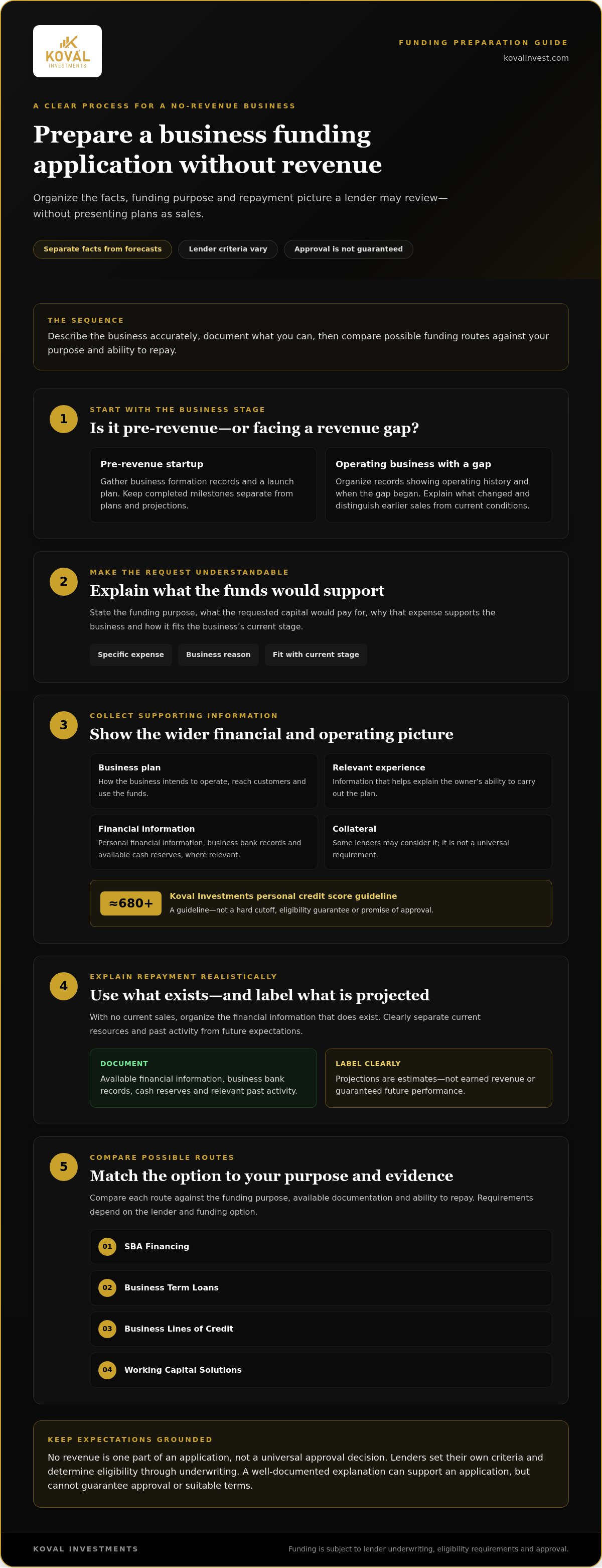
A well-organized application can explain the business clearly, even if sales have not started. If you’re asking, “can you get a business loan without revenue,” preparation helps you present the facts lenders need to assess, but it cannot guarantee approval. Work through these steps before submitting an application or discussing funding options.
- Define the capital need. Identify the expense or business objective the funds would support. State the amount you’re seeking and explain how you arrived at it, using actual quotes or documented costs where available. A focused request is easier to evaluate than a broad estimate without a clear purpose.
- Review the applicant and business profile. Gather a current view of your personal credit and finances, business stage, operating history if applicable, and available resources. Note any gaps or changes that may need explanation. Keep your account factual and consistent across the application and supporting records.
- Gather records. Collect the business and financial documents available to you, then check that names, dates, and details align. If the business has not generated income, say so plainly. Do not describe forecasts as earned revenue or suggest that future performance is guaranteed.
- Assess repayment realistically. Consider how repayment could fit your financial picture if projected sales take longer to arrive or differ from estimates. Keep assumptions clear and separate from current income. If the plan depends on future revenue, explain the basis for the estimate and acknowledge uncertainty.
Define the need, review the profile, organize the records, and assess repayment realistically. These steps prepare an application, but they do not ensure approval.
What documents may be needed for a funding review?
Common documents include the following. Requirements vary by application and lender, so organize the records that apply to your business and be prepared to explain any item you do not have.
- Government-issued photo ID
- Business formation documents
- EIN confirmation
- Business bank account information
- Recent bank statements
- Proof of income (when applicable)
Recent bank statements can show available account activity, and proof of income applies when relevant to the applicant’s circumstances. Do not substitute projections for these records. If the business has no revenue, present the records you do have accurately.
How should owners present a funding plan?
Connect the requested amount to specific uses, then explain what the funding would support and how the business expects to manage repayment. Use realistic assumptions, label projections clearly, and keep supporting records together. A complimentary consultation with Koval Investments can be a first step to discuss your goals and review your applicant profile. Koval connects business owners with lending partners.
Discuss your funding goals and prepare a clear picture of the need, available records, and repayment plan.
How Koval Investments Helps You Explore Funding Without Revenue
For owners asking, “can you get a business loan without revenue,” a practical next step is to review the business and its funding goals. Koval Investments is a consulting firm that connects business owners with lending partners. It is not a lender and does not make approval decisions. Newer businesses may qualify if other criteria are met, but that possibility is not a promise of funding.
Koval’s four-step process gives applicants a structured way to discuss their needs, review their profile, and prepare for a potential application. Each stage focuses on a different part of the funding journey:
What happens during Koval Investments’ four-step funding process?
- Funding Consultation: discuss business, goals, desired capital amount.
- Funding Assessment: review business and financial profile.
- Funding Strategy: develop financing plan based on qualifications.
- Application & Funding: guide through application and documentation.
This sequence helps turn a broad funding question into an organized discussion. It also gives business owners a chance to identify the information they have and what may need further preparation before an application moves forward.
What should applicants understand before starting?
Funding is not guaranteed. Any decision is subject to lender underwriting, eligibility requirements, approval, and the applicant’s financial and credit profile. Koval’s personal credit score guideline is approximately 680 or higher. Treat this as a guideline, not a hard cutoff or assurance of approval. Lending partners set their own requirements and make final decisions.
Applicants with less-than-perfect credit can discuss Koval’s Credit Optimization Program as part of funding readiness. The program is one consideration when reviewing an applicant’s profile, not a guarantee of a credit change or funding approval. Bring a clear explanation of the capital need and an accurate account of the business’s current situation. Be ready to discuss what the business can document, along with its plans and uncertainties.
If you’re ready to review your goals and profile, schedule a complimentary consultation with Koval Investments. The conversation can help clarify potential next steps, while any funding remains subject to the lending partner’s review and decision.
Turn Your Funding Question Into a Practical Next Step
The answer to “can you get a business loan without revenue” depends on the lender’s review, but you can start organizing your next move now. Identify what you want the business to accomplish and what information you can bring to a funding conversation. A focused discussion can help clarify which questions to address as you consider your options.
Koval Investments is a consulting firm that connects business owners with lending partners, not a lender. Its process moves through Funding Consultation, Funding Assessment, Funding Strategy, and Application & Funding, helping you approach the application in a structured way. Funding is not guaranteed. Lending partners make approval decisions based on underwriting, eligibility requirements, and your financial and credit profile.
If you’re ready to discuss your goals and review your profile, schedule a complimentary funding consultation. Take a practical next step with a clearer plan, while keeping in mind that the lending partner makes the funding decision.
Frequently Asked Questions
Can I get an SBA loan before my business has revenue?
It may be possible, but a business without revenue is not automatically eligible for an SBA-backed loan. The answer to “can you get a business loan without revenue” depends on the applicable program requirements, lender underwriting, and your financial and credit profile. Clarify the intended use of funds and review the relevant criteria. Approval and funding are not guaranteed.
Can a startup get a business line of credit with no revenue?
A startup may be considered for a business line of credit, but having no revenue does not establish that it will qualify. Lender requirements differ, and a lender may assess the full applicant profile and available financial information. Explain what you would use the credit for and how you expect to manage repayment. Treat a line of credit as an option to explore, not an assured source of startup capital.
Does no business revenue mean I cannot show repayment capacity?
No. A lack of business sales does not necessarily mean there is no financial information to review. Depending on the application, available records may show current resources and the applicant’s broader financial position. Distinguish cash already available from sales expected in the future. Forecasts can explain your plan, but they are not established income or proof that future repayment is certain.
Do lenders require collateral for a business loan without revenue?
Not in every case. Collateral may be a factor for some lenders or financing options, but it is not a universal requirement for every business loan. Requirements depend on lender underwriting and the applicant’s profile. Document any relevant assets accurately, but do not assume they will offset other eligibility factors or secure approval. Review proposed obligations carefully before accepting financing.
What documents can a startup provide before it has sales?
A startup can provide records that establish its identity, formation, and available financial information. Common documents include government-issued photo ID, business formation documents, EIN confirmation, business bank account information, recent bank statements, and proof of income (when applicable). If the business has not earned income, do not present projections as proof of income. Document requirements vary with the application and lender requirements.
Can a newer business qualify for funding if the owner has less-than-perfect credit?
Clients with less-than-perfect credit can still qualify, and Koval Investments offers a Credit Optimization Program. Koval’s personal credit score guideline is approximately 680 or higher, not a hard cutoff. A lender makes its own decision based on underwriting, eligibility requirements, and the applicant’s financial and credit profile. Funding is not guaranteed.
What happens if a business funding application is declined?
A declined application means the lending partner did not approve that request under its review. It does not guarantee that another application or funding route will be approved. Review the decision information available to you, identify which parts of the profile or application may need attention, and update the plan or supporting records where appropriate. Koval Investments can help assess your profile and consider next steps, but funding is not guaranteed.