
Mastering Business Credit Repair Services: A Strategic Guide for 2026 Capital Access
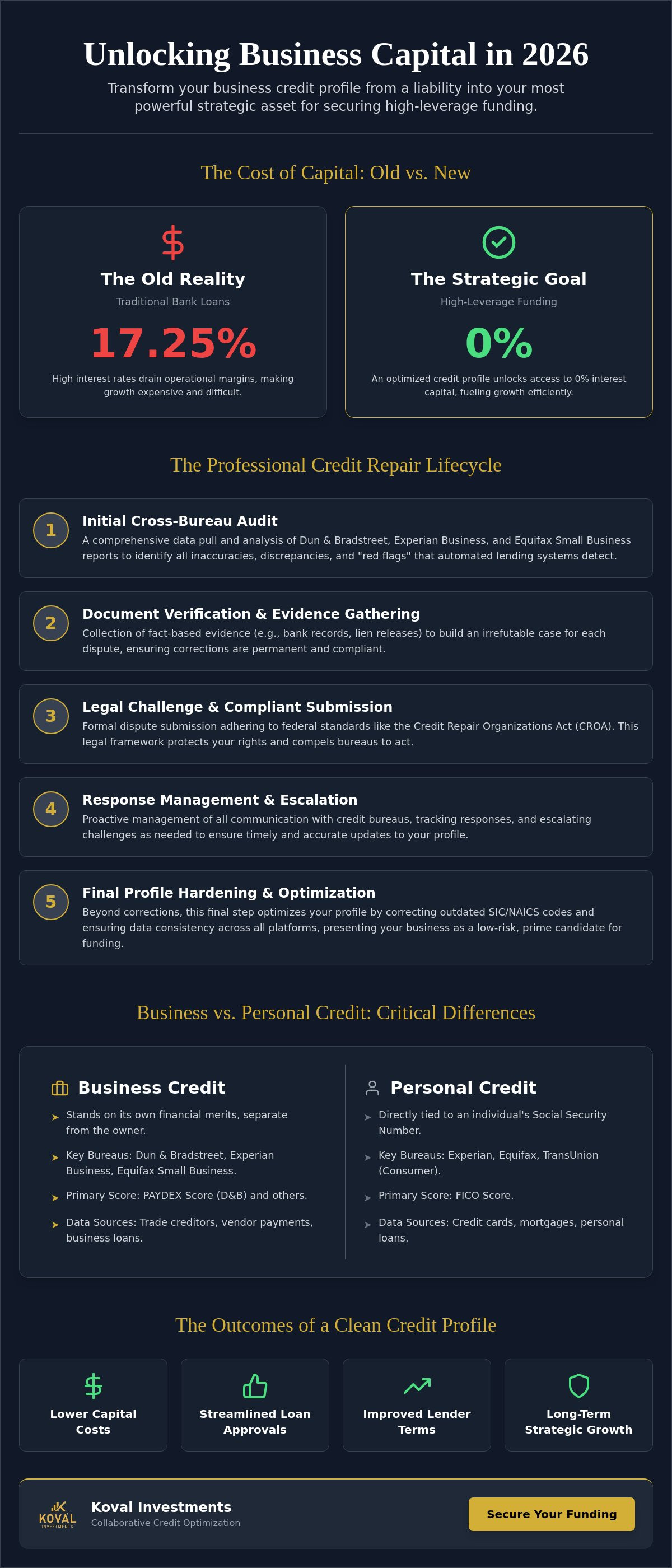
What if the invisible errors on your business credit report are the only thing standing between your company and an SBA loan approval? You've likely felt the frustration of high interest rates eating into your operational margins or the confusion of why your business profile remains stagnant. Utilizing professional business credit repair services is no longer just a defensive move; it's an offensive strategy to secure the capital you need in a 2026 economy where traditional bank loans can reach interest rates as high as 17.25%.
We believe that your credit profile should be a strategic asset rather than a hurdle. This guide explains how professional credit restoration transforms your financial profile into a magnet for high-leverage, 0% interest funding. You'll learn how to navigate the new ESCRA Act licensing landscape and optimize your standing across all bureaus. We'll walk through the specific steps to clean your profile and secure the capital necessary for your next phase of growth.
Key Takeaways
- Understand why modern credit restoration requires a sophisticated approach beyond simple consumer disputes to meet 2026 regulatory standards.
- Discover the 5-step lifecycle of professional business credit repair services and why profile optimization is now the gold standard for lenders.
- Learn the critical differences between personal FICO scores and business bureau reporting cycles to ensure your company stands on its own financial merits.
- Identify the specific credit score thresholds required to unlock 0% interest capital and streamline your path to SBA loan approval.
- Explore how a success-based, collaborative partnership aligns credit restoration with your long-term strategic growth and funding objectives.
What Are Business Credit Repair Services in 2026?
Professional business credit repair services involve the systematic identification and correction of inaccuracies within a company's credit reports. In 2026, the landscape of commercial lending has shifted significantly toward data-driven automation. This means that even a minor clerical error can trigger an automatic denial from an SBA lender or a traditional bank. Unlike consumer-level credit fixes, business restoration requires a deep understanding of commercial data silos and the specific reporting cycles of trade creditors. It is a strategic tool designed to align your company's public financial record with its actual operational success.
A clean credit profile serves as the foundation for the broader ecosystem of capital procurement. When your reports are optimized, you move from a position of seeking capital to a position where lenders compete for your business. This shift is essential for securing high-leverage, unsecured business funding. By removing "invisible" barriers like outdated liens or incorrect delinquency markers, your firm becomes a magnet for the most favorable terms available in the market.
The Core Components of Business Credit Restoration
The process starts with a rigorous audit of your reports from Dun & Bradstreet, Experian Business, and Equifax Small Business. We frequently find business credit report errors such as misclassified SIC codes or duplicate accounts that artificially lower your score. Addressing these issues requires precise dispute management. All actions must comply with federal standards, including the Credit Repair Organizations Act (CROA), which provides the necessary consumer and business protections. This isn't just about sending letters; it's about providing the specific documentation that bureaus require to update their records permanently.
Why Business Credit Matters More Than Ever
Algorithmic lending is now the standard. In 2026, your "cost of capital" is dictated almost entirely by the data points found in your credit file. With traditional bank term loans currently carrying rates between 8% and 17.25%, even a slight improvement in your profile can save thousands in interest over the life of a loan. There's also a direct correlation between a high Paydex score and your ability to access 0% interest funding solutions. When your scores are optimized across all three bureaus, you gain the leverage needed to negotiate better terms, extend your runway, and maintain healthy operational margins without the burden of high-interest debt. Utilizing business credit repair services is the most direct path to lowering these costs and improving your bottom line.
The Mechanics: How Professional Credit Repair Works
Professional business credit repair services operate through a methodical lifecycle designed to align your company's data with strict lender expectations. It's a strategic engagement rather than a simple series of dispute letters. The process follows a five step lifecycle: initial cross-bureau audit, document verification, legal challenge submission, response management, and final profile hardening. This structured approach ensures that every correction is permanent and compliant with federal standards.
Experts in this field navigate bureau-specific protocols that individual business owners often miss. For instance, Dun & Bradstreet's internal data validation differs significantly from Experian's algorithmic scoring. Professional restoration ensures that your data is consistent across all platforms, preventing the "red flags" that occur when bureaus report conflicting information about your business's age, size, or industry classification.
The Professional Dispute Process
The first phase of a professional engagement focuses on precision and compliance. We start with a comprehensive data pull and cross-bureau analysis to find discrepancies that aren't visible on surface-level reports. Next, we gather fact-based evidence for each inaccuracy, such as bank records or lien release documents, to ensure the dispute is irrefutable. Finally, we handle formal dispute submission and federal compliance tracking. This process adheres strictly to the Federal Trade Commission guidance on CROA, ensuring that your rights are protected throughout the restoration period.
Optimizing Your Financial Profile
Modern credit restoration has moved beyond simple disputes toward a standard of profile optimization. This involves correcting outdated SIC or NAICS codes that might mistakenly categorize your company as a "high-risk" industry, which often triggers automatic loan denials. We also focus on managing debt-to-credit ratios to show lenders you have ample liquidity without sacrificing your operational cash flow. Ensuring that public records, liens, and judgments are accurately reflected or removed is a critical part of this phase. Establishing a clean baseline is the first step toward a broader strategic funding plan that leverages your improved scores for better terms.
Maintaining "credit hygiene" is the final, ongoing component of the mechanics. Once your profile is optimized, you must monitor reporting cycles to avoid future funding blocks. This proactive stance ensures that your business remains ready for capital opportunities at a moment's notice, keeping your operational margins healthy and your growth trajectory steady.
Business vs. Personal Credit Repair: Critical Differences
Many entrepreneurs mistakenly believe that a high personal FICO score is the only requirement for securing institutional funding. While your personal credit often acts as a gatekeeper for small business loans, it represents only 50% of the financial picture. Business credit repair is a distinct discipline because commercial bureaus operate under different rules than consumer ones. While the Fair Credit Reporting Act (FCRA) provides a rigid legal framework for personal disputes, the business credit environment is less regulated. This "wild west" nature makes the expertise of business credit repair services essential for navigating the complexities of commercial data reporting.
One of the most significant advantages of separating these two profiles is avoiding the "Personal Guarantee" trap. When your business lacks its own established credit, lenders force you to tie your personal assets to the debt. By repairing and building your company's independent profile, you move toward non-recourse funding that protects your family's financial future. As noted in the SBA guide to establishing business credit, maintaining this separation is a fundamental step for any growing enterprise.
The Multi-Bureau Ecosystem
Unlike the consumer world dominated by three primary bureaus, the business ecosystem relies on specialized metrics. Dun & Bradstreet is the most prominent, where your D-U-N-S number and Paydex score (ranging from 0 to 100) track your payment performance with trade vendors. Experian Business utilizes Intelliscore Plus, a model that predicts the likelihood of serious delinquency based on more than 808 variables. Equifax Business focuses on a Business Credit Risk Score and a Failure Score, which measures the probability of your business closing within the next 12 months. Each bureau requires a specific strategy for data correction and profile hardening.
Strategic Integration for Business Owners
The most successful founders don't choose between personal or business restoration; they integrate both into a single strategy. You can improve business credit profile standing while simultaneously addressing personal score inaccuracies to qualify for "blended" scoring models like the FICO SBSS. This specific score is a primary filter for SBA 7(a) loans and can be the difference between an automatic approval and a manual decline. Because these are professional business credit repair services, they're typically treated as a tax-deductible business expense. This makes the restoration process a strategic investment in your company’s future rather than a personal liability.
Strategic Preparation: Repairing Credit for High-Leverage Funding
Capital is the primary fuel for scaling any enterprise, but your credit profile acts as the filter through which that fuel must pass. In 2026, the gap between businesses that thrive and those that stagnate is often defined by their "time-to-capital." Utilizing professional business credit repair services ensures that when a market opportunity arises, your company is positioned to strike immediately. By proactively addressing inaccuracies before you apply for funding, you transform your profile from a liability into a strategic asset that commands the lowest possible interest rates.
Positioning your business as a "low-risk" entity is about more than just avoiding denials. It's about maximizing your funding limits. Lenders use automated algorithms to determine how much capital they're willing to extend. A clean, optimized profile suggests stability and reliability, which often results in higher unsecured limits and more favorable repayment terms. This preparation phase is the most critical step in reducing your long-term cost of capital.
SBA Loan Readiness
For many founders, the SBA 7(a) loan is the gold standard of long-term financing. However, the approval process is rigorous. You'll need to follow specific steps to fix credit for SBA loan approval, specifically focusing on your FICO SBSS score. This score is a "blended" metric that pulls data from both your personal and business reports. If this score falls below the current threshold, many lenders will automatically decline the application without a manual review. Additionally, we focus on clearing "CAIVRS" reports. This federal database flags any outstanding debt to the government, such as defaulted student loans or previous SBA obligations, which can instantly disqualify you from new federal funding.
Unlocking 0% Interest Opportunities
The most sophisticated entrepreneurs use 0% interest business funding to manage their operational cash flow without the burden of interest payments. Accessing these accounts requires an optimized credit profile, typically with scores in the mid-700s or higher. When you use business credit repair services to reach this "Zero-Interest" threshold, you eliminate the need for predatory, high-interest "bridge" loans or merchant cash advances. This strategy preserves your operational margins and allows you to reinvest more of your revenue back into growth. If you're ready to see how your current profile measures up against these institutional standards, you can request a strategic capital assessment to identify your best path forward.
Ultimately, credit restoration is the mandatory first step for any high-leverage funding strategy. It provides the foundation upon which you can build a diverse capital stack, from unsecured lines of credit to long-term government-backed loans. By focusing on health before the application, you ensure that your business remains a magnet for the most competitive funding in the market.
The Koval Investments Approach: Collaborative Credit Optimization
At Koval Investments, we view business credit repair services as a foundational element of a much larger financial strategy. We don't operate as a distant service provider; instead, we act as a seasoned strategic partner. Our "Success-Based" philosophy ensures that our objectives are perfectly aligned with your funding goals. We recognize that a clean credit profile is a means to an end, specifically the procurement of high-leverage capital that allows your business to scale without unnecessary financial strain.
Our "Insider" advantage comes from years of navigating complex financial landscapes. We understand how lenders view risk and how bureaus process data, which allows us to move with professional precision. This expertise creates a clear roadmap for our partners, moving them from the initial restoration phase directly into 0% interest capital procurement. By bridging the gap between high-level financial strategy and your day-to-day operational realities, we provide a path that's both aspirational and deeply practical.
A Partnership, Not a Transaction
We adopt a supportive, low-pressure stance because we believe the best results come from collaborative ventures. Our consultations are designed to be informative rather than sales-driven, focusing on shared objectives and long-term success. This "win-win" nature of our engagements means we prioritize the quality of the relationship and the alignment of goals over high-volume transactions. By focusing on accuracy and transparency, we minimize financial risk to the client while maximizing the potential for institutional approval.
Next Steps for Your Business Growth
As you move through the credit restoration process, it's often beneficial to integrate other strategic tools like professional business valuations. Knowing the true value of your enterprise helps in negotiating better terms and understanding your leverage during mergers or acquisitions. We encourage you to start this journey with a zero-obligation strategic consultation. This session allows us to assess your current profile and identify the specific steps needed to reach your 2026 expansion goals.
Choosing the right business credit repair services is about finding a mentor who's equally invested in your success. Whether you're preparing for an SBA loan or looking to unlock unsecured working capital, our methodical approach ensures that every step builds trust and moves you closer to your objectives. We're ready to help you navigate these challenges. You can connect with our team to begin building a profile that truly reflects the strength of your business.
Positioning Your Business for 2026 Capital Growth
Optimizing your commercial profile is the single most effective way to lower your cost of capital and increase your operational runway. By addressing inaccuracies and separating your personal liability from your company's debt, you create a clear path to institutional approval. Utilizing professional business credit repair services ensures your data is accurate across all bureaus, making your business an ideal candidate for high-leverage funding. This proactive approach transforms your credit from a static report into a dynamic tool for expansion.
Koval Investments was founded in 2018 with a specific focus on 0% interest solutions and strategic growth. Our success-based philosophy means we work alongside you to achieve measurable results, offering a comprehensive suite of services that includes SBA loan assistance and professional business valuations. We believe in a collaborative approach that removes financial risk while providing the "insider" knowledge needed to navigate today's competitive lending market. You don't have to face these financial complexities alone; we're here to provide the steady hand your business needs.
Secure your 0% interest funding by optimizing your credit today.
Take the first step toward a more resilient financial future. Your company's growth deserves a partner who is as invested in your long-term success as you are.
Frequently Asked Questions
Is business credit repair legal under federal law?
Yes, it's completely legal and governed by the Credit Repair Organizations Act (CROA). This federal law establishes the guidelines that providers must follow to protect consumers and business owners. Additionally, as of January 1, 2026, the Ending Scam Credit Repair Act (ESCRA Act) requires all organizations to maintain state-level licensing, providing an extra layer of regulatory oversight and security for your business.
How long does it typically take to see an increase in business credit scores?
Most business owners begin to see measurable results within 30 to 90 days. This timeline depends on the reporting cycles of bureaus like Dun & Bradstreet and Experian, which typically update their records once per month. While simple clerical errors might be corrected quickly, more complex issues involving public records or historical trade lines may require multiple reporting cycles to fully reflect on your profile.
Can I repair my business credit myself, or do I need a professional service?
You have the legal right to manage the dispute process yourself. However, many entrepreneurs choose professional business credit repair services because the commercial credit environment is less regulated and more complex than the consumer world. Professionals bring "insider" knowledge of bureau-specific protocols and can identify high-risk flags, like incorrect industry codes, that most business owners might overlook.
What is the difference between a credit dispute and credit optimization?
A dispute is a reactive process focused on removing specific inaccuracies or outdated information from your report. Optimization is a proactive, strategic approach designed to make your business more attractive to lenders. This involves managing debt-to-credit ratios, verifying industry classification codes, and ensuring your data is consistent across all three major business bureaus to maximize your funding limits.
Will repairing my business credit automatically qualify me for an SBA loan?
Credit restoration is a critical prerequisite, but it's not a guarantee of approval. While a healthy FICO SBSS score is mandatory for SBA eligibility, lenders also evaluate your company's cash flow, time in business, and debt-service coverage ratio. Repairing your credit simply ensures that your application isn't disqualified by the automated filters that many institutional lenders use in 2026.
How much do professional business credit repair services cost in 2026?
The investment required for credit restoration typically depends on the depth of the audit required and the complexity of your specific profile. Reputable firms often utilize a success-based philosophy that aligns their results with your ultimate funding objectives. It's important to choose a partner that views the process as a collaborative venture rather than a one-time transactional expense.
Do business credit repair services also fix my personal credit score?
These are generally separate processes because they involve different bureaus and legal frameworks. While business credit repair services focus on your company's independent profile, a strategic partner understands how your personal FICO score impacts "blended" lending decisions. They can provide guidance on how to manage both profiles simultaneously to qualify for the most competitive 0% interest capital available.
How do I know if a business credit repair company is a scam?
Legitimate companies won't demand full payment upfront before any services are performed, as this is a violation of federal law. You should also verify that the firm is licensed under the 2026 ESCRA Act requirements. Be wary of any provider that "guarantees" a specific score increase or suggests that you create a new Employer Identification Number (EIN) to hide your business's actual credit history.