
Creative Financing for Buying a Business: How Funding Mixes Work
The smartest business purchase may be funded by more than one pocket. Creative financing for buying a business combines sources such as buyer cash, seller financing, and an acquisition loan; according to the U.S. Small Business Administration, SBA 7(a) loans for business acquisitions can be as large as $5 million. In a seller-financed arrangement, the seller provides financing to help the buyer complete the transaction.
It’s reasonable to focus on the purchase price and ask how to cover it without relying on a single source of capital. Creative financing for buying a business can combine funding sources, but each one affects the buyer’s cash needs, repayment obligations, and deal structure.
This article explains how common financing options fit together and what to consider when comparing them. You’ll see how a blended purchase structure may work, how seller notes and SBA financing can fit alongside buyer funds, and where options such as earnouts or retirement-fund arrangements may come into play. The goal is to help you assess the whole deal, not just the headline price.
Key Takeaways
- Compare a traditional all-cash or lender-funded sale with structures that share payment timing, risk, or ownership between buyer and seller.
- Assess each funding source by its repayment demands, effect on buyer cash, and fit with the business’s cash flow.
- Understand the compliance and ongoing responsibilities that come with using retirement funds through a ROBS arrangement.
- Use a worked financing example to see how the purchase price, closing funds, and post-close capital needs fit together.
- Weigh seller notes, earnouts, investors, and other alternatives by how they affect control, risk, and the seller’s future payments.
1. Combining SBA loans, seller notes, and buyer cash
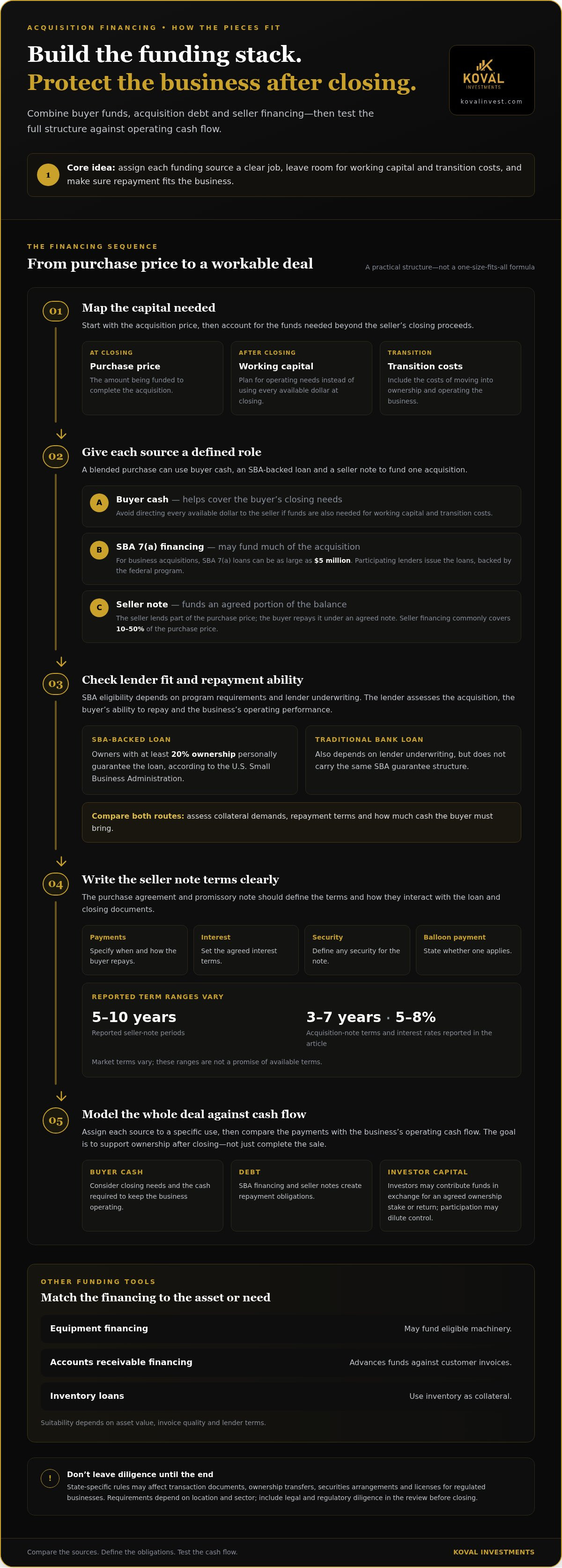
A buyer can combine personal cash, an SBA-backed loan, and a seller note to fund one acquisition. The U.S. Small Business Administration says SBA 7(a) loans for business acquisitions can be as large as $5 million. The loan can cover much of the purchase, while buyer equity and seller financing fill the remaining gap. This approach also leaves room to plan for working capital and transition costs, rather than directing every available dollar to the seller at closing.
SBA 7(a) loans are issued by participating lenders and backed by the federal program. The lender assesses the acquisition, the buyer’s ability to repay, and the business’s operating performance. Owners with at least 20% ownership personally guarantee the loan, according to the U.S. Small Business Administration. Eligibility depends on program requirements and lender underwriting, so buyers should prepare financial records, acquisition details, and a clear repayment case. Traditional bank loans also depend on lender underwriting, but they don’t carry the same SBA guarantee structure. Comparing both options helps buyers assess collateral demands, repayment terms, and how much cash they must bring.
With seller financing, the seller lends part of the purchase price, and the buyer repays that amount under an agreed note. Seller financing for a business acquisition commonly covers 10-50% of the purchase price. Market terms vary: reported seller-note periods range from five to 10 years, while acquisition notes commonly have 3-7-year terms and 5-8% interest rates. The purchase agreement and promissory note should define payments, interest, security, and any balloon payment. An attorney can review how those terms interact with the loan and closing documents.
Seller notes can reduce the buyer’s immediate cash requirement, while SBA financing may provide acquisition capital and private investors may contribute funds in exchange for an agreed ownership stake or return. The trade-off is debt versus shared equity: debt creates scheduled repayment obligations, while investor participation may dilute control.
State-specific rules may affect transaction documents, ownership transfers, securities arrangements, and licenses for businesses in regulated industries. Requirements depend on the business’s location and sector, so include legal and regulatory diligence in the review before closing.
Equipment financing can fund eligible machinery, while accounts receivable financing advances funds against customer invoices. Inventory loans use inventory as collateral. These asset-based options may support an acquisition or operating needs, but their suitability depends on asset value, invoice quality, and lender terms.
To compare a financing mix, assign each source to a specific use: buyer cash for closing needs, SBA financing for the main acquisition amount, and a seller note for an agreed balance. Then model payments against the business’s operating cash flow. This side-by-side review shows whether the structure can support ownership after closing, not just the sale itself.
2. What's the most common way to finance buying a small business?
No single financing structure fits every small-business sale. A common starting point is acquisition debt combined with buyer funds, sometimes alongside a seller note. SBA-backed financing may support eligible acquisitions, while a conventional bank loan depends on the bank’s underwriting. The right route depends on the purchase price, the business’s financial performance, available collateral, and how much capital the buyer can contribute.
A traditional sale usually sets the price and payment terms before closing, with the buyer arranging funds to pay the seller. Creative financing can change when or how part of the price is paid. For example, a seller may accept a note for part of the balance or agree to an earnout tied to future results. A willing seller may help bridge a funding gap, but the terms affect both the seller’s proceeds and the buyer’s obligations after the transition.
An earnout makes a portion of the purchase price payable only if the business meets agreed financial benchmarks after closing. Payments may be tied to performance over 1-3 years, and 30-50% of the purchase price may be linked to future results in a typical structure. The purchase agreement should define the metric, measurement period, accounting method, and payment process. Buyers and sellers should also clarify how operating decisions affect the targets, especially when the former owner remains involved.
Earnouts and SBA financing do not fit together under the rule described for this article: earnouts are not allowed with SBA financing. That makes lender compatibility an early decision, not a detail to leave until closing. If the buyer expects SBA funding, the proposed purchase structure must align with lender requirements. If an earnout is central to the seller’s offer, the buyer needs to assess another funding route and its repayment demands with an advisor.
Compare options by mapping each payment to its source and timing. Lender debt requires scheduled repayment; a seller note creates a direct obligation to the seller; an earnout depends on future performance; and private capital may involve shared equity. For example, a buyer could compare a conventional loan with a seller note against a structure where part of the price depends on agreed results. The business’s cash flow and the buyer’s control priorities help determine which trade-offs are workable.
Before signing, prepare a sources-and-uses schedule, then test the projected payments against operating cash flow. Ask the seller to define any performance measures clearly, and have an attorney review the purchase documents. A financial advisor can help compare funding scenarios. For a broader view of business funding options, consider how each structure affects the capital available to operate after closing.
3. Using retirement funds through a ROBS arrangement
A ROBS arrangement uses a C-Corporation and a 401(k) plan to roll retirement funds into company stock used to acquire a business. Instead of taking a personal distribution, the buyer structures the transaction through the corporation and its retirement plan. The funds can then contribute to the acquisition. This method changes how the buyer supplies capital, but it also adds corporate and retirement-plan responsibilities.
The sequence matters. First, the buyer establishes the C-Corporation and its 401(k) plan. The plan then uses rolled-over retirement funds to purchase company stock. The corporation uses those funds toward the acquisition and becomes the operating entity. This is a distinct financing structure, not simply a withdrawal from a retirement account. Before closing, map each step against the purchase agreement, ownership structure, and intended use of funds.
ROBS can reduce the cash a buyer needs from outside lenders, but it puts retirement savings at risk if the acquired business underperforms. The buyer may lose value in both the business investment and the retirement assets committed to it. A careful review considers the target’s cash flow, acquisition price, operating needs, and the buyer’s remaining retirement resources. For example, model how a slow transition could affect both business liquidity and personal financial security.
The arrangement also requires ongoing administration. The owner must take a reasonable salary and maintain C-Corporation compliance, including annual meetings and separate tax returns. These obligations continue after the purchase, so include them in the operating plan rather than treating ROBS as a one-time closing task. The corporation’s records, retirement-plan administration, and business finances need clear separation and consistent oversight.
Tax exposure is another consideration: using retirement savings for startup funding may result in a tax hit. That possibility makes a ROBS structure different from financing with scheduled lender repayments. Before committing retirement assets, buyers should compare each strategy’s risks, control implications, and cash-flow demands. A financial advisor and attorney can help assess the structure alongside the acquisition documents and the buyer’s broader financial position.
ROBS may suit a buyer with retirement funds available who wants to use them as acquisition capital, but it is not a substitute for evaluating the business. Prepare a due-diligence file, test the company’s projected cash flow, and plan for corporate compliance before funds move. Then compare ROBS with debt and other financing options. This helps determine whether the potential access to capital justifies the long-term investment and administrative responsibilities.
4. Example financing mix for a business purchase
Together, those sources equal the stated uses. The example shows how a buyer can allocate funding across a lender, personal capital, and the seller rather than expecting one source to cover everything.
Full standby means the seller note is structured to remain unpaid during the agreed standby period. In this example, the buyer’s cash contribution supports closing, while the SBA loan provides most of the acquisition funding. The seller’s $100,000 note adds another source without requiring that amount from the buyer at closing. Its documented terms should specify repayment, interest, security, and how standby affects payment timing.
Treat this as a financing illustration, not a forecast of the acquired company’s performance. Before agreeing to the mix, compare scheduled loan payments with the target’s revenue, operating expenses, and working-capital needs. If revenue falls or the business faces an unexpected disruption, available cash flow still needs to support operations and required debt payments.
Buyers should also distinguish the purchase price from other transaction uses. These items affect the full funding plan, even when they are not part of the seller’s price. Keep an updated sources-and-uses schedule so the buyer, seller, lender, and advisors are working from the same figures.
To structure and negotiate creative financing, first confirm the acquisition price and itemize closing and operating needs. Then identify each funding source, test payment obligations against cash flow, and negotiate the seller note’s standby, interest, security, and repayment terms. Finally, have an attorney review the purchase agreement and financing documents before signing.
Investors can provide another source of capital, but this example does not include them. Adding an investor changes the ownership structure and may affect decision-making after closing. Compare that trade-off with the debt obligations in the SBA loan and seller note. Credit records, business administration documents, and financial statements should support the buyer’s funding request and the company’s operating plan.
A financing mix works as a coordinated plan, not merely a list of available funds. This makes gaps easier to spot before closing, including whether enough capital will remain for administration, inventory, and day-to-day operations after ownership transfers.
5. What are common creative financing options for buying a business in the US?
U.S. buyers can combine debt, seller participation, investor capital, or equity arrangements to structure an acquisition. Each option changes who provides funds, when payments are due, and whether ownership is shared. Compare the complete costs and obligations, not just the cash needed at closing. A structure that reduces the buyer’s upfront contribution may create repayment or control commitments later.
Seller financing lets the seller lend part of the purchase price under a promissory note and purchase agreement. The documents can specify interest, repayment dates, security, and any balloon payment. A seller-financed purchase may require a balloon payment three to five years after the purchase date. Interest and fees can increase the total cost, so model the full payment schedule before agreeing.
Earnouts make some payment contingent on the business meeting financial benchmarks after closing. In a typical structure, 50-70% of the purchase price is paid at closing, with the remaining portion linked to performance. Define the benchmark, accounting method, measurement period, and payment process in the acquisition documents. Clear terms help both parties understand how revenue or other agreed results determine future payments.
Mezzanine financing can fill a funding gap behind senior bank debt and seller financing. These lenders may take a junior lien position and often rely on limited collateral. Rates may be north of 15%–20%, making this option materially different from lower-cost senior debt. Review how its interest and repayment schedule affect cash flow before adding it to the capital stack.
Angel investors may contribute funding and business advice in exchange for an agreed-upon share. This can reduce the buyer’s borrowing needs, but also means sharing ownership and potentially decision-making. Set out the investor’s role, rights, and return expectations in written agreements. Weigh that exchange against the fixed repayment demands of debt.
Equity swaps use shares or equity in the buyer’s company instead of a traditional cash payment. A debt-to-equity swap works differently: it converts the target company’s debt obligations into equity ownership. Both structures affect ownership and control, so document how the exchange is valued and what rights the new equity holder receives.
Regulation Crowdfunding offerings use an SEC-registered funding website and are subject to limits and disclosure requirements. This route can bring in funds from multiple investors, but adds disclosure and administration responsibilities. Compare those obligations with a private investor arrangement before including crowdfunding in the acquisition plan.
Start by matching each option to a specific funding need, then compare repayment, security, ownership, and documentation. For practical support assessing acquisition financing, discuss your funding strategy.
Koval Investments: 0% Interest Funding Solution
Koval Investments helps business buyers assess funding paths through its 0% Interest Funding Solution and SBA Loans. If you’re comparing acquisition financing, these options can be considered alongside the purchase structure, repayment obligations, and cash needed to keep the business operating after closing.
Working Capital can address operating needs, while Credit Repair Services focus on a buyer’s financial profile. The useful next step is to clarify the acquisition amount, available funds, and expected business cash flow, then compare which financing options align with those needs. This practical review can help connect the purchase plan with the capital required to operate the business.
For a conversation about financing your business purchase, contact Koval Investments or visit kovalinvest.com.
Put your acquisition plan into motion
The next step is to turn your financing ideas into a decision-ready plan. Set out the capital you can contribute, the obligations you are prepared to take on, and the cash the business needs to operate after the purchase. This framework can help you compare creative financing for buying a business against your ownership goals and financial priorities.
Koval Investments offers a 0% Interest Funding Solution and SBA Loans for buyers exploring funding options. Credit Repair Services can also support work on your financial profile. The focus is a financing approach that fits the acquisition and the responsibilities that come with ownership.
Bring your acquisition goals and financing questions to a conversation with Koval Investments. Contact Koval Investments to discuss your plans, and take the next step with a clear view of the capital your purchase requires.
Frequently Asked Questions
What Is Creative Financing?
Creative financing for buying a business means combining or adapting funding sources to complete an acquisition. Rather than relying only on buyer cash or one conventional loan, a deal might use lender financing, a seller note, investor capital, or payments tied to future performance. The structure should match the buyer’s resources and the business’s ability to support payments. Each source brings different repayment, ownership, and documentation considerations.
What's the most common way to finance buying a small business?
No single structure fits every small-business acquisition, but buyers often compare acquisition loans with available cash and any seller financing. SBA-backed financing may be relevant when the buyer and business meet program and lender requirements. Start by separating the purchase price from operating funds, then compare scheduled debt payments with the company’s cash flow. A seller note or investor capital can change the amount borrowed and the buyer’s obligations.
Can SBA 7(a) loans finance a business acquisition, and what are the current requirements?
Yes. SBA 7(a) loans can finance business acquisitions, with loans as large as $5 million, according to the U.S. Small Business Administration. Requirements include lender underwriting and program eligibility. The described acquisition structure calls for a 10% down payment, with up to half potentially coming from a seller note on full standby or a small passive investor. Since March 1, 2026, every owner for the SBA financing discussed must be a U.S. citizen or U.S. national living in the United States.
How much down payment is typically needed to buy a business using creative financing?
SBA 7(a) business acquisition loans typically require a 10-20% down payment. The described SBA acquisition structure requires a 10% down payment, with up to half potentially coming from a seller note on full standby or a small passive investor. These figures describe different financing contexts, not a universal rule for every deal. The amount a buyer needs depends on the structure, lender requirements, and how the funding sources are documented.
How do earnouts and contingent payments work in business acquisitions?
An earnout makes part of the purchase price payable only if the business meets specified financial benchmarks after closing. Payments may track performance over 1-3 years, and a typical structure may tie 30-50% of the purchase price to future results. The agreement should state how the benchmark is calculated and when results are measured. Earnouts aren’t allowed with SBA financing, so the proposed payment structure must fit the selected funding route.
Can a buyer use an IRA or 401(k) to finance a business purchase through ROBS?
A ROBS arrangement uses a C-Corporation and a 401(k) plan to roll retirement funds into company stock used to acquire a business. It requires the owner to take a reasonable salary and maintain C-Corporation compliance, including annual meetings and separate tax returns. Using retirement savings for business funding may result in a tax hit. Buyers should weigh the retirement assets at risk against the acquisition’s cash-flow needs and ongoing administrative responsibilities.
What are the risks and tax implications of seller financing and other creative acquisition structures?
Seller financing creates a repayment obligation, and interest, fees, security, and balloon payments can affect the buyer’s costs and cash flow. A seller may be able to spread capital gains over time and receive tax advantages; earnout payments may also offer tax benefits. A ROBS arrangement carries retirement-investment and compliance risks. Tax treatment depends on the transaction structure, so account for these issues during diligence and document review.