
Crowdfunding vs. Traditional Business Loans: Which Funding Fits Your Business?
A funding route without scheduled loan payments can still demand a serious investment of time, audience-building, and campaign effort, with no guarantee of reaching its goal. That’s the trade-off at the heart of crowdfunding vs traditional business loans. If you’re weighing community support against borrowing, compare repayment, ownership, and whether the funds can arrive in time for your business need.
Neither option fits every goal. A loan usually involves scheduled repayments and interest, but generally lets owners retain equity. Crowdfunding can take several forms, from preorders and rewards to debt or equity, and each comes with different obligations. A campaign may avoid conventional loan payments, but it doesn’t guarantee that you’ll raise the amount you need. Equity funding can also mean sharing ownership.
This guide compares both options across repayment, ownership, eligibility, timing, effort, and funding certainty. It also explains how to match a funding route to your cash flow and purpose, and how financial readiness and your credit profile fit into borrowing preparation. Koval Investments helps business owners plan capital procurement in light of their financial position and broader business goals.
Key Takeaways
- Use crowdfunding vs traditional business loans to compare the obligations behind each route, not just how quickly it may raise capital.
- Match the funding method to your project, required amount, and timeline before committing to an application or campaign.
- Test whether scheduled loan payments remain manageable under conservative cash-flow assumptions.
- Assess whether you can build an audience and deliver on campaign commitments before relying on crowdfunding.
- A clear capital strategy can connect your funding purpose, financial readiness, and next steps, including credit optimization when borrowing is under consideration.
Crowdfunding vs. Traditional Business Loans: What Is the Difference?
Both crowdfunding and business loans can bring capital into a company, but they create different obligations for the owner. A loan provides borrowed funds that the business must repay under agreed terms. Crowdfunding gathers contributions from multiple people, and what the business owes, if anything, depends on the campaign model. The distinction matters: borrowing creates a repayment obligation, while crowdfunding can involve supporters, customers, or investors under different arrangements.
In short: crowdfunding raises money from a group of backers under a defined campaign model; a traditional business loan provides borrowed capital that must be repaid according to its terms. Neither is automatically cheaper. Costs and obligations depend on the specific arrangement.
What counts as crowdfunding for a business?
Crowdfunding describes several ways to raise money from multiple contributors. This What Is Crowdfunding? overview offers a starting point. The model determines what contributors receive:
- Donation-based: contributors give without expecting a financial return.
- Reward-based: backers receive a product, experience, or other promised reward.
- Equity: investors receive an ownership interest in the business.
- Debt: contributors lend funds that the business agrees to repay, potentially with interest.
Before launching, review the platform’s current campaign rules and any securities requirements that may apply, particularly to equity offerings. Requirements and terms depend on the campaign structure, so verify the rules that apply to your specific model.
What makes a business loan traditional?
A business loan is borrowed money, called the principal, that the company repays over an agreed schedule. The lender may charge interest, which is the cost of borrowing. Before making an offer, a lender typically reviews information about the business and its finances through underwriting. The resulting terms set out the repayment obligation.
Bank loans and SBA-backed loans are both forms of borrowing, but they are not interchangeable products. Their terms, application processes, and qualification standards vary by lender and program. An SBA-backed loan follows a specific program structure, so its requirements may differ from those of a bank loan without that backing. Review the actual terms rather than assuming the labels tell the whole story.
That’s the core of crowdfunding vs traditional business loans: a campaign may exchange contributions for rewards, ownership, or repayment, while a loan creates a contractual repayment obligation. To compare them meaningfully, identify what the funds will support and what your business can responsibly commit to in return. The next step is to look at how each route works in practice.
How Crowdfunding and Business Loans Work in Practice
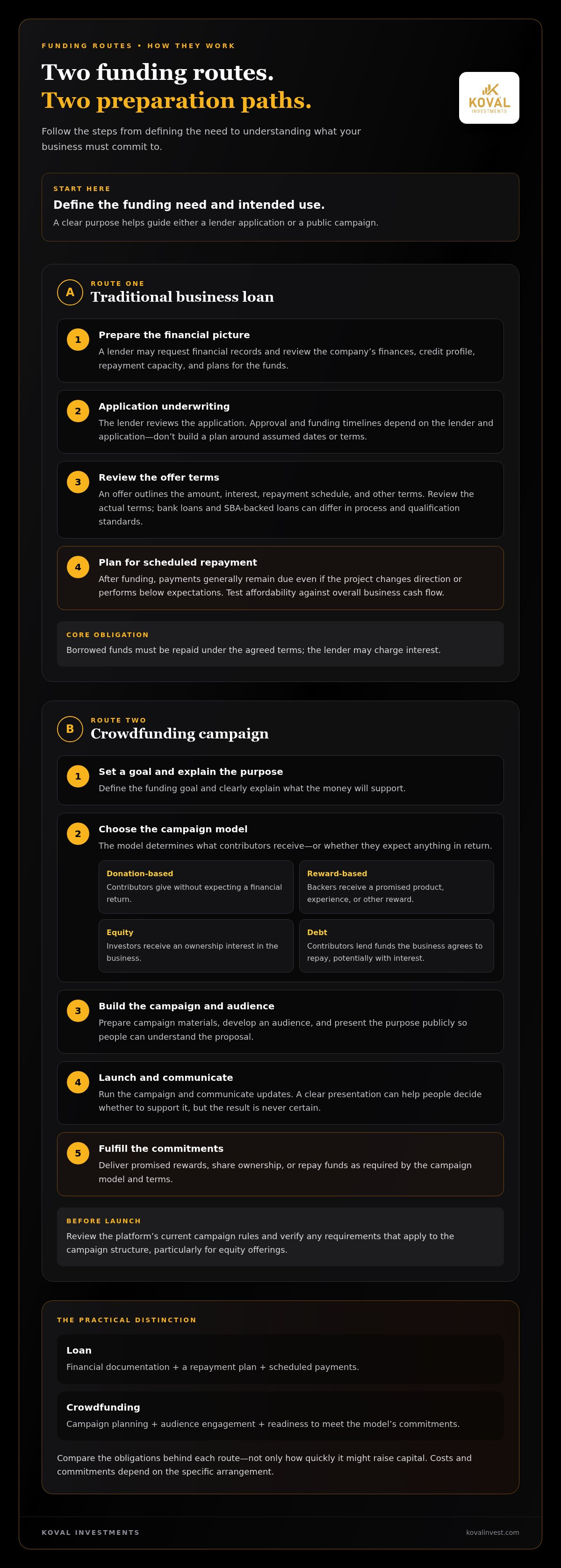
The two routes require different preparation. A loan application centers on the business’s finances and ability to repay. A crowdfunding campaign requires the business to explain its purpose publicly, attract support, and meet the commitments attached to its funding model. In either case, defining the amount needed and what it will accomplish helps guide the process.
What happens before and after a loan is approved?
Start by defining the funding need and intended use. A lender may request financial records and review the company’s finances, credit profile, repayment capacity, and plans for the funds. It then underwrites the application and, if it makes an offer, outlines the amount, interest, schedule, and other terms. Approval and funding timelines depend on the lender and application, so avoid building a plan around assumed dates or terms.
After funding, the business follows the agreed repayment schedule. Payments generally remain due even if the project changes direction or performs below expectations. Assess repayment against the business’s overall cash flow, not only the projected return from the funded project.
What does a crowdfunding campaign require?
A campaign starts with a specific funding goal and a clear explanation of what the money will support. The business then develops its audience, prepares campaign materials, launches, communicates updates, and follows through on its promises. A clear public presentation helps people understand the purpose and decide whether to support it, but a campaign’s result is never certain.
Crowdfunding outcomes depend on the funding model and campaign terms. A reward-based campaign may require the business to produce and deliver promised rewards. Equity and debt arrangements involve different commitments, such as sharing ownership or repaying funds. Public contributions, rewards, investments, and loans are not the same kind of funding. Review the current platform terms and verify any requirements relevant to the campaign structure before launch.
The practical difference in crowdfunding vs traditional business loans is also the preparation involved: borrowing requires financial documentation and a repayment plan, while crowdfunding calls for campaign planning, audience engagement, and readiness to fulfill commitments. Capital procurement planning with Koval Investments can connect your funding need with financial readiness and business priorities.
Crowdfunding vs. Business Loans: Compare Risk, Cost, Control, and Timing
The right comparison is not simply “free money” versus “debt.” A loan can preserve ownership but requires repayment. Crowdfunding can bring obligations such as delivering rewards, repaying contributors, or sharing equity. The trade-offs depend on the specific loan offer or campaign model, so compare the actual terms and demands rather than relying on broad assumptions.
| Factor | Traditional business loan | Crowdfunding |
|---|---|---|
| Repayment | Scheduled payments of principal and interest create an ongoing obligation. | Donation and reward models may not require repayment; debt crowdfunding does. |
| Ownership | Borrowing alone generally doesn’t transfer ownership, though the loan agreement sets its own terms. | Equity crowdfunding may dilute ownership and give investors rights under the offering terms. |
| Access | Depends on lender underwriting, the business’s financial position, and program requirements. | Depends on the model, campaign setup, applicable platform terms, and ability to reach supporters. |
| Timing | Review and funding timelines vary by lender and application. | Preparation, promotion, campaign duration, and fulfillment affect the timeline. |
| Effort | Requires application materials and engagement with lender review. | Requires a clear public pitch, audience outreach, updates, and possibly reward fulfillment. |
| Funding certainty | Funding depends on approval and the final offer. | Campaign results depend on audience response and the campaign’s terms; reaching the goal isn’t guaranteed. |
How do repayment and ownership obligations differ?
Loan repayments can strain cash flow even if the funded project underperforms. The business still needs to plan for payments according to its agreement. Crowdfunding obligations vary: a reward campaign can create production and delivery responsibilities, debt crowdfunding involves repayment, and equity fundraising can reduce the owner’s share of the business. Donation-based support is different again. Treating all crowdfunding as one arrangement overlooks these important distinctions.
Which option offers more certainty and control?
A lender makes an underwriting decision based on its process and the application. A campaign relies on potential backers choosing to contribute. Neither route guarantees funding, and timing, terms, and any applicable fees can vary. A campaign may demand substantial promotion without reaching its goal. Borrowing avoids that particular audience-building effort but introduces scheduled repayment. A loan doesn’t automatically mean giving up equity, and crowdfunding isn’t automatically free. In crowdfunding vs traditional business loans, control comes down to the commitments in the specific agreement. Review them against your cash flow, ownership preferences, and capacity to deliver.
How to Choose Between Crowdfunding and a Traditional Business Loan
Choose based on what the capital needs to accomplish and which obligations your business can manage. This decision process can help you compare crowdfunding vs traditional business loans without assuming either route is automatically faster, less costly, or more accessible.
- Define the project and amount. Identify what the funds will pay for, how much the project requires, and what happens if you raise less than planned.
- Set the deadline. Work backward from when the capital must be available. Leave room for application review or campaign preparation and promotion. Neither route guarantees funding by a particular date.
- Test repayment capacity. If considering a loan, estimate payments against conservative revenue and cash-flow assumptions. Ask whether the business could keep up if the project is delayed or underperforms.
- Assess campaign readiness. If considering crowdfunding, identify the audience you can reach, the message that will motivate support, and the time and resources available to communicate throughout the campaign.
- Compare the obligations. Weigh loan terms against campaign commitments, including any reward fulfillment, repayment, or ownership implications that apply to the crowdfunding model.
When might a loan align better with the business?
A loan may suit a defined capital need when the business has a credible repayment plan, relevant financial documentation, and cash flow that can support scheduled payments under cautious assumptions. A clear intended use also helps frame the funding request. SBA-backed financing is one option to understand, though program requirements and loan terms vary. Read SBA loan assistance guidance for more context.
When might crowdfunding fit the funding goal?
Crowdfunding may be worth considering when the business has a reachable audience, a proposition that’s easy to explain, and the capacity to manage campaign work. Rewards may suit a product or experience supporters can receive. Public contributions, debt, and equity each involve different terms and responsibilities. Compare those obligations with the value of the capital sought and the time needed to prepare, promote, and fulfill the campaign.
A sound decision starts with financial readiness, not a headline rate or an optimistic campaign target. Koval Investments approaches capital procurement as a planning process that considers business needs and financial position. Discuss your funding readiness as you weigh your next step.
Plan Your Next Funding Step with a Clear Capital Strategy
The right funding choice should support the business purpose without creating obligations the company can’t manage. Compare repayment capacity, ownership preferences, campaign readiness, and how soon the funds are needed. A clear capital strategy turns the crowdfunding vs traditional business loans decision into a practical plan, grounded in the business’s finances and priorities rather than assumptions about either route.
Prepare your business before pursuing capital
Bring together current financial records, a defined use for the funds, projected cash flow, and a picture of existing obligations. If borrowing is under consideration, review the business’s credit profile to identify areas that may need attention as part of preparation. These steps can help clarify financial readiness, though they don’t guarantee approval or particular terms. Koval Investments also offers 0% interest funding solutions, which you can consider as part of broader capital planning.
Explore funding options with strategic support
Capital procurement connects a business’s funding need with its financial position and objectives. Koval Investments helps business owners pursue capital through 0% interest funding solutions, SBA loans, and working capital, alongside credit optimization and strategic planning. Reviewing funding options in context can help owners understand useful preparation steps and how different sources of capital fit their plans. For more perspective, see this guide to alternative business funding solutions.
Before moving forward, write down the amount needed, the purpose, the required timeline, and the obligations the business is prepared to take on. For a loan, test potential repayments against conservative cash-flow projections. For crowdfunding, consider whether the audience, campaign effort, and any fulfillment or investor commitments align with the value and timing of the funds sought.
A thoughtful funding discussion can help organize these priorities and identify a practical next step. Start a conversation about aligning capital with your business objectives and prepare to assess the options against your financial readiness.
Make Your Next Funding Decision with Confidence
The right choice in crowdfunding vs traditional business loans depends on what the capital will support and what your business can realistically take on. Compare repayment capacity, ownership preferences, campaign readiness, and timing before committing. A loan’s scheduled payments need to fit cash flow, while crowdfunding requires a suitable model, clear campaign terms, and the capacity to reach supporters and meet commitments.
Preparation can make the next step more informed. Organize financial records, clarify the funding purpose, and review projected cash flow and existing obligations. If borrowing is part of the plan, credit repair and financial optimization may help address readiness needs. Koval Investments supports capital procurement through 0% interest funding solutions, SBA loans, and working capital, with funding and advisory options considered in light of business goals.
Explore Koval Investments’ business funding support to discuss how capital options may align with your objectives and prepare a practical next step. With a clear view of the commitments and your financial position, you can move forward with greater confidence.
Frequently Asked Questions
Is crowdfunding better than a traditional business loan?
Neither is universally better. The right fit depends on your funding purpose, cash flow, timeline, and willingness to take on specific obligations. A loan may suit a defined need when the business can manage scheduled repayments. Crowdfunding may fit a business with an engaged audience and the capacity to run a campaign and meet its commitments. Compare the actual terms and likely demands of each route rather than assuming one is always cheaper or easier to secure.
Does crowdfunding have to be paid back?
Not always. Donation-based crowdfunding generally involves contributions without repayment, while reward-based campaigns require the business to deliver the promised rewards. Debt crowdfunding involves repayment under its terms, and equity crowdfunding involves giving investors an ownership interest rather than repaying a conventional loan. The obligations depend on the specific model and campaign terms. Before raising funds, understand what supporters or investors are promised and what responsibilities the business will need to fulfill.
Can a startup get a traditional business loan?
Yes, a startup may be able to obtain a business loan, but qualification depends on the lender, program, and application. A newer company may have less operating and repayment history to demonstrate, so lenders may review available financial records, the owner’s credit profile, the business plan, and the intended use of funds. SBA-backed loans are one possible route, but requirements vary by program. Prepare realistic cash-flow projections and supporting documentation before pursuing financing.
What are the risks of crowdfunding for a small business?
Crowdfunding carries the risk that a campaign won’t attract enough support to meet its goal, despite the time and promotion invested. A business may also need to deliver rewards, communicate with backers, repay debt contributors, or share ownership, depending on the model. Poorly planned fulfillment or unclear campaign terms can create operational and reputational challenges. Before launching, assess whether the business can meet its promises and understand the platform’s current rules and terms.
Do business loans affect your credit score?
They can, but the impact depends on how the lender handles credit checks and reports the loan, as well as whether the business or an owner is responsible for repayment. An application may involve a credit inquiry, and missed payments can have consequences under the lender’s reporting practices. Ask how the loan will be reported and review the terms before applying. Reviewing and improving your credit profile may be a useful part of financing preparation, but results aren’t guaranteed.
Can a business combine crowdfunding with a loan?
A business may use both, provided each funding arrangement’s terms allow it and the combined obligations make sense for its finances. For example, a company might use campaign proceeds for a defined launch while borrowing for a separate business expense. Account for loan repayments alongside any crowdfunding commitments, such as rewards, investor interests, or debt repayment. Be transparent about how funds will be used, and review applicable lender and platform terms before combining funding sources.
How do I decide between crowdfunding and a business loan?
Start with the project, the amount required, and when the funds must be available. Then test whether projected cash flow can support loan payments under conservative assumptions. If considering crowdfunding, assess whether you can reach an audience, explain the offer clearly, and fulfill campaign commitments. In crowdfunding vs traditional business loans, the better choice is the one whose obligations, timing, and preparation needs align with your business goals and financial position.