
Debt Financing vs Equity Financing: Compare Costs and Control
Debt can preserve ownership, but it must be repaid with interest; equity avoids scheduled loan payments but gives investors a share of the business. The debt financing vs. equity financing pros and cons come down to whether predictable repayments or shared ownership better fit your cash flow and growth plans. Neither option is automatically cheaper: debt has a borrowing cost, while equity can mean sharing future profits and decisions.
It makes sense to weigh both carefully. A loan may suit a business with steady revenue and a clear repayment plan, while equity may fit a company that needs capital but has limited cash for regular payments. The trade-off is about more than interest versus ownership: repayment obligations, investor influence, funding needs, and the business’s stage all matter.
This comparison explains how debt and equity affect repayment, cost, control, and ownership. It also covers other ways to fund a business and when combining options may make sense, giving you a practical framework for matching a funding choice to your company’s finances and priorities.
Key Takeaways
- Choose debt when predictable cash flow can support repayments and keeping ownership is a priority.
- Consider equity when regular loan payments would strain cash flow and sharing ownership or decisions fits your growth goals.
- Compare more than interest: weigh repayment terms, potential collateral, investor influence, and the future share of profits.
- Match funding to your business stage, financial profile, and a clear plan for how the capital will be used.
- Combining debt and equity can balance repayment obligations with ownership dilution when one source alone does not fit.
Why Would a Company Choose Debt Financing Over Equity Financing?
In the United States, equity raises involve legal and disclosure obligations shaped by how shares are offered. A company needs to address the offering’s terms, investor rights, and material risks; specific requirements depend on the route used.
Ownership priorities help clarify the choice: debt preserves founders’ shares, while equity exchanges a stake for capital. Comparing the debt financing vs. equity financing pros and cons means weighing that ownership trade-off against the company’s funding needs and desired decision-making authority.
Equity Ownership Dilution
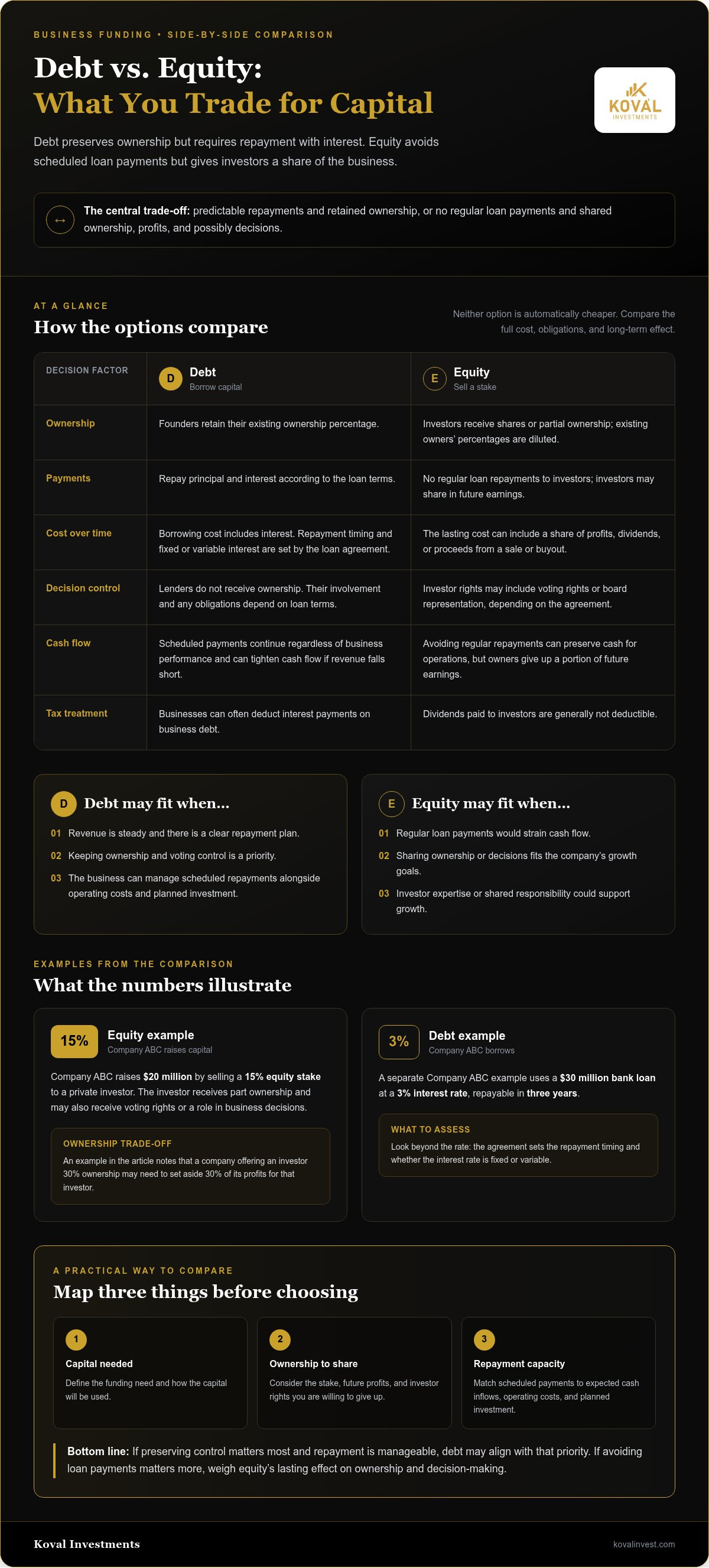
Equity financing raises capital by selling shares or partial ownership to an investor. The investor receives a stake, which dilutes the ownership percentage held by founders and existing investors. For example, Company ABC raises $20 million by selling a 15% equity stake to a private investor. That investor’s ownership can also bring voting rights or a role in business decisions.
The percentage matters over time. If a company offers an investor 30% ownership, it may need to set aside 30% of its profits for that investor. Issuing additional equity can dilute existing investors again, so the initial agreement affects future fundraising and the founders’ share of potential gains.
Debt Ownership Retention
Debt financing brings in capital through borrowing rather than selling shares. The lender receives repayment of principal and interest, not an ownership stake, so founders retain their existing ownership percentage. Depending on the loan terms, the lender may not take part in day-to-day operations.
That distinction does not mean every decision remains unrestricted. Loan terms may impose obligations, but the lender relationship ends after repayment. Debt can therefore suit owners who want to protect voting control and avoid sharing future profits, provided the business can manage the repayment commitment.
Consider decision authority alongside ownership percentage. An investor requesting more than 50% ownership could eliminate the owner’s decision-making authority. Even a smaller stake can influence important choices when the shareholder agreement grants voting rights or board representation. Review the proposed rights, not only the headline percentage.
A practical test is whether you can earn $1 without asking anyone for permission. If independent decisions are central to your plans, debt may better align with that priority. If investor expertise or shared responsibility could support growth, equity may offer value beyond capital. Company ABC’s 10% ownership example also shows that a smaller stake still means giving up part of the business.
| Financing option | Ownership outcome | Decision control | Key obligation |
|---|---|---|---|
| Equity | Investor receives shares or partial ownership | May include voting rights or board seats | Share profits and follow agreed investor rights |
| Debt | Founders retain their ownership | Lender involvement depends on loan terms | Repay principal and interest |
To choose, map the capital needed, the ownership you are willing to share, and the authority investors would receive. If preserving control ranks highest and repayment is manageable, debt may fit. If avoiding loan payments matters more, weigh the lasting ownership and decision-making effects of equity.
Repayment obligations and interest
Debt financing turns borrowed capital into scheduled payments, while equity financing avoids loan repayments in exchange for a share of future earnings. Compare the payment schedule, interest terms, and effect on operating cash flow before choosing how to fund a business.
Debt Costs, Terms, and Tax Treatment
Debt costs include principal and interest, with the loan agreement setting repayment timing and whether the interest rate is fixed or variable. A Company ABC example uses a $30 million bank loan at a 3% interest rate, repayable in three years. The example shows why businesses should assess the full obligation across the term, rather than looking at the rate alone.
Tax treatment also affects the comparison: businesses can often deduct interest payments on business debt, while dividends paid to investors are generally not deductible. Consider the repayment schedule, interest structure, and tax treatment together. A lower payment at one point in the schedule may still mean managing debt over a longer period.
Equity Without Repayment
Equity financing provides capital without requiring regular loan repayments. Instead, investors receive an ownership stake and may share in future earnings. This can help a business preserve cash for operations when scheduled debt payments would leave too little flexibility.
The trade-off lasts beyond the funding period. An investor may receive dividends, a share of profits, or proceeds from a sale or buyout. Unlike a loan, equity does not end with a final principal payment; the investor’s rights and share of returns follow the ownership agreement.
Repayment and Cash-Flow Impacts
Debt requires scheduled repayments regardless of business performance. Map each payment against expected cash inflows, operating costs, and planned investment. If revenue falls short, the same fixed obligation can tighten cash flow precisely when the company needs room to respond.
Equity can ease monthly pressure because the company does not make regular repayments to investors. However, the owner gives up a percentage of future earnings. Compare the value of retaining cash today with the long-term share of profits surrendered, rather than treating equity as cost-free funding.
Before committing to either option, work through three steps: forecast cash flow across the repayment schedule, identify how much capital the business needs, and compare the total debt obligation with the ownership and earnings shared under equity. Businesses that cannot support repayments from expected cash flow should weigh equity carefully; those with stable revenue may value debt’s predictable cost and lack of ownership dilution.
For a business comparing borrowing costs with other funding routes, Koval Investments’ 0% interest funding solution is one option to consider alongside repayment needs and cash-flow plans.
Debt financing through business loans and lines of credit
Business loans and lines of credit are common forms of debt financing. A term loan provides capital under a repayment agreement, while a line of credit lets a business borrow as needed within its approved limit. Both involve borrowing, and their interest rates and repayment terms shape the effect on cash flow and profit.
A startup or small business may favor debt when revenue can support payments and owners want to retain shares. Equity may fit an early-stage company without reliable revenue or spare cash for repayments. The deciding factors are cash-flow capacity, growth stage, funding purpose, and willingness to bring investors in as partners.
Loan eligibility often depends on the business’s financials and creditworthiness. Lenders may look for a solid business credit history or collateral, and some may require personal or family financial assets as a guarantee. According to USAGov, creditors use credit scores to assess borrowing behavior, including the likelihood of making loan payments.
For debt financing, compare the loan structure with the business need. A term loan can suit a planned investment with a clear use, while a line of credit can support changing working-capital needs. Bonds are another common form, though the amount sought, business stage, credit profile, and available collateral can affect which options are accessible.
Equity financing raises capital by selling shares to investors, venture capital firms, or the public. It can suit a startup seeking funds to scale before steady revenue can support loan payments. An investor may also bring experience or knowledge that helps the company grow. The trade-off is giving up partial ownership and potentially sharing profits and decisions.
Growth stage affects both access and affordability. An established business with steady cash flow may be better positioned to manage borrowing, while a pre-revenue startup may find equity more suitable. A sole proprietor may need to change the business structure to use equity financing. The funding plan should match the company’s stage and intended use of capital.
Equity can also take longer to arrange because founders and investors negotiate the ownership percentage and investment terms. U.S. venture capital investment totaled more than $170 billion across nearly 14,000 deals in 2023. Those figures show the scale of that funding channel, but a company still needs a clear case for its growth plan and investor fit.
Before choosing, write down the funding purpose, expected cash flow, repayment capacity, and ownership you are willing to share. Then compare a business loan or credit line with selling shares, including how each affects profit and decision-making. Debt can preserve ownership but creates a payment obligation; equity avoids loan repayments but brings investors into the business.
Combining debt and equity financing
A company can use debt and equity together to balance financial risk, preserve cash flow, and fund growth. This blended structure works best when each source has a defined purpose, rather than adding borrowing or investor obligations without a clear connection to the business plan.
Start with the use of funds. Assign debt to an expense with a repayment path, such as equipment that supports operating revenue, and consider equity for expansion whose returns may take longer to develop. This separation helps owners connect loan payments to cash generation while reserving investor capital for growth opportunities with less predictable timing.
Business stage can shape the sequence. Companies commonly use debt during seed and bridge rounds to reach their next equity round. In this approach, borrowing provides interim capital, while a later equity raise may support broader growth. Founders should model whether the business can meet debt obligations before the next financing event.
Convertible debt is another structure. It begins as a loan with a repayment period and interest rate, then can convert into equity at the end of that period or at an agreed milestone. The company receives capital without immediately issuing shares, but conversion can dilute ownership later. The conversion terms therefore matter to founders and future investors.
To build a workable combination, map each source to a distinct role:
- Purpose: Identify which planned costs debt or equity will cover.
- Timing: Match borrowing payments to expected cash flow and equity to longer-term growth needs.
- Ownership: Estimate how conversion or a new share issuance could affect existing owners.
- Flexibility: Leave room for operating needs instead of committing all available cash to payments.
For example, a growing company might use a bridge loan to reach a planned equity round, then direct investor capital toward a longer expansion plan. That structure makes sense only if the business can manage the bridge payments and explain how the later funding supports growth. If the next equity round is delayed, repayment pressure can increase.
Compare the combined plan with using either source alone. Debt may reduce immediate dilution but adds repayment obligations; equity may protect near-term cash flow but shares ownership and potentially decision-making. A clear financing sequence lets owners assess both effects together instead of treating each funding choice as an isolated exchange.
Pros and cons of debt financing
Debt financing can fund a business venture while owners retain their equity and decision-making control. Its trade-off is a repayment obligation that continues regardless of revenue. To assess the advantages, compare the loan’s cost and terms with the cash flow available to meet payments.
Advantages: A borrower keeps ownership rather than exchanging shares for capital. The loan agreement sets repayment terms, and knowing the financing cost can help owners plan spending. Businesses can often deduct interest payments on business debt, while dividends paid to investors are generally not deductible. This tax treatment is one factor to weigh alongside the loan’s full cost.
Debt can also preserve the owner’s share of future profits. Unlike equity financing, it does not give a lender ownership or an automatic role in daily operations. Once the loan is repaid, the relationship with the lender ends. For a company with steady revenue and a defined use for borrowed funds, these features can make debt a suitable growth tool.
Disadvantages: Scheduled payments can pressure cash flow when sales fall or expenses rise. A missed payment may create financial stress, and assets used as collateral may be at risk. Loan covenants can add obligations, such as maintaining minimum cash reserves or meeting performance measures. These terms may limit flexibility even when a lender does not direct everyday decisions.
Access and affordability also depend on the company’s financial position. Lenders may assess creditworthiness, set borrowing limits, and require collateral. Interest rates, fees, and loan terms affect the overall burden. Variable interest can make future payments less predictable than fixed interest, so owners should understand how the agreement handles changes before relying on projected cash flow.
Use this practical review before raising debt:
- Match the borrowing purpose to a clear business plan and expected source of repayment.
- Test payments against revenue forecasts, including a period of weaker sales.
- Review interest, fees, collateral, and covenants together, not as separate details.
- Consider whether preserving ownership outweighs the repayment risk for this venture.
Debt is not the only alternative when a loan creates too much pressure. Grants do not require repayment or ownership, though they may be competitive. Vendor financing can extend supplier payment terms, while leasing equipment may preserve working capital. Revenue-based financing exchanges a share of future sales for capital without giving up equity, but still reduces incoming revenue.
The clearest takeaway is to borrow only when the business can connect the funds to a credible repayment plan. If revenue is uncertain or payments would restrict essential operations, compare other financing options before committing. Debt works best when its cost, obligations, and purpose fit the company’s capacity to repay.
Koval Investments: 0% Interest Funding Solution
Koval Investments offers a 0% Interest Funding Solution for business owners comparing borrowing with equity. It also provides SBA Loans and Working Capital, giving businesses additional funding options to consider alongside their cash-flow needs, growth plans, and ownership priorities.
If loan payments could restrict operating flexibility, compare available funding structures and how each fits your business’s financial profile. Koval Investments offers a Credit Optimization Program for owners working to optimize that profile as they explore capital options. The right path depends on your goals and capacity, so focus on terms and obligations that align with your plan.
Contact Koval Investments to discuss your business funding needs and next steps.
Turn your funding decision into a clear next step
Before choosing a funding path, write a short capital plan: what the funds will support, how success will be measured, and which business decisions you want to retain. This keeps the debt financing vs. equity financing pros and cons connected to your company’s priorities, rather than treating funding as a stand-alone transaction.
Bring that plan into a financing discussion. Koval Investments offers a 0% Interest Funding Solution, Credit Repair Services, and SBA Loans. These offerings give business owners options to discuss in relation to their funding goals and financial profile, without assuming one route suits every company.
Use the conversation to clarify what you need capital for and how financing could fit your plans. A deliberate next step can make a complex decision easier to assess and help you move forward with greater focus.
Contact Koval Investments to discuss financing and take the next step toward a funding plan aligned with your business.
Frequently Asked Questions
Does equity financing mean I lose control of my business?
Not necessarily; equity financing gives an investor ownership, but the agreement defines their decision-making rights. A founder might sell a minority stake while retaining day-to-day authority, yet grant voting rights over major decisions. Review the shareholder agreement for voting rules, board seats, dividends, and sale rights. The ownership percentage alone doesn’t reveal who controls every decision, so assess the rights attached to the shares before agreeing.
What is the best fundraising option for my business?
The best option is the one that fits your cash flow, funding purpose, and ownership priorities. A company with reliable revenue may be positioned to borrow for a defined project, while a pre-revenue venture may value equity’s lack of scheduled loan payments. The debt financing vs. equity financing pros and cons become clearer when you compare those factors with alternatives such as grants, vendor terms, or leasing.
What is the difference between debt and equity?
Debt is money a business borrows and must repay under agreed terms; equity represents ownership in the business. Consider a business buying equipment: debt leaves the owner responsible for repayment, while equity raises funds by giving an investor a stake. The distinction affects the balance sheet, future cash commitments, and who participates in the company’s potential profits and important decisions.
What is the difference between debt financing and equity financing?
Debt financing raises capital through borrowing, while equity financing raises capital by selling shares or partial ownership. A loan creates a borrower-lender relationship governed by repayment terms. An equity investment makes the investor a partial owner, with rights set by the share terms and shareholder agreement. Compare the funding structure and ongoing relationship each option creates, not just the amount raised.
What are the pros and cons of debt financing for a business?
Debt can let owners raise capital without issuing shares, and the loan agreement can make financing costs easier to plan. The drawback is that scheduled payments remain due even when revenue weakens. A lender may also require collateral or impose covenants, which can constrain operating choices. Before borrowing, test projected payments against a slower-sales scenario and consider whether the business can still cover essential expenses.
How do interest rates, fees, and repayment terms compare for business loans and equity funding?
A business loan has an interest rate and repayment terms, and fees may contribute to its overall cost. Rates can be fixed or variable under the agreement. Equity funding has no loan interest or scheduled principal payments, but investors receive ownership and may share in profits. Compare the loan’s total obligations with the ownership and future returns exchanged for equity. These structures create different costs over time.
How does debt financing affect ownership, control, and dilution?
Debt financing doesn’t issue shares, so borrowing alone doesn’t dilute the ownership percentage of founders or existing investors. Equity financing does: issuing new shares reduces existing owners’ proportional stakes. Control also depends on voting rights, board representation, and contract terms. For example, a founder can retain a larger ownership share yet give an investor influence over specified decisions. Review both the capitalization table and the financing agreements.
What are the tax implications of business debt versus equity financing in the United States?
Interest payments on business debt can often be deducted, while dividends paid to investors generally aren’t deductible. That difference can affect the financing comparison, but it doesn’t determine the full tax outcome by itself. Keep records that distinguish borrowing costs from payments to owners, and evaluate how the company’s structure and transaction details apply. A tax projection should consider the business’s actual financing arrangement and how it reports income.