
Fast Business Funding for Emergencies: A 2026 Decision Guide
The fastest funding option can become the most expensive part of an emergency. When payroll, repairs, or another operating expense can’t wait, fast business funding for emergencies may help protect day-to-day operations. But speed alone won’t tell you whether the repayment fits your cash flow.
Choose a funding path that matches both the urgency and your business’s circumstances. This guide compares working capital, SBA loans, and a 0% Interest Funding Solution, and explains how timing, eligibility, repayment structure, and total obligations affect the decision. You’ll also learn what financial information can help support an efficient review, and why a quick application doesn’t guarantee approval. Koval Investments helps businesses assess funding options alongside credit profile optimization and strategic guidance, connecting an immediate capital need with broader business goals. Use the steps below to weigh your choices before committing.
Key Takeaways
- Separate a one-time emergency expense from an ongoing cash-flow shortfall before choosing a funding path.
- Evaluate fast business funding for emergencies by how repayment fits your business’s cash flow, not by speed alone.
- Compare working capital, business credit, SBA financing, and a 0% Interest Funding Solution against the purpose and timing of the need.
- Make your request more focused by clarifying the amount needed, identifying a repayment source, and organizing relevant business records.
- Koval Investments’ capital procurement guidance helps you assess funding options and repayment fit. Approval and funding timing aren’t guaranteed.
Fast business funding for emergencies starts with defining the cash need
An urgent bill can disrupt operations before a business has time to work through a lengthy funding process. Fast business funding for emergencies may help address a defined shortfall, but quick access isn’t guaranteed, and speed alone doesn’t make an option suitable. Start by identifying what must be paid, when it’s due, and how the business expects to repay any borrowed funds.
Emergency business funding is a broad term for capital used to manage an unexpected expense or temporary cash shortfall. It can take different forms, so let the need guide the funding decision rather than the label. A one-time disruption may call for a different response than an ongoing mismatch between revenue and expenses. If the problem persists, borrowing without addressing its cause can add repayment pressure without fixing the underlying gap.
Working capital helps explain why a profitable business can still face a cash crunch: money may be tied up in receivables or inventory while bills come due. For a concise overview of understanding working capital, see how current assets and current liabilities relate to short-term operating liquidity.
Which business emergencies may require outside capital?
A delayed customer payment could leave payroll or a supplier invoice due before cash arrives. An essential equipment repair or an unexpected operating expense may also create a time-sensitive need. These are defined shortfalls when the business can identify the expense and a plausible repayment source, such as receivables expected later. If monthly expenses repeatedly exceed revenue, treat that as an ongoing cash-flow or structural issue, not a one-time emergency.
How much funding does the business actually need?
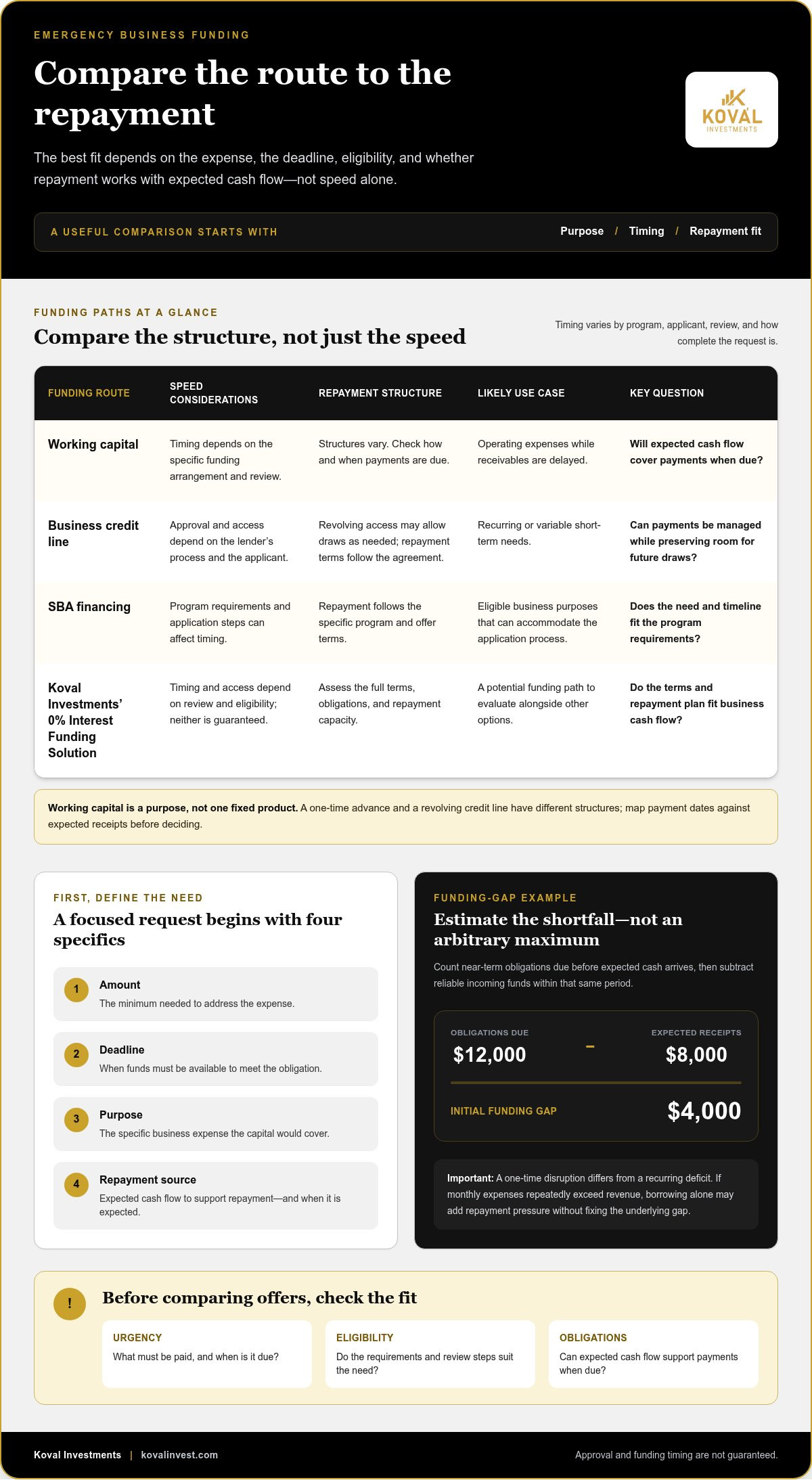
Estimate the smallest amount that resolves the immediate issue, rather than requesting an arbitrary maximum. Include obligations due before expected cash arrives, then account for reliable incoming funds within that same period. The funding gap is the amount of near-term bills that available cash and expected receipts can’t cover. For example, if $12,000 in obligations are due before $8,000 in expected receipts arrive, the initial gap is $4,000.
Before comparing options, write down four points:
- Amount: The minimum needed to address the expense.
- Deadline: When the funds must be available to meet the obligation.
- Purpose: The specific business expense the capital would cover.
- Repayment source: The cash flow expected to support repayment, and when it is expected.
This brief gives you a clearer basis for weighing timing and repayment fit. If the numbers show a recurring deficit, reassess the operating plan alongside any funding need.
Compare emergency business funding options by timing and repayment fit
The right route depends on the expense, how soon capital is needed, and what the business can repay. “Fast” has no universal timeline. Review steps, eligibility, and funding timing vary by program, applicant, and the completeness of the request. Compare the repayment structure as carefully as the expected access to funds.
| Funding route | Speed considerations | Repayment structure | Likely use case | Key question |
|---|---|---|---|---|
| Working capital | Timing depends on the specific funding arrangement and review. | May be structured in different ways; check how and when payments are due. | Operating needs such as covering expenses while receivables are delayed. | Will expected cash flow cover payments when they come due? |
| Business credit line | Approval and access depend on the lender’s process and the applicant. | Revolving access may allow draws as needed, with repayment terms set by the agreement. | Recurring or variable short-term needs. | Can the business manage payments while preserving room for future draws? |
| SBA financing | Program requirements and application steps can affect timing. | Loan repayment follows the specific program and offer terms. | Eligible business purposes that can accommodate the application process. | Does the need and timeline fit the program’s requirements? |
| Koval Investments’ 0% Interest Funding Solution | Timing and access depend on review and eligibility; neither is guaranteed. | Assess the full terms, obligations, and repayment capacity. | A potential funding path to evaluate alongside other options. | Do the terms and repayment plan fit the business’s cash flow? |
When may working capital or business credit suit an urgent need?
Working capital describes a business purpose, not one fixed product structure. A one-time advance provides a set amount under its repayment agreement. A revolving business credit line lets the business draw from available credit, repay, and potentially draw again under the account terms. The choice depends on the cash-flow pattern: a predictable one-time expense may call for a different structure than recurring fluctuations. For either route, map payment dates against expected receipts before deciding.
When should a business consider SBA financing or 0% interest funding?
SBA financing can involve program-specific eligibility and application steps, so it may not match every urgent deadline. For a declared disaster, review the U.S. Small Business Administration’s information on SBA disaster loans, including eligibility and intended uses. Koval Investments’ 0% Interest Funding Solution is another option to assess against its terms and the business’s ability to repay. Explore the 2026 guide to 0% interest business funding for more detail.
When considering fast business funding for emergencies, Koval Investments’ capital procurement guidance can help align the request with the immediate need and the business’s broader strategy. Learn more about Koval Investments funding guidance.
Does fast business funding create more risk? Assess the trade-offs first
The quickest offer isn’t automatically the best fit. Fast business funding for emergencies can help keep an essential repair, payroll obligation, or supplier payment from disrupting operations, but it also creates repayment obligations. Compare the immediate benefit with the pressure payments may put on cash flow, and calculate the total amount the business would owe under the written terms.
Look at the structure, not just how soon funds might be available. A repayment schedule that clashes with the timing of customer receipts can strain operations, even if the original expense is resolved. Repeated borrowing deserves particular scrutiny. If a business needs new funds to make payments on earlier borrowing or cover the same recurring deficit, the underlying cash-flow problem may remain unresolved. Funding should address a defined business need, not simply postpone a persistent gap.
Can the business repay without disrupting essential operations?
Map expected cash inflows against proposed payments and existing obligations. Then test a less favorable scenario: a major customer pays late, sales fall short, or the emergency leads to additional costs. Would the business still meet payments and cover essential expenses? Repayment fit matters more than speed alone. Capital that arrives quickly can still create a cash-flow problem if the business can’t meet its obligations.
Which terms should owners understand before accepting funding?
Read the full written offer before committing. Confirm payment frequency, all fees and charges, whether early repayment changes the amount owed, and whether the agreement includes collateral or personal obligations. Compare the total repayment obligation, not only the stated interest rate. Other charges and payment timing can affect the overall cost and cash-flow impact.
- Payment schedule: How often are payments due, and when does repayment begin?
- Full cost: What fees or other charges apply in addition to interest?
- Early repayment: Are there conditions or costs for paying ahead of schedule?
- Obligations: Does the agreement involve collateral or personal responsibility?
If any term is unclear, pause and get an explanation before agreeing. A sound decision accounts for both the immediate disruption and the obligations that continue after it has passed. If the repayment plan only works under optimistic assumptions or depends on borrowing again, reconsider whether the offer truly supports the business.
Prepare a focused emergency funding request in five practical steps
A clear request helps a reviewer understand the business need, the amount sought, and the repayment plan. It can also help you compare options without assuming fast business funding for emergencies is guaranteed. Prepare information carefully, keeping in mind that documentation and eligibility requirements vary by funding route.
- 1. Define the need. Summarize the specific expense, the amount required to address it, and the date the funds are needed. Explain how the capital would support business operations.
- 2. Confirm the repayment source. Identify the cash flow expected to cover payments, such as incoming receivables or projected operating revenue. Compare its timing with existing obligations so your plan reflects realistic cash flow.
- 3. Assemble relevant records. Examples that may help explain the request include available business financial statements, bank records, revenue information, current debt details, and documentation of the expense. These are preparation examples, not universal requirements. A particular funding route may call for different information.
- 4. Compare written terms. Review payment frequency, total repayment obligations, fees, and other commitments alongside the amount and timing of the funding. For SBA-specific context, review program requirements and application steps.
- 5. Decide with the full picture. Check that the request, records, and repayment plan tell a consistent story. Proceed only when you understand the written terms and can assess their fit with the business’s needs.
What information can help explain an urgent funding request?
Prepare a concise use-of-funds summary that states the requested amount, the business purpose, and the deadline. Gather relevant records you already have, such as financial statements, bank records, and revenue information. Note existing debts, expected receipts, and the proposed repayment source. Keep the figures in your request consistent with the supporting records, and explain any differences clearly.
How can owners avoid slowing down a funding review?
Organize records before beginning and keep copies together so you can respond accurately if additional information is requested. Review available business and personal credit information for inaccuracies, and address errors through appropriate channels. Credit profile optimization can support longer-term funding readiness, but it isn’t an instant fix. Koval Investments’ credit repair services identify and dispute credit report inaccuracies and help clients build a stronger credit profile for future funding opportunities.
Koval Investments’ capital procurement guidance can help align a funding request with an immediate need and broader business goals. Explore funding guidance from Koval Investments as you assess your next steps.
How Koval Investments can help evaluate emergency business funding
After defining the need and weighing repayment fit, assess which funding route aligns with the business’s circumstances. Koval Investments provides capital procurement guidance to connect an immediate capital need with the company’s broader financial objectives. Funding decisions still depend on the business’s situation, eligibility, and the terms of the funding option.
What does a strategic funding conversation help clarify?
A focused discussion brings four considerations together: the expense, the amount requested, when the capital is needed, and the business’s capacity to repay. This helps distinguish a defined short-term need from an ongoing cash-flow challenge that may call for a broader strategy. Consider potential capital routes in context rather than choosing an option based on speed or its name alone.
Koval Investments provides access to its 0% Interest Funding Solution, SBA loans, and working capital. Each has distinct terms and considerations. A 0% interest option still needs to be assessed against its eligibility requirements, written terms, and the business’s repayment capacity. SBA loan assistance helps owners consider program pathways, while working capital can be evaluated in relation to operating needs. The suitable route depends on the business and its circumstances.
This measured approach matters when fast business funding for emergencies is under consideration. A funding decision should address the immediate disruption while remaining workable alongside existing obligations and longer-term goals. Koval Investments combines capital procurement with credit profile optimization and strategic advisory to support a fuller view of funding readiness. Credit profile changes aren’t an instant solution.
What should owners do next?
Before taking the next step, prepare a concise summary of the emergency, the amount needed, the deadline, and the expected source of repayment. Organize relevant business financial information and note existing obligations. Then use the comparison framework in this guide to identify the questions that matter most: how repayments work, what the total obligations are, and whether the timing fits the business’s cash flow.
A funding review can help clarify which options merit consideration and how they relate to the company’s wider priorities. Approval and funding aren’t assured, so ground your decision in the written terms and the business’s ability to meet them. To discuss your capital needs and potential next steps, explore business funding support with Koval Investments.
Make your next funding decision with a clear plan
Fast business funding for emergencies can help address an urgent operating need, but the right choice depends on more than how quickly funds may become available. Define the cash gap, identify a realistic repayment source, and compare the funding structure and full obligations with your business’s cash flow. A focused request and organized financial information can support a more efficient review, though they don’t guarantee approval or a particular timeline.
Koval Investments provides access to working capital, SBA loans, and its 0% Interest Funding Solution. Its capital procurement work brings together funding guidance, credit profile optimization, and strategic business advisory to help assess options in light of immediate needs and wider business goals. Evaluate each route against its terms, suitability, and your capacity to repay.
If you’re ready to consider the next step, explore business funding support with Koval Investments. A measured decision can help you address the emergency while keeping your business’s financial priorities in view. Start with a clearly defined need and a practical repayment plan.
Frequently Asked Questions
What is the fastest way to get emergency funding for a small business?
An existing business credit line with available credit may be a practical place to start because access has already been established, though draw terms still apply. If no credit is available, timing depends on the funding route, application review, and business circumstances. Compare options by how soon funds may be accessible and whether the repayment schedule fits cash flow. No route guarantees approval or a specific funding date.
Can a business get emergency funding with bad credit?
It may be possible, but credit history can affect which options a business can pursue and the terms offered. Lenders may also consider revenue, time in business, existing obligations, and cash flow. Review business and personal credit information for inaccuracies, and prepare clear financial records. Credit profile optimization can support future funding readiness, but it isn’t an immediate fix or assurance of approval.
How quickly can a business receive emergency funding?
There’s no reliable universal timeline. Funding speed depends on the route, the applicant’s circumstances, the review process, and whether the requested information is complete. An existing credit facility may involve different steps from a new loan application, while SBA financing can include program-specific requirements. Before relying on a funding date to meet an obligation, confirm the timing stated in the offer or process. Approval and disbursement aren’t guaranteed.
What documents are needed for emergency business funding?
Requirements vary by funding route, so there isn’t one universal document checklist. Useful records may include business financial statements, bank records, revenue information, current debt details, and documentation describing the expense. Prepare a concise summary of the amount requested, its business purpose, the deadline, and the expected repayment source. Keep figures consistent across the request and supporting records, and provide additional materials if the review requires them.
Is 0% interest funding available for emergency business expenses?
Koval Investments offers a 0% Interest Funding Solution for businesses to evaluate against a potential capital need. Whether it fits an emergency expense depends on the business’s circumstances, applicable eligibility, the terms, and repayment capacity. Review the written agreement carefully, including any fees, payment schedule, and total obligations. The solution doesn’t guarantee access, approval, or funding by a particular date, so compare it with other suitable routes before committing.
Can a business use an SBA loan for an emergency?
An SBA loan may suit some urgent business needs, depending on the program, intended use, eligibility, and application process. For businesses affected by a declared disaster, SBA disaster assistance may provide a relevant route if the business and expense meet program requirements. Other SBA financing has its own rules and steps, which may not match every emergency deadline. Review current program guidance and weigh the process against the timing of the need.
What should a business compare before accepting fast funding?
Compare more than how quickly funds may arrive. Review the total repayment obligation, interest and other charges, payment frequency, repayment start date, early-payment terms, and any collateral or personal obligations. Then map payments against expected cash inflows and existing expenses. Fast business funding for emergencies should address a defined business need without placing essential operations under unsustainable repayment pressure. Read and understand every written term before making a commitment.