
Funding a Roll-Up Acquisition Strategy and Its Tradeoffs
Investor capital isn’t the only way to finance a roll-up. Funding for a roll-up acquisition strategy can combine a self-funded search, investor capital, and debt. The right mix depends on the buyer’s resources, acquisition plan, and ownership priorities. A roll-up brings several smaller companies together under a platform to build a larger business.
That structure can create opportunities to expand into adjacent markets, add capabilities, or consolidate operations. But each funding choice affects more than the capital available. It can shape control, repayment obligations, a seller’s continuing stake, and the buyer’s risk. Those tradeoffs matter whether you’re acquiring a platform, pursuing add-ons, or considering a sale to a consolidating business.
This article explains how roll-ups work, where add-on opportunities may arise, and how self-funding compares with investor-backed and debt-funded approaches. It also explores what owners may gain or give up when they sell or reinvest, so you can assess how a financing structure fits your growth strategy.
Key Takeaways
- Understand how a platform company can combine smaller businesses and where operational integration may support growth.
- Assess add-on targets by how well they extend the platform’s capabilities, geography, customer base, or services.
- Compare self-funding, investor capital, and debt by the control, repayment obligations, and ownership each may involve.
- Weigh potential gains from a sale or reinvestment against reduced independence and possible involvement after closing.
What is a Roll Up Strategy?
A roll-up strategy combines separate businesses through acquisitions or mergers to build a larger, coordinated company. The buyer often starts with a platform, the foundational business that provides management, financing, and operating systems for later transactions. Each acquired company is then considered for integration into the combined organization.
Buy-and-build describes the broader growth model: acquire a platform, then add businesses that strengthen it. A roll-up is one form of buy-and-build, often involving several companies in a fragmented industry. An add-on acquisition is a later purchase that expands the platform’s reach, customer base, services, or capabilities. These terms describe connected steps, not interchangeable transactions.
For example, a home-services platform could acquire other operators, then align scheduling, financial reporting, and purchasing. A target might retain its local customer relationships while adopting the platform’s shared processes. Whether the buyer merges each company into one legal entity or keeps separate entities depends on the transaction structure. Either way, operational integration requires clear responsibilities and consistent reporting.
Lenders assess the platform’s historical earnings, cash flow, debt obligations, and financial records. For each add-on, they also consider the target’s performance, purchase terms, fit with the platform, and the combined business’s ability to service debt. For SBA-financed acquisitions, debt-service coverage must be demonstrated using historical results rather than projected synergies.
The U.S. Small Business Administration states that SOP 50 10 8.1 took effect on October 1, 2026. The rulebook’s effective date matters when evaluating SBA financing requirements. A platform’s operating history and a target’s relationship to its business can affect how an expansion is assessed.
Roll-up financing carries risks: acquisition debt can strain cash flow, integration can disrupt operations, and expected efficiencies may take time to emerge. Loan agreements may include covenants governing financial reporting, leverage, additional borrowing, or future acquisitions. A breach can limit flexibility or trigger lender remedies. Buyers need to understand how combined cash flow, integration costs, and future purchases interact with those terms.
Industry fragmentation and add-on acquisition opportunities
Roll-ups often target industries with many small operators and no dominant company. Fragmentation can create room for a platform to expand through acquisitions, but a crowded market alone does not make a sound consolidation thesis. The initial business needs a clear advantage, such as trusted customer relationships, capable management, or systems that can support additional locations.
Build the thesis around specific operating opportunities. A landscaping platform, for example, might acquire other firms to extend its reach, combine purchasing, and coordinate scheduling. An add-on should complement the platform’s capabilities, customer base, services, or footprint. A target that adds revenue without supporting the strategy may increase integration demands without strengthening the combined business.
Potential roll-up industries include healthcare services, plumbing, HVAC, commercial roofing, cleaning, distribution, and auto body repair. Engineering, architecture, consulting, and other professional services also see consolidation. These sectors differ, but each can include smaller firms with related services or customers. The practical question is whether the platform can preserve what attracts customers while improving how the businesses operate.
Assess a sector’s fit through its operating characteristics, not its label. Consistent demand can support planning; fragmented operations may create opportunities to improve processes; and repeatable services can make expansion easier to manage. A diverse customer base or strong customer loyalty may also support stability. By contrast, different service models or incompatible systems can make integration harder, even when targets look attractive on paper.
For each target, consider:
- Strategic fit: Does it add a useful service, market, or location?
- Financial fit: Can its revenue and costs support the combined business’s valuation and funding plan?
- Operating fit: Can teams align reporting, purchasing, and customer service?
These checks connect the target’s price and equity needs to the work required after closing. A disciplined expansion thesis also benefits from strategic planning that ties target selection to integration capacity.
Potential benefits and tradeoffs for firm owners
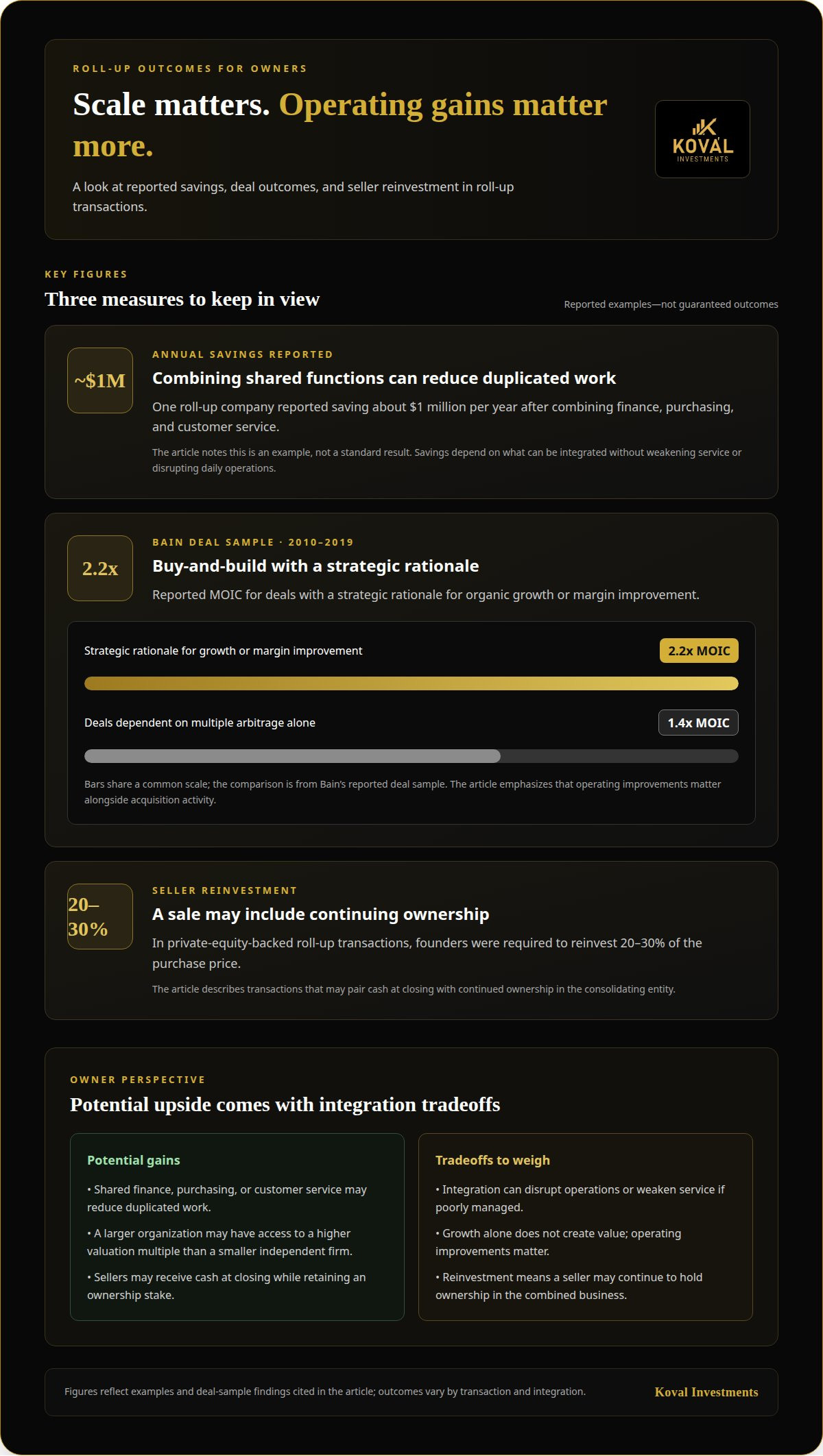
A roll-up can give owners access to a larger organization’s resources while creating economies of scale. Consolidated finance, purchasing, or customer service may reduce duplicated work. One roll-up company reported saving about $1 million per year after combining those functions. That example shows the potential, not a standard result: savings depend on what can be integrated without weakening service or disrupting daily operations.
Size may also affect valuation. Larger organizations often achieve higher valuation multiples than smaller independent firms, but growth alone does not create value. Bain’s 2010-2019 deal sample reported 2.2x MOIC for buy-and-build deals with strategic rationale for organic growth or margin improvement, compared with 1.4x for deals dependent on multiple arbitrage alone. The comparison underscores why operating improvements matter alongside acquisition activity.
For a seller, a transaction with a private equity firm may combine cash at closing with continued ownership in the consolidating entity. In private equity-backed roll-up transactions, founders were required to reinvest 20-30% of the purchase price on average. That reinvestment can preserve participation in future growth, but it also keeps part of the seller’s financial outcome tied to the combined business and its eventual performance.
Ownership and responsibilities can change after closing. A founder may be expected to stay in management, while consolidation can eliminate some acquired-company management roles. A business sold into a roll-up may also change hands again later. Owners planning to retire should weigh the possibility of active involvement after closing against their desired timeline and responsibilities.
Before agreeing to terms, clarify three points: how much is paid at closing, whether the owner retains equity, and what role the owner is expected to play. Also consider whether day-to-day decisions will move to the combined company. A private equity firm may offer a path to expansion, but the owner trades some independence for participation in a larger enterprise. Aligning the terms with personal goals can help determine whether the partnership is a good fit.
Self-funded searches and investor capital
Roll-up financing can combine a buyer’s own capital, investor equity, debt, and seller-provided terms. The right mix depends on the acquisition’s size, earnings, and the buyer’s appetite for control and repayment obligations.
Small U.S. roll-ups, especially owner-operator and search-fund acquisitions, often use SBA 7(a) loans. Larger companies can draw on broader equity and debt sources, with financing shaped by enterprise scale, cash flow, and acquisition plans.
Equity, Debt, and Seller Financing
Equity funds a purchase in exchange for ownership, while debt provides capital that the business must repay. Financing shares vary: across $1 million-$10 million transactions in the first nine months of 2024, senior debt represented 66.7%, subordinated debt 13.7%, and equity 19.6%. Platform-only deals in that band used 61.4% equity and 31.8% senior debt.
Those figures describe deal financing, not a fixed requirement for every roll-up. Seller financing can defer part of the purchase payment, while an earnout makes some payment contingent on agreed future performance. Both can bridge a funding gap, but they also make the seller’s proceeds depend on later payments or results.
Steps to Secure Roll-Up Financing
Securing financing means matching a documented acquisition plan with capital sources that fit the platform’s earnings and repayment capacity. Of 14 surveyed roll-up searchers, 10, or 71%, self-funded their search and raised investor funds for their first transaction.
Start by defining the platform and target criteria, then organize historical financials for both businesses. Build a combined cash-flow view, set out the purchase structure, and determine how much equity, debt, or seller financing the transaction needs. Present lenders and investors with the acquisition rationale, earnings support, and integration plan. SBA 7(a) financing can be relevant for smaller U.S. acquisitions, while larger enterprises may need a different capital mix.
For a structured review of acquisition funding and deal planning, discuss your roll-up financing strategy.
Koval Investments: Mergers and Acquisitions Consulting
Koval Investments offers Mergers and Acquisitions Consulting for business owners evaluating a platform purchase, add-on acquisition, or sale to a consolidator. Its consulting can help connect deal structure, business valuation, and growth plans so financing decisions reflect the broader transaction.
If capital is part of the decision, Koval Investments also offers SBA Loans and a 0% Interest Funding Solution. Credit Repair Services may be relevant when improving a financial profile is part of preparing for a funding strategy. The appropriate path depends on the business, acquisition plan, and ownership goals.
When you’re ready to discuss how acquisition planning and funding fit your objectives, contact Koval Investments.
Make the Next Move With a Clear Capital Plan
A roll-up plan becomes actionable when its financing structure supports the pace of acquisitions and the work required after each closing. Before committing, bring the target criteria, integration capacity, repayment needs, and ownership goals together in a practical plan. This gives lenders and investors a clearer view of how each transaction contributes to the larger enterprise.
The right funding for a roll-up acquisition strategy is not simply the largest pool of available capital. It is a structure that gives the business room to execute while keeping obligations and decision-making aligned with its long-term direction. If those elements still need to come together, Koval Investments can help you assess acquisition and financing questions through its Mergers and Acquisitions Consulting.
Discuss your strategy with Koval Investments and take the next step with a plan grounded in your business goals.
Frequently Asked Questions
How does an add-on acquisition work?
An add-on acquisition is a purchase made by an existing platform to extend its business. The buyer identifies a target that fits the platform’s strategy, assesses its finances and operations, agrees on transaction terms, and plans integration. For example, a regional service company might acquire a neighboring operator to add customers and local capacity. The platform then decides which systems or functions to combine and which customer-facing practices to preserve.
How does the buy-and-build strategy create value?
Buy-and-build can create value by pairing acquisitions with improvements to the combined company. A platform might expand its services, enter new markets, or improve purchasing and reporting across acquired businesses. The acquisition itself is not enough: the buyer needs a workable plan for integrating operations and supporting growth. When evaluating a deal, distinguish value from stronger earnings or better operations from value that depends only on the market assigning a higher valuation.
What is a roll-up acquisition?
A roll-up acquisition brings multiple businesses in a related or fragmented industry into a larger organization. A buyer may begin with a platform and acquire targets over time, combining some or all of their operations. For example, separate repair businesses could operate under shared management while retaining local customer relationships. The goal is to build a coordinated enterprise, though integration choices and the businesses’ fit shape how the combined company functions.
What funding sources are available for a roll-up acquisition strategy?
Common sources include buyer capital, investor equity, senior or subordinated debt, seller financing, and, for eligible smaller U.S. transactions, SBA 7(a) loans. A deal may combine several sources rather than rely on one. For instance, an investor could provide equity while a lender finances part of the purchase and the seller defers another portion. The mix depends on cash flow, acquisition structure, repayment capacity, and how much ownership the buyer is willing to share.
How do private equity firms finance buy-and-build strategies?
Private equity firms commonly use investor equity alongside debt to acquire a platform and fund later add-ons. They assess the company’s earnings, cash flow, existing obligations, and capacity to support more borrowing. Financing may be arranged for the platform, then reconsidered as acquisitions change the combined business. The investment plan also needs to account for integration costs and the timing of expected operating improvements, not just purchase funding.
What are typical interest rates, fees, and terms for acquisition financing?
There is no single rate or standard fee structure for every acquisition loan. Pricing and repayment terms depend on the lender, financing type, borrower and target financials, collateral, transaction structure, and repayment capacity. Agreements may also set reporting duties, limits on additional borrowing, or conditions for future acquisitions. Compare the full obligations, including fees and covenants, rather than judging an offer by its interest rate alone.