
Funding options for service-based businesses, from loans to personal funds
The best funding route for a service business isn’t automatically a loan. In the United States, owners can use personal funds, seek investors, or take out a small-business loan. Funding options for service-based businesses can also include credit cards and crowdfunding, each with different trade-offs in repayment, ownership, and control.
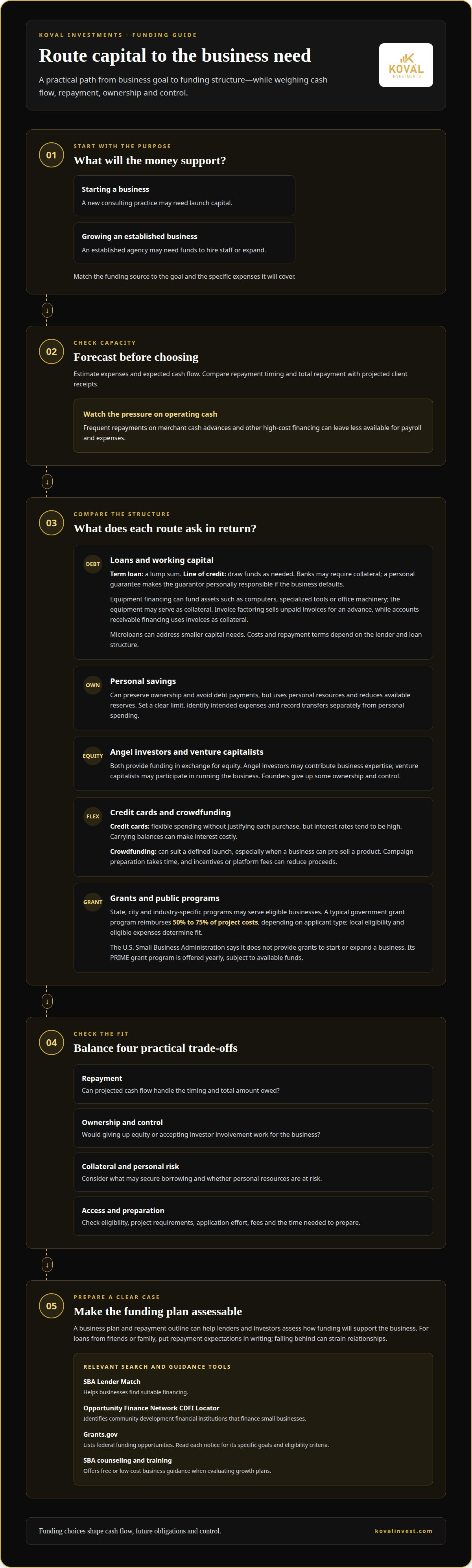
Choosing among funding options means weighing more than the amount available. The structure affects cash flow, future obligations, and how much control you retain. Match the funding source to what the money will support and what the business can manage in repayments or investor involvement.
This guide compares loans, working capital, personal funds, investors, credit cards, and crowdfunding. It explains what to consider when choosing among them, including the business plan and repayment outline lenders and investors may expect, so you can assess each option’s practical implications.
Key Takeaways
- Match borrowing to the business need, and weigh repayment terms and collateral against the flexibility of working capital.
- Consider how grants, investors, credit cards, and crowdfunding differ in eligibility, ownership, and access to funds.
- Personal savings can preserve ownership, but using them means putting personal resources at risk.
- A clear business plan and repayment outline can help lenders and investors assess how funding will support the business.
Small-business loans and working capital
Among the funding options for service-based businesses, small-business loans can help cover operating expenses, hiring, or expansion. Certain loans may also support operating expenses when an essential employee is called to active military duty.
Banks offer term loans and lines of credit, including some loans through the Small Business Administration. A term loan provides a lump sum, while a line of credit lets you draw funds as needed. Some bank loans require collateral, and a personal guarantee makes the guarantor personally responsible if the business defaults. Costs and repayment terms depend on the lender and loan structure.
Owners with limited operating history or credit challenges may consider personal funds, loans from friends or family, or community lenders. The Opportunity Finance Network CDFI Locator identifies community development financial institutions that finance small businesses. Loans from friends or family can strain relationships if repayment falls behind, so put repayment expectations in writing.
Equipment financing can fund business assets such as computers, specialized tools, or office machinery. In some arrangements, the equipment serves as collateral. Invoice factoring sells unpaid invoices in exchange for an advance, while accounts receivable financing uses invoices as collateral for borrowing. Both can turn expected client payments into working capital sooner.
Grants are more limited than loans. The U.S. Small Business Administration says it does not provide grants to start or expand a business. Its PRIME grant program is offered yearly, subject to available funds. A professional can help identify programs that align with a business’s purpose and organize application materials. Grants.gov is a tool for finding federal funding opportunities.
When comparing funding options for service-based businesses, weigh repayment against cash flow. Merchant cash advances and other high-cost financing can strain operating funds if frequent repayments leave less for payroll and expenses. Compare total repayment and timing with projected client receipts. SBA Lender Match helps businesses find suitable financing, while microloans can address smaller capital needs.
Funding a business to start or grow
Start by matching the funding source to the goal. A new consulting practice may need launch capital, while an established agency may need funds to hire staff or expand. Personal savings, loans, investors, credit cards, and crowdfunding differ in their effects on repayment, ownership, and control. Forecast expenses and expected cash flow before choosing.
Angel investors provide capital in exchange for an equity stake and may contribute business expertise. Venture capitalists also exchange funding for equity and may participate in running the business. This structure can support ambitious growth, but founders give up some ownership and control. Crowdfunding can suit a defined launch, especially when a business can pre-sell a product. Campaign preparation takes time, and incentives or platform fees can reduce proceeds.
Yes, state, city, and industry-specific funding programs can serve eligible businesses. A typical government grant program reimburses 50% to 75% of project costs, depending on applicant type. Local eligibility and eligible expenses shape whether a program fits a service business.
Screen federal grants carefully. The U.S. Small Business Administration says it does not provide grants to start or expand a business. Grants.gov lists federal funding opportunities from agencies including the National Science Foundation, National Institutes of Health, Department of Defense, and NASA. These opportunities may have specific goals and eligibility criteria, so read each notice before preparing an application.
- Grants.gov: Find federal funding opportunities by agency and program.
- Candid Foundation Directory: Explore information about major public and private foundations; its listings are updated monthly.
- SBA counseling and training: Access free or low-cost business guidance when evaluating growth plans.
For a structured review of potential capital routes, explore business funding options through Koval Investments.
Personal funds
Personal savings can fund startup costs without giving investors an ownership share. Bootstrapping can let an owner retain company profits and control, but it also puts personal resources at risk if client revenue arrives later than expected. For example, a consultant might use savings for software and initial marketing while keeping a separate reserve for personal expenses.
Set a clear limit before moving personal money into the business. List intended uses, such as licensing, equipment, or early operating costs, then estimate when revenue could cover ongoing expenses. This clarifies whether savings can support the plan or whether another financing source is needed. Record transfers clearly to keep business and personal spending separate.
Business credit cards, personal loans, and savings differ in access and repayment. Credit cards offer flexible spending without requiring borrowers to justify each purchase, but interest rates tend to be high. A personal loan provides borrowed funds with repayment obligations; savings avoid debt payments but reduce the owner’s available reserves.
- Savings: Useful when the amount needed is manageable and preserving ownership matters. The trade-off is less personal liquidity.
- Credit cards: Can cover smaller, revolving expenses, such as recurring software charges. Carrying balances can make interest costly.
- Personal loans: Can provide a set amount for planned startup expenses. Repayment continues even if the business takes longer to generate income.
Before choosing, connect the funding amount to specific expenses and expected cash flow. A nonprofit or government agency may offer counseling or training that helps entrepreneurs assess a startup plan. The U.S. Small Business Administration’s guide to starting a business has 10 steps, making it a useful planning tool for organizing launch decisions.
Personal funding may not cover a larger expansion, such as hiring staff before new contracts begin. Compare available savings with the timing and scale of the need. Treat personal funds as one source among several, and preserve enough flexibility to manage household costs while the business develops.
Preparing a business plan and repayment outline
A lender or investor needs a clear case for the capital requested. Banks may ask for a business plan, financial forecast, and evidence of debt repayment history. Angel investors may examine the plan closely and expect a reasoned case for investing. A service business should connect its funding request to specific uses, such as hiring staff or expanding client capacity.
Prepare a concise application package with a business plan, current financial records, a forecast, and a repayment outline. Include relevant client contracts, invoices, or pipeline details to explain expected revenue. These materials help show how the business operates and how projected cash flow could support repayment. Requirements vary by lender and financing type.
A useful planning sequence is to:
- Define the use: Separate launch costs, operating capital, and expansion expenses.
- Build the forecast: Map expected income against payroll, rent, software, and other recurring costs.
- Show repayment capacity: Link proposed payments to realistic revenue timing, not optimistic sales assumptions.
- Explain alternatives: State whether the business is considering debt, equity, or another source, and why it fits.
The U.S. Small Business Administration’s business-starting guide provides 10 steps that can help organize early planning. A cash-flow spreadsheet is another practical tool: it lets business owners test how delayed client payments or added staffing expenses affect available funds. For grant searching, Grants.gov lists federal opportunities, while the Candid Foundation Directory provides information on public and private foundations and is updated monthly. Each program’s purpose and eligibility should match the business initiative.
Professional guidance can help organize documents, identify gaps in the forecast, and align the application with the chosen financing structure. Get help preparing a funding application with a clear use of funds and repayment outline.
Koval Investments: Credit Repair Services
Koval Investments offers Credit Repair Services to help business owners strengthen their financial profiles before pursuing capital. This may be a useful step when credit concerns complicate financing plans. The service helps clients optimize their financial profiles, but does not promise loan approval or a particular result.
Once funding needs and business finances are clearer, Koval Investments also offers SBA Loans and a 0% Interest Funding Solution. Business Valuations can support a clearer understanding of a company’s value during planning. The right route depends on the business’s objectives and financial circumstances, so align the funding discussion with the intended use of capital and repayment plan.
Contact Koval Investments to discuss your business’s financing goals.
Make your next funding decision with a clear plan
Turn your financing priorities into a focused discussion: what the capital will support, how it fits the business’s plans, and what repayment approach is sustainable. A thoughtful review can clarify which funding route aligns with your goals and financial profile. Funding options for service-based businesses are most useful when assessed against the work ahead, rather than in isolation.
Koval Investments offers Credit Repair Services, SBA Loans, and a 0% Interest Funding Solution. These offerings can be relevant when you’re strengthening your financial profile or assessing potential sources of business capital. The right conversation starts with your objectives and the financial picture you’re working from, without assuming one approach suits every business.
When you’re ready to discuss your funding needs, connect with Koval Investments. A clear next step can help you move forward with greater focus and confidence.
Frequently Asked Questions
What funding options are available for service-based businesses in the U.S.?
U.S. service businesses can consider owner savings, bank or SBA loans, working capital, business credit cards, investors, and crowdfunding. The right fit depends on whether the need is recurring cash flow, a one-time launch expense, or expansion. For example, a business managing uneven client payments may prioritize flexible access to capital, while a defined growth project may suit structured financing.
How do SBA 7(a) loans work for service businesses, including eligibility, rates, and fees?
SBA 7(a) loans are provided through commercial lenders, which assess applications and set applicable rates and fees according to the loan terms. Eligibility depends on the business and its financing purpose, alongside the lender’s review of repayment capacity and other application details. Koval Investments is a funding advisory firm, not a lender. All funding is subject to lender approval, underwriting and terms. Results vary and are not guaranteed.
What are the requirements and costs for business lines of credit and term loans for service providers?
Application documents can include identification, recent business bank statements, and formation documents; SBA applications may also require tax returns. Lenders may review the business plan, financial forecast, and repayment history. Costs depend on the lender and loan structure, including interest, fees, repayment terms, and any collateral requirements. Koval Investments keeps client information 100% confidential and handled through secure, encrypted systems.