
How to Get Working Capital Fast: A Strategic Guide for 2026
The quickest way to get working capital fast isn’t always choosing the lender with the fastest advertised approval. Prepare your financial profile before you apply so you can move quickly without accepting costly terms by default. If cash flow is holding back payroll, inventory, or growth, it’s understandable to want funds this week and feel frustrated by slow bank decisions.
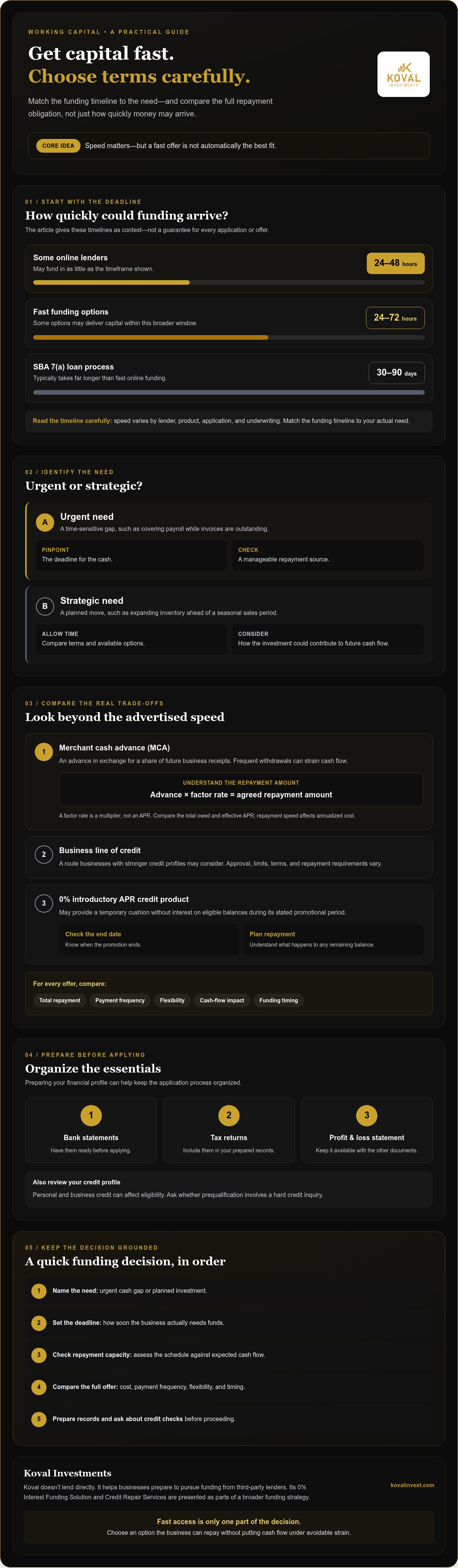
This guide explains how to compare funding options that may deliver capital within 24 to 72 hours, assess lower-cost alternatives, and spot repayment terms that could strain cash flow. You’ll also learn how credit preparation can support better financing opportunities over time. Online funding may move quickly, while SBA loans generally take far longer. Match the funding timeline to your actual need.
We’ll cover the trade-offs between fast financing and lower-cost alternatives, including Koval Investments’ 0% Interest Funding Solution and Credit Repair Services. Koval doesn’t lend directly. It helps businesses prepare to pursue funding from third-party lenders. The goal is to address today’s cash need while making decisions that support your next stage of growth.
Key Takeaways
- Learn how to get working capital fast by matching your funding option to the amount, timing, and repayment flexibility your business needs.
- Compare fast funding offers by reviewing total repayment and payment schedules, not just how quickly funds may arrive.
- Prepare bank statements, tax returns, and a profit and loss statement before applying to help keep the process organized.
- Understand how personal and business credit can affect eligibility, and ask whether prequalification involves a hard credit inquiry.
- Explore how credit repair and Koval Investments’ 0% Interest Funding Solution may support your funding strategy. Koval helps businesses pursue funding from third-party lenders.
Understanding Working Capital: Why Speed is Critical in 2026
Working capital gives a business room to handle everyday obligations and act on opportunities, from restocking products to taking on a new project. It is the difference between a business’s current assets and current liabilities. The Understanding Working Capital overview explains this measure and its role in business operations.
In 2026, a delay in accessing funds can affect more than a balance sheet. Suppliers may change terms, inventory may become unavailable, and a promising contract may require upfront spending before customer payments arrive. Traditional financing can help with planned investments, but its application and underwriting process may not fit a short cash-flow window. For context, the standard SBA 7(a) loan process typically takes 30 to 90 days from application to funding, while some online lenders can fund in 24 to 48 hours. Faster access, however, doesn’t automatically mean a better fit.
First, distinguish an urgent need from a strategic need. Urgent capital addresses a time-sensitive gap, such as covering payroll while invoices are outstanding. Strategic capital supports a planned move, like expanding inventory ahead of a seasonal sales period. For an urgent need, identify the deadline and a manageable repayment source. For a strategic need, allow more time to compare terms and consider how the investment could contribute to future cash flow. This distinction helps answer how to get working capital fast without treating speed as the only measure of success.
The Cost of Slow Capital
Waiting can carry an opportunity cost. A supplier discount may expire, or a business may lose leverage to negotiate favorable terms because it can’t pay promptly. A cash shortfall can also force managers to delay projects, reduce staffing flexibility, or stretch employee workloads. Before borrowing, estimate what the delay could cost in missed savings, postponed revenue, and operational disruption. Compare that impact with the full repayment obligation of available funding, not just the date funds may arrive.
Modern Working Capital Challenges
Supply chain shifts and changing demand can make liquidity needs difficult to predict. Digital-first lenders may offer a faster application and funding process than traditional brick-and-mortar institutions, but terms and repayment structures vary. Review total cost, payment frequency, and the effect on daily cash flow before accepting an offer. To compare options and trade-offs, explore alternative business funding solutions. The right path balances timing with the business’s ability to repay.
Comparing Fast Funding Options: From MCAs to 0% Interest Solutions
Fast funding isn’t one product, and the quickest offer may not be the most sustainable. When deciding how to get working capital fast, compare total repayment, payment frequency, flexibility, and timing with the cash the funding is expected to generate. The U.S. Small Business Administration’s guide to calculating your working capital needs can help you account for business costs before choosing an amount.
The Reality of Merchant Cash Advances
An MCA provides an advance in exchange for a share of future business receipts. Its factor rate is a multiplier, not an APR. Multiply the advance by the factor rate to understand the agreed repayment amount. Because repayment speed affects the annualized cost, compare the effective APR as well as the total owed. Frequent withdrawals can strain cash flow. An MCA may suit a short, time-sensitive need only if projected receipts can support repayment. Otherwise, it can deepen a cash shortfall and make refinancing harder.
Businesses with stronger credit profiles may have other routes to consider, including a business line of credit or qualifying for a third-party 0% introductory APR credit product. Approval, limits, terms, and repayment requirements vary, so review the actual offer rather than assuming a particular rate or timeline.
The Strategic Advantage of 0% Interest Funding
A business credit product with a 0% introductory APR can provide a temporary cushion without interest on eligible balances during its stated promotional period. That may help cover a planned cash-flow gap, but only if the business can repay within the offer’s terms. Check when the promotion ends, what happens to any remaining balance, and whether the available credit is sufficient for the need. A promotional rate isn’t a permanent funding solution.
Koval Investments’ 0% Interest Funding Solution is a funding-preparation and credit strategy, not a direct loan. The firm helps businesses pursue credit products from third-party lenders. Learn more about 0% interest business funding and compare its potential cost with other options. For businesses assessing their credit profile and funding path, Koval’s credit and funding support may be a useful place to explore.
Other options may suit different cash needs:
- Business lines of credit: Draw funds as needed for recurring expenses, then repay and potentially reuse available credit according to the agreement. Review draw fees, rates, and payment terms.
- Invoice factoring: A business receives cash against eligible unpaid invoices, usually for a fee. It can help bridge the wait for customer payment, but compare the cost and understand how collections will work.
Choose based on fit, not speed alone. A flexible credit line, invoice-based advance, or carefully managed promotional offer may be more suitable than an MCA when its terms align with your cash-flow cycle.
The Credit-First Approach: How Your Profile Dictates Your Speed
Fast funding depends on more than business revenue. Lenders may also assess personal and business credit, existing debt, time in operation, and recent payment history. Revenue-based providers may emphasize sales and cash flow, but credit information can still inform eligibility, pricing, or repayment terms. That’s why the answer to how to get working capital fast often starts with reviewing your financial profile before submitting applications.
For smaller businesses, personal credit may matter because owners can be asked to support a business application or demonstrate their ability to manage obligations. Requirements vary by lender and funding product, so don’t assume strong revenue will offset every credit concern. An incorrectly reported late payment, duplicate account, unfamiliar inquiry, or outdated balance can prompt questions and slow review. Check reports from the relevant bureaus, gather supporting records, and address suspected inaccuracies before or alongside an application.
Leveraging Professional Credit Restoration
Business credit repair services can help identify report issues and organize the steps involved in challenging inaccuracies. Credit restoration can strengthen a funding profile, but it can’t guarantee that a lender will approve an application or change its decision on a set timeline. If capital is time-sensitive, consider addressing documented credit issues while exploring suitable funding options, rather than waiting to begin one process until the other is complete.
This allows the business to work toward improving its credit record while evaluating current capital needs. Koval Investments offers Credit Repair Services and helps businesses prepare to pursue funding. It isn’t a direct lender. Ask prospective providers and lenders what their process involves, and distinguish confirmed report errors from accurate negative information.
Optimizing Your Financial Profile
Before applying, take stock of recurring debt payments against available cash flow. Lenders may use different measures, and debt-to-income calculations can be more relevant to personal finances than to a business’s underwriting. Still, a clear view of obligations, payment schedules, and cash reserves helps you assess whether new payments are manageable and present your finances consistently.
A business valuation may help explain the company’s assets, earnings, or overall position, particularly when seeking capital for a larger strategic purpose. It doesn’t replace a lender’s credit and cash-flow review, and its usefulness depends on the financing request. A 50-point credit increase doesn’t guarantee thousands in annual interest savings. Any savings depend on the lender’s offer, financing amount, repayment term, and other underwriting factors. Focus on accurate records and sustainable repayment capacity, not a score change alone.
Step by Step: How to Get Working Capital Fast
Funding within 72 hours may be possible with some providers, but preparation can’t guarantee approval or a particular funding date. Improve your readiness by assembling accurate records, comparing offers carefully, and confirming exactly what each provider needs before you apply.
Preparation: The Secret to Faster Decisions
Start by defining the amount you need and how you’ll use it. Gather recent business bank statements, tax returns, a current profit and loss statement, and details of outstanding debts. Requirements vary, so ask the provider what else it needs. Complete, consistent records can prevent avoidable follow-up requests.
- Organize your financial data. Check that account balances, reported revenue, and financial statements align. Note any unusual deposits or recent changes you may need to explain.
- Ask about prequalification. Before submitting an application, confirm whether an initial review uses a soft or hard credit inquiry. A soft inquiry typically doesn’t affect credit scores, but terms and processes vary. Don’t assume prequalification is approval, and avoid submitting multiple full applications without understanding their credit-check impact.
- Compare lower-cost possibilities. Review any eligible 0% introductory APR options alongside other offers. Confirm the promotional period, repayment obligations, and terms after it ends before relying on the offer. Koval Investments’ 0% Interest Funding Solution helps businesses pursue funding from third-party lenders. Koval isn’t a direct lender.
- Audit your credit and application details. Review relevant reports for unfamiliar accounts, inaccurate balances, or payment information you believe is wrong. Gather evidence for any disputes, and make sure the information on your application matches your records.
- Review final documents before signing. Confirm total repayment, payment schedule, fees, and any conditions. Ask when funds are expected and whether disbursement will be by wire or another method. Don’t assume a wire transfer or a specific arrival time until the provider confirms it.
Choosing the Right Strategic Partner
A direct lender makes the credit decision and provides its own funding. A broker or consultant may help assess options or prepare an application, depending on its services. Neither route guarantees the best terms. Ask who will fund the offer, how the provider is compensated, and whether checking eligibility requires a hard inquiry. Be cautious of pressure to sign immediately, unclear repayment terms, or claims of guaranteed approval.
Fast capital and longer-term financing can serve different goals. SBA loans are not generally suited to a 72-hour need. The standard SBA 7(a) process typically takes 30 to 90 days, while SBA Express takes approximately 30 to 45 days. SBA loan assistance may be relevant when planning for longer-term stability alongside a short-term cash need.
For a structured review of your credit and funding approach, explore Koval Investments’ funding support.
Partnering with Koval Investments for Rapid, Low-Cost Funding
Choosing a funding route is only part of the work. Businesses also need to understand how financing fits their cash flow, credit profile, and growth plans. Koval Investments works as a strategic partner in capital procurement, helping entrepreneurs assess funding pathways rather than lending directly. Its services include working capital, Credit Repair Services, SBA loan assistance, and a 0% Interest Funding Solution that helps businesses pursue eligible products from third-party lenders.
That distinction matters. A 0% introductory offer may reduce interest costs during its promotional period, but eligibility, credit limits, repayment terms, and costs after the offer ends depend on the third-party lender. Review the full terms before deciding whether this option fits your needs. A thoughtful funding strategy weighs access to capital against repayment capacity and future financial flexibility.
The Koval Advantage: Credit and Capital Integration
Credit standing can shape which funding options a business may pursue and the terms it receives. By pairing Credit Repair Services with capital procurement guidance, Koval helps business owners address credit concerns while considering their financing needs. The aim is a more complete view of readiness, not a promise of approval or a specific outcome. This approach connects credit support with funding guidance to help align financing decisions with business objectives.
For longer-term expansion, the right financing route may differ from the one that addresses an immediate cash-flow gap. Koval can help businesses consider how SBA 7(a) vs. 504 loans may fit a broader capital strategy. These SBA options aren’t designed to deliver funds within a few days, so they’re better considered as part of longer-range planning.
Koval supports entrepreneurs across the United States. Whether you’re evaluating a short-term working capital need or planning a larger investment, clarify the purpose, timing, and repayment source for the funds. That preparation makes it easier to compare options and have a focused conversation about your business’s financing profile.
Get Started: Your Roadmap to 0% Funding
Begin by outlining how much capital you need, when you need it, and how you expect to repay it. Gather current financial records and note any credit-report issues you’re already addressing. Then ask about relevant funding pathways, eligibility considerations, and the role of credit optimization. If you’re exploring how to get working capital fast, remember that Koval doesn’t provide funds directly or guarantee a lender’s decision. It helps businesses prepare to pursue third-party funding options.
Explore funding and credit services with Koval Investments.
Build a Stronger Capital Plan for What Comes Next
Getting working capital quickly starts with preparation, but speed should never come at the expense of sound terms. Compare repayment obligations and total cost, and review your credit profile before applying. A funding choice that fits your cash flow today can also support stronger financing opportunities in the future.
If you’re weighing how to get working capital fast, Koval Investments offers capital procurement guidance, credit restoration, and mergers and acquisitions consulting. Its 0% Interest Funding Solution helps businesses pursue funding options through third-party lenders. Koval isn’t a direct lender, and eligibility and terms depend on the funding provider. Strategic guidance can help you assess available options in light of your business goals.
Take the next step with a clear view of your funding needs and the outcomes you want to achieve. Explore 0% Interest Funding with Koval Investments and learn about its funding and credit services.
Frequently Asked Questions
What is the fastest way to get working capital for a small business?
Some online lenders can fund business lines of credit or term loans within 24 to 48 hours, while revenue-based funding may be available the same day. If you’re researching how to get working capital fast, prepare accurate financial records and check the repayment schedule and total cost before applying. Timing depends on the provider, your application, and eligibility. SBA loans generally take longer, so they’re not suited to an immediate cash need.
Can I get working capital with a low credit score?
Possibly, but a low score can limit your choices or affect the terms offered. Some providers weigh revenue and cash flow heavily, while others also review personal credit, business history, debts, and payment records. Check your reports for inaccuracies and gather evidence to dispute errors. Koval Investments offers Credit Repair Services to help address credit-report issues, but credit repair doesn’t guarantee approval or a particular rate.
How does 0% interest business funding actually work?
Some third-party business credit products offer a promotional period with 0% APR on eligible balances. The offer has specific terms, including its duration, required payments, and what happens to balances after the promotion ends. Approval and credit limits depend on the lender. Koval Investments’ 0% Interest Funding Solution helps businesses pursue funding from third-party providers. Koval isn’t a direct lender. Review all terms before using promotional credit.
What documents do I need to apply for fast business funding?
Requirements vary by provider, but applicants are commonly asked for recent business bank statements, tax returns, and a current profit and loss statement. You may also need to provide details about business ownership, existing debt, and the requested funding amount. Prepare clear, up-to-date copies and check that figures align across documents. Ask the provider for its specific list before applying, since missing or inconsistent information can lead to follow-up requests.
Is a merchant cash advance the same as a working capital loan?
No. A working capital loan is a form of borrowing with repayment terms set by the lender. A merchant cash advance provides funds in exchange for an agreed amount repaid from future business receipts. MCAs typically use a factor rate rather than an interest rate, so compare the total repayment amount and effective APR, along with payment frequency. Frequent deductions can put pressure on cash flow, so consider the repayment source carefully.
How long does it take to repair business credit for a loan?
There’s no reliable fixed timeline. The time needed depends on the issue, the credit bureau’s review, and whether supporting records are available. Correcting inaccurate information may take a different amount of time than building a stronger payment history. If you’re seeking funding soon, review reports and begin addressing documented errors while exploring suitable options. Koval Investments offers Credit Repair Services, but can’t promise a particular result or approval date.
What are the common requirements for fast working capital approval?
Providers often review business revenue, bank activity, time in operation, credit history, outstanding obligations, and the ability to manage repayments. Requirements differ by funding type and lender, so there isn’t one universal approval standard. Have financial statements and bank records ready, and be prepared to explain the intended use of funds. Before accepting an offer, confirm the repayment schedule, total repayment, and any conditions that could affect your cash flow.
Does applying for fast funding hurt my credit score?
It depends on the type of credit check. A soft inquiry generally doesn’t affect your credit score, while a hard inquiry may affect it. Ask the provider which inquiry it uses before submitting an application, and confirm whether prequalification is available without a hard pull. Don’t assume every lender follows the same process. Understanding the inquiry terms can help you compare options without submitting unnecessary full applications.