
Short-Term Business Funding: Options, Uses, and How to Choose in 2026
What if the funding that gets you through a cash-flow gap creates a bigger one next month? Short term business funding can help cover expenses, purchase inventory, or act on a growth opportunity, but the repayment schedule needs to fit the cash flow the funding supports.
It’s reasonable to feel unsure about which structure to choose or whether repayments will put pressure on day-to-day operations. The right option depends on the purpose of the funds, when revenue is expected, and how much your business can comfortably repay.
This guide explains common short-term funding options, their trade-offs, and how to assess repayment against projected cash flow. You’ll also learn what information and documents to prepare before pursuing capital. We compare Business Lines of Credit, Business Term Loans, and Working Capital Solutions, then explain how Koval Investments helps align funding strategy with business goals and qualifications. Koval Investments is a consulting firm that connects businesses with lending partners and guides them through the application process. Funding is subject to lender underwriting, eligibility requirements, approval, and the applicant’s financial and credit profile.
Key Takeaways
- Match short term business funding to a defined cash need and the cash flow expected to repay it.
- Compare borrowing a set amount with drawing from available credit, including how each structure schedules repayment.
- Estimate repayment capacity before applying. A personal credit score of approximately 680 or higher is a general eligibility consideration, not a hard cutoff.
- Prepare your business and financial information early so you can assess eligibility and support an application.
- Koval Investments connects businesses with lending partners and provides funding strategy guidance. Lending partners make approval decisions.
What Is Short-Term Business Funding, and When Can It Help?
A business can be profitable on paper and still face a cash-flow gap. A supplier may need payment before customer invoices arrive, or inventory may need to be purchased ahead of a busy sales period. Short term business funding can address a defined, near-term need, but the key question isn’t simply how quickly capital is available. It’s whether the need and expected cash flow align with the repayment terms.
What does short-term business funding mean?
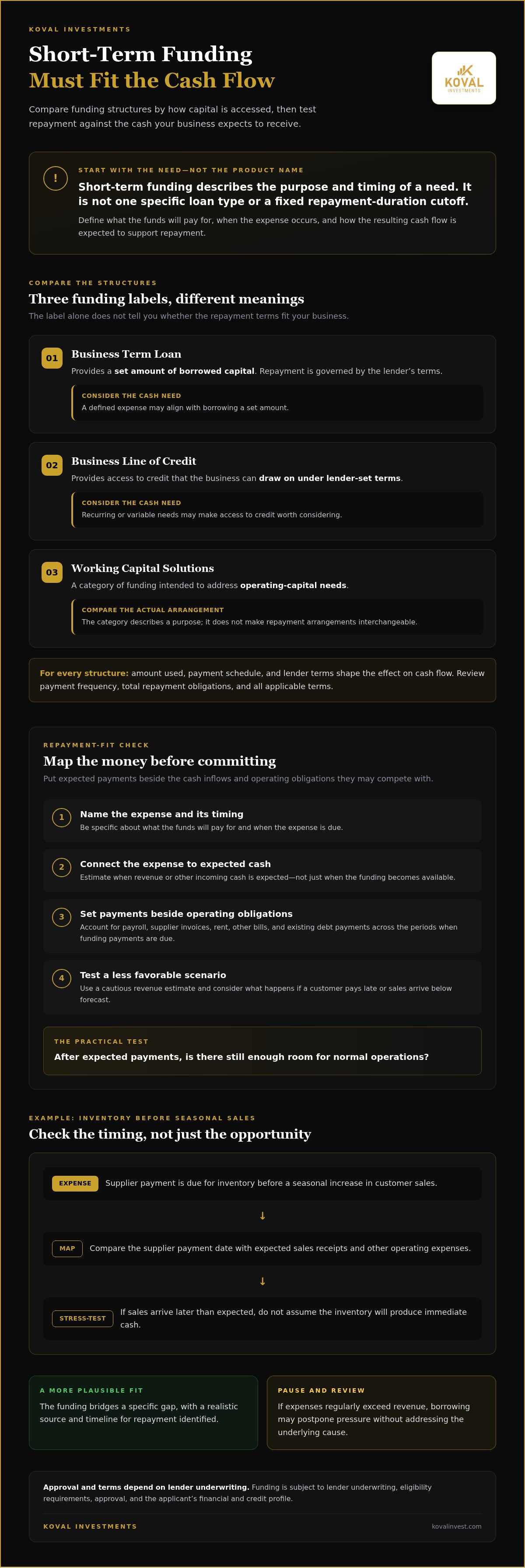
Short-term business funding is capital sought for a specific, near-term business need. The financing product and repayment schedule depend on the arrangement and lender. The phrase describes the purpose and timing of the need, not one specific loan type or a fixed repayment-duration cutoff.
A business might address that need with a set amount of borrowed capital or access to a credit line. Those structures work differently, and their terms, payment timing, and costs depend on the financing arrangement. Short-term funding therefore isn’t a synonym for a particular product. It’s a way to define the business need before comparing possible structures.
That distinction matters because business financing includes different forms of debt and other sources of capital. The broader Small business financing overview provides context for how these approaches fit within the wider range of options available to businesses.
When might a business consider short-term funding?
It may be worth assessing when a business faces temporary working-capital pressure, plans an inventory purchase, or needs to cover a time-sensitive operating expense. Start by stating exactly what the funds will pay for and when the business expects the expense to support revenue or operations. A defined use helps narrow the comparison. Capital for inventory needed before a seasonal sales period may call for a different structure than funds to address a recurring payroll gap.
For example, imagine a retailer needs to pay a supplier for inventory before a seasonal increase in customer sales. The owner can map the supplier’s payment date against expected sales receipts, then estimate whether incoming cash can support repayments while also covering other operating expenses. If sales arrive later than expected, the plan should account for that timing rather than assume the inventory will produce immediate cash.
This differs from long-term expansion financing, which may support a broader investment whose benefits develop over time, such as a major capacity increase. A near-term need has a defined purpose and an expected cash-flow connection. A long-term project may require a repayment plan based on a longer path to returns.
There’s also an important distinction between a temporary timing gap and an ongoing structural shortfall. If expenses regularly exceed revenue, borrowing may postpone the pressure without addressing its cause. Review the underlying cash-flow pattern first. Funding is more plausibly aligned when it bridges a specific gap and the business can identify a realistic source and timeline for repayment.
How Short-Term Business Funding Structures Work, and What Repayment Means
The structure determines how a business receives capital and how it repays it. With a loan, the business borrows a set amount. With a credit line, it can draw from available credit under lender-set terms. Either way, payment timing matters. Payments due before customer receipts arrive can compete with payroll, inventory purchases, rent, and other operating obligations.
How do term loans, lines of credit, and working capital differ?
A Business Term Loan provides a set amount of borrowed capital, with repayment governed by the lender’s terms. A Business Line of Credit provides access to credit that the business can draw on under lender-set terms. Working Capital Solutions are a category of funding intended to address operating-capital needs. These labels describe different structures or purposes, not interchangeable repayment arrangements.
Start the comparison with the cash need. A defined expense may align with borrowing a set amount, while recurring or variable needs may make access to credit worth considering. Neither structure is automatically more suitable. The amount used, payment schedule, and terms all shape the impact on cash flow. The SBA loans and funding programs page also illustrates that financing programs can differ, so a program’s name alone doesn’t explain how its terms fit a particular business.
How should owners think about repayment and financing costs?
Look beyond the amount received. Review payment frequency, total repayment obligations, and all applicable lender terms. Then put expected payments alongside existing expenses in a cash-flow forecast. A payment schedule that looks manageable in isolation may be difficult when payroll, supplier invoices, and other bills are also due.
For a practical test, map expected incoming cash against outgoing obligations across the periods when payments will fall due. Use a cautious revenue estimate, account for existing debt payments, and consider what happens if a customer pays late or sales arrive below forecast. This won’t predict every disruption, but it can reveal whether repayment leaves enough room for normal operations.
Approval and terms depend on lender underwriting. Funding is subject to lender underwriting, eligibility requirements, approval, and the applicant’s financial and credit profile. Advertised structures aren’t a promise of approval or specific terms. Evaluate short term business funding against your business’s projected cash flow and the lender’s actual offer.
Before accepting an arrangement, compare its payment timing and total obligations with the business’s cash-flow plan, not just the immediate need it addresses. Koval Investments connects businesses with lending partners and provides funding guidance. Explore funding strategy guidance to learn how a potential structure can be considered in relation to your business goals and qualifications.
How to Compare Short-Term Business Funding Options for Your Situation
Compare funding against the need it must meet, not just the product name. Ask what the funds will support, how capital is accessed, whether expected cash flow can accommodate repayment, and what the application requires. The table offers a starting point. Actual terms and eligibility depend on the financing arrangement and lender.
| Option | Purpose and structure | Repayment fit | Eligibility and documentation |
|---|---|---|---|
| Business Term Loan | A set amount of borrowed capital can be considered for a defined expense, such as a planned inventory purchase. | Compare the lender’s payment schedule with when the expense is expected to support business cash flow. | Requirements and requested records vary by lender and applicant. |
| Business Line of Credit | Provides access to credit under lender-set terms. It may be considered for needs that vary or arise at different times. | Assess the terms for drawing and repayment, then account for obligations alongside operating expenses. | Eligibility and application documentation depend on lender review. |
| Working Capital Solutions | A category to consider for operating-capital needs, such as covering business expenses. | Assess whether projected cash flow can support the specific repayment terms offered. | Requirements and documents depend on the financing arrangement and lender. |
| SBA Financing | A distinct financing route with program-specific features, not simply another name for a term loan or credit line. | Review the applicable program and lender terms in light of the business’s cash-flow plan. | Eligibility and documentation vary. The SBA loan assistance guide explores this route. |
Which funding structure fits a specific business need?
If the need is defined and the amount can be estimated, compare a Business Term Loan with other structures based on the offered terms and expected repayment capacity. A Business Line of Credit may be worth considering if capital needs fluctuate, but access to credit still carries lender-set obligations. Working Capital Solutions may fit an operating-capital need, but they aren’t automatically suitable for every business. Short term business funding should align the use of capital with the cash flow expected to support repayment.
Keep SBA Financing distinct and assess its program-specific requirements. For a wider view of possible structures, compare alternative business funding approaches, especially if the business need doesn’t fit neatly into one product category.
How can owners compare 0% introductory-rate funding?
Evaluate 0% Intro APR Funding by reviewing the lender’s actual terms, introductory-rate conditions, and applicant qualifications. Don’t assume the introductory terms apply indefinitely or remove repayment obligations. Consider whether expected cash flow can support the obligations under the applicable terms, and compare this option with other structures for the same defined need. For a deeper comparison, see the 0% Interest Business Funding guide.
Eligibility and required documentation vary across arrangements. Compare actual terms against the business’s cash-flow plan before deciding which option to pursue.
How to Assess Repayment Fit, Eligibility, and Application Readiness
Before pursuing short term business funding, test whether the proposed amount and repayment schedule fit the business’s finances, then organize the information a lender may need. This preparation can clarify the request, but it can’t determine an approval outcome in advance.
- Define the need. Identify the expense the funds would address and how it supports operations or revenue. A clear purpose helps keep the request focused.
- Estimate the amount sought. Build the estimate from the specific expense and related needs. Avoid requesting more than the business can explain or reasonably plan to repay.
- Assess repayment capacity. Compare projected incoming cash with scheduled payments, existing debt obligations, and routine expenses. Consider a cautious scenario if revenue is delayed or operating needs change.
- Review eligibility factors. Lenders assess applications using their own criteria and the applicant’s financial and credit profile. Personal credit requirements are approximately 680 or higher, not a hard cutoff. Newer businesses may qualify if other criteria are met. Applicants with less-than-perfect credit may still qualify, and Koval Investments offers a Credit Optimization Program.
- Gather application documents. Prepare the records below so key information is organized and ready for review.
Can projected cash flow support the repayment?
Map expected cash receipts against scheduled business obligations over the periods when payments would be due. Include payroll, supplier invoices, existing debt, and other regular expenses. Then test a cautious scenario: delay expected revenue or account for a change in operating needs. If payments would leave too little room for essential expenses, reconsider the amount or timing before proceeding.
Funding decisions depend on lender underwriting and the applicant’s profile.
What information and documents should applicants prepare?
Keep the following items organized and consistent with the information in the application. Specific requirements can vary with the lender and financing arrangement, so prepare these core records for review:
- Government-issued photo ID
- Business formation documents
- EIN confirmation
- Business bank account information
- Recent bank statements
- Proof of income (when applicable)
Review the figures across your records before submitting them. Make sure your funding purpose, amount sought, and cash-flow projections tell a consistent story. If something has changed, such as a recent shift in revenue or expenses, be ready to explain it clearly.
Once you’ve reviewed repayment fit and gathered the documents, a conversation can help you organize your next steps. Koval Investments connects businesses with lending partners and provides strategic funding guidance. Schedule a consultation to discuss how a funding strategy may align with your goals and qualifications.
How Koval Investments Guides a Short-Term Business Funding Strategy
Choosing a funding structure is only part of the decision. The proposed capital should also align with the business’s goals, qualifications, and ability to manage repayment. Koval Investments provides strategic funding guidance and connects businesses with lending partners. It isn’t a lender. Lending partners review applications and make approval decisions, so guidance can help prepare a business to pursue funding but can’t promise an outcome.
The process moves from understanding the need to preparing for an application. Each step connects the funding request with the business’s circumstances rather than treating short term business funding as a one-size-fits-all choice.
What happens during Koval Investments’ four-step funding process?
- Funding Consultation: discuss business, goals, desired capital amount.
- Funding Assessment: review business and financial profile.
- Funding Strategy: develop financing plan based on qualifications.
- Application & Funding: guide through application and documentation.
The sequence gives the funding request a clear foundation. First, the business explains what it wants to accomplish. The assessment provides context for considering potential financing approaches. The resulting strategy is based on qualifications and goals, while application guidance supports the next steps with a lending partner.
How does strategic guidance support a funding application?
A well-framed funding strategy connects the intended use of capital with the company’s financial profile and business objectives. That can help owners prepare a clear application, understand the role of documentation, and consider whether a potential structure fits the business’s plans. Koval Investments guides clients and connects them with lending partners. The lender, not the consulting firm, determines approval and terms.
Koval Investments describes its funding guidance as 100 % Confidential, and its site lists Secure Transactions and Client Privacy. These stated commitments reflect the importance of handling funding discussions and application information with care.
Every application remains subject to the lending partner’s review. The strategy helps prepare and pursue an aligned option, but it doesn’t guarantee that a lender will approve funding.
If you’re ready to discuss your business goals and funding needs, schedule a complimentary consultation. It’s a practical starting point for reviewing your objectives and considering a funding strategy that fits your business.
Make Your Next Funding Decision With a Clear Plan
Turn your cash-flow outlook into a practical decision: identify what the business needs, what repayment it can support, and what questions remain before pursuing short term business funding. A considered plan can help you move forward with purpose, even if it leads you to reassess the timing or amount.
Koval Investments’ guidance includes a Funding Assessment and a Funding Strategy developed based on qualifications. The firm describes its approach as Trusted Funding and Flexible Capital, and states that its guidance is 100 % Confidential, with Secure Transactions, Client Privacy, and Encrypted Security.
Koval Investments connects businesses with lending partners. Lending partners make approval decisions, and funding is not guaranteed.
Ready to discuss your business goals and funding needs? Schedule a complimentary consultation to take a thoughtful next step toward a funding strategy aligned with your plans.
Frequently Asked Questions
Is a business line of credit the same as a short-term business loan?
No. A business line of credit provides access to credit under lender-set terms, while a business term loan involves borrowing a defined amount under its agreement. Compare whether your need is a known one-time purchase or access to credit for variable needs. Review payment obligations and eligibility for the specific arrangement. Lenders make approval decisions through underwriting.
Can short-term business funding help cover a temporary cash-flow gap?
It may be considered for a defined near-term need, including a temporary operating cash-flow gap. For example, a business waiting on a customer payment can compare the expected receipt date with an upcoming bill and any proposed repayment obligations. If cash has been short month after month, borrowing may not resolve the underlying issue.
How much short-term business funding can a business receive?
Most qualified clients receive between $25,000 and $150,000+, with higher amounts possible for highly qualified applicants. This is not a promise of a particular amount. Koval Investments doesn’t guarantee a specific funding amount.
Can a newer business qualify for funding?
Newer businesses may qualify if other criteria are met; an established business isn’t required. Be prepared to explain the business’s goals, desired capital amount, and financial profile so the lending partner can assess the application. Qualification doesn’t guarantee approval or a particular funding amount.
Is short-term business funding guaranteed once an application is submitted?
No. Submitting an application doesn’t guarantee funding. Lending partners make approval decisions based on underwriting criteria, eligibility, and the applicant’s financial and credit profile. Koval Investments connects businesses with lending partners and provides funding guidance and application support. It isn’t a lender and can’t promise approval or a specific amount.