
Working Capital Loans for Small Business: A Practical Guide
The largest loan isn’t always the safest choice. With working capital loans for small business, repayment timing can matter more than the amount borrowed. If customer payments arrive after payroll, rent, or inventory bills are due, financing may help bridge the gap. The key is choosing a structure that covers the need without making the next cash-flow squeeze harder.
The right option depends on what the funds will cover, when you need them, and how the business can repay them. A term loan, line of credit, invoice financing, or another structure can create very different payment obligations, even when each is described as working capital financing.
This guide shows how to match financing to a specific business need, compare repayment structures, and assess whether borrowing is likely to ease or deepen a cash-flow gap. It also explains what financial information to prepare for a funding discussion, so you can compare costs, timing, and obligations with a clearer picture.
Key Takeaways
- Use working capital loans for small business to address a defined near-term operating need, not an ongoing gap between revenue and expenses.
- Compare financing structures by how funds are accessed and repaid, then match the repayment schedule to your cash-flow timing.
- Weigh the potential cash-flow benefit against the added repayment obligation, especially if customer payments may arrive later than expected.
- Prepare a clear funding amount, financial records, debt details, and a repayment forecast before discussing financing.
- Koval Investments helps businesses explore working capital access, SBA loan assistance, and credit profile optimization in light of their funding purpose and financial profile.
When Do Working Capital Loans for Small Business Make Sense?
Working capital financing can cover near-term operating needs, such as paying employees or suppliers while the business waits for customer payments. It may make sense when the business has a defined, temporary cash-flow gap and a realistic repayment plan. First identify whether cash is arriving later than expenses are due, or whether income regularly falls short of operating costs. Those are different problems and may call for different solutions.
Working capital is commonly calculated as current assets minus current liabilities. For example, if a business has $45,000 in cash, receivables, and inventory, and $30,000 in bills and other short-term obligations, its working capital is $15,000. This snapshot helps show the resources available to cover near-term obligations, but it doesn’t show exactly when receivables will turn into cash or whether inventory can be sold quickly. For a foundational explanation, see What is working capital?
Operating liquidity keeps routine obligations moving; profit measures whether the business earns more than it spends, while long-term investment capital supports assets and projects with a longer horizon. A business can report a profit and still face a cash shortfall if customers pay after bills come due. Conversely, borrowing can provide cash without making an unprofitable operation sustainable.
Which business needs may justify short-term working capital?
A specific purpose makes the need easier to evaluate and lets you connect the borrowed amount to an operating expense and expected cash flow. Working capital loans for small business may help bridge a timing gap when:
- Payroll is due before customer invoices are paid. Financing may help cover wages during the wait. Base the repayment plan on expected receipt dates, not just invoice dates.
- Inventory must be purchased ahead of a busy season. Estimate the purchase cost and consider when expected sales are likely to generate cash for repayment.
- A supplier payment comes before incoming revenue. Short-term funding may help meet an agreed payment obligation while maintaining supply.
- Seasonal expenses rise before sales do. Map the period of higher operating costs against expected income and identify when the business can repay the funds.
When might borrowing fail to solve a cash-flow problem?
A timing gap is different from a persistent mismatch. If expenses repeatedly exceed revenue, or customers consistently pay later than the business can manage, borrowing may add a repayment obligation without correcting the underlying cause. These patterns are reasons to examine pricing, costs, collection practices, and operating plans before deciding that more capital is the answer.
Before borrowing, forecast cash coming in and going out across the proposed repayment period. Include existing debt payments and routine expenses, then test what happens if customer receipts arrive later than expected. If the forecast only works under an optimistic scenario, the planned payments may be difficult to sustain.
Financing can bridge a temporary operating gap, but it doesn’t replace a sustainable operating plan. A clear purpose, realistic repayment forecast, and understanding of what caused the shortfall help you decide whether borrowing supports the business or adds pressure.
Which Working Capital Loan Structure Fits Your Business Need?
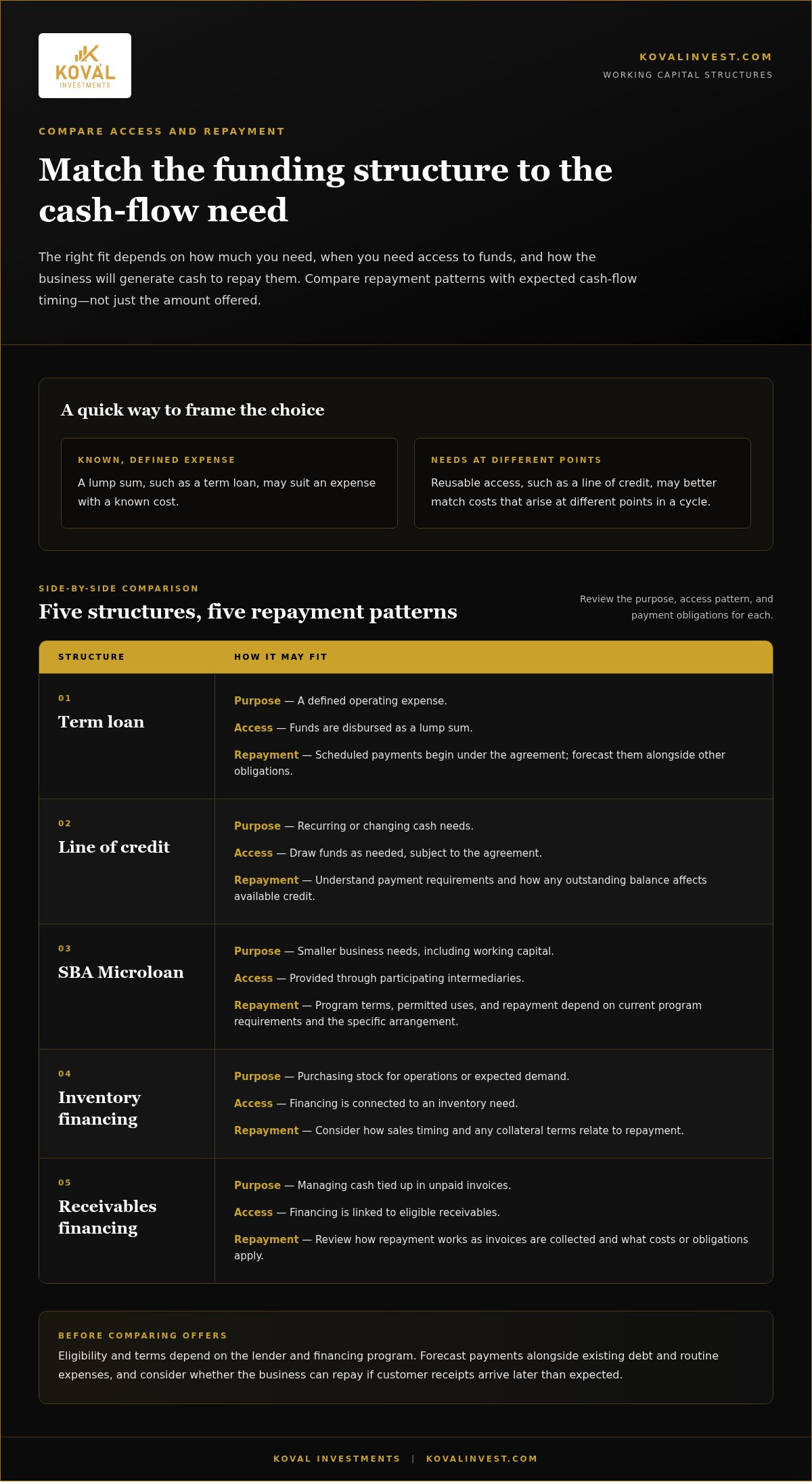
The right structure depends on how much you need, when you need access to funds, and how the business will generate cash to repay them. A lump sum may suit a known expense, while reusable access may better match costs that arise at different points in a cycle. Compare repayment patterns with expected cash-flow timing, not just the amount offered. Eligibility and terms depend on the lender and financing program.
| Structure | Typical purpose | Access pattern | Repayment considerations |
|---|---|---|---|
| Term loan | A defined operating expense | Funds disbursed as a lump sum | Scheduled payments begin under the agreement, so forecast them alongside other obligations. |
| Line of credit | Recurring or changing cash needs | Draw funds as needed, subject to the agreement | Understand payment requirements and how any outstanding balance affects available credit. |
| SBA Microloan | Smaller business needs, including working capital | Provided through participating intermediaries | Program terms, permitted uses, and repayment depend on current program requirements and the specific arrangement. |
| Inventory financing | Purchasing stock for operations or expected demand | Financing is connected to an inventory need | Consider how sales timing and any collateral terms relate to repayment. |
| Receivables financing | Managing cash tied up in unpaid invoices | Financing is linked to eligible receivables | Review how repayment works as invoices are collected and what costs or obligations apply. |
Term loans, lines of credit, and SBA Microloans
A term loan delivers an agreed sum up front, which can suit a specific expense with a known cost. A line of credit lets a business draw funds as needs arise, which may align with uneven expenses, but each draw still needs a repayment plan. SBA Microloans are provided through intermediaries. Their repayment schedules and permitted uses depend on current program requirements and the specific financing agreement.
Inventory and receivables financing
Inventory financing may be relevant when a purchase must happen before sales generate cash. Receivables financing may be considered when completed work has been invoiced but payment is still pending. Neither structure removes the need to assess sales and collection timing. Collateral, costs, and repayment mechanics can differ, so review the full obligation rather than assuming the asset or invoice alone determines the terms.
As you compare working capital loans for small business, map each option against the cash-flow cycle: when funds become available, what triggers repayment, and whether expected inflows can support it. Other capital structures may also be worth understanding. Koval Investments’ 0% interest business funding guide explains that option without implying a particular rate or approval.
For a guided discussion based on your funding purpose and financial profile, explore working capital funding with Koval Investments.
Will a Working Capital Loan Improve Cash Flow or Put More Pressure on It?
Borrowed funds can cover a short-term cash need, but they also create repayment obligations. Payments remain due even if customers pay late, sales soften, or expenses rise. The question is not only whether the business needs cash today. It’s whether projected cash flow can support repayment without disrupting essential operations.
Financing improves liquidity only when its repayment fits projected cash flow. A loan may help a business meet an expense while waiting for expected receipts. The same loan can increase pressure if payments come due before those receipts arrive or if the original shortfall reflects an ongoing operating problem.
- Potential benefit: Funds may help cover a planned operating cost or bridge a known delay between paying expenses and collecting revenue.
- Potential risk: Payments reduce cash available for payroll, suppliers, rent, and other obligations, especially if revenue timing changes.
- Decision point: Compare the timing and amount of expected inflows with all business outflows, including proposed and existing debt payments.
A practical test for repayment capacity
Build a forecast covering the proposed repayment period. For each period, estimate customer collections and other inflows, then subtract essential operating costs, existing debt payments, and the proposed payment. The remaining cash shows what may be available for unexpected needs. Use expected payment dates, not just invoice dates, so you don’t count money before it reaches the business.
Then stress-test the forecast. Move some collections later or reduce expected sales and see whether the business can still make payments and meet essential expenses. A conservative plan should work without relying on the most optimistic sales projection. If a modest delay creates a cash shortfall, reconsider the amount, structure, or timing before taking on the obligation.
What to compare beyond the amount borrowed
Two offers for the same amount can place different demands on cash flow. Review the total repayment, annual percentage rate (APR), fees, payment frequency, and term together. A payment schedule that looks manageable on a monthly budget may be harder to meet if payments occur more often or receipts arrive irregularly. Understand when repayment begins and how the agreement handles early repayment or missed payments.
Collateral and personal guarantees can also affect the decision, but requirements depend on the specific offer. Review the financing documents to understand what obligations they create before proceeding. For program-based funding, SBA loan assistance can be part of a structured funding discussion.
Assess working capital loans for small business against a realistic forecast, not just an immediate cash need. Koval Investments helps businesses explore working capital and SBA funding in light of their purpose and financial profile, making it easier to compare repayment obligations and financing structures.
How Can a Small Business Prepare to Apply for Working Capital?
A well-prepared funding request connects a specific operating need to a realistic amount and repayment plan. Lenders and programs may assess business performance, credit profile, time in business, and intended use of funds. Requirements differ, so organized records help you explain your business clearly without assuming that one set of criteria applies everywhere.
Build a clear funding request
Before seeking working capital loans for small business, define what the funds will cover and why the need exists now. Support the request with relevant documents, then distinguish a one-time expense from a recurring shortfall. This helps clarify whether financing addresses a specific timing need or whether the business should first review its ongoing cash-flow plan.
- Define the need. Describe the operating purpose, such as covering payroll between invoice and payment dates, paying a supplier, or purchasing planned inventory. Note when the expense is due and what business activity it supports.
- Calculate the amount. Build the request from actual costs rather than a round estimate. Use invoices, payroll needs, inventory plans, or documented cash-flow projections to show how the requested amount relates to the need.
- Organize financial records. Prepare current financial statements, cash-flow statements, and recent business bank statements. Include tax returns, business records, and a debt schedule showing existing balances and payment obligations.
- Forecast repayment. Map expected collections and other inflows against operating expenses, current debt payments, and the proposed new payment. Include accounts receivable details where unpaid invoices affect available cash, and test the forecast against delayed collections or weaker sales.
Organize records and review your financial profile
Consistency matters. Make sure figures in your financial statements, bank records, tax returns, and debt schedule tell a coherent story. If revenue varies by season, be ready to explain the pattern and how it affects repayment capacity. Review business credit information and personal credit information where relevant to the funding route, and address errors or unresolved issues before submitting an application.
- Cash-flow statements and bank statements help show the timing of receipts and expenses.
- Tax returns and financial statements provide context for business performance.
- Debt schedules and accounts receivable clarify existing obligations and expected collections.
- Invoices, payroll records, or inventory plans connect the funding request to its intended use.
Use the preparation process to identify gaps, not just gather paperwork. If your credit profile needs attention, Koval Investments’ business credit repair services and capital access guidance can help you understand how credit optimization relates to funding readiness.
To prepare a funding discussion around your business purpose and financial profile, explore working capital funding with Koval Investments.
How Koval Investments Can Help Explore Working Capital Funding
Choosing financing is only part of the decision. A useful funding discussion also considers why the business needs capital, how repayment fits projected cash flow, and whether financing supports broader business goals. Koval Investments facilitates access to working capital, SBA loans, and other capital sources. Its capital procurement and advisory services help business owners consider funding options in relation to their financial profile and purpose.
Similar funding amounts can serve very different needs. A business managing a temporary delay in customer payments may approach financing differently from one preparing for a planned operating expense. Koval’s support includes working capital access, SBA loan assistance, and credit repair services. Bringing capital procurement and credit considerations into the same discussion helps owners assess how funding relates to their financial profile, without treating approval or a particular financing outcome as guaranteed.
A funding discussion grounded in your business goals
Bring the intended use of funds, the amount needed, and a repayment forecast into the conversation. Koval can connect those details to the business’s financial profile and objectives, while strategic advisory can add context when a funding decision affects wider plans. This keeps the discussion focused on what the capital is for, how repayment may fit, and whether the option supports the business’s direction.
Koval also offers a 0% Interest Funding Solution as an option to explore. The name isn’t a promise that every business will qualify or receive 0% terms. Eligibility and terms depend on the applicable funding arrangement. As with any financing option, weigh its requirements and repayment obligations against the business’s needs before moving forward.
Explore a next step without rushing the decision
Before discussing working capital loans for small business, organize a concise picture of your situation. Be ready to explain the operating need, how you calculated the requested amount, what funds are expected to come in, and how existing obligations affect repayment capacity. If the need is recurring, distinguish the immediate funding request from the longer-term issue affecting cash flow. This context makes the discussion more focused and practical.
- Funding purpose: Identify the expense or operating need the capital would address.
- Financial picture: Gather recent records that show business performance, cash flow, and existing debt obligations.
- Repayment outlook: Compare expected inflows with proposed payments, including a scenario where receipts arrive later than planned.
Take time to compare the repayment structure with your forecast and decide whether the financing fits the business’s actual needs. To discuss how working capital access, SBA loan assistance, or credit optimization may relate to your circumstances, Discuss working capital funding with Koval Investments.
Move Forward with a Funding Decision That Fits
The next step isn’t necessarily to borrow. It’s to turn what you’ve learned about your business into a decision you can stand behind. Before committing, consider whether the funding purpose is clear, the repayment plan holds up under realistic conditions, and the financing supports the direction you want the business to take. That preparation can make a conversation about working capital loans for small business more focused and useful.
Koval Investments connects capital planning with the realities of your financial profile. Its services include working capital access, SBA loan assistance, credit repair, and strategic business advisory. This gives business owners a way to explore funding options alongside the financial considerations that shape them, without treating any particular outcome as certain.
To discuss your funding needs, contact Koval Investments about working capital funding. Bring your questions and the information you’ve gathered, then take the time you need to weigh the choices. A clear, considered decision is a strong next step for your business.
Frequently Asked Questions
How much working capital should a small business borrow?
Borrow only what the business needs for the defined expense and can reasonably repay. Start with the amount due, subtract cash already available for that purpose, and account for any directly related costs. For example, if cash on hand covers part of a supplier invoice, base the request on the remaining need rather than the full invoice. Then compare that amount with the repayment schedule.
Can a working capital loan be used for any business expense?
No. Permitted uses depend on the financing agreement and program. Some working capital financing is intended for operating costs such as payroll, supplies, or inventory, while other programs set specific use restrictions. Match the planned expense to the written terms before accepting funds. Don’t assume a loan described as “working capital” can also cover long-term investments, personal expenses, or existing debt.
Is a working capital loan secured or unsecured?
It can be either, depending on the financing structure and the lender’s requirements. A secured arrangement may involve collateral, while an unsecured one may not require a specific asset as security. Some agreements may also include a personal guarantee. Review the offer documents to understand what secures the obligation, who is responsible for repayment, and what could happen after a default.
What credit information may lenders review for a working capital loan?
Lenders or program intermediaries may review business credit information and, where relevant to the funding route, the owner’s personal credit. They may consider payment history, outstanding obligations, and the broader financial profile alongside business records. Reviews vary, so there isn’t one score or checklist that applies to every application. Review your reports for errors and be prepared to explain unusual items or recent changes.
How quickly can a small business receive working capital funding?
There isn’t one reliable timeline for every application. Timing can depend on the financing structure, lender or program, review requirements, and whether the application and supporting records are complete. Program-based funding may involve additional steps. Factor the application process into your cash-flow planning, and don’t base business expenses on an estimated decision or disbursement date.
What happens if a business cannot make a working capital loan payment?
Missing a payment can lead to consequences set out in the loan agreement, which may include additional charges, default, collection activity, or action involving pledged collateral or a guarantor. The outcome depends on the contract and applicable rules. If cash flow signals that a payment may be missed, review the agreement promptly and communicate with the lender or financing party. Don’t assume a missed payment will be automatically deferred.
Can an SBA Microloan be used to repay existing business debt?
Generally, SBA Microloan proceeds can’t be used to repay existing debt. The program is intended for eligible small-business purposes, and permitted uses are subject to current SBA requirements and intermediary terms. If debt repayment is the goal, don’t assume a Microloan is suitable. Confirm the intended use is permitted under the applicable program requirements and financing arrangement before relying on this structure.