
Business Loan Denied? What to Do Next in 2026
If you’re asking “business loan denied what to do next,” pause before sending another application. A denial may reflect a mismatch with one lender’s criteria, not a final judgment on your business. Start by reviewing what the lender said and identifying what may need attention.
A denial can feel especially difficult when growth plans or working capital needs are time-sensitive. Applying again quickly without understanding the stated concerns may leave the underlying gap unresolved.
This article explains how to review a denial, identify possible readiness gaps, and compare next steps before applying again. You’ll learn what to clarify with the lender, how to organize a focused plan, and how to consider funding routes that may fit your business. Koval Investments helps business owners assess their financial profile and develop a financing strategy with lending partners. Funding is not guaranteed. Funding is subject to lender underwriting, eligibility requirements, approval, and the applicant’s financial and credit profile.
Key Takeaways
- Start with the lender’s stated reason for the denial, and distinguish its feedback from your assumptions about what went wrong.
- If you’re wondering “business loan denied what to do next,” request clarification and make a focused plan before applying again.
- Address the specific readiness gap identified, and check that your financial records are complete and consistent.
- Compare SBA financing, lines of credit, term loans, and working capital solutions by purpose, repayment capacity, documentation needs, and readiness.
- Koval Investments connects business owners with lending partners and helps develop a financing plan. Funding is not guaranteed and is subject to lender underwriting, eligibility requirements, approval, and the applicant’s financial and credit profile.
Why Was Your Business Loan Denied? Start With the Lender’s Stated Reason
A loan denial can disrupt plans for hiring, equipment, inventory, or working capital. It’s a setback, but it doesn’t automatically close every other funding route. Lenders assess applications according to their own underwriting criteria, which can vary by lender and financing product. A decision on one application is not a universal verdict on your business.
If you’re searching for “business loan denied what to do next,” begin with the explanation you received, not a guess about what went wrong. A denial notice may identify a specific issue, list several factors, or provide only a broad explanation. Treat what the lender states as confirmed feedback. Other concerns may have contributed, but don’t assume which one drove the decision without clarification.
A small business loan can take different forms, and lenders may evaluate applications in light of the requested financing and the business’s circumstances. A factor that matters to one lender or product may not apply in the same way to another.
What common business loan denial reasons can signal
Credit history, repayment capacity, cash flow, existing debt, business history, and application completeness may all be underwriting considerations. These are possibilities to investigate, not a diagnosis of your specific denial. For example, “insufficient repayment ability” may prompt a closer look at cash flow and current obligations. A request for additional records may mean the lender couldn’t complete its review with the information provided.
- Credit profile: The lender may have concerns about the business’s or owner’s credit history.
- Repayment capacity: The lender may be uncertain whether available resources can support the proposed payments.
- Cash flow or debt: Revenue patterns or existing obligations may affect the lender’s assessment of repayment.
- Documentation: Missing, incomplete, or inconsistent information may have made it difficult to evaluate the application.
- Business history: The lender may have considered the business’s operating record in relation to its criteria.
Use these possibilities as prompts for review, not proof that a particular factor caused the decision.
Why the exact denial reason matters
The right response depends on the gap the lender identified. If the notice points to missing documentation, organizing the requested records may matter more than changing your borrowing plans. If it raises cash flow or debt concerns, review the business’s financial picture and obligations. If it identifies credit or requested terms, examine those issues before pursuing another application. Reapplying without addressing the stated concern may leave it unresolved.
Keep the decision notice and any written or verbal feedback together. Note the lender’s exact wording, what remains unclear, and any explanations you receive. Separate facts from interpretation: “the lender requested updated financial statements” is specific feedback; “the lender thinks my business is failing” is an assumption unless the lender said so. A denial explains one lender’s decision. It does not guarantee the outcome of another application.
How to Read a Business Loan Denial and Identify the Real Gap
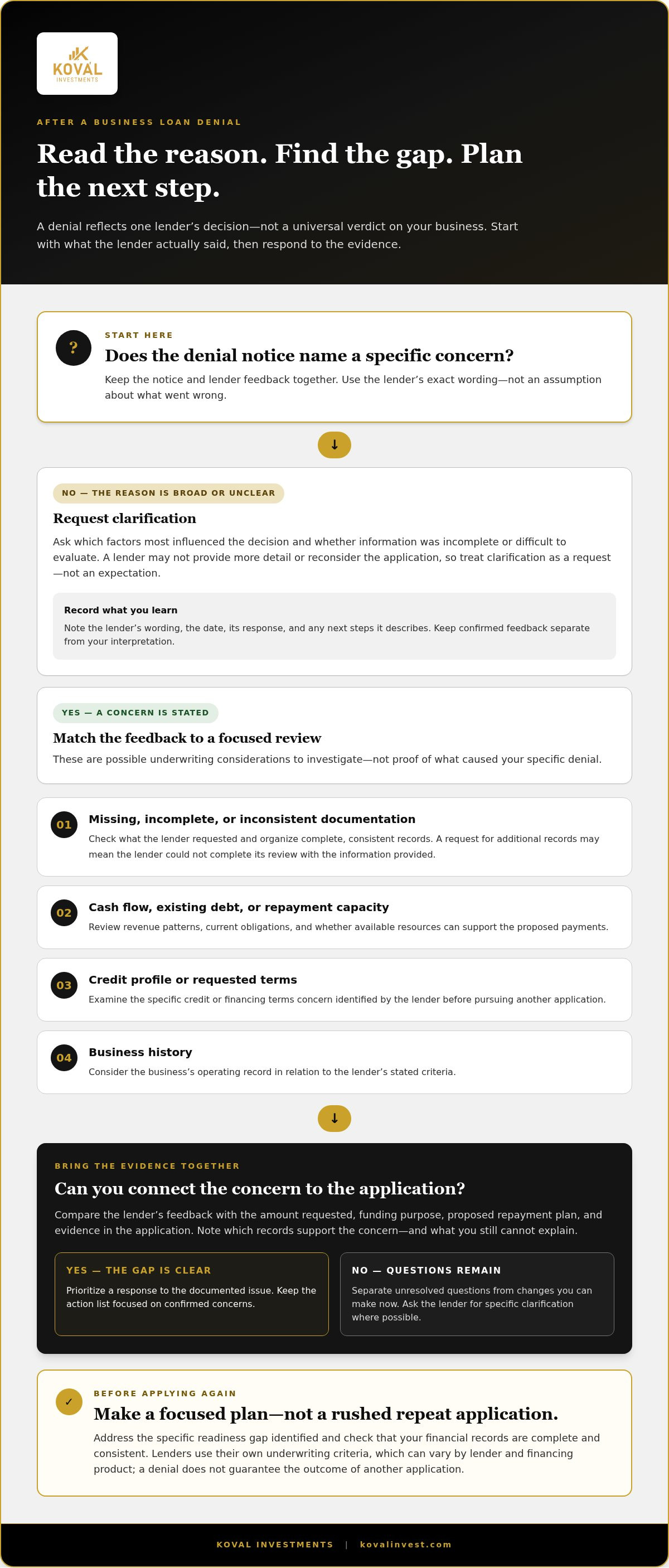
A denial notice is most useful when you treat it as a record of the lender’s decision, not a complete diagnosis of your business. Start with the exact language, then compare it with the information you submitted. Identify what the lender documented, what remains unclear, and which next step responds to the evidence. That turns “business loan denied what to do next” into a practical review, rather than a reason to rush into another application.
- Reread the notice. Highlight each stated reason, request for information, or qualification concern. Keep the lender’s wording intact instead of turning a broad phrase into a more specific cause.
- Request clarification. Ask which application factors drove the decision and whether the lender can share additional feedback. A lender may not provide more detail or reconsider the application, so treat clarification as a request, not an expectation.
- Map each concern. Compare the feedback with the amount requested, funding purpose, proposed repayment plan, and evidence in the application. Note which records support the concern and which details you can’t yet explain.
- Prioritize a response. Turn confirmed issues into a short action list. Address the documented gap first, and keep unresolved questions separate from changes you can make now.
What to ask the lender after a business loan rejection
Keep your questions neutral and specific. Ask which factors most influenced the decision, whether the issue involved the information provided or the financing request, and whether any documentation or qualification concerns need clarification. Avoid asking for a prediction about approval on a future application. Record the date, the response, and any next steps the lender describes. This helps you distinguish direct feedback from your own interpretation.
- Which stated factor was most significant in the decision?
- Was any submitted information incomplete or difficult to evaluate?
- Can you explain what you mean by a concern about repayment capacity or requested terms?
- Is there additional feedback you’re able to share?
How to map the denial reason to your application
Review the application alongside the notice, rather than relying on memory. If the concern mentions cash flow, compare the figures you submitted with financial records for the same period. If it mentions documentation, identify what was requested and what you provided. If the notice refers to the purpose or terms, check that the requested amount, intended use, and repayment plan are clearly explained. Mark each item as supported, unclear, or needing attention. An unanswered question isn’t proof of a particular problem.
For an SBA application, the SBA loan programs page can help you review relevant program information alongside the lender’s feedback. A useful reapplication plan addresses the documented gap before changing lenders. Koval Investments can help organize your business and financial profile into a financing plan through its funding guidance. Koval is a consulting firm that connects business owners with lending partners. Funding is not guaranteed and is subject to lender underwriting, eligibility requirements, approval, and the applicant’s financial and credit profile.
What to Address Before You Apply for Business Funding Again
Use the lender’s stated concern to set your preparation priorities. If the decision identified missing records, focus on completing and organizing them. If it pointed to repayment capacity, review the business’s obligations and cash flow before changing unrelated parts of your application. Trying to improve every financial metric at once can take time without addressing the issue that affected the decision.
Check that your financial records tell a consistent story. Compare application figures with recent business records, and prepare a clear explanation for unusual changes, such as a revenue fluctuation, when relevant. The goal is to make the information accurate and understandable, not to present a stronger picture than the records support.
If the concern is credit, debt, or repayment capacity
Review personal and business credit information for accuracy, then identify the specific concern before deciding what action makes sense. Take stock of existing obligations and consider whether the business can reasonably manage the proposed repayment alongside its current commitments. Avoid relying on a universal score, debt ratio, or cutoff because lender criteria vary. Higher scores generally qualify for better funding options, but no score alone guarantees approval or particular terms.
For additional background, read this guide to business credit considerations. Koval Investments offers a Credit Optimization Program for clients with less-than-perfect credit. The program is not a promise of a score increase or funding approval.
If the concern is cash flow or incomplete documentation
Reconcile the figures in your application with recent business records. Look for differences in revenue, expenses, deposits, or existing debt, and determine whether they reflect an error, a timing difference, or a change that needs explanation. If documentation was incomplete, assemble the requested materials and check that the same figures appear consistently wherever they’re reported. A complete, consistent file helps a lender review the information, but it can’t guarantee a particular outcome.
Common documents include:
- government-issued photo ID
- business formation documents
- EIN confirmation
- business bank account information
- recent bank statements
- proof of income (when applicable)
Before applying again, write a short readiness plan tied to the identified gap. For each action, note the concern it addresses, the record or information you’ll use, and what remains unresolved. If the issue was a mismatch between the requested financing and your business’s repayment capacity, reconsider the amount, purpose, or structure rather than making unrelated changes. The objective is a clearer, better-supported application that reflects your actual financial profile. Funding is not guaranteed and is subject to lender underwriting, eligibility requirements, approval, and the applicant’s financial and credit profile.
Which Business Funding Path Could Fit After a Loan Denial?
Choosing what to do after a denial starts with the business need, not a search for a route that promises approval. Define how much capital you need, what it will fund, when you need it, and what repayment the business can realistically support. Then compare funding paths by purpose, documentation needs, readiness, and lender requirements. If you’re asking “business loan denied what to do next,” use the documented concern and intended use of funds to narrow the options.
Each financing product has its own eligibility and underwriting criteria. A route that suits one business may not fit another, and changing products doesn’t remove the need to assess repayment capacity. If you’re considering SBA financing, review how that path aligns with your plans and application readiness.
Match the next funding route to the business need
Consider the purpose before comparing structures. Working capital may fit operating needs, while term financing is commonly considered for a defined business investment. A business line of credit differs from a term loan, so compare its actual terms, repayment requirements, and lender criteria rather than assuming it works like a loan with a fixed disbursement. Review the details of each option before making a decision.
- SBA financing: Assess whether the program and its requirements align with your business purpose, financial profile, and documentation readiness.
- Business term loans: Consider whether the requested financing is tied to a defined investment and whether the repayment plan fits business capacity.
- Business lines of credit: Compare the structure and terms with the way your business expects to use and repay funds.
- Working capital solutions: Evaluate whether the funding purpose addresses an operating need and whether repayment is realistic.
- Other funding paths: Consider alternative business funding solutions as options to assess, not automatic workarounds for a lender’s decision.
Grants, investor capital, and personal borrowing are not interchangeable with business loans. They involve different arrangements and considerations, so evaluate them separately rather than treating them as equivalent loan products.
When to pause, prepare, or explore another route
Pause if you still don’t understand the denial or the underlying concern remains unresolved. Prepare further if updated records, clearer explanations, or complete documentation could address the feedback. Explore another financing route when its purpose and requirements appear more aligned with your situation, while recognizing that the lender will assess the application independently.
Koval Investments is a consulting firm that connects business owners with lending partners and helps assess a business and financial profile to develop a financing plan. Review business funding strategy options in light of your needs and readiness.
How Koval Investments Helps You Plan the Next Funding Step
After a denial, your next move should reflect your business’s financial profile and funding needs, not pressure to submit another application quickly. Koval Investments is a consulting firm that connects business owners with lending partners. It isn’t a lender. The firm helps assess your business and financial profile, consider your goals, and develop a financing plan based on your qualifications.
For owners asking “business loan denied what to do next,” a structured process can help turn lender feedback into a more deliberate funding plan. It also gives you a chance to discuss what the capital is intended to support and whether your application materials are ready for review. The process does not determine a lender’s decision or promise a particular funding result.
What happens during Koval Investments’ funding process
The process moves from an initial discussion toward application guidance. Each step has a defined purpose:
- Funding Consultation: discuss business, goals, desired capital amount
- Funding Assessment: review business and financial profile
- Funding Strategy: develop financing plan based on qualifications
- Application & Funding: guide through application and documentation
This sequence connects the funding request to the business’s circumstances. The assessment and strategy stages help organize the relevant financial picture and shape a financing plan around qualifications. Application guidance focuses on the materials needed for the process. These steps support informed planning, not a prediction of approval.
What to expect before moving forward
A complimentary consultation is the first step. You can discuss the business, its goals, and the desired capital amount. Bring the lender’s denial notice and any feedback you’ve gathered so the discussion has useful context. One conversation may not resolve every concern or establish an outcome.
Lending partners make approval decisions using their own underwriting criteria. Koval Investments can help you consider a financing plan, but it can’t guarantee funding or a specific amount.
Before deciding whether to move forward, consider whether your funding need is clear, whether the stated concern has been addressed, and whether your financial information is ready to support an application. A measured review can help clarify your options, even if more preparation is needed first.
If a structured review would help you plan your next move, schedule a complimentary consultation.
Turn the Setback Into a More Deliberate Next Step
A denial can be a reason to reassess, not a reason to put your plans on hold indefinitely. As you consider business loan denied what to do next, focus on what your business needs now, what it can reasonably support, and what you want to be better prepared to explain in a future funding discussion. A clear decision can help you move forward with purpose, even if that means taking time to strengthen your readiness first.
Koval Investments brings Strategic Funding Guidance and Flexible Capital into a consulting approach centered on your business profile and goals. Its lending partners make approval decisions according to their underwriting criteria. Funding is not guaranteed and is subject to eligibility requirements, approval, and the applicant’s financial and credit profile.
If you’re ready to discuss a funding plan shaped around your business needs, schedule a complimentary consultation. One thoughtful next step can help you approach your growth plans with greater clarity.
Frequently Asked Questions
Can I reapply after a business loan is denied?
Yes, you can reapply, but first use the lender’s stated reason to identify what may need attention. If you requested funds for equipment, for example, make sure the amount, purpose, and repayment plan are supported by current business information. The question of business loan denied what to do next is best answered with a funding request that fits your needs and repayment capacity. Another application doesn’t ensure approval.
How long should I wait to apply again after a business loan denial?
There’s no universal waiting period for every lender or applicant. Rather than choosing a date alone, decide whether you understand the denial and have addressed the relevant concern. You can ask the lender whether it can share more feedback, but it may not provide additional detail. If the issue is still unclear or unresolved, applying immediately may leave the same problem in place. Any new decision depends on lender underwriting and eligibility.
Does a business loan denial affect my credit score?
It depends on whether the application involved a credit inquiry and how the relevant reporting and scoring systems treat it. Don’t assume the denial itself automatically lowers your score or appears as a separate credit-report item. Review the application disclosures to understand what type of inquiry may have occurred, then check your credit reports for information you don’t recognize. For guidance about a specific report or score, seek qualified advice.
Can a startup get business funding after a loan rejection?
Newer businesses may qualify if other criteria are met. Prepare clear information about your business structure, banking information, income when applicable, and repayment capacity. These details can support an application, but they don’t promise approval. Lending partners decide based on underwriting criteria and eligibility requirements.
What documents should I prepare after a business loan denial?
Common required documents include government-issued photo ID, business formation documents, EIN confirmation, business bank account information, recent bank statements, and proof of income (when applicable). Compare these with the lender’s feedback. If the lender raised a question about a figure, make sure the relevant records are current and consistent with the application. A lender may request additional materials. Submitting documents doesn’t guarantee approval or funding.
Can I get an SBA loan after being denied for another business loan?
It may be possible to explore SBA financing after another lender declines your application. The earlier decision doesn’t determine the outcome of a different application, so assess the reason for the denial alongside the next route’s eligibility and documentation requirements. Koval Investments is a consulting firm that connects business owners with lending partners and provides strategic funding guidance. Approval decisions rest with lending partners. Funding is not guaranteed and is subject to their underwriting criteria.
Can I qualify for funding if my credit is less than perfect?
Clients with less-than-perfect credit can still qualify; Koval offers a Credit Optimization Program. Eligibility depends on the applicant’s overall financial and credit profile and the lending partner’s criteria, so a credit concern doesn’t determine the outcome by itself. Consider what the lender identified and whether the information in your credit profile is accurate before choosing a next step. Funding is not guaranteed, and no specific score improvement, approval, or funding amount should be assumed.