
Credit Repair for Entrepreneurs: A Practical Guide
Credit repair for entrepreneurs starts with a practical question: could a financing application depend on more than your company’s credit file? Personal credit, business credit, or both may factor into a lender’s decision. Credit repair is best understood as part of funding readiness, not a promise to erase accurate history or secure approval.
If you’re unsure which report matters or whether an outdated or unfamiliar entry is inaccurate, start by reviewing the records that may be relevant to your financing plans. Comparing report details with your own documents can help distinguish potential errors from accurate information and identify responsible next steps.
This guide explains how personal and business credit may factor into financing, what credit repair can and can’t change, and how to review potentially inaccurate report information. You’ll also find practical ways to organize your broader financial profile before pursuing capital. Koval Investments provides credit repair services alongside financial optimization and capital-procurement guidance. Financing requirements vary, and improving your profile can’t guarantee approval, but a clear review can help you plan with greater confidence.
Key Takeaways
- Learn how personal and business credit records differ, and identify which reports may matter before reviewing them.
- Use a clear process to check report entries, gather supporting evidence, and submit focused disputes when information appears inaccurate.
- Understand what credit repair for entrepreneurs can address, and why it can’t guarantee changes to accurate history, scores, or financing decisions.
- Prepare for financing with a checklist covering credit-report accuracy and broader business readiness.
- See how credit repair can work alongside financial optimization and capital-procurement guidance as part of a wider funding plan.
What Credit Repair for Entrepreneurs Means, and Which Credit It Addresses
Credit repair involves reviewing credit reports and challenging information you believe is inaccurate or incomplete. For entrepreneurs, that review may involve a personal consumer report, a business credit file, or both. The goal is to address reporting issues, not erase accurate history or guarantee a financing result.
Credit repair reviews and disputes potentially inaccurate report information; credit building develops positive credit habits over time; financing approval is a lender’s decision. These are related parts of financial preparation, but they aren’t interchangeable. A brief credit repair overview offers additional background on the general concept.
Personal Credit and Business Credit: What Is the Difference?
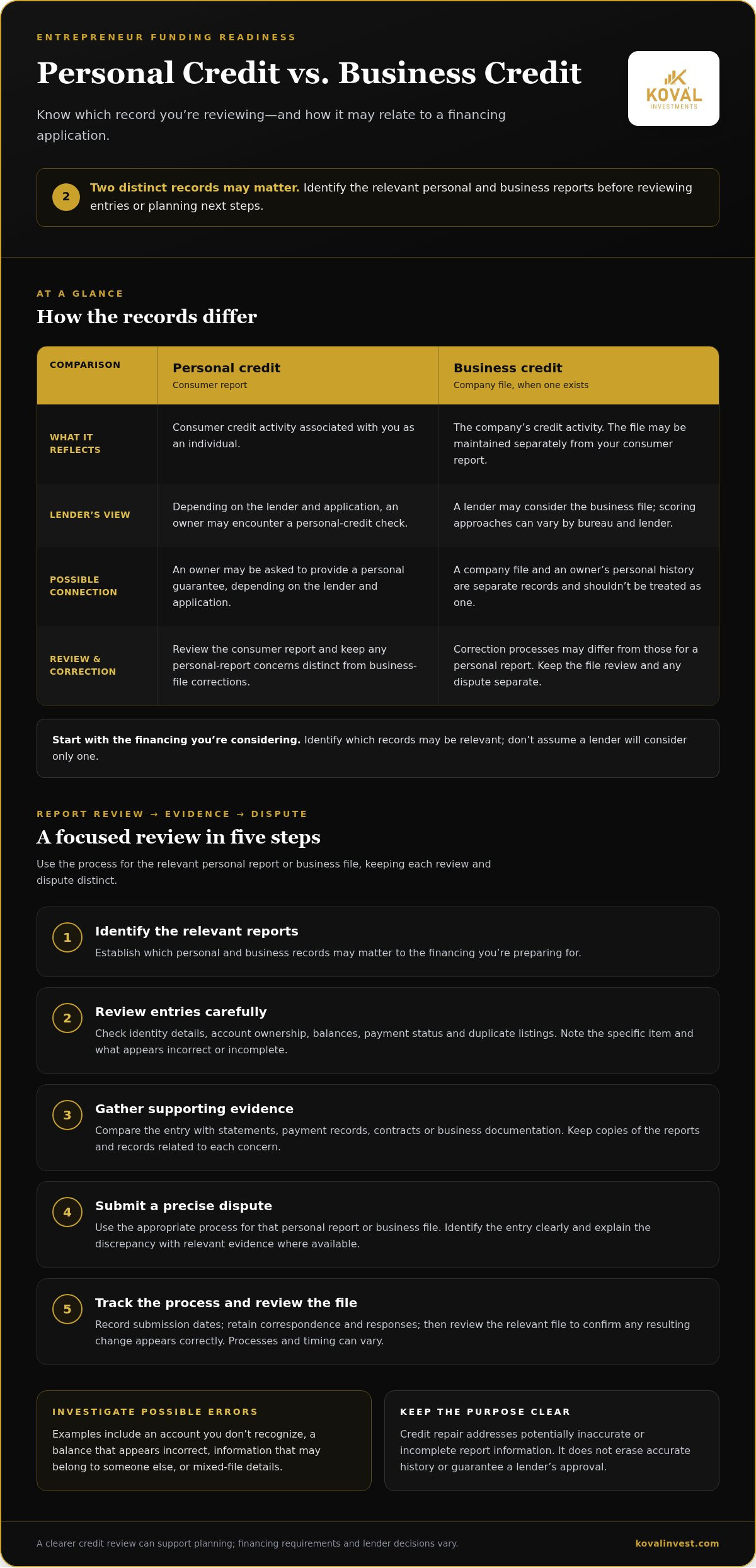
Your personal credit report reflects consumer credit activity associated with you as an individual. A business credit file, when one exists, relates to the company’s credit activity. It may be maintained separately from your consumer report, so an owner’s personal history and a company’s file shouldn’t be treated as one record.
That separation doesn’t mean lenders will consider only one. Depending on the lender and application, an owner may encounter a personal-credit check or be asked to provide a personal guarantee. Business credit files and scoring approaches can also vary by bureau and lender. Before reviewing entries or planning next steps, identify which records may be relevant to the financing you’re considering.
When Might an Entrepreneur Consider Credit Repair?
Review a report closely if it contains an account you don’t recognize, a balance that appears incorrect, or information that may belong to someone else. Mixed-file information, where details appear to have been associated with the wrong person or business, is another reason to investigate. A discrepancy isn’t automatically proof of an error, so compare the entry with your own records before deciding whether to dispute it.
Accurate reports provide a clearer foundation for future financing conversations. They won’t ensure a lender’s approval, but identifying possible inaccuracies can help you understand what needs attention before you apply. Keep personal-report concerns separate from business-file corrections, since the records and correction processes may differ.
For a broader look at how this work fits into business funding preparation, explore Koval Investments’ business credit repair services. Credit repair for entrepreneurs is most useful as one part of a considered plan for reviewing credit information and preparing a broader financial profile.
How Entrepreneur Credit Repair Works: Reports, Evidence, and Disputes
A reliable review starts with the right records and a clear paper trail. Credit repair for entrepreneurs can involve personal credit reports, business credit files, or both. Keep each review and any resulting dispute distinct, because the correction process for a personal report may differ from that for a business file. Use these steps to organize your review:
- Identify the relevant reports. Establish which personal and business records may matter to the financing you’re preparing for.
- Review entries carefully. Check identity details, account ownership, balances, payment status, and duplicate listings. Note the specific item and what appears incorrect or incomplete.
- Gather supporting evidence. Compare the entry with statements, payment records, contracts, or business documentation. Keep copies of the reports and records related to each concern.
- Submit a precise dispute. Use the appropriate process for that personal report or business file. Identify the entry clearly and explain the discrepancy.
- Track the process. Record submission dates, retain correspondence and responses, and review the relevant file afterward to see whether any resulting change appears correctly.
How to Review Credit Reports for Possible Errors
Be specific and evidence-led. If a balance seems wrong, compare it with recent statements and payment records. If an account isn’t yours, check whether the identifying details point to a mix-up. A dispute should identify a specific item and explain why it may be inaccurate or incomplete, with relevant evidence where available. Don’t label accurate but unfavorable history as an error. Accion Opportunity Fund’s Small Business Credit Repair also outlines practical considerations for business owners reviewing credit information.
What Happens After a Credit Report Dispute?
The relevant reporting organization or information provider reviews the claim and supporting details. Keep copies of what you submitted and note any response or request for more information. Processes and timing can vary, particularly between personal reports and business files, so don’t assume one timeline applies to every dispute. Once you receive a response, review the relevant report again and confirm that any change is accurate. If the information remains, assess the explanation and your records before deciding on a next step.
Koval Investments’ credit repair support focuses on identifying and disputing credit-report inaccuracies as part of broader financial preparation.
Credit Repair for Entrepreneurs: What It Can, and Cannot, Change
Credit repair can help address information that appears inaccurate or incomplete. It can’t guarantee that accurate negative history will be removed. A valid late payment or default doesn’t become an error simply because it complicates a financing application. Dispute work should focus on a specific reporting concern and its supporting facts, not on trying to erase an accurate record.
A correction may change information in a report, but it doesn’t automatically change every credit score or determine how a lender evaluates an application. Different scoring approaches and lender criteria can produce different outcomes from the same financial profile. For general information about building a separate business credit record, the U.S. Small Business Administration explains how to establish business credit.
Can Credit Repair Remove Accurate Negative Information?
Disputes are for information you believe is inaccurate or incomplete, such as a balance that doesn’t match your records or an account that isn’t yours. They aren’t a reliable way to remove accurate late payments, defaults, or other unfavorable history. Applicable consumer protections may provide ways to challenge reporting errors, but the details depend on the situation. This is general information, not legal advice.
| Situation | What to expect |
|---|---|
| Inaccurate information | Review the entry, gather relevant records, and consider a focused dispute. |
| Accurate negative information | A dispute isn’t a shortcut to removal; plan around the history as reported. |
| New credit behavior | Consistent habits may support credit building over time, but results aren’t immediate or guaranteed. |
Does Better Credit Guarantee Business Funding?
No. Lenders may assess more than credit, including business cash flow, time in operation, and other details of the application. Correcting a report can improve its accuracy, but it doesn’t promise approval, a particular rate, or a specific funding limit. Credit repair, credit-building habits, and broader financial planning serve different purposes, so consider them together rather than treating a dispute as a complete funding strategy.
For a wider view of financing considerations, read Koval Investments’ SBA loan assistance guidance. A practical approach to credit repair for entrepreneurs addresses verifiable report issues while preparing the rest of the business profile for a financing conversation.
A Practical Credit-Readiness Checklist Before Seeking Business Financing
Credit review is one part of getting ready to discuss financing. A useful preparation process also organizes your business records and clarifies what the capital would support. Use this checklist to separate report-accuracy tasks from financial and operational planning.
Organize Your Credit Records
- Gather the relevant files. Collect current personal credit reports and business credit-file copies that apply to your situation. Keep the dates you accessed them with each copy.
- Assemble supporting records. Organize identification details, account statements, payment records, and relevant business documents so you can compare them with report entries.
- Log possible discrepancies. List each concern by bureau or reporting organization. Note the account or entry, what seems inconsistent, and which records support your observation.
- Keep a correspondence trail. Save copies of submissions, responses, and related communications, along with the dates sent and received. A consistent record makes follow-up easier.
- Monitor changes. Review the relevant files periodically and check that any updates appear accurately. Keep report monitoring separate from efforts to build positive credit behavior.
These steps focus on accuracy, not on pursuing a particular score. Credit repair for entrepreneurs is most constructive when each concern is documented and tied to a specific record, rather than treated as a general effort to improve a number.
Connect Preparation to Your Funding Plan
Before discussing financing, write down what the funds would support, when the business needs them, and how repayment could fit into its cash flow. Connect the requested capital to a clear business objective, such as a planned purchase or working-capital need. Then organize the operating and financial records that help explain the business’s position, including cash-flow information and relevant business documentation.
Consider potential financing paths in light of the project and your business profile. Don’t assume that one credit factor alone determines eligibility, or that correcting a report settles the broader financing question. Koval Investments’ 0% interest business funding guidance provides additional context for considering funding options.
Readiness combines accurate, well-documented credit records with a clear funding purpose and organized business information. If you want support aligning credit review with broader financial preparation, explore credit repair and funding guidance.
How Koval Investments Supports Entrepreneur Credit Repair and Funding Preparation
For a business owner, a credit concern rarely exists in isolation. It may sit alongside questions about capital needs, financial organization, and the next stage of growth. Koval Investments provides credit repair services focused on identifying and disputing credit-report inaccuracies, alongside financial optimization and capital-procurement guidance for broader funding preparation.
The work begins with understanding the credit concern and the business owner’s objectives, then identifying practical next steps. Credit repair for entrepreneurs can help address report concerns, but it isn’t a promise of a score change, item removal, loan approval, or particular financing terms.
What to Expect From a Collaborative Credit Review
A useful review focuses on your concerns and financing goals. You might bring a report entry that appears unfamiliar, a balance that doesn’t match your records, or a question about how credit preparation fits into a planned business expense. Koval Investments’ credit repair services identify and dispute credit-report inaccuracies, with relevant documentation helping clarify the issue.
Report review can also be considered alongside the broader financial picture. Clear communication and realistic expectations matter: an item may warrant a dispute, while other aspects of your profile may call for separate planning. The process focuses on your records and goals, not a promised outcome.
Choose a Next Step That Fits Your Business Goal
If your immediate concern is a report entry, identify the specific information and gather records that help explain why it may be inaccurate. If your priority is pursuing capital, clarify what the funds would support and consider how credit preparation fits alongside the business’s financial position and readiness. These paths can overlap, but neither should be reduced to a single score or dispute.
Koval Investments brings credit repair together with financial optimization and capital-procurement guidance, helping entrepreneurs consider credit concerns in the context of broader business objectives. This preparation cannot guarantee a financing decision. It can provide a more structured way to assess your profile and plan your next move.
If you’re weighing a report concern or preparing for a financing conversation, discuss your credit profile and business goals with Koval Investments. Start with the questions you have, then consider which next steps best align with your plans.
Build a Clearer Path Toward Financing Readiness
Credit repair for entrepreneurs starts with understanding which personal or business records matter, then addressing specific inaccuracies with supporting information. It can’t erase accurate negative history or guarantee a score change, loan approval, or financing terms. A more complete preparation plan pairs report accuracy with organized business records, a clear use for capital, and realistic consideration of repayment capacity.
Koval Investments provides credit repair and capital-procurement services, connecting credit-profile review with financial optimization and strategic guidance while keeping the entrepreneur’s broader goals in view.
Ready to plan your next steps? Discuss your credit profile and business goals with Koval Investments to approach financing preparation with greater clarity.
Frequently Asked Questions
Can credit repair help an entrepreneur qualify for business financing?
Credit repair may help address inaccurate or incomplete information on a credit report, making your profile more accurate as you prepare for financing. It can’t guarantee qualification, approval, a particular rate, or a funding amount. Lenders may assess other factors, such as business cash flow, time in operation, and the purpose of the financing. Treat credit repair for entrepreneurs as one part of a broader funding-readiness plan.
Is business credit separate from personal credit?
Yes. A personal credit report records an individual’s consumer credit activity, while a business credit file relates to a company’s credit activity. A business file may exist separately from its owner’s consumer report. Still, separation doesn’t mean a lender will review only business credit. Depending on its criteria and the application, a lender may consider personal credit or require a personal guarantee. Review the records relevant to your financing plans.
How do entrepreneurs dispute an error on a credit report?
Identify the specific entry and explain what appears inaccurate or incomplete. Compare it with relevant documents, such as account statements, payment records, contracts, or business records. Submit a clear dispute through the appropriate process for the personal report or business file, since processes may differ. Keep copies of the report, supporting evidence, the dispute, and any response. Review the file after receiving a response to check whether any change is accurate.
Does credit repair guarantee a higher credit score?
No. Credit repair doesn’t guarantee a higher score. A dispute may lead to a report correction, but that correction doesn’t automatically change every score or lender decision. Scoring approaches can vary, and a score reflects the information and model being used. Focus on verifiable report accuracy and consistent credit behavior rather than a promised number. A more accurate profile can support better-informed financial planning, but it can’t ensure a specific outcome.
Should entrepreneurs repair personal credit before applying for a business loan?
Review personal credit before applying, especially if the lender may check it or require a personal guarantee. If you find a specific, supportable inaccuracy, addressing it may be a sensible part of preparation. But not every entrepreneur needs a dispute, and personal credit is only one possible consideration. Organize business financial records, clarify the purpose of the funds, and assess repayment capacity alongside credit information when planning an application.