
Disputing Inaccurate Business Credit: 2026 Strategic Guide
A single "ghost" late payment on your business credit report can cost your company more than a physical disaster. While property damage is covered by insurance, an invisible reporting error quietly strangulates your growth by blocking access to 0% interest funding and premium SBA loans. You likely already understand that your business reputation is your most valuable asset, so it's incredibly frustrating when that reputation is tarnished by data you didn't create. Successfully disputing inaccurate business credit information is the first step in reclaiming your financial standing and stopping the cycle of high interest rates despite your strong revenue.
This 2026 strategic guide provides the professional roadmap you need to identify hidden errors, navigate the revised 2026 dispute protocols, and resolve inaccuracies that hinder your capital procurement. We will explore the specific steps required to clean your profile and position your firm for premium capital opportunities. By the end of this article, you'll have a clear, actionable plan to move from being a perceived credit risk to a prime candidate for success-based funding solutions.
Key Takeaways
- Understand why business credit accuracy is your company's most vital financial asset for reducing the cost of capital and securing long-term growth.
- Learn to identify common reporting errors like "mixed files" and "ghost payments" that unfairly suppress your scores and trigger loan denials.
- Master the strategic step-by-step process for disputing inaccurate business credit information across all three major reporting bureaus.
- Discover why professional credit optimization provides a significant advantage over DIY methods when navigating complex bureau logic and documentation requirements.
- Learn how to leverage a newly cleaned credit profile to unlock high-leverage opportunities like 0% interest funding and SBA loans.
Why Business Credit Accuracy is Your Most Valuable Financial Asset
Business credit accuracy is the precise reflection of your company's payment history and debt-to-income ratio across all reporting agencies. It serves as your firm's financial reputation in the eyes of institutional lenders and vendors. When your profile is riddled with errors, it creates an invisible barrier to growth. Inaccuracies directly inflate your cost of capital; a single misplaced late payment can shift you from a "prime" borrower to a "high-risk" category, leading to higher interest rates or outright denials. Lenders don't see reporting mistakes as clerical errors. Instead, they interpret them as indicators of operational instability.
Maintaining a pristine profile is the essential prerequisite for accessing 0% interest business funding. Since these programs are highly competitive, any discrepancy can disqualify you immediately. The process of disputing inaccurate business credit information isn't just about cleaning up the past; it's a strategic move to unlock your company's future borrowing power.
The Difference Between Personal and Business Credit Disputes
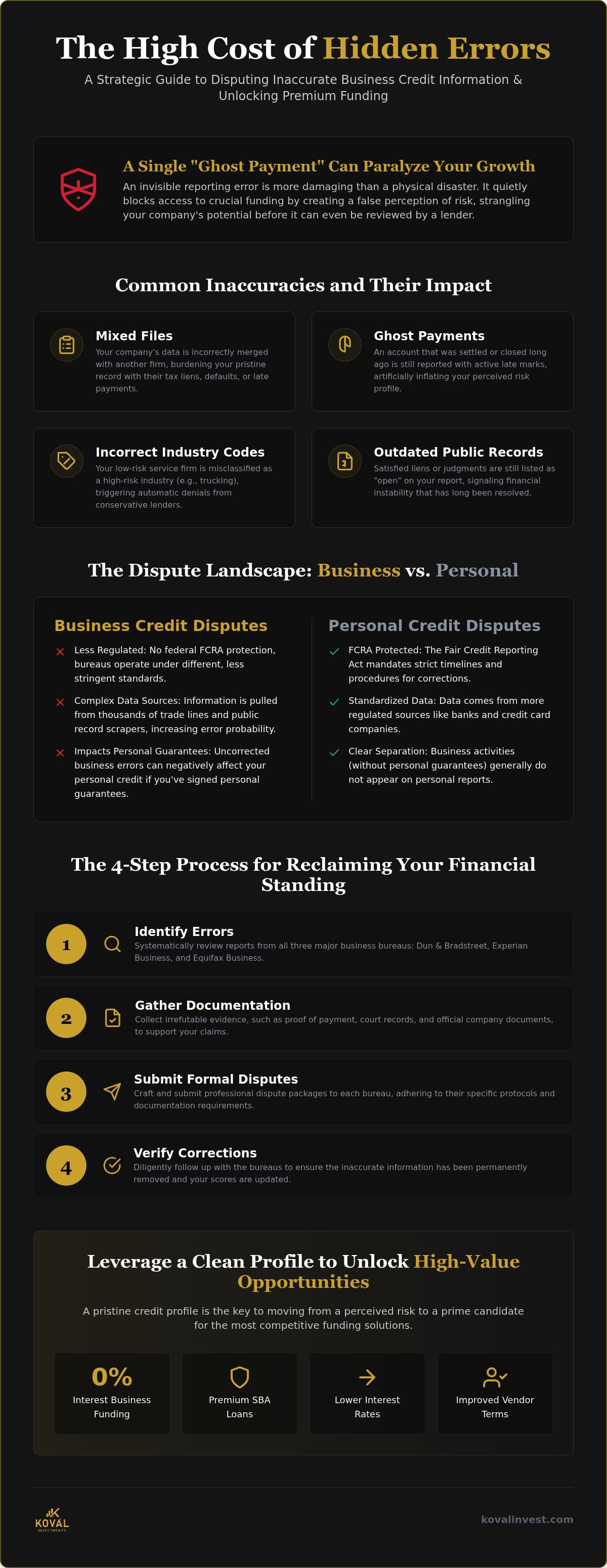
Founders often assume that the protections of the Fair Credit Reporting Act (FCRA) extend to their company's files. Unfortunately, business credit exists in a much less regulated environment. While consumer laws mandate strict timelines for corrections, the "Big Three" bureaus, Dun & Bradstreet, Experian, and Equifax, operate under different standards. Business credit reports are generated from diverse data sources, making them prone to errors like "mixed files" where another company's debt appears on your ledger. If left uncorrected, these business errors can bleed into your personal life, especially if you've signed personal guarantees on business obligations.
The Strategic Impact on SBA Loan Eligibility
Accuracy is particularly critical when pursuing government-backed capital. Most lenders use the FICO SBSS score to pre-screen applicants. This score aggregates data from both your personal and business profiles to determine your risk level. A score below the current threshold often leads to an automatic denial before a human even reviews your application. Professional SBA loan assistance starts with report verification to ensure your data meets these strict requirements. By proactively disputing inaccurate business credit information, you remove the "technical" obstacles that prevent founders from securing the low-cost capital they deserve.
Common Inaccuracies in Business Credit Reports and Their Impact
Identifying the specific root of a reporting error is the most difficult part of disputing inaccurate business credit information. Unlike personal reports, business data comes from thousands of trade lines and public record scrapers that often lack human oversight. One of the most damaging issues is the "mixed file." This happens when a bureau incorrectly merges your company's data with another entity that has a similar name or tax ID. Suddenly, your pristine record is burdened by another firm's tax liens or defaults. These errors are common in the business world because the data matching algorithms used by bureaus are not always precise.
"Ghost payments" are equally problematic for founders. These occur when an account that was settled or closed is still reported with active late marks. If your report shows a 60-day delinquency on a debt you paid off two years ago, your risk profile increases significantly. Additionally, incorrect SIC or NAICS industry codes can place your business in a high-risk category, such as trucking or heavy manufacturing, even if you operate a low-risk service firm. This classification error alone can trigger automatic loan denials from conservative lenders. Outdated public records, such as satisfied liens or judgments that still appear as "open," further complicate your ability to secure competitive terms.
Technical Errors in Payment Reporting
Bureaus often miscalculate "Days Beyond Terms" (DBT), which is a core metric for your business credit score. If a vendor reports a payment as late due to their own internal accounting delay, your DBT score reflects a pattern of delinquency. Many bureaus also fail to report your high credit limits. If your report shows a $20,000 balance but fails to mention your $100,000 limit, you appear to have 100% utilization. This artificial leverage makes you look desperate for cash. For more guidance on the basics of correcting these types of issues, you can review the FTC's guide on Disputing Errors on Your Credit Reports.
Identity and Firmographic Discrepancies
Minor clerical errors in your business address or phone number can trigger fraud flags during the underwriting process. If your credit file doesn't match your official state filings, lenders may suspect identity theft or operational instability. Similarly, discrepancies in your "years-in-business" data can strip away the perceived stability of an established firm. If a bureau reports your ten-year-old company as a two-year-old startup, you lose the advantage of a long-term track record. If you aren't sure where to start with your audit, our team offers specialized credit repair services to help you identify these hidden traps. Successfully disputing inaccurate business credit information requires a deep understanding of how these identity markers influence bureau algorithms.
The Strategic Advantage: Professional Credit Optimization vs. DIY Disputes
While most major bureaus promote free online portals as the standard way to fix errors, these automated systems often lead to dead ends. Clicking a button on a dashboard rarely provides the nuance required for successfully disputing inaccurate business credit information. In fact, these portals are designed to streamline the bureau's workload rather than ensure your company's profile is fully optimized. Professional optimization relies on a deep understanding of bureau logic and the specific evidentiary standards required to force a correction.
A significant risk of the DIY approach is the "frivolous" designation. If a founder submits a dispute without the correct legal phrasing or sufficient documentation, the bureau may flag the request as groundless. This prevents you from raising the same issue again, even if you later find better evidence. By utilizing specialized business credit repair services, you ensure that every submission is backed by "insider" knowledge of how bureaus categorize and process data. This collaborative, success-based approach aligns our interests with your growth, as we only win when you achieve a clean profile.
The Time-Value of Outsourcing Financial Optimization
The opportunity cost of a founder spending 20 or more hours navigating bureau bureaucracies is immense. Every hour you spend drafting letters or waiting on hold is an hour taken away from high-level strategic planning or revenue-generating activities. Professional firms act as a steady hand, navigating these complex systems with precision. We also understand how to dispute an error by leveraging existing relationships with data furnishers to resolve discrepancies at the source rather than just fighting the bureaus. This methodical approach reinforces the brand’s image as a careful partner that values thoroughness over quick, superficial wins.
Beyond Correction: Building a Stronger Credit Profile
Removing inaccuracies is only half of the journey toward securing premium capital. Simply deleting a negative mark doesn't automatically make you a "Tier 1" borrower. Strategic optimization involves adding positive tradelines to "dilute" the historical impact of corrected items. This proactive approach positions your firm to qualify for alternative business funding solutions that require a robust, multi-layered credit history. Successfully disputing inaccurate business credit information is the foundation, but building a resilient profile is what ultimately unlocks 0% interest opportunities.
The Step-by-Step Process for Disputing Inaccurate Business Credit Information
Success in disputing inaccurate business credit information requires a methodical approach that mirrors a legal audit. It's not enough to simply point out a mistake; you must build a case that makes it impossible for the bureau to ignore your claim. The process starts with a comprehensive audit of all three major reports to identify cross-bureau discrepancies. Often, one bureau will have the correct data while another carries a "mixed file" error. Identifying these contradictions provides immediate leverage during the initial filing phase.
Once you've identified the errors, you must gather "Contradictory Evidence." This includes bank statements, cancelled checks, or formal payoff letters from creditors. We then employ a "Two-Pronged Attack." Unlike standard advice that suggests only contacting the bureau, we initiate simultaneous contact with both the bureau and the original creditor. This forces the data furnisher to verify their own records while the bureau is conducting its investigation, which significantly accelerates the resolution timeline and prevents the creditor from simply "rubber-stamping" the error during the bureau's inquiry.
Crafting a Dispute Letter That Gets Results
Every formal dispute must include three essential components: the "Confirmation Number" from the specific credit report, a clear "Item Description" of the error, and the exact "Corrective Action" you demand. Using specific regulatory language is vital to trigger a mandatory investigation rather than a cursory automated scan. You should avoid generic templates found on the internet because bureaus have developed filters to identify and deprioritize "form" letters. Sending your dispute via certified mail with a return receipt is non-negotiable for business disputes because it provides the legal proof of delivery required to hold bureaus accountable for their response times.
Managing the 30-to-45 Day Investigation Window
Bureaus generally aim to complete investigations within 30 days, though the window can extend to 45 days if you provide additional information mid-stream. Behind the scenes, the bureau's automated system sends a code to the creditor to verify the data. If the creditor "verifies" an obviously incorrect item, you must move to escalation tactics. This involves providing more granular evidence or contacting the bureau's legal compliance department directly. If you're struggling with stubborn errors that are blocking your growth, our credit repair services can handle the heavy lifting of these complex escalations for you. Ensuring an error stays off your report permanently requires a final verification audit 60 days after the initial correction.
Leveraging a Clean Credit Profile for 0% Interest Funding Solutions
The "Golden Window" is a critical phase in your capital journey. Once the bureaus have finalized the process of disputing inaccurate business credit information, your profile represents the lowest possible risk to institutional lenders. You must act during this period to capture the highest possible funding limits. Koval Investments specializes in this precise timing, taking your newly optimized profile and presenting it to our network of 0% interest funding providers. We move you quickly from the frustration of fixing the past to the excitement of funding your company's future growth.
A clean profile doesn't just lower your interest rates; it expands your entire range of financial options. For example, a founder in the logistics sector recently discovered a $45,000 "mixed file" error that had caused two previous loan denials. After successfully disputing inaccurate business credit information with our team, their score improved enough to qualify for professional SBA loan assistance. They secured the expansion capital they needed at terms that were previously unavailable, illustrating how credit accuracy serves as the ultimate gatekeeper to government-backed funding.
Maintaining Your Optimized Credit Profile
Securing your funding is only one part of our collaborative partnership. You must remain vigilant because credit bureaus occasionally re-insert deleted errors during data refreshes. We recommend a proactive monitoring strategy to catch these "zombie" marks before they impact your next round of capital. When you begin utilizing new 0% APR lines, it's vital to manage your debt-to-income ratio carefully. Avoid maxing out your new limits immediately; keeping your utilization below 30% ensures your score remains high for future credit needs. Our team stays by your side to provide ongoing guidance on maintaining this delicate balance.
Your Next Steps Toward Capital Procurement
Our success-based philosophy means we're fully aligned with your funding results. We don't just fix credit; we build a bridge to the capital your business requires to scale. With interest rate cycles constantly shifting, the cost of waiting is high. Taking action now to clean your profile ensures you're positioned as a "Tier 1" borrower before market conditions change. We invite you to take the next step in your growth journey today. Schedule a consultation with Koval Investments to optimize your business credit and secure 0% funding.
Transforming Credit Accuracy into Strategic Growth
Maintaining an accurate business credit profile is no longer a passive administrative task. It is a strategic necessity for any founder looking to scale without the burden of high interest rates. By systematically disputing inaccurate business credit information, you remove the artificial barriers that prevent lenders from seeing your true operational strength. We've explored how professional documentation and a two-pronged attack can resolve the "ghost" payments and mixed files that DIY efforts often miss.
A clean report is the essential foundation for the high-leverage opportunities we specialize in, including 0% interest funding and government-backed loans. Koval Investments serves as your professional credit optimization expert, providing a success-based philosophy that eliminates financial risk for our partners. We bridge the gap between where your credit stands today and the premium capital sources your business deserves. Secure Your 0% Interest Funding Strategy with Koval Investments and take the first step toward a more profitable financial future. Your company's potential is too valuable to be limited by reporting errors.
Frequently Asked Questions
How long does it take to dispute inaccurate business credit information?
Most business credit bureaus aim to resolve investigations within 30 days, though the window can extend to 45 days if you submit additional evidence during the process. Unlike consumer credit, there is no federally mandated timeline for business disputes. This lack of regulation makes proactive monitoring essential to ensure your corrections are processed by the bureaus in a timely manner.
Can I fix my business credit score myself or do I need a professional?
You can certainly attempt the process yourself, but many founders find the complexity of disputing inaccurate business credit information leads to repetitive denials. Professional optimization provides a strategic advantage by using specific legal phrasing and established relationships with data furnishers. This approach prevents your requests from being flagged as "frivolous" or "groundless" by automated bureau filters.
Will disputing an error on my business credit report hurt my score?
No, filing a dispute will not negatively impact your business credit score. In fact, removing a "ghost" late payment or correcting an artificial high-utilization mark will typically lead to an immediate score increase. The only risk to your score occurs if you accidentally dispute a positive tradeline that's helping your average age of accounts or credit depth.
What documents do I need to prove a business credit error is wrong?
You should gather "Contradictory Evidence" such as bank statements, cancelled checks, and formal payoff letters from your creditors. For identity or firmographic errors, you'll need official state filings or utility bills that verify your correct business address and name. Providing these documents via certified mail ensures the bureau can't claim your evidence was never received during their investigation.
How do I know if an error on my report is a sign of identity theft?
Unfamiliar addresses, unknown trade lines, or sudden inquiries from lenders you haven't contacted are primary indicators of identity theft. If you notice these red flags, you should immediately place a security alert on your files with Experian, Equifax, and Dun & Bradstreet. Monitoring services like D&B's CreditSignal or Experian's Business Credit Advantage can help you detect these anomalies early.
Why did the bureau verify an error as 'accurate' when I know it's wrong?
Bureaus often verify errors as "accurate" because their automated systems simply ask the original creditor to confirm the data electronically. If the creditor's internal records are also incorrect, they'll "rubber-stamp" the error during the investigation. Resolving this requires an escalation tactic where you provide granular proof directly to the bureau's compliance department to bypass the automated verification loop.
Does fixing my business credit help me qualify for an SBA loan?
Yes, correcting your profile is vital because the FICO SBSS score used for SBA pre-screening relies heavily on business credit accuracy. An error that suppresses your score below the current threshold can trigger an automatic denial before an underwriter even sees your file. Cleaning your report ensures you meet the technical requirements for low-interest, government-backed capital.
What is the difference between a business credit dispute and a personal one?
The primary difference is that the Fair Credit Reporting Act (FCRA) doesn't protect business credit profiles. This means you don't have a legal right to a free annual report or a mandated 30-day resolution timeline. Because business credit exists in a less regulated environment, disputing inaccurate business credit information requires more persistence and higher standards of proof than personal disputes.