
How to Finance a Business Acquisition: Strategic Capital Solutions for 2026
The most expensive mistake you can make in the 2026 market is failing to optimize your financial profile before researching how to finance a business acquisition. While traditional banks have tightened their lending criteria, many entrepreneurs still believe they must choose between draining their personal liquid assets or walking away from a promising deal. You likely understand that securing the right capital is the difference between a thriving legacy and a cash-flow struggle; however, the fear of being rejected due to strict credit requirements remains a constant weight. It's a common hurdle, but it doesn't have to be the end of your expansion plans.
This strategic guide simplifies the complexities of how to finance a business acquisition by demonstrating how to layer traditional loans with 0% interest solutions and creative seller debt. We believe in a success-based philosophy where your funding structure aligns perfectly with the company's tangible valuation. You'll learn the practical steps of how to finance a business acquisition while preserving your liquidity and mastering the newest combined SBA loan limits. We'll start with the high-level strategy of modern capital stacks and move into the specific mechanics of leveraging credit as a powerful tool for growth.
Key Takeaways
- Understand why the 2026 market requires a multi-layered capital stack to navigate higher interest rates and stricter lending requirements.
- Discover how to leverage the new $10 million combined SBA loan limit to maximize your purchasing power for large-scale acquisitions.
- Learn the specific strategies for how to finance a business acquisition using 0% interest solutions that preserve your personal liquid assets.
- Master the art of negotiating seller carry-back notes to bridge funding gaps and align the seller's interests with your long-term success.
- Identify why credit restoration is a high-ROI preliminary step that unlocks more favorable terms and lower down payment requirements.
Evaluating Your Readiness for Business Acquisition Financing
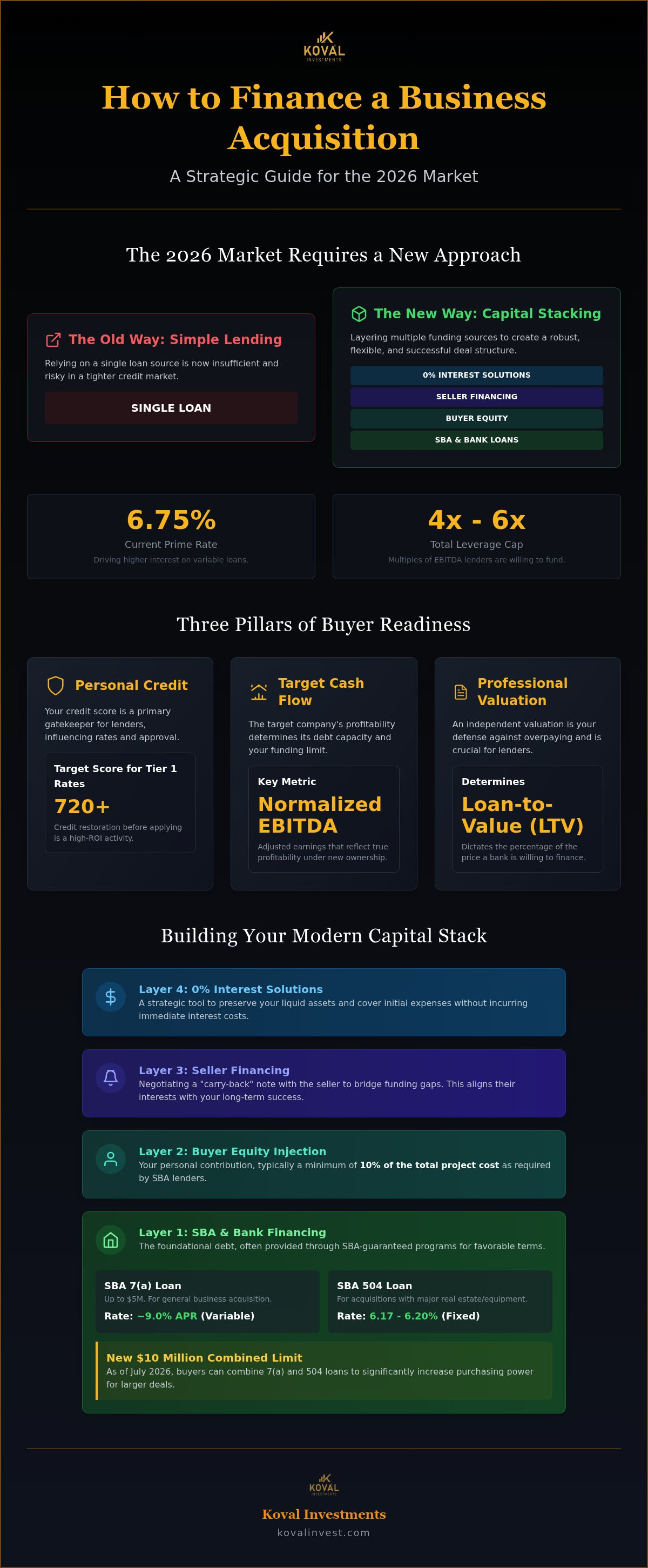
Acquisition financing is the strategic use of debt, equity, or hybrid capital to purchase an existing enterprise. In the current economic climate, understanding how to finance a business acquisition requires looking far beyond a single bank loan. The 2026 market, characterized by a Prime Rate of 6.75%, has shifted the paradigm from simple lending to complex capital stacking. This often mirrors the mechanics of a Leveraged buyout (LBO), where the assets and cash flow of the target company serve as collateral to secure the necessary funding. Success depends on your "Entry State," which refers to the financial health you bring to the table before the first application is filed.
Market conditions in 2026 demand a multi-layered funding approach. Relying on a single source of capital is often insufficient because total leverage is typically capped at 4 to 6 times EBITDA. This is a noticeable decrease from the higher multiples seen in previous years. Most successful deals now integrate a mix of buyer equity, seller notes, and senior debt to reach the finish line without over-extending any single party. When you're determining how to finance a business acquisition in this environment, you must account for the three pillars of readiness: personal credit, target cash flow, and professional valuation.
The Role of Professional Business Valuations
An independent valuation is your best defense against over-leveraging during an acquisition. Lenders use these professional reports to establish Loan-to-Value (LTV) ratios, which dictate the percentage of the purchase price they're willing to cover. If the valuation doesn't support the seller's asking price, you'll face a funding gap that usually requires more personal cash or a larger seller carry-back. We prioritize the analysis of normalized EBITDA, which adjusts the business's earnings to reflect its true profitability under new management. This specific figure determines your total debt service coverage and your ultimate funding capacity.
Assessing Your Personal and Business Credit Profile
SBA lenders rely on FICO SBSS scores as a primary gatekeeper for acquisition loans. This score blends your personal credit history with business financial data to provide a comprehensive risk assessment. Certain red flags, such as recent bankruptcies, unresolved tax liens, or excessive credit utilization, can stop an acquisition loan in underwriting before it ever reaches a human reviewer. To secure Tier 1 interest rates in 2026, you generally need a personal credit score of 720 or higher. Investing in credit restoration before you apply is a high-ROI activity that directly lowers your long-term cost of capital and improves your chances of a "win-win" deal structure.
Leveraging SBA Loans and Traditional Bank Financing
When you explore how to finance a business acquisition, the Small Business Administration (SBA) often provides the most accessible path for entrepreneurs. The SBA 7(a) loans program remains the primary vehicle for acquisitions up to $5 million. These loans are popular because they offer longer repayment terms and lower down payments than most conventional options. As of July 2026, the SBA has increased the combined loan limit for 7(a) and 504 programs to $10 million, allowing buyers to scale their ambitions significantly. This rule change provides a powerful advantage for those looking to acquire larger enterprises or multiple locations simultaneously.
While the 7(a) program is versatile, the SBA 504 loan is a superior choice when the acquisition includes significant real estate or heavy equipment. For July 2026, the effective fixed rates for the SBA portion of 504 loans sit between 6.17% and 6.20%. This provides long-term stability that variable-rate loans cannot match. In contrast, variable 7(a) rates for loans over $250,000 are currently capped at Prime plus 2.25%, which totals approximately 9.0% APR based on the current 6.75% Prime Rate. Understanding these nuances helps you choose the right instrument for your specific deal structure.
A critical component of SBA financing is the 10% equity injection requirement. Lenders expect the buyer to contribute at least 10% of the total project cost from their own resources. You can source this capital through personal savings, home equity, or occasionally through a portion of seller financing, provided the seller note is on a full standstill for the life of the SBA loan. If you need help structuring your application to meet these strict requirements, our team provides comprehensive SBA loan assistance to ensure your package is lender-ready.
Navigating the SBA Application Process
The application process is rigorous and requires meticulous documentation. You must provide three years of personal and business tax returns, current profit and loss statements, and a detailed personal financial statement. Lenders also require a comprehensive business plan that specifically outlines how the target acquisition will maintain cash flow to service the debt. A "lender-ready" plan doesn't just describe the business; it proves the acquisition's viability through data. We often see that a well-prepared package is the difference between a quick approval and a months-long delay.
Conventional Bank Loans vs. SBA-Backed Funding
Conventional financing is often reserved for mid-market acquisitions where the deal size exceeds SBA limits or the buyer has an established relationship with a commercial bank. For August 2026, conventional term loan rates range from 8% to 17.25%. The primary trade-off is that conventional loans often require 20% to 30% down and involve stricter collateral requirements. Most entrepreneurs prefer SBA-backed funding because the government guarantee reduces the bank's risk, which translates to the lower down payments and longer amortizations that preserve your operational cash flow.
Creative Deal Structures: Seller Financing and Equity
Relying solely on institutional debt often leaves a significant capital gap that can stall a promising deal. Creative deal structures allow you to bridge this divide by aligning the interests of the buyer, the seller, and outside investors. This approach is central to any sophisticated guide to financing a business in 2026. By layering different types of capital, you can reduce your personal cash outlay while ensuring the business remains healthy enough to service its obligations during the transition period.
Seller financing is perhaps the most powerful tool for those learning how to finance a business acquisition without over-leveraging. In this arrangement, the seller agrees to accept a portion of the purchase price over time, effectively acting as a junior lender. This doesn't just fill a funding gap; it serves as a vote of confidence in the company's future. When a seller keeps "skin in the game," they're far more likely to provide a thorough training period and ensure a smooth handoff of key customer relationships.
For acquisitions targeting high-growth industries, mezzanine financing and equity partners offer alternative paths. Mezzanine debt sits between senior debt and equity, often requiring no collateral but carrying a higher interest rate. Equity partners, on the other hand, provide capital in exchange for ownership stakes. This is particularly useful for buyers who have the operational expertise to run a company but lack the liquid capital for a substantial down payment. These structures prioritize long-term stability over immediate full ownership.
Structuring a Winning Seller Note
Typical seller financing notes in 2026 carry interest rates between 6% and 9%. These notes often include a balloon payment after five to seven years, giving the buyer time to refinance or pay down senior debt first. If you're using an SBA loan, a seller note can sometimes count toward your equity injection if it's structured correctly with a full standstill. We also recommend including "clawback" provisions. These clauses allow you to reduce the note's balance if the business fails to meet specific performance benchmarks or if undisclosed liabilities surface after the closing date.
Attracting Private Equity and Angel Investors
Trading equity for capital is a strategic move to avoid heavy debt service during your first year of operations. To attract these investors, you must present a professional case rooted in data. This begins with a professional business valuation that justifies the entry price and demonstrates a clear path to ROI. While bringing in partners means sharing control, it also distributes risk. In the 2026 landscape, most successful buyers find that owning 70% of a thriving, well-capitalized company is far better than owning 100% of one that is struggling under the weight of high-interest debt.
Strategic Optimization: Credit Repair and 0% Interest Solutions
Most entrepreneurs focus exclusively on the target company's financials while neglecting their own financial leverage. This is a missed opportunity. Optimizing your personal and business credit profile before approaching a lender is the highest ROI activity you can perform. When you understand how to finance a business acquisition effectively, you realize that your credit score isn't just a number; it's a pricing tool that determines your cost of capital. By proactively addressing your credit health, you transition from a borrower who accepts whatever terms are offered to a strategic buyer who dictates the structure of the deal.
The synergy between business credit repair services and loan approval cannot be overstated. A cleaner credit profile reduces the perceived risk for underwriters, which often leads to lower down payment requirements and faster closing times. This optimization process ensures that you aren't just getting funded, but you're getting funded on terms that protect your company's long-term cash flow.
Repairing Credit to Unlock Tier 1 Rates
Even a modest 50-point increase in your credit score can have a massive impact on the lifetime cost of a $1M acquisition loan. In the 2026 interest rate environment, this score jump can be the difference between a standard rate and a Tier 1 rate, potentially saving you over $100,000 in interest over a ten-year term. Our process involves identifying and disputing specific inaccuracies, such as outdated late payments or incorrect credit limits, that often trigger automatic SBA rejections. Credit repair acts as a leverage multiplier by reducing the risk premium lenders charge, allowing you to secure significantly more capital with the same cash flow.
Utilizing 0% Interest Funding Solutions
Once your credit is optimized, you gain access to our "secret weapon" for acquisition working capital: 0% interest business funding. These unsecured business lines of credit provide a non-dilutive alternative to bringing on equity partners. Instead of giving away a percentage of your new company to cover closing costs or initial inventory, you can use zero-interest capital to fund the first 6 to 12 months of post-acquisition operations. This preserves your equity while providing a much-needed safety net during the transition period.
Strategic layering is the ultimate goal for a sophisticated buyer. By combining a senior SBA loan with unsecured 0% APR lines, you maximize your liquidity without increasing your immediate interest expense. This approach ensures that you have the capital necessary to handle unforeseen operational challenges or to invest in growth immediately after taking the reins. If you want to see how these optimized capital solutions can work for your next deal, connect with our strategic advisors today to begin your financial assessment.
Partnering for Success: The Koval Investments Advantage
The final piece of the acquisition puzzle is not just knowing which programs are available, but having a partner who understands how to weave them together. We operate on a success-based philosophy that ensures our objectives are perfectly aligned with your strategic goals. In a market where leverage is capped and interest rates are stabilized but elevated, the margin for error is slim. By integrating capital procurement with strategic advisory, we eliminate the friction that often kills deals during the final stages of underwriting. Our role is to act as a steady hand, navigating the complex financial landscape so you can focus on the operational transition of your new enterprise.
When you are determining how to finance a business acquisition, you shouldn't have to manage a fragmented team of credit repair firms, loan brokers, and valuation experts. This disjointed approach often leads to conflicting advice and missed deadlines that can alienate sellers. We provide a single, professional point of contact to guide you through the entire lifecycle of the deal. From the initial credit optimization that unlocks Tier 1 rates to the final negotiation of a seller carry-back, our focus remains on your long-term profitability. We believe that a well-structured deal is the foundation of a lasting business legacy.
Unified M&A and Capital Procurement
A boutique consulting firm offers a level of depth that high-volume brokers simply cannot match. We facilitate "win-win" transitions by providing objective mergers and acquisitions consulting that evaluates the health of the target company alongside your personal financial profile. Our commitment is to identify the most cost-effective capital stack for every unique deal. Whether that involves layering 0% interest lines or maximizing SBA guarantees, we ensure your new company is capitalized for growth rather than just the purchase price. This holistic view prevents the common pitfall of being "asset rich but cash poor" after the closing date.
Take Action: Secure Your Acquisition Capital
The most successful buyers don't wait for a signed Letter of Intent to begin their financial preparation. We recommend starting the credit optimization process at least three to six months before you intend to close a deal. This lead time allows us to resolve inaccuracies and position your score for maximum leverage. Additionally, securing a professional valuation early provides the objective data needed to anchor your negotiations and justify your funding request to lenders. Building your financial "war chest" is a deliberate process that requires precision and foresight. If you are ready to master how to finance a business acquisition with a strategic partner invested in your results, consult with Koval Investments to fund your acquisition today.
Optimizing Your Path to Ownership
The landscape of 2026 requires a more sophisticated approach than the lending environments of the past. You've seen that mastering how to finance a business acquisition is no longer just about finding a bank; it's about optimizing your personal credit to unlock Tier 1 rates and layering non-dilutive capital like 0% interest funding. By combining these tools with professional valuations and strategic seller notes, you ensure that your new enterprise is built on a foundation of stability rather than overwhelming debt. This methodical preparation transforms a complex transaction into a manageable, strategic growth move.
We're here to act as your strategic partner throughout this entire journey. Through our success-based consulting model, we provide the specialized 0% interest funding solutions and expert SBA loan assistance needed to close your deal with confidence. We also integrate credit restoration to maximize your leverage from day one. Secure Your Acquisition Funding with Koval Investments and take the first step toward a seamless transition. Your next successful acquisition is within reach when you have the right capital stack behind you.
Frequently Asked Questions
How much of a down payment is required to finance a business acquisition?
Lenders generally require a minimum 10% equity injection for most SBA deals, while conventional commercial loans often demand between 20% and 30% down. This contribution ensures you have sufficient skin in the game to align your interests with the bank's risk. You can source these funds from personal savings, retirement accounts, or a portion of seller financing, provided the deal remains within the lender's specific leverage guidelines.
Can I finance a business purchase with no money down?
Pure no money down deals are rare in 2026, but you can achieve high leverage by layering multiple capital sources to meet the equity requirement. This strategy involves combining an SBA loan with a seller carry-back note and unsecured business lines. Understanding how to finance a business acquisition using this layered approach allows you to satisfy the bank's 10% injection rule while preserving your personal liquid cash for post-close operations.
How does my personal credit score affect my ability to buy a business?
Your personal credit score is the primary gatekeeper that determines both your eligibility for funding and the interest rates you'll pay. Lenders use this score to assess your historical reliability and to calculate the risk premium on your loan. A score of 720 or higher is typically required to unlock Tier 1 rates, while scores below 680 may lead to automatic rejections or significantly higher down payment demands.
What is the typical interest rate for a business acquisition loan in 2026?
Interest rates currently vary based on the loan type, with variable SBA 7(a) loans averaging around 9.0% APR for amounts over $250,000. For those seeking long-term stability, SBA 504 loans offer fixed rates near 6.2% for the government-backed portion. Conventional bank loans are more expensive, often ranging from 8% to 17.25% depending on the strength of the target company's cash flow and your own financial profile.
Is seller financing better than an SBA loan for an acquisition?
Seller financing is not necessarily better, but it serves as a critical bridge that complements institutional debt. These notes often carry lower interest rates, typically between 6% and 9%, and don't require the same level of collateral as a bank. Most successful buyers use seller financing to cover a portion of the purchase price, which reduces the total amount they need to borrow from a traditional lender.
How long does it take to get funding for a business acquisition?
The timeline for how to finance a business acquisition usually ranges from 60 to 90 days for SBA-backed transactions. Conventional bank loans might close in 45 to 60 days, while unsecured 0% interest lines can be secured in as little as three weeks. These timelines depend heavily on the speed of your documentation and the complexity of the target company's financial records during the due diligence phase.
Can I use 0% interest funding to buy an existing business?
You can use 0% interest business lines as a strategic tool to fund specific parts of the purchase, such as closing costs or initial inventory. While these lines rarely cover the entire purchase price, they are excellent for providing the working capital needed during the first year of ownership. This capital is non-dilutive, allowing you to maintain full control of the company without bringing on expensive equity partners.
Do I need a professional business valuation to get a loan?
Every commercial lender requires a professional business valuation to establish the Loan-to-Value ratio before they will release funds. This report proves to the bank that the company's earnings and assets justify the purchase price you've agreed to pay. Without a valuation that supports the deal, the bank will likely reduce the loan amount, forcing you to find additional capital to cover the resulting funding gap.