
The Comprehensive Guide to Unsecured Business Funding Options in 2026
What if the most effective way to scale your operations this year didn't involve pledging your home or equipment as collateral? Many business owners believe that rapid growth requires either high-interest debt or the constant risk of personal asset seizure. With the prime rate holding at 6.75% as of June 2026, the pressure to find affordable, non-collateralized capital is higher than ever. You likely feel the weight of rising rates and the frustration of shifting SBA requirements, such as the new 1.1:1 debt service coverage ratio now required for small loans.
We believe that capital should be a strategic tool rather than a source of stress. This guide will show you how to identify the most competitive unsecured business funding options available today, including how to unlock 0% interest funding for up to 24 months. You'll learn exactly how to navigate the current lending environment, understand the updated qualification criteria for 2026, and leverage your credit profile to secure the capital your business deserves without the typical financial risks. We'll move beyond the confusion of non-collateralized debt to help you find a path that protects your assets while fueling your progress.
Key Takeaways
- Learn how to insulate your personal and business assets from seizure by transitioning to capital structures that do not require physical collateral.
- Identify the most effective unsecured business funding options for your situation, ranging from flexible revolving lines to predictable term loans.
- Discover why the speed of execution in unsecured funding provides a competitive advantage for businesses operating in high-growth or fast-moving sectors.
- Understand the direct link between your FICO score and your funding costs, and how credit repair services can unlock significantly higher approval limits.
- Explore the strategic use of credit stacking to secure between $50,000 and $250,000 in capital through a specialized 0% Interest Funding Solution.
What is Unsecured Business Funding and Why Does It Matter?
Unsecured business funding is a strategic financial tool where capital is provided without the requirement of physical collateral. Unlike traditional loans that might require a lien on your commercial property or equipment, What is Unsecured Business Funding essentially boils down to a lender's trust in your business's cash flow and credit history. In the current 2026 market, where the prime rate sits at 6.75%, choosing the right unsecured business funding options allows you to maintain operational agility. You don't have to worry about the bank seizing your personal residence or essential business assets if the market takes an unexpected turn. This protection is the primary reason many entrepreneurs prefer this route; it keeps the risks of entrepreneurship contained within the business's performance.
However, this lack of collateral means lenders must find other ways to protect their investment. They typically mitigate risk through higher interest rates or stricter credit requirements. For instance, while an SBA 7(a) loan might offer variable rates between 9.75% and 13.25%, online lenders often charge between 14% and 36% for similar unsecured terms. This trade-off makes your credit profile the most valuable asset you own. It's the key to accessing lower-cost capital without putting your physical property on the line. For service-based and tech companies that lack heavy machinery or large real estate holdings, these options are often the only viable path to significant growth capital.
The Distinction Between Secured and Unsecured Capital
The main difference lies in what happens during a default. In a secured arrangement, a lender can immediately claim assets like real estate, vehicles, or specialized equipment. For modern service-based and tech companies, these physical assets often don't exist in a high enough volume to satisfy traditional lenders. Unsecured funding eliminates the need for lengthy asset appraisals and environmental reports, which significantly accelerates the approval cycle. There is also a clear psychological benefit to this approach. Keeping your business debt separate from your personal property ensures that your family's security isn't tied to every pivot your company makes. It fosters a cleaner balance sheet and a more focused approach to strategic progress.
Common Use Cases for Non-Collateralized Funding
Non-collateralized funding is particularly effective for high-momentum activities that don't produce a tangible asset for a bank to hold. You can move quickly to fund a sudden marketing expansion or manage a spike in inventory costs before a peak season. It's also the ideal solution for acquiring talent or investing in proprietary technology. Traditional asset-based lending often fails in these scenarios because you can't put a lien on a software developer's expertise or a brand's growing reputation. By utilizing unsecured business funding options, you can bridge cash flow gaps without the burden of long-term asset encumbrance, allowing your business to remain lean and responsive to the fast-paced economic shifts of 2026.
A Roundup of Top Unsecured Business Funding Options
Identifying the right unsecured business funding options requires a clear understanding of your company's cash flow patterns and growth objectives. Because there is no physical collateral at stake, the structure of the capital you choose dictates both your cost and your operational flexibility. Not every product fits every business lifecycle; some are designed for short-term gaps, while others support multi-year expansion plans. Selecting the wrong structure can lead to unnecessary interest expenses or restrictive repayment schedules that hinder your momentum.
A business line of credit represents the most flexible form of revolving capital. It works like a safety net; you only pay interest on the funds you draw. This is ideal for managing the ebb and flow of operational expenses without committing to a large, lump-sum debt. Conversely, unsecured term loans provide a fixed amount of capital upfront with a set repayment schedule. These are best suited for predictable projects, such as a major software upgrade or a specific hiring initiative, where you can calculate the return on investment over a defined period. Many sophisticated owners also leverage business credit cards with 0% APR introductory periods to fund initial startup costs or inventory spikes. These offers, which can extend up to 24 months in 2026, essentially provide interest-free capital if managed with discipline.
Revolving Credit vs. Fixed-Term Funding
Choosing between revolving credit and fixed-term funding depends on your specific situation. Revolving credit offers ongoing access to funds, while term loans are project-specific. It's also vital to look at repayment structures. Some online lenders require daily or weekly withdrawals from your bank account, which can strain cash flow compared to traditional monthly installments. Understanding these nuances is a core part of our strategic planning services, where we align capital choices with your long-term goals.
Alternative Unsecured Solutions
Merchant Cash Advances (MCAs) offer rapid speed, often funding within 24 hours, but they carry a high cost that can erode profit margins if you aren't careful. Peer-to-peer (P2P) platforms remain a viable alternative in 2026 for those with strong community or industry reputations. Additionally, automated lending through platforms like Stripe or Shopify has streamlined access for e-commerce businesses by using real-time sales data to determine creditworthiness. While various SBA loan programs and alternative tools provide different paths, the goal remains the same: accessing capital that fuels growth without compromising your assets or your peace of mind.
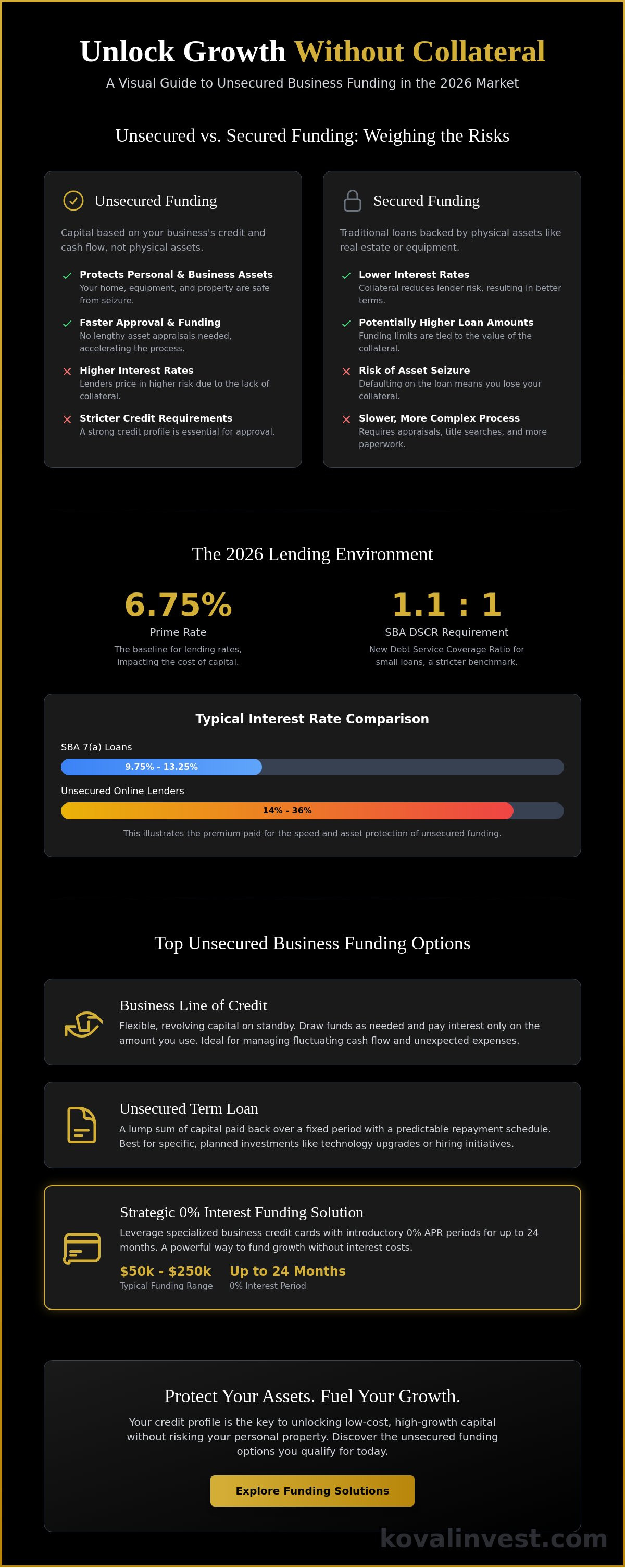
Unsecured vs. Secured Funding: Weighing the Risks and Rewards
Deciding between secured and unsecured debt is a strategic choice about how you allocate risk within your company. While traditional banking institutions often highlight the lower interest rates associated with secured loans, they rarely account for the significant opportunity cost of slow approval cycles. In the high-velocity markets of 2026, the speed of unsecured business funding options often provides a competitive edge that far outweighs a few percentage points in interest. When you don't have to spend weeks appraising equipment or verifying property titles, you can deploy capital exactly when a market window opens.
One of the most overlooked risks of secured funding is the impact of asset liens on your future borrowing capacity. When a lender places a lien on your property or inventory, they essentially freeze that portion of your balance sheet. This can block you from securing secondary funding or revolving lines of credit later because other lenders won't want to take a subordinate position. By keeping your assets unencumbered, you maintain maximum leverage for future growth phases. It's also worth reviewing the SBA explanation of unsecured funding to understand how personal guarantees act as the primary security for these loans. While you aren't pledging a specific house or car, you remain personally accountable, which is why lenders still focus heavily on your individual credit profile.
The Cost of Capital Debate
Lenders charge higher rates for unsecured debt to compensate for the lack of physical collateral they can seize in a default scenario. The Risk Premium is the specific interest spread a lender adds to a loan's base rate to offset the increased probability of loss without asset backing. To determine if an unsecured loan makes sense, you must focus on the return on investment (ROI) rather than just the APR. If a loan with a 14% interest rate allows you to fulfill a contract with a 35% profit margin, the capital is a high-value tool that generates a net gain for the business.
Flexibility and Asset Protection
Maintaining a clean balance sheet gives you the freedom to pivot your business model without seeking permission from a lienholder. Secured debt often includes restrictive covenants that can complicate asset sales, corporate restructuring, or even mergers. Unsecured debt allows for much more fluid strategic moves. This flexibility is particularly advantageous when you are using working capital for business acquisition, as it lets you move quickly on a competitor or partner without the red tape of re-negotiating existing asset-based agreements.
How to Qualify for Premium Unsecured Rates: The Credit Factor
Your credit profile is the engine that drives your borrowing capacity. In a financial environment where physical collateral is absent, lenders view your credit history as the ultimate proof of reliability. Most institutions in 2026 require a personal FICO score of 680 or higher to qualify for the most competitive unsecured business funding options. If you're targeting elite 0% interest opportunities, that threshold often climbs to 700 or above. This direct correlation between your score and your approval limit makes credit management a core business strategy rather than just a personal financial habit.
We view credit as a dynamic asset that you can optimize to lower your total cost of capital. Many entrepreneurs don't realize that even minor reporting errors can cost them thousands in unnecessary interest. Beyond your personal score, you must also cultivate a strong Business Credit Profile with bureaus like Dun & Bradstreet and Experian Business. Underwriters use these reports, alongside your Debt-to-Income (DTI) ratio, to determine if your cash flow can comfortably support new debt. A healthy DTI suggests that your business is growing sustainably rather than relying on debt to survive, which makes you a much more attractive partner for lenders.
Optimizing Your Financial Profile
The first step toward better rates is identifying and disputing inaccuracies that suppress your borrowing power. These hidden errors are more common than most owners suspect, and removing them can lead to a significant boost in your eligibility. It's often possible to see a measurable improvement in your business credit score in under 90 days with a disciplined, methodical approach. At Koval Investments, we actively look for these discrepancies to ensure your profile reflects your true financial strength before you enter the application phase. If your current score isn't where it needs to be, our credit repair services provide a clear path to qualifying for the capital you need.
Documentation Requirements for Unsecured Capital
While many unsecured business funding options are marketed as "Low-Doc," you should still prepare a foundational set of records to secure the highest possible limits. Lenders typically request the last three to six months of bank statements and your most recent tax returns to verify operational health. A concise, professional business plan also plays a vital role; it demonstrates to the underwriter that you have a clear roadmap for generating the revenue required for repayment. Maintaining total transparency with your strategic advisor allows us to present your business in the best possible light, ensuring a smoother approval process and more favorable terms.
Strategic Capital: Accessing 0% Interest Unsecured Funding
Most discussions around unsecured business funding options focus on high interest rates as a necessary trade-off for speed. We challenge that assumption. The "holy grail" of capital is the 0% Interest Funding Solution, which allows you to fuel growth without the drag of monthly interest payments. This isn't a government grant or a rare non-profit loan; it's a strategic arrangement of institutional credit lines designed for businesses with strong financial profiles. By transitioning from high-interest debt to a 0% interest model, you immediately increase your net margins. You can then reinvest that saved capital back into your core operations, creating a compounding effect on your growth that high-interest loans simply can't match.
Transitioning to this model requires a shift in how you view your business's credit capacity. Instead of taking the first loan offer that comes your way, you look for opportunities to stack capital in a way that minimizes cost. This approach is particularly effective for entrepreneurs who have already optimized their credit scores and are looking for a more sophisticated way to fund their next stage of expansion. It turns your financial profile into a tool for wealth preservation rather than just a way to pay for today's expenses.
The Mechanics of 0% Interest Credit Stacking
Credit stacking involves the simultaneous acquisition of multiple unsecured business credit lines to create a larger pool of liquid capital. When executed correctly, this strategy can provide between $50,000 and $250,000 at zero interest for introductory periods of 12 to 24 months. Managing these repayment cycles requires precision to maintain your 0% status, but the results are transformative for large-scale operations. Leveraging 0% interest credit stacking provides capital significantly faster than traditional SBA loans while eliminating the interest costs that typically erode small business profits. This method allows you to fund inventory, marketing, or even new hires with zero cost of capital during the promotional window.
Partnering for Long-Term Expansion
Navigating these complex funding landscapes alone often leads to sub-optimal results or missed opportunities. Professional consulting ensures that your applications are sequenced correctly to avoid red flags and maximize your total limits. Our "success-based" philosophy means we're fully aligned with your goals; we only succeed when you secure the capital you need to scale. This removes the traditional friction between a service provider and a client, turning the engagement into a true partnership. We act as your strategic mentor, helping you move beyond basic loans and into a sophisticated capital structure that supports long-term stability. For a deeper dive into these strategies, read The Ultimate Guide to 0% Interest Business Funding in 2026.
Growth shouldn't be limited by the cost of your capital or the fear of losing your assets. If you're ready to protect your personal property while accessing elite-tier funding, it's time to take the next step. Schedule a consultation with Koval Investments to secure your 0% funding and begin your transition to a more profitable growth model today.
Scaling Your Vision with Strategic Capital
Capital is the fuel for your business's progress, but it shouldn't come at the cost of your personal security. We have explored how identifying the right unsecured business funding options allows you to protect your assets while maintaining the agility needed in the 2026 market. By prioritizing your credit profile and understanding the nuances of credit stacking, you can move beyond expensive debt and into a model that supports sustainable, long-term growth. Protecting your balance sheet today ensures you have the leverage needed for tomorrow's opportunities.
Koval Investments is here to act as your steady partner in this journey. We have facilitated over $500M in business funding by specializing in elite 0% interest credit stacking solutions. Our success-based model ensures there is no upfront risk to you; we are fully invested in your results. It's time to leverage our expertise as insiders to unlock the capital your company deserves. Your next stage of expansion is within reach, and we're ready to help you navigate the complexities of the financial landscape with confidence.
Secure Your 0% Interest Unsecured Funding Today
Your business has the potential to reach new heights. Let's build that future together.
Frequently Asked Questions
Is it possible to get unsecured business funding with bad credit?
Yes, it's possible, though your choices will be more limited and carry higher costs. While premium rates typically require a FICO score of 680 or higher, certain SBA Microloans are accessible with scores as low as 575. If your credit is currently a barrier, utilizing professional credit repair services is the most effective way to transition toward more affordable capital and higher approval limits.
How much unsecured funding can a small business realistically qualify for?
Most small businesses can qualify for amounts ranging from $5,000 to $250,000 depending on their credit profile and revenue. For those seeking the upper end of this range, unsecured business funding options like credit stacking are often necessary. Lenders generally look for at least $150,000 in annual revenue if you're applying for traditional term loans or lines of credit over $50,000.
What is the difference between an unsecured loan and an unsecured line of credit?
The primary difference is how you receive and repay the capital. An unsecured loan provides a one-time lump sum with fixed monthly payments, making it ideal for specific projects. A line of credit is revolving, allowing you to draw funds as needed and only pay interest on the amount you've used. This flexibility makes lines of credit better suited for managing ongoing operational cash flow.
Do unsecured business loans require a personal guarantee?
Yes, a personal guarantee is a standard requirement for nearly all unsecured business capital. Because you aren't pledging specific physical collateral like real estate or equipment, the lender relies on your personal commitment to repay the debt. This means you're personally responsible for the balance if the business is unable to meet its financial obligations.
How fast can I receive funds from an unsecured business funding option?
Speed is one of the greatest advantages of these products, with many online lenders providing funds in as little as 24 to 72 hours. Traditional bank options and SBA loans usually take several weeks due to more rigorous documentation requirements. If your objective is rapid execution, choosing unsecured business funding options through digital platforms is the most efficient path to liquidity.
Are 0% interest business funding options truly interest-free?
They are interest-free during the introductory promotional period, which typically lasts between 12 and 24 months. These opportunities are primarily available through specialized business credit lines for owners with scores above 700. It's important to pay the balance or refinance before the promotional window closes, as standard rates will apply to any remaining balance after that date.
Can I use unsecured funding to buy an existing business?
Yes, you can use these funds for acquisitions or to cover the down payment on a larger SBA loan. Using working capital or 0% interest lines provides the speed necessary to secure a deal before competitors intervene. We often integrate these funding strategies into our mergers and acquisitions consulting to help clients expand their portfolios without exhausting their cash reserves.
What happens if my business cannot repay an unsecured loan?
If the business defaults, the lender will look to the personal guarantee for repayment. While there is no specific asset for them to seize immediately, they can pursue your personal assets through legal channels or collections. This process will also significantly damage both your business and personal credit scores, which is why we emphasize strategic planning to ensure your debt levels remain sustainable.