
Unsecured Business Lines of Credit for Working Capital: The 2026 Strategic Guide
What if your business growth wasn't limited by the equity in your home or the equipment on your warehouse floor? Many entrepreneurs view debt as a burden; however, the right structure transforms capital into a genuine competitive advantage. When you secure unsecured business lines of credit for working capital, you gain the freedom to bridge gaps between payables and receivables without risking your most valuable assets. This strategic shift moves your company from a defensive posture to one of proactive expansion.
You've likely felt the frustration of watching a growth opportunity slip away because your cash is tied up in outstanding invoices. It's a common pain point for successful owners who are tired of rigid bank requirements and the constant fear of collateral seizure. This guide will show you how to access revolving funds that scale with your revenue, specifically focusing on 0% introductory APR strategies that drastically reduce your cost of capital. We'll explore the path to qualifying for higher limits, the mechanics of credit optimization, and how to maintain a permanent capital cushion for your 2026 operations.
Key Takeaways
- Understand how unsecured credit facilities protect your personal and business assets by eliminating collateral requirements while maintaining operational liquidity.
- Learn the specific 2026 benchmarks for revenue and credit scores required to transition from traditional bank denials to successful funding approvals.
- Discover how to leverage unsecured business lines of credit for working capital with 0% introductory APR periods to fund growth initiatives at zero interest cost.
- Identify high-leverage strategies for deploying capital, such as inventory arbitrage and marketing blitzes, to drive measurable returns on investment.
- Explore a success-based approach to capital procurement that aligns professional strategic advisory with your company's long-term objectives.
Understanding Unsecured Business Lines of Credit for Working Capital
A business line of credit acts as a flexible financial reservoir rather than a static debt obligation. Unlike traditional loans that provide a one-time lump sum, this facility allows you to draw funds as needed, repay them, and draw them again. The "unsecured" designation is critical. It means the lender doesn't require physical assets like real estate or equipment to back the debt. Instead, approval relies on your business's performance and creditworthiness. This structure is particularly effective when seeking unsecured business lines of credit for working capital because it keeps your core assets safe from seizure while providing the liquidity needed to scale.
Working capital is the lifeblood of daily operations. It bridges the gap between when you pay your suppliers and when your customers pay you. In the 2026 economy, speed is a primary differentiator. Traditional term loans often feel like a blunt instrument, forcing you to pay interest on a full balance even if you only need a fraction of it. A line of credit is different. It's a surgical tool that provides exactly what you need, exactly when you need it. This agility is essential for managing seasonal fluctuations or sudden surges in demand without disrupting your long-term financial stability.
The Revolving Nature of Capital
The core advantage of a line of credit is its revolving nature. Think of it as a "draw, repay, repeat" cycle. You aren't locked into a single transaction. If you have a $100,000 limit but only draw $20,000 to cover a temporary inventory shortage, you only pay interest on that $20,000. Once you repay that amount, your full $100,000 limit becomes available again. This flexibility allows you to pivot quickly when opportunities arise without the need to re-apply for funding every time you face a new expense. It's about maintaining a permanent capital cushion that grows alongside your revenue.
Unsecured vs. Secured: A Risk-Reward Analysis
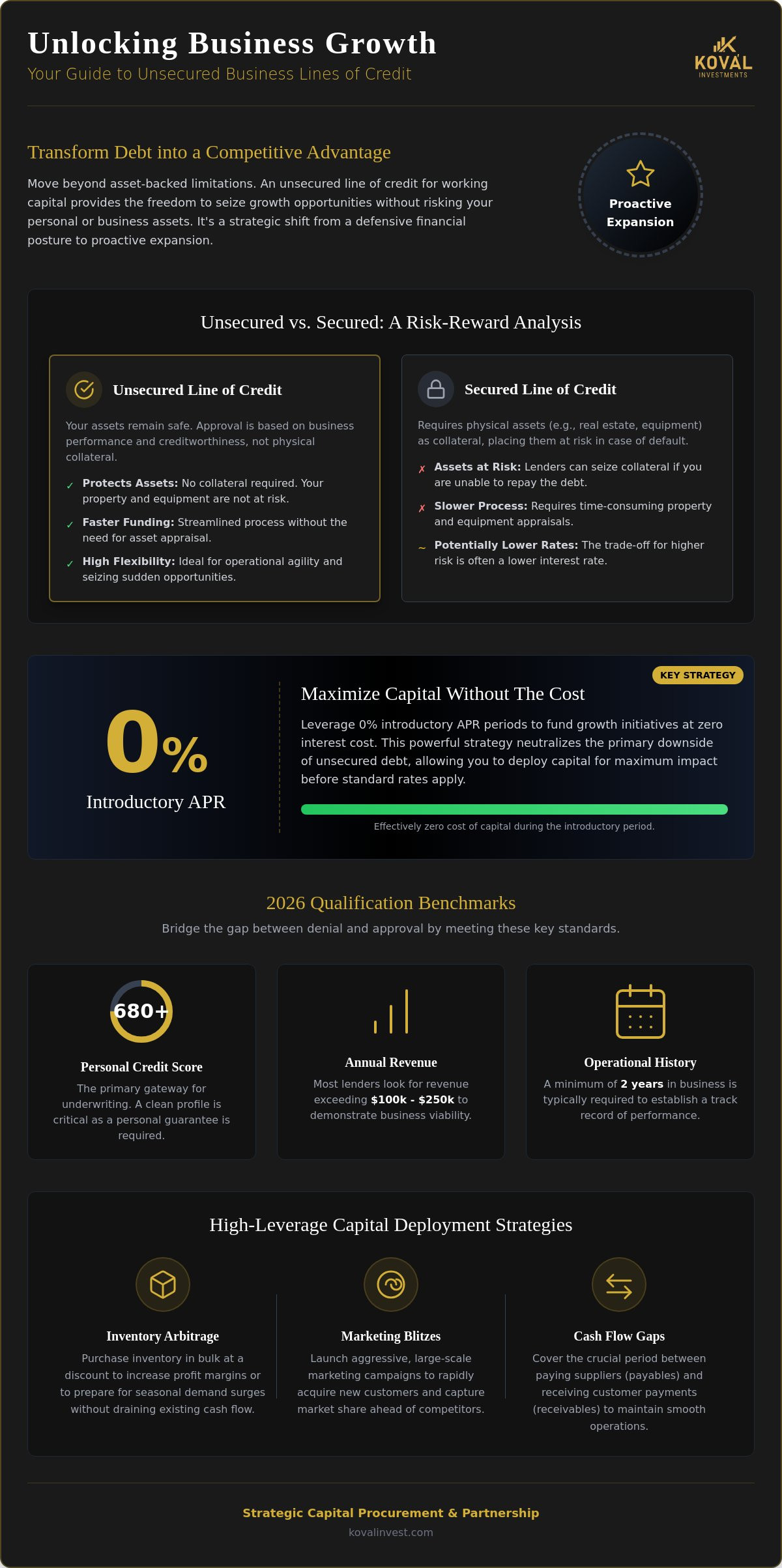
Choosing between a secured and unsecured approach involves a clear trade-off. Secured lines often offer lower interest rates because the bank holds your assets as collateral. However, the "cost" of that lower rate is the risk of losing your property or equipment if the market shifts. Unsecured options prioritize your peace of mind and operational speed. Because there's no collateral to appraise, the funding process is significantly faster. While lenders may charge a slightly higher rate to account for the lack of physical security, you can mitigate this by utilizing 0% introductory APR periods. This strategy allows you to access unsecured business lines of credit for working capital at zero cost for a set period, effectively neutralizing the traditional downside of unsecured debt.
Qualification Standards: Bridging the Gap Between Denial and Approval
Qualification benchmarks have shifted significantly as we move into 2026. Lenders now utilize more sophisticated algorithms that look beyond a simple balance sheet to analyze the synergy between personal reliability and business performance. Most national lenders expect at least two years of operational history and annual revenue exceeding $100,000 to $250,000. While these facilities don't require physical collateral, they almost always involve a personal guarantee. This reality means your personal credit profile remains the primary gateway to securing unsecured business lines of credit for working capital. If your personal score is below the 680 mark, you'll likely face immediate friction in the underwriting process.
The "Credit Gap" is a frequent hurdle for otherwise healthy businesses. A single reporting error or an outdated collection account can be the difference between a 0% introductory rate and a flat denial. Underwriters for unsecured products have a lower risk tolerance than those handling collateralized loans because they have no physical asset to seize if things go wrong. Consequently, they view minor report nuances as indicators of future volatility. It's often more productive to fix these underlying issues before applying than to settle for high-interest, subprime alternatives that drain your cash flow.
The Importance of a Clean Credit Profile
The path to approval starts with mastering business credit repair services to ensure every data point on your report is accurate and optimized. Lenders in 2026 prioritize "clean" profiles over high-limit profiles that are riddled with inaccuracies. A funding-ready credit score threshold is 680-720 for most unsecured providers. If you're currently hovering in the mid-600s, focusing on strategic debt reduction and error correction can unlock significantly higher limits and better terms. Our team often recommends a strategic credit review before submitting formal applications to protect your score from unnecessary hard inquiries.
Financial Documentation for Unsecured Access
Underwriters need to see a clear narrative of stability and growth. While some fintech lenders offer "no-doc" options for smaller amounts, substantial access to working capital usually requires organized bank records, P&L statements, and recent tax returns. You should be prepared to explain exactly how you'll deploy the funds. Whether you're bridging a 60-day gap in receivables or preparing for a seasonal inventory surge, a well-justified business plan reduces the underwriter's perceived risk. Presenting your financials with transparency builds the trust necessary for a long-term funding partnership.
The 0% Interest Advantage: Maximizing Capital Without the Cost
Most business owners assume that unsecured capital always comes with a premium interest rate. While traditional banks often charge higher percentages for no-collateral risk, the modern financial market offers a unique window of opportunity through 0% interest funding solutions. By securing unsecured business lines of credit for working capital that feature introductory periods of six to 18 months, you can effectively borrow for free. This isn't a gimmick; it's a strategic tool designed to help businesses scale without the immediate drag of interest expenses.
The ROI of interest-free capital is inherently superior to traditional bank debt. If you use a standard 10% loan to purchase inventory, your profit margin must first cover that 10% before you see a true return. With a 0% line, every dollar of profit stays within your business. This creates a "Cycling Strategy" where savvy owners use unsecured business lines of credit for working capital to pay down existing high-interest debt, such as equipment leases or merchant cash advances. You're not just getting new capital; you're optimizing your entire balance sheet by replacing expensive debt with a zero-cost alternative.
Introductory APR vs. Standard Rates
Identifying the right lenders requires looking beyond the headline rate. You need to focus on providers offering 0% APR on both purchases and balance transfers. Having a clear exit strategy is paramount. You must know exactly how you'll repay the balance or transition to a different funding source before the introductory window closes. For a deeper dive into these mechanics, read our guide on 0% interest business funding for rapid scaling.
Avoiding Common Interest Traps
You must distinguish between "deferred interest" and true 0% APR. Deferred interest plans can retroactively charge you for the entire period if the balance isn't paid in full by the deadline. True 0% APR only applies interest to the remaining balance after the period ends. Additionally, a single late payment can void your interest-free status immediately. Keep a close eye on your utilization rates. Even if the capital is free, using too much of your available limit can lower your credit score, making it harder to secure future funding rounds.
Our collaborative approach focuses on creating these win-win scenarios where the cost of capital doesn't eat your margins. We view 0% interest lines as a bridge to long-term stability rather than a temporary fix. When you align your funding strategy with your operational goals, you create a sustainable path for growth that doesn't rely on expensive, predatory lending products.
Strategic Deployment: Using Unsecured Lines to Drive Operational Growth
Securing capital is only the first half of the equation. The true value of unsecured business lines of credit for working capital lies in how you deploy those funds to generate a return that exceeds the cost of the draw. Sophisticated owners don't treat a line of credit as a passive safety net; they use it as an active growth engine. By having immediate access to liquidity, you can capitalize on market inefficiencies that your competitors might miss because their cash is tied up in accounts receivable.
One of the most effective tactics is inventory arbitrage. Suppliers often offer significant discounts for bulk purchases or early payments. If a vendor offers a 10% discount for a volume order, and your cost of capital on a draw is negligible, you've effectively increased your gross margin by nearly 10% instantly. Similarly, a marketing blitz requires upfront spending to acquire customers who will provide long-term lifetime value. Using your line to fund these acquisition costs ensures that your growth isn't throttled by your current bank balance. It allows you to scale your most profitable channels with a clear, data-driven payback period.
Operational stability also benefits from strategic draws. Payroll smoothing is essential for businesses with seasonal revenue dips. Retaining top talent is far more cost-effective than the expense of recruiting and training new staff after a layoff. Having an "Emergency Resilience" fund provides a psychological advantage as well. It's the "sleep well at night" fund that costs you nothing in interest until the moment you decide to use it. This readiness ensures that a broken piece of equipment or a delayed client payment doesn't derail your entire operation.
Working Capital for Business Acquisition
In a competitive M&A environment, speed is your greatest asset. An unsecured line can act as the "earnest money" or gap funding needed to move a deal forward while permanent financing is finalized. You can find more detail on using working capital for business acquisition in our specialized guide. Unsecured capital provides the speed necessary for competitive M&A, allowing you to sign letters of intent with confidence.
Seasonal Cash Flow Management
Mapping your revenue cycles to your line of credit draw periods creates a predictable financial rhythm. Instead of draining your cash reserves to prepare for a peak season, you use the line to stock up and staff up. As the peak season revenue flows in, you repay the balance. This revolving nature is far superior to fixed-term loans, which often require set monthly payments regardless of your current cash flow position. It keeps your capital working as hard as you do.
If you're ready to move beyond basic survival and start using debt as a strategic lever, we invite you to explore our 0% interest funding solutions to see how much capital your business can unlock.
The Koval Approach: Strategic Capital Procurement and Partnership
At Koval Investments, we operate on a success-based philosophy that prioritizes your results over simple transactions. Most business owners are used to the cold, detached nature of institutional finance, where you're just a file number in a pile. We've built our firm to be the opposite. We act as a seasoned strategic partner, navigating the complex world of capital procurement alongside you. Our commitment is rooted in a win-win framework; we only move forward when there's a clear path to success that leaves your business in a stronger financial position than when we started.
Securing unsecured business lines of credit for working capital is only one part of a larger financial optimization strategy. We don't just look for the first available approval. Instead, we analyze your entire operation to ensure the capital you receive supports your long-term objectives, whether that's preparing for an acquisition or scaling a marketing department. This methodical approach allows us to bridge the gap between high-level financial strategy and the day-to-day realities of your business ownership.
Consultancy vs. Brokering
The primary difference between a consultant and a traditional broker is the depth of the relationship. A broker wants to close a deal; a consultant wants to build a growth engine. We integrate strategic planning and business valuations into our process to determine the ideal funding mix for your specific needs. This might involve a combination of SBA loans, 0% interest funding solutions, and unsecured business lines of credit for working capital. Our "straight-talk" mentality ensures you receive honest feedback on your eligibility and a realistic roadmap for improvement.
Next Steps: Your Funding Roadmap
Your journey toward high-limit funding begins with a comprehensive initial audit. We assess your current credit profile and financial records to identify any "funding killers" that might lead to an immediate denial. Once we've identified the gaps, we move into the optimization phase. This involves addressing credit report errors and building a stronger scoring model to ensure you qualify for the highest possible limits at the lowest possible cost. We don't believe in rushing a flawed application; we believe in preparing you for a definitive win.
If you're ready to stop guessing and start executing a professional capital strategy, we're here to help. You can schedule a consultation with Koval Investments to begin your audit and unlock the capital potential your business deserves. Let's work together to build a steady, reliable foundation for your 2026 growth.
Empowering Your 2026 Growth Strategy
The journey from simply managing cash flow gaps to driving aggressive operational expansion requires a fundamental shift in how you view debt. By leveraging unsecured business lines of credit for working capital, you protect your core assets while maintaining the agility needed for the fast-paced market of 2026. We've explored how 0% interest strategies and credit optimization create a permanent capital cushion that doesn't eat your margins. These tools transform capital from a simple safety net into a high-leverage growth engine.
Koval Investments brings over eight years of specialized credit restoration expertise to every partnership. Our success-based philosophy means there's no upfront risk to you; we only win when you do. We combine our national reach with a boutique level of personalized service to ensure your funding roadmap aligns with your specific operational goals. Your business deserves a partner who is as invested in your long-term success as you are. We're ready to help you navigate the complexities of modern finance with confidence and clarity.
Unlock your business growth with a success-based funding strategy from Koval Investments.
Frequently Asked Questions
What is the difference between a secured and unsecured business line of credit?
A secured business line of credit requires physical collateral, such as real estate, equipment, or inventory, to back the debt. In contrast, an unsecured business line of credit relies on your company's creditworthiness and financial performance without requiring you to pledge specific assets. This distinction is vital for protecting your core property while maintaining the liquidity needed for daily operations and unexpected expansion costs.
Can I get an unsecured business line of credit with a 650 credit score?
While it's possible, obtaining an unsecured line with a 650 score is challenging because most national lenders set their 2026 benchmarks at 680 or higher. You'll likely face lower limits or higher interest rates at the 650 level. We often recommend a period of credit optimization to move your score into the 700 range before applying to ensure you receive the most competitive terms available for your business.
How much working capital can I typically access through an unsecured line?
Most businesses can access between $10,000 and $250,000 through an unsecured facility, though larger amounts are available for high-revenue companies. The specific limit depends on your annual revenue, time in business, and personal credit profile. Sophisticated borrowers often stack multiple 0% interest lines to increase their total available unsecured business lines of credit for working capital without increasing their immediate interest burden.
Is a personal guarantee required for an unsecured business line of credit?
Yes, a personal guarantee is almost always required for unsecured funding because the lender isn't holding physical collateral as security. This guarantee signifies that you're personally responsible for the debt if the business cannot repay it. While this adds a layer of personal responsibility, it's the mechanism that allows lenders to provide significant capital without requiring you to tie up your home or business equipment.
How does an unsecured line of credit affect my business credit score?
An unsecured line of credit can significantly improve your business credit score by establishing a positive payment history and diversifying your credit mix. As you draw and repay funds, lenders report this activity to business credit bureaus. Maintaining low utilization on your unsecured business lines of credit for working capital demonstrates financial responsibility and makes your company more attractive to future lenders for larger projects.
Can I use an unsecured line of credit to fund a startup in 2026?
Startups can certainly utilize unsecured lines if the founders have strong personal credit scores, typically 700 or higher. Since startups lack a long track record of revenue, lenders rely heavily on the personal reliability of the owners. This makes unsecured funding an excellent alternative to traditional bank loans, which often require two years of tax returns that a new business simply doesn't have yet.
What are the typical interest rates for unsecured business lines of credit?
Interest rates generally range from 8% to 24% depending on your creditworthiness and the lender's risk assessment. However, many sophisticated borrowers prioritize lines that offer 0% introductory APR periods for the first six to 18 months. These interest-free windows allow you to deploy capital for growth initiatives without the immediate drag of interest costs, provided the balance is managed within the promotional timeframe.
How long does the approval process take for unsecured business funding?
The approval process for unsecured funding is remarkably fast, often taking between 48 hours and seven business days. Because there's no need for asset appraisals or complex collateral valuations, underwriters can move quickly through your financial documentation. This speed is a primary reason why entrepreneurs choose these lines when they need to capitalize on sudden market opportunities or bridge unexpected cash flow gaps.