0% Interest Funding vs. SBA Loan: Choosing the Best Capital Strategy for 2026
What if the most expensive capital you can find isn't the one with the highest interest rate, but the one that takes the longest to hit your bank account? Choosing between 0% interest funding vs SBA loan options is rarely a simple decision; it's a strategic calculation of timing and cost. We understand that with the current Prime Rate at 6.75%, seeing SBA 7(a) variable rates climb toward 11.5% can make any business owner hesitant. It's difficult to watch margins shrink while you wait months for a traditional approval process that feels designed to slow you down.
This guide helps you determine which funding vehicle aligns with your specific growth goals for 2026. You'll discover the critical differences between interest free capital and SBA backed loans, including a breakdown of the total cost of capital and the realistic timeline for each. We also outline how to optimize your credit profile to qualify for both, ensuring you have the flexibility to scale without taking on unnecessary financial risk. Our goal is to provide the clarity you need to make an informed, confident choice for your company's future.
Key Takeaways
- Distinguish between short-term, high-agility business credit lines and the long-term, government-guaranteed debt required for major corporate expansions.
- Understand the mechanics of unsecured funding to leverage interest-free windows for immediate capital needs without the requirement of collateral.
- Identify when the 7(a) and 504 programs provide the necessary stability for 10 to 25 year repayment terms on large-scale acquisitions.
- Apply a practical decision matrix to determine if 0% interest funding vs SBA loan options better suit your current project's timeline and scale.
- Recognize how strategic credit optimization serves as a master key to lower your total cost of capital and unlock premium funding tiers.
Understanding the Capital Landscape: 0% Interest vs. SBA Loans
In 2026, the distinction between a thriving enterprise and a stagnant one often comes down to capital strategy. Most business owners view debt as a burden, but savvy leaders treat it as a tool for leverage. When evaluating 0% interest funding vs SBA loan options, you aren't just looking at interest rates. You're weighing the velocity of growth against the security of long-term repayment. Every dollar you bring into your business should have a specific job description, and the structure of that capital determines how hard those dollars can work for you.
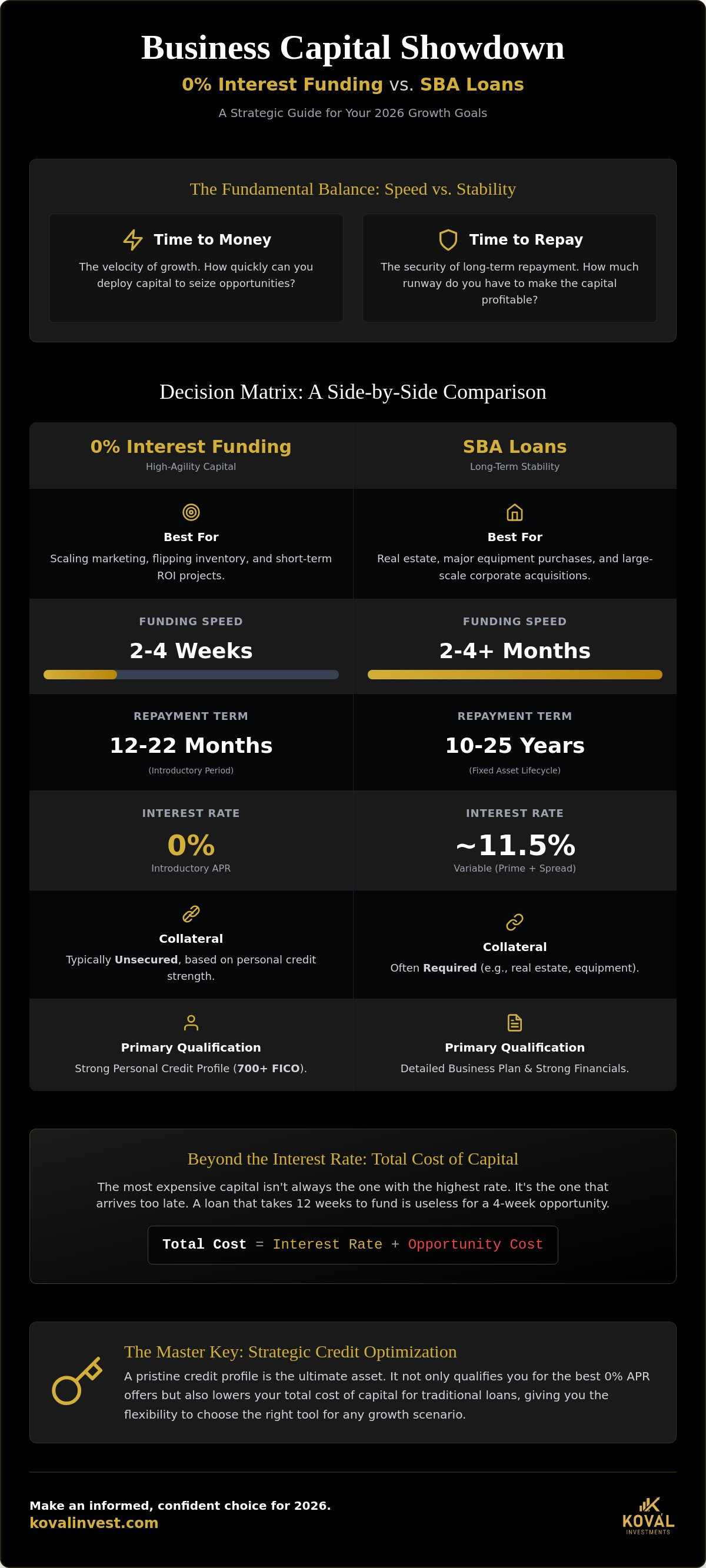
The most vital metric for your 2026 strategy is the total cost of capital. This includes the interest rate, but it also accounts for the opportunity cost of waiting for approval. If a time-sensitive expansion opportunity disappears in four weeks, a loan that takes twelve weeks to fund is effectively useless, regardless of how low the rate is. Your decision rests on a fundamental balance: your "Time to Money" versus your "Time to Repay." High-agility capital serves immediate needs, while long-term debt provides the foundation for massive, multi-year projects.
The Rise of 0% Interest Capital for Business
Short-term capital has evolved significantly. In the current market, introductory 0% APR windows on business credit lines act as interest-free working capital for 12 to 22 months. This is the preferred choice for scaling marketing campaigns or flipping inventory where the ROI is realized quickly. It requires a success-based philosophy. You only deploy this capital into activities with a clear, predictable return that allows you to retire the debt before the interest rate resets. Because this funding is often unsecured, it provides the liquidity needed to move faster than your competition without tying up your personal assets as collateral.
The SBA Loan Standard: Stability Over Speed
While interest-free funding offers speed, the Small Business Administration (SBA) programs offer unparalleled stability. The SBA doesn't lend money directly; instead, it guarantees a portion of the loan to reduce risk for private lenders. This guarantee allows for lower down payments and longer repayment terms, reaching up to 25 years for real estate. This makes the SBA loan the gold standard for fixed assets or real estate investment funding. It provides a steady, predictable debt structure that allows you to plan for the next decade of growth without the pressure of a looming repayment deadline. For acquisitions or major infrastructure changes, the SBA remains the most reliable vehicle for securing large-scale capital.
Deep Dive: The Mechanics of 0% Interest Funding Solutions
The 2026 financial market offers a unique range of introductory 0% APR windows, typically spanning 6 to 22 months. These aren't standard term loans; they're revolving business credit lines that allow for maximum operational flexibility. Unlike the structured repayment schedules of SBA loan programs, revolving credit allows you to draw capital, repay it, and draw it again as needed. This interest-free period is a powerful lever for growth if managed with a clear exit strategy. When comparing 0% interest funding vs SBA loan options, the primary advantage here is agility. You can often secure these funds in a fraction of the time it takes to finalize a government-backed facility.
One of the most attractive features of this strategy is its unsecured nature. Most traditional lenders require tangible collateral, like real estate or equipment, to back a significant line of credit. Interest-free funding solutions usually rely on the strength of the business owner's credit profile instead. This protects your personal and business assets while providing the liquidity necessary to seize market opportunities. However, you must consider the transition period. Once the introductory window closes, the rate adjusts to a standard market APR. Successful entrepreneurs use this time to generate a return that covers the principal, effectively making the capital free for the duration of the promotion.
Qualification Criteria for Interest-Free Capital
Accessing these prime offers requires a pristine personal credit foundation. Lenders in 2026 look for a FICO score of 700 or higher as the baseline for the most competitive 22-month windows. Because these lines are often unsecured, your personal credit history serves as the primary indicator of reliability. If your score isn't quite there, engaging with specialized business credit repair services is a logical first step to unlock these high-limit, low-cost options.
Optimal Use Cases for 0% Funding
This capital is best suited for high-velocity investments. Bridging seasonal cash flow gaps or funding digital marketing campaigns with a proven return are classic examples. It's also an excellent tool for providing initial working capital for business acquisition during the transition phase. While the acquisition itself might require a larger SBA loan, the 0% lines provide the immediate "dry powder" needed for day-one operations. Partnering with a firm that understands the nuances of capital structures ensures you don't leave money on the table. You can explore how we help clients secure strategic capital through our tailored funding solutions.
The SBA Advantage: When Long-Term Debt Makes More Sense
While interest-free credit lines provide the agility needed for rapid-ROI projects, they aren't designed to support fundamental infrastructure growth. This is where the 0% interest funding vs SBA loan debate shifts toward longevity. For 2026, the primary advantage of an SBA-backed loan is the amortization period. Spreading debt over 10 to 25 years significantly reduces monthly cash flow pressure compared to the aggressive 12 to 22 month repayment windows of promotional credit. This stability allows you to reinvest profits into operations rather than racing to retire a principal balance before an interest rate reset.
Securing these larger facilities requires meeting specific underwriting standards that are more rigorous than those for unsecured credit. Lenders look closely at your Debt Service Coverage Ratio (DSCR), typically requiring a ratio of 1.15 or greater. This ensures your business generates enough net operating income to cover its debt obligations comfortably. Unlike unsecured 0% lines, larger SBA loans usually require collateral. This often includes a first lien on the assets being financed or a general lien on business assets. It's a trade-off: you provide security in exchange for the lowest long-term rates and the highest capital amounts available to small businesses.
SBA 7(a) vs. 504: Which Fits Your Strategy?
Choosing between these programs depends on your intended use of funds. The 7(a) program is highly versatile, offering up to $5 million for working capital, equipment, or debt refinancing. Conversely, the 504 program is specifically structured for major fixed assets like land, buildings, or heavy machinery. For 2026, manufacturers in particular benefit from fee waivers that reduce upfront costs to 0% on many 504 projects. You can explore the nuances of these options in our SBA 7(a) vs 504 loan comparison guide.
The Strategic Value of SBA Loan Assistance
The complexity of government-backed lending means that a "lender-ready" package is essential for approval. With the combined SBA exposure cap now at $10 million per borrower as of July 2026, the stakes for a successful application are higher than ever. Professional SBA loan assistance helps you navigate the "Lender Match" process by aligning your business profile with the specific appetite of various banks. As noted in this comprehensive guide to small business loans, understanding the full spectrum of funding is vital before committing to a long-term obligation. A consultant ensures your documentation survives the scrutiny of underwriting, positioning you as a low-risk partner for the bank.
Decision Matrix: 0% Interest Funding vs. SBA Loan
Selecting the right capital strategy isn't about finding the "best" product in a vacuum. It's about matching the specific needs of your project to the most efficient funding vehicle. Many entrepreneurs mistakenly view 0% interest funding vs SBA loan options as mutually exclusive. In reality, they're complementary tools that serve different phases of a business's lifecycle. Your decision should be dictated by the speed of the opportunity and the lifespan of the asset you're financing.
- Scenario A: You need $100,000 in three weeks to secure a time-sensitive inventory deal with a high margin. Winner: 0% Funding. The speed of deployment is the priority here.
- Scenario B: You're acquiring a $2 million warehouse to stabilize your long-term operational costs. Winner: SBA 504. This requires the 25-year amortization that only government-backed debt provides.
- Scenario C: You have a low personal credit score but your business shows strong, consistent revenue. Winner: Alternative Business Funding Solutions. These products prioritize cash flow over FICO scores.
- Scenario D: You want to refinance existing high-interest merchant cash advances to improve monthly cash flow. Winner: SBA 7(a). The 10-year term allows you to consolidate and significantly lower your debt service.
Total Cost of Capital Analysis
To make an informed choice, you have to look beyond the headline rate. If you secure a 0% line with a 3% origination fee and pay it off within 12 months, your effective rate is roughly 3%. Contrast this with an SBA 7(a) loan at the current Prime Rate of 6.75% plus a 2.75% margin, totaling 9.5%. While the 9.5% rate is higher, the monthly payments are smaller because the debt is spread over a decade. In the 2026 economic environment, locking in a long-term fixed rate through an SBA facility serves as a deliberate hedge against the rising costs of labor and materials.
The "Speed to Market" Factor
The opportunity cost of waiting is a silent killer of growth. 0% credit lines typically fund within 10 to 21 days, whereas an SBA loan can take 60 to 120 days to reach the finish line. If waiting four months for an approval means losing a contract or a strategic acquisition, the interest savings of the SBA loan become irrelevant. Agile startups and rapidly scaling firms often prioritize 0% capital to maintain momentum, using it as a bridge until they qualify for larger, slower institutional debt. If you're ready to identify the most efficient path for your next move, you can schedule a strategic consultation with our team to review your options.
The Koval Approach: Optimizing Credit to Unlock Both
Koval Investments operates as a seasoned strategic partner rather than a distant service provider. We believe that securing capital is only one part of a larger growth narrative. Our approach is built on a "win-win" philosophy where our success is entirely dependent on your results. By aligning our objectives with your funding approval, we create a collaborative environment that focuses on long-term stability rather than quick, high-volume transactions. This success-based mentality ensures that we're just as invested in your company's trajectory as you are.
When evaluating 0% interest funding vs SBA loan strategies, many business owners overlook the foundation of their eligibility: their credit profile. We view credit repair as the "Master Key" to the financial kingdom. It isn't just about fixing mistakes; it's about optimizing your profile to ensure you qualify for the lowest possible cost of capital. Before you take on any debt, we advocate for a holistic view of your business through professional valuation and strategic planning. This methodical approach ensures you aren't just getting money, but getting the right kind of money for your specific stage of development.
Repairing Credit to Lower Your Interest Rates
SBA underwriters are notoriously meticulous. Even minor inaccuracies on a credit report can trigger an automatic rejection or force you into a higher interest bracket. A 50-point score increase doesn't just improve your chances of approval; it can save your business tens of thousands of dollars in interest payments over the lifespan of a 10-year loan. Building a "fundable" business credit profile involves more than just paying bills on time. It requires a methodical approach to managing debt ratios and ensuring that your public records align with lender expectations. By addressing these issues early, you position your business to access premium interest-free windows and prime-rate SBA facilities simultaneously.
Your Next Steps for 2026 Growth
Securing capital is most effective when it's part of a documented strategic plan. Whether you're considering mergers and acquisitions or a simple operational expansion, you need to know your starting point. A professional business valuation provides the data necessary to determine exactly how much capital you need and what debt structure your cash flow can support. This level of preparation ensures that when you do pull the trigger on a funding solution, it's a move made from a position of strength. We're here to provide the "straight-talk" advice you need to navigate these complex financial landscapes with confidence.
Ready to see where you stand? You can schedule a consultation with Koval Investments to analyze your funding eligibility and build a clear roadmap for your 2026 growth.
Strategizing Your Capital Deployment for 2026
The decision to pursue a 0% interest funding vs SBA loan is a strategic pivot that depends entirely on your business's current lifecycle and immediate needs. High-agility credit lines offer the velocity required for rapid-return projects, while SBA programs provide the long-term stability necessary for major asset acquisitions. Success in the 2026 economic environment requires more than just a loan; it requires a fundable credit profile and a methodical plan for deployment.
Koval Investments is committed to being your seasoned strategic partner throughout this process. Our success-based funding philosophy ensures that our objectives are perfectly aligned with your company's growth. By providing expert SBA loan navigation and comprehensive credit optimization, we help you unlock the most efficient capital structures available today. We prioritize the quality of our relationships, acting as a steady hand to help you navigate complex financial choices with clarity.
Your path to sustainable growth starts with an informed choice and a trusted advisor. Secure Your 0% Interest Funding Solution with Koval Investments today. We're ready to help you turn your strategic goals into a reality.
Frequently Asked Questions
Can I get a 0% interest business loan with bad credit?
Generally, no. Most lenders require a personal FICO score of 700 or higher to qualify for premium interest-free offers. If your score is lower, our credit repair services can help remove inaccuracies that block access to these rates. Securing 0% funding is an earned privilege based on your credit reliability, which serves as your primary collateral for unsecured lines.
How long does the 0% interest period typically last for business funding?
These introductory windows typically last between 12 and 18 months, though some 2026 offers extend up to 24 months. The exact duration depends on the strength of your credit profile and the specific lender's current promotion. We recommend planning your capital deployment to ensure the principal is retired or refinanced before this promotional window closes.
Is an SBA loan better than a 0% credit line for a startup?
The better choice depends on your timeline and the asset's lifespan. A 0% credit line is superior for high-velocity needs like inventory flips or marketing because it funds in weeks. An SBA loan is better for startups acquiring heavy machinery or real estate, as it offers a 10 to 25 year repayment term that protects your monthly cash flow.
What are the main requirements for SBA loan assistance in 2026?
Requirements for 2026 include a FICO score of 680 or higher, a Debt Service Coverage Ratio of at least 1.15, and solid financial documentation. You'll also need a clear business plan and, for larger loans, tangible collateral. Our role in SBA loan assistance is to ensure your application package meets these rigorous underwriting standards before submission.
Do 0% interest funding solutions require a personal guarantee?
Yes, almost all unsecured 0% business credit lines require a personal guarantee. Since these solutions don't require physical collateral like real estate, the lender relies on your personal commitment to repay the debt. This is why maintaining a strong personal credit profile is essential for accessing and maintaining high-limit revolving credit.
Can I use 0% interest capital to bridge the gap while waiting for an SBA loan?
Using 0% capital as a bridge is a highly effective strategy for maintaining momentum. Since SBA loans can take 60 to 120 days to fund, interest-free credit lines provide the immediate liquidity needed for day-to-day operations. This ensures you don't miss market opportunities while waiting for your long-term debt structure to finalize.
What happens if I cannot pay off the 0% funding before the interest kicks in?
If the balance remains after the introductory period, the rate resets to a standard market APR, which often ranges from 15% to 29%. This transition can significantly increase your cost of capital overnight. We work with clients to develop clear exit strategies, ensuring they have a plan to retire the debt or transition it into a more stable loan facility.
How does credit repair impact my ability to get an SBA loan?
Credit repair is often the deciding factor in SBA approval. Removing inaccuracies from your report improves your fundability and can lower your interest rates by placing you in a more favorable risk tier. When evaluating 0% interest funding vs SBA loan options, a cleaner credit report always results in more favorable terms across both capital types.