
Business Broker vs. M&A Advisor: Choosing the Right Partner for Your 2026 Exit
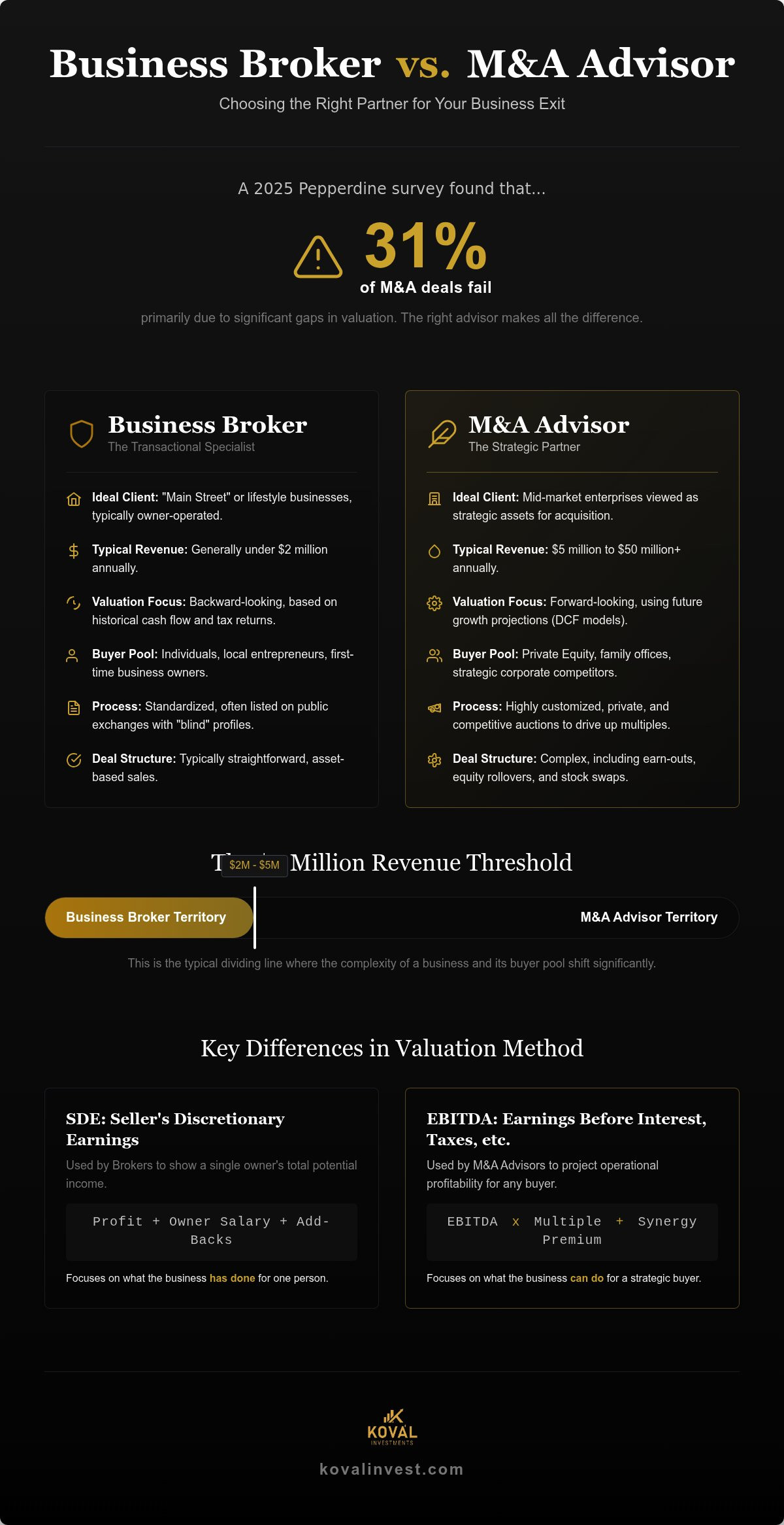
According to a 2025 Pepperdine survey, 31% of M&A engagements end without a deal, primarily due to significant gaps in valuation. This statistic is a sobering reminder that choosing the wrong representation can cost you years of effort and substantial equity. You likely feel the weight of this decision, especially if you're unsure whether your company requires a local business broker vs m&a advisor to navigate the complexities of a 2026 exit.
It's natural to feel anxious about the due diligence process or confused by the various fee structures used in the industry today. We'll clarify these roles so you can hire a partner who maximizes your sale price while protecting your long-term interests. This breakdown covers the critical differences in buyer pools, service levels, and the $2 million revenue threshold that typically dictates which expert will lead you to a successful closing.
Key Takeaways
- Identify whether your company is a lifestyle business or a strategic asset to determine the specific type of buyer you should target.
- Navigate the business broker vs m&a advisor debate by understanding how revenue thresholds and scalability influence your choice of partner.
- Master the valuation differences between SDE and EBITDA to ensure you don't leave money on the table during negotiations.
- Learn the essential steps for exit readiness, including balance sheet optimization and credit repair, before you list your business for sale.
- Gain a clear roadmap for the 2026 market to ensure a smooth transition and maximum valuation for your life's work.
Understanding the Fundamental Roles: Business Broker vs. M&A Advisor
Choosing the right professional to represent your company is the most critical decision you'll make in the lead-up to your 2026 exit. The distinction between a business broker vs m&a advisor isn't just a matter of semantics; it dictates the type of buyers you attract and the ultimate structure of your deal. If you hire a partner whose expertise doesn't align with your company's size or complexity, you risk leaving significant capital on the table or, worse, failing to clear the due diligence hurdle entirely.
As we move through 2026, digital deal-making platforms have started to blur the traditional lines between local reach and national exposure. While a Business broker might have historically relied on local networks, modern tools allow all advisors to cast a wider net. However, the fundamental approach to valuation and buyer engagement remains distinct. A broker acts as a transactional specialist for "Main Street" businesses, while an M&A advisor functions as a strategic partner for mid-market enterprises looking for institutional or corporate buyers.
The Business Broker Profile
Business brokers typically manage transactions for companies with annual revenue under $2 million. Their primary focus is on historical cash flow, specifically using a metric called Seller’s Discretionary Earnings (SDE). This valuation method helps individual owner-operators understand the total financial benefit they can expect to draw from the business. Brokers often follow a standardized process that includes:
- Creating "blind" business profiles to maintain confidentiality during the initial outreach.
- Listing the business on public exchanges frequented by individual buyers.
- Managing the paperwork and logistics for straightforward, asset-based sales.
This approach works well for stable, lifestyle businesses where the buyer is likely an individual looking to replace a salary with business ownership.
The M&A Advisor Profile
When you compare a business broker vs m&a advisor for companies generating between $5 million and $50 million in revenue, the M&A advisor’s strategic depth becomes apparent. These professionals focus on EBITDA multiples and look for "synergies"—factors that make your business more valuable to a specific buyer than its historical earnings suggest. Their process is highly customized and includes:
- Targeting private equity firms, family offices, and strategic corporate competitors.
- Structuring complex deals that may include earn-outs, equity rollovers, or stock swaps.
- Conducting deep-dive financial analysis to prepare for rigorous institutional due diligence.
An M&A advisor doesn't just list a business; they run a managed, competitive process designed to drive up the multiple by playing several strategic buyers against one another.
Key Differences in Valuation and Deal Structure
The valuation of your company is a variable outcome, not a fixed point. When deciding between a business broker vs m&a advisor, you must consider how each professional calculates value and justifies it to a buyer. Brokers typically look backward at tax returns and use Seller’s Discretionary Earnings (SDE). This asset-based approach focuses on what a single owner can take home. In contrast, M&A advisors utilize EBITDA and Discounted Cash Flow (DCF) models to project future growth. This forward-looking perspective is what attracts institutional capital and drives higher multiples.
Confidentiality also differs significantly between these two paths. A broker might list your business on public exchanges using a "blind" profile, which can sometimes lead to leaks or unqualified inquiries. M&A advisors prefer private, highly targeted auctions. They identify a shortlist of strategic buyers and private equity firms, ensuring that your sensitive data only reaches parties with the financial capacity to close the deal. Industry standard valuation methods and fee structures often dictate the level of service you receive; brokers usually work on a straight commission, while advisors often require a retainer to cover the costs of deep-dive financial modeling.
Valuing a Small Business vs. a Strategic Asset
Brokers often treat a business as a "lifestyle" purchase, focusing on historical stability. M&A advisors view your company as a strategic asset. They search for the "Synergy Premium," which is the extra value a buyer pays because your business solves a specific problem for them, such as providing access to a new patent or a specialized sales team. Securing a professional business valuation is the essential first step before committing to a specific exit strategy. It allows you to see your business through the lens of a buyer before negotiations begin.
Deal Complexity and Documentation
Transaction structures vary wildly between these two categories. Broker-led deals are often standardized asset sales, frequently relying on SBA financing which comes with specific regulatory constraints. M&A transactions are far more complex. They often involve stock sales, earn-outs, and equity rollovers where you might retain a small percentage of the company post-sale. The intensity of due diligence in an M&A environment is rigorous. You'll need to provide audited or highly organized financial statements and undergo deep operational scrutiny. If you're unsure where your company fits, exploring strategic planning can help clarify your market position and ensure you're prepared for this level of investigation.
The Revenue Threshold: When to Hire an M&A Advisor Over a Broker
Revenue figures often serve as the primary filter for professional representation, yet they rarely tell the whole story. While many industry professionals point to a $5 million annual revenue mark as the dividing line, this threshold is merely a starting point. The decision between a business broker vs m&a advisor should rest on your company's growth trajectory and its appeal to different buyer classes. A company with $4 million in revenue but a 40% profit margin and proprietary technology is a strategic asset. Conversely, a $10 million retail operation with thin margins and high overhead might still be a better fit for a traditional broker.
It's about leverage and scalability. If your business runs efficiently without your daily involvement, you've eliminated the "Key Man" risk that often devalues smaller companies. Institutional buyers look for operational maturity. They want to see a management team and systems that can support rapid expansion. If your business passes this "Strategic Buyer" test by offering a competitor a new territory, unique talent, or defensive technology, you've moved beyond the scope of a standard listing service.
Signs You Outgrew a Business Broker
You'll know you've outgrown a broker when the pool of potential buyers shifts from individual owner-operators to private equity groups or corporate competitors. These buyers don't browse public listing sites. They respond to targeted, confidential outreach and require sophisticated financial modeling that goes beyond basic tax returns. If your exit requires complex tax structuring, multi-year earn-outs, or the navigation of proprietary intellectual property rights, a broker's standardized purchase agreement won't protect your interests. At this stage, the complexity of the deal structure becomes as important as the sale price itself.
The Hybrid Approach for the Lower Mid-Market
Many business owners find themselves in a "gray area" where their company is too large for a local broker but perhaps too small for a global investment bank. This is the lower mid-market. Traditional "Main Street" brokers often struggle with transactions exceeding $10 million because they lack the network to reach institutional capital. Boutique firms solve this by providing the high-level strategy of a large firm with the personalized attention of a local partner. Utilizing M&A advisory for small business during this transition phase ensures you don't undersell a scalable asset. This hybrid approach allows you to run a competitive process that pits strategic buyers against one another, frequently resulting in a higher multiple than a single inbound offer would provide.
Preparing Your Business for a High-Value Transaction
Exit readiness is a deliberate process that starts long before you sign a representation agreement. Whether you eventually choose a business broker vs m&a advisor, the quality of your internal preparation dictates your leverage during negotiations. A buyer's primary goal is to identify risks that justify a lower multiple. Your goal is to present a "turnkey" asset that promises predictable future returns. This preparation requires a shift in perspective from managing for tax mitigation to managing for maximum enterprise value.
To ensure your business stands up to the scrutiny of institutional due diligence, follow these five essential steps:
- Step 1: Clean up the balance sheet. Eliminate non-business expenses and personal "add-backs" that cloud your true profitability.
- Step 2: Optimize your business credit. A strong credit profile ensures the buyer can secure the necessary financing to close the deal.
- Step 3: Secure growth capital. Showing a rising revenue trend in the 12 months prior to a sale significantly boosts your valuation multiple.
- Step 4: Formalize SOPs. Documenting every operational process reduces the "owner-dependency" that often scares off strategic buyers.
- Step 5: Conduct a pre-sale audit. Hiring a third party to find "red flags" in your contracts or financials allows you to fix them before a buyer sees them.
The Role of Financial Optimization
A buyer's ability to finance the acquisition is often the biggest hurdle to a successful closing. Professional business credit repair services improve your company's fundability, making it a more attractive target for those utilizing SBA loans or private equity debt. Additionally, savvy owners use 0% interest business funding to fuel late-stage marketing or equipment upgrades. This creates a "hockey stick" growth curve that justifies a higher EBITDA multiple. Clean financial records don't just increase value; they accelerate the closing process by reducing the time spent in the due diligence phase.
Strategic Planning for the Exit
You must define your post-sale goals early. Are you looking for a full exit to pursue retirement, or are you open to a partial equity roll where you stay on as a consultant? Identifying your ideal buyer profile allows your advisor to tailor the marketing narrative. If you want to attract a strategic corporate buyer, your preparation should emphasize your proprietary technology or market share. If you're targeting a private equity firm, focus on your management team's ability to scale the business without you. To begin this process with precision, you can explore our strategic planning services to align your operations with your long-term exit objectives.
Strategic Advisory: How Koval Investments Bridges the Gap
The traditional choice between a business broker vs m&a advisor often leaves business owners in a difficult position. Brokers might lack the technical depth to handle complex deal structures, while large investment banks often ignore businesses in the lower mid-market. Koval Investments fills this void by acting as a strategic partner that focuses on exit readiness long before your company ever hits the market. We believe that the best time to sell a business is when you don't have to; this allows us to clean up the balance sheet, optimize operations, and ensure you're positioned to command a premium multiple.
Our success-based philosophy ensures that our interests remain perfectly aligned with yours. We don't view our services as a traditional expense but as a collaborative venture. By focusing on tangible value and financial optimization, we eliminate the friction often found in institutional finance. This partnership approach allows us to provide sophisticated mergers and acquisitions consulting that bridges the gap between historical performance and future strategic potential. We integrate credit optimization, funding solutions, and deep-dive valuations into a single, cohesive exit strategy.
The Koval Advantage in M&A
We don't simply list businesses; we optimize them. Many owners struggle to secure the highest possible multiple because they haven't addressed underlying financial or operational inefficiencies. Our team provides the straight-talk mentorship required to navigate these challenges. This includes specialized SBA loan assistance for acquisition-minded sellers who want to ensure their buyers have a clear path to funding. By securing growth capital and repairing business credit profiles before the sale, we remove the most common obstacles that cause deals to fall through during due diligence.
Your Next Steps Toward a Successful Exit
A successful transition requires time and deliberate planning. We recommend starting the preparation process at least 12 to 24 months before your intended exit date. This window provides enough time to implement strategic changes that reflect positively on your tax returns and EBITDA growth. The first step is always a professional valuation. It serves as your benchmark, showing you exactly where your business stands today and what needs to change to reach your target sale price. Whether you eventually decide on a business broker vs m&a advisor for the final listing, having a strategic foundation ensures you never leave money on the table.
Schedule a strategic consultation with Koval Investments to value your business and plan your exit.
Securing Your Legacy Through Strategic Selection
Your business is likely your most significant financial asset, and its successful transition requires a partner who understands the nuances of the 2026 landscape. We've explored how the choice between a business broker vs m&a advisor hinges on your revenue, your operational maturity, and whether you're selling a stable lifestyle business or a scalable strategic asset. Achieving a maximum multiple isn't a matter of luck; it's the result of meticulous preparation and financial optimization.
Koval Investments provides the steady hand you need to navigate this complex process. By integrating Specialized Mergers and Acquisitions Consulting with Expert Business Valuations, we ensure your company is ready for the rigors of institutional due diligence. Our focus on Strategic Planning for Market Impact helps you clean up your balance sheet and optimize your credit profile long before the first offer arrives.
Take the first step toward a successful transition today. Secure your business valuation and exit strategy with Koval Investments and gain the clarity you need to move forward with confidence. Your years of hard work deserve a reward that reflects the true value of your legacy.
Frequently Asked Questions
What is the typical fee for a business broker vs. an M&A advisor?
Business brokers typically operate on a success-fee basis, where their compensation is a percentage of the final sale price paid at closing. M&A advisors generally utilize a more complex structure that includes an upfront retainer or monthly engagement fee alongside a tiered success fee. This allows the advisor to dedicate significant resources to research, financial modeling, and identifying strategic buyers who offer higher multiples for your company.
Can an M&A advisor help sell a business with less than $1 million in EBITDA?
An M&A advisor can represent a business with less than $1 million in EBITDA if the company presents high growth potential or proprietary value. The decision depends on whether the business is a lifestyle operation or a strategic asset. If your company offers unique technology or a dominant market position, an advisor can help you capture a synergy premium that a traditional broker might miss during the valuation.
How long does the sale process take with a broker compared to an M&A firm?
Transaction timelines vary based on the complexity of the business broker vs m&a advisor engagement. A broker-led sale often concludes within six to nine months, as it typically targets individual buyers using standardized processes. M&A transactions generally require nine to eighteen months. This longer duration accounts for the intensive due diligence and the competitive bidding process required to secure institutional capital and the best possible deal terms.
Do I need an M&A advisor if I already have a buyer interested in my company?
Engaging an advisor when you have an interested buyer is a strategic move to protect your equity. Without professional representation, you lack the leverage of a competitive process, which often leads to re-trading or unfavorable deal terms during due diligence. An advisor manages the negotiation and ensures the buyer's offer reflects the true market value, often paying for their own fee through the increased final sale price.
Will a business broker handle the due diligence process for me?
Business brokers usually facilitate the exchange of documents but rarely manage the due diligence process in depth. They provide the platform for the buyer to review your records. In contrast, an M&A advisor takes an active role in defending your valuation. They anticipate potential red flags and prepare detailed financial responses to ensure the buyer doesn't use the audit phase as an excuse to lower the price or change terms.
What is the difference between SDE and EBITDA in business valuations?
SDE is a backward-looking metric that adds personal expenses and the owner's salary back into the profit. It's designed for individual buyers looking for a lifestyle business. EBITDA provides a clearer picture of the company's operational efficiency at scale. Institutional investors prefer EBITDA because it shows how the business will perform under new management without owner-specific add-backs, making it the standard for mid-market and larger transactions.
Can I switch from a business broker to an M&A advisor mid-process?
Switching mid-process is possible but requires a careful legal review of your existing listing agreement. Most broker contracts include a tail period, meaning you may still owe them a commission if the business sells to a buyer they previously identified. If you feel your business has outgrown its current representation, it's best to wait for the contract to expire or negotiate a formal termination before engaging a more sophisticated firm.
Why is business credit important when selling my company?
Business credit is a critical component of fundability for the incoming owner. When a buyer looks at a business broker vs m&a advisor deal, they must also consider how they will finance the acquisition. A strong business credit profile allows the buyer to secure more favorable interest rates and higher loan amounts. This reduces the buyer's risk and makes your company a more attractive, liquid asset in a competitive market.