
Business Credit Repair Timeline: 2026 Strategic Guide
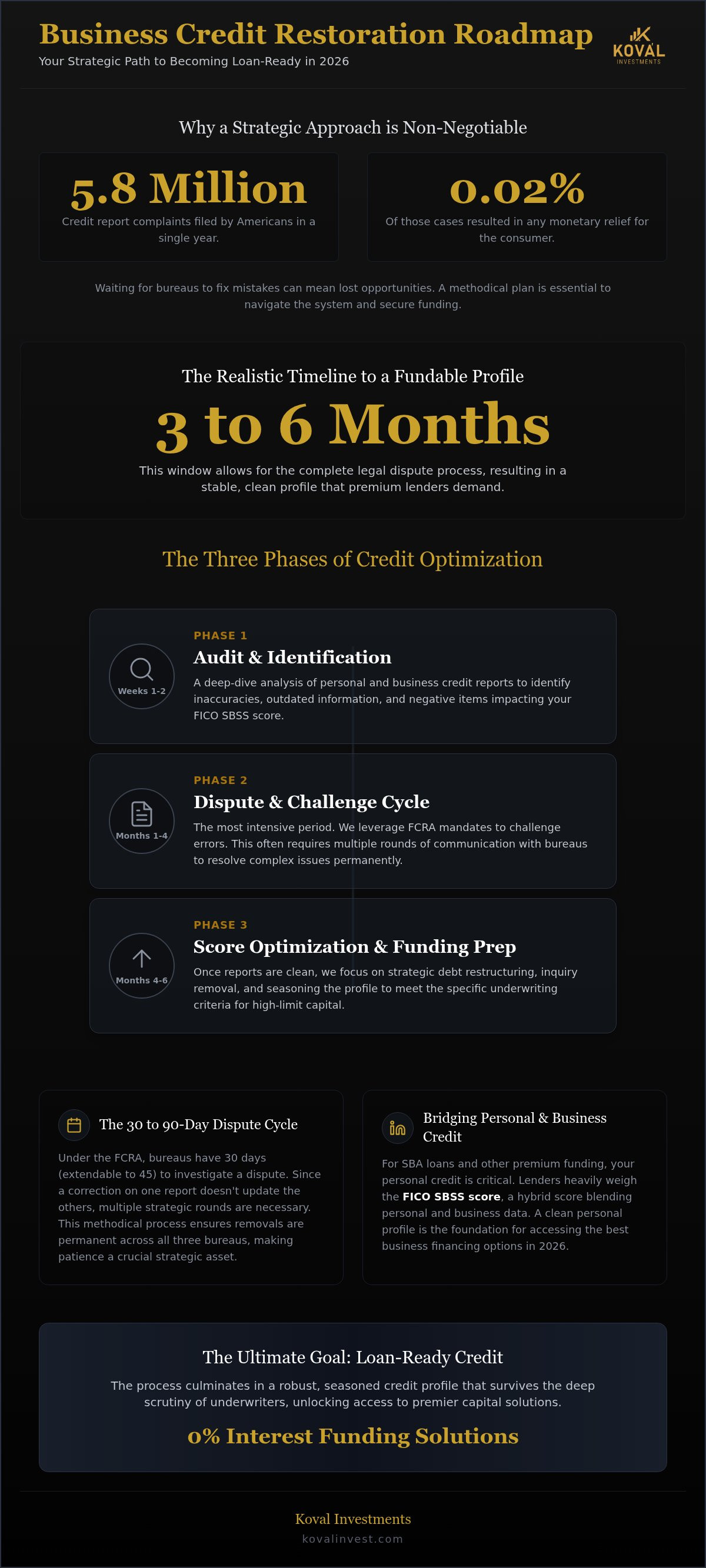
If you are waiting for a credit bureau to fix a mistake so you can finally fund your expansion, the odds are stacked against you. In the twelve months leading up to June 30, 2026, Americans filed over 5.8 million complaints about their credit reports, yet only 0.02% of those cases resulted in any monetary relief. It is incredibly frustrating to watch growth opportunities slip away because of funding delays or confusion between your personal and business credit profiles. You likely feel that the system is designed to move slowly while your business needs to move fast.
We understand that the most pressing question on your mind is exactly how long does credit repair take for business loans. This 2026 strategic guide provides a clear, predictable roadmap to help you become loan-ready. You will discover the exact timeline for restoration and learn how to synchronize these improvements with your loan applications to unlock maximum funding. We will examine the 30 to 90 day dispute cycle, explain how to navigate tightening lending criteria, and show you the path toward 0% interest capital solutions that can transform your business's financial future.
Key Takeaways
- Establish a realistic 3 to 6 month window to transition from credit challenges to a clean profile that attracts premium lenders.
- Determine how long does credit repair take for business loans by analyzing the impact of mandatory 30 to 90 day dispute cycles on complex business files.
- Identify the critical link between your personal credit history and SBA loan eligibility, including the specific role of the FICO SBSS score in 2026.
- Shorten your path to capital by using parallel tracking to complete strategic planning and business valuations while your credit scores improve.
- Synchronize your credit restoration with a 0% interest funding solution to ensure you are ready to secure capital the moment your profile is optimized.
Understanding the Realistic Timeline for Business Credit Restoration
Achieving a fundable profile involves more than just a numerical increase. For most entrepreneurs, the answer to how long does credit repair take for business loans falls within a three to six month window. This duration allows for the legal dispute process to unfold and for the clean profile that lenders demand to stabilize. Before beginning, Understanding Business Credit Reports is essential because business underwriting differs significantly from consumer lending. Lenders in 2026 prioritize the quality of your data over a simple three-digit score. A high score masked by recent derogatory removals often triggers red flags during manual underwriting.
Sustainable financial optimization is our benchmark for success. We move beyond quick fixes that offer temporary score bumps. Instead, we focus on creating Loan-Ready Credit. This benchmark means your profile shows consistent, positive behavior that survives the scrutiny of high-limit capital providers. By the end of this process, your credit acts as a foundation for our 0% Interest Funding Solution rather than a barrier to entry.
Why Business Loans Require a Longer Lead Time
Lenders analyze the depth of your credit history far more rigorously than a standard credit card issuer. They look for seasoned accounts that demonstrate long-term reliability. If you have recently removed negative items, underwriters often wait to see if those changes stick. Rapidly opening new accounts or having too many recent inquiries can signal financial desperation, which lowers your approval rates. Your repaired credit must be seasoned, meaning it needs a few months of clean reporting to prove the new profile is stable and low-risk for significant capital injections.
The Three Phases of the Credit Repair Timeline
The journey toward maximum funding follows a methodical, three-phase structure. This logical progression ensures no steps are missed and your application hits the lender's desk at the optimal moment.
- Phase 1: Audit and Identification (Weeks 1-2). We conduct a deep-dive analysis of your personal and business reports. This phase identifies inaccuracies, outdated information, and specific items that weigh down your FICO SBSS score.
- Phase 2: The Dispute and Challenge Cycle (Months 1-4). This is the most intensive period. We utilize the Fair Credit Reporting Act (FCRA) mandates to challenge inaccuracies. Because bureaus have 30 days to investigate, this phase often requires multiple rounds of communication to resolve complex issues.
- Phase 3: Score Optimization and Funding Prep (Months 4-6). Once the report is clean, we focus on strategic debt restructuring and inquiry removal. This final stage aligns your profile with the specific requirements for SBA loans and other high-limit capital solutions.
Understanding that how long does credit repair take for business loans depends on these phases helps you plan your growth strategy with precision. We act as your strategic partner, ensuring you don't rush into an application before your profile is truly ready for a win-win funding outcome.
The 30-to-90 Day Dispute Cycle: Why Patience is a Strategic Asset
The engine of credit restoration is the dispute cycle. While the total timeline spans several months, the individual phases are governed by strict legal windows. Under the Fair Credit Reporting Act (FCRA), bureaus generally have 30 days to investigate a dispute. This timeframe can extend to 45 days if you submit additional information while an investigation is already in progress. Understanding these legal windows helps you manage expectations for how long does credit repair take for business loans. The process isn't instant; it's a series of methodical steps designed to ensure accuracy.
Patience is a strategic asset because one round of letters is rarely sufficient for complex business profiles. We use a 'Round' system to systematically peel back layers of reporting errors. Experian, Equifax, and TransUnion operate as separate entities with different internal logic. A correction on one report does not automatically trigger a change on the others. This decentralized system requires methodical follow-ups to ensure that removals are permanent across all three major bureaus. Without this persistence, a deleted item on one report might still prevent you from securing capital on another.
The Anatomy of a Dispute Round
Every round begins with precision documentation. You must provide clear identification and specific evidence to challenge an entry. Once the bureaus receive this, the 30-day investigation window begins. At the end of this period, you receive a 'Results of Investigation' (ROI) report. We analyze these results to determine our next strategic move. If a bureau verifies an inaccurate item, we don't give up. Instead, we refine the legal argument and launch the next round with additional supporting data to force a re-evaluation.
Common Delays in the Repair Process
Bureau backlogs represent the most significant hurdle in 2026. With Americans filing 5,867,288 complaints about their credit reports in the twelve months leading up to June 30, 2026, the system is under immense strain. Incomplete documentation is the most common reason for a timeline reset. If a bureau deems your request incomplete or vague, they may stop the investigation entirely. This forces you to start the 30-day clock all over again.
Automated systems often flag DIY dispute letters as 'frivolous' if they match common online templates. This designation can halt your progress for weeks. Working with professional Credit Repair Services allows you to bypass these common pitfalls. We understand the specific language and evidence required to keep the investigation moving forward. By avoiding these delays, you stay on track for the 0% Interest Funding Solution your business deserves. This methodical approach ensures your capital procurement strategy remains on schedule.
Personal vs. Business Credit: Bridging the Gap for SBA and 0% Funding
Entrepreneurs often believe their personal and business credit exist in separate silos. In reality, for most small business funding in 2026, they are two sides of the same coin. Lenders view your personal credit history as a primary indicator of how you will handle business capital. This is why repairing your personal FICO score is often the most direct path to improving your business borrowing power. When you ask how long does credit repair take for business loans, you are really asking how long it takes to align your entire financial profile with a lender's risk model.
The FICO Small Business Scoring Service (SBSS) is the critical bridge between these two worlds. This score, which ranges from 0 to 300, is used by the SBA to pre-screen 7(a) loan applications. It blends your personal credit data with your business's financial history and data from business bureaus. A weak personal score will drag down your SBSS score, making it nearly impossible to pass the initial automated screening. By focusing on personal credit restoration, you are simultaneously building the foundation for a high SBSS score and a successful loan application.
The SBA 7(a) and 504 Credit Requirements
SBA loan assistance remains a gold standard for growth capital, but the entry requirements are strict. In the current 2026 market, most lenders look for a personal FICO score of at least 680, though 720+ is preferred for the best rates. Specific negative items can trigger automatic denials regardless of your overall score. Federal liens, recent bankruptcies, or defaults on previous government-backed loans are typically non-negotiable barriers. For a deeper look at these requirements, see our SBA Loan Assistance: A Strategic Guide to Navigating Small Business Funding in 2026. Addressing these specific red flags during the credit repair period is essential for moving from denial to approval.
Qualifying for 0% Interest Funding Solutions
Our 0% Interest Funding Solution relies heavily on a 'Tier 1' credit profile. These unsecured business lines of credit often don't require collateral, so the lender's only security is your personal credit strength. High utilization is the most common reason for rejection in this category. Even if you have no late payments, using more than 30% of your available personal credit suggests a reliance on debt that lenders find risky. Credit repair in this context focuses on strategic debt restructuring and the removal of unnecessary inquiries. You can learn more about this path in The Ultimate Guide to 0% Interest Business Funding in 2026. By lowering your utilization and cleaning your personal report, you position yourself for maximum capital access with minimal interest costs.
Understanding how long does credit repair take for business loans requires a holistic view of your financial health. We work with you to ensure that as your personal credit improves, your business's ability to secure high-limit, low-cost capital grows alongside it. This dual-track approach is the most efficient way to reach your funding goals.
Accelerating Loan Readiness: Shorten the Path to Funding
Waiting for your credit report to update is only half the battle. Many entrepreneurs lose valuable time by treating credit restoration as a standalone task. They wait until their scores rise before even looking at a loan application. This creates a "funding bridge" gap where months are wasted on administrative prep that could have happened simultaneously. When considering how long does credit repair take for business loans, the answer depends on how efficiently you manage the downtime between dispute rounds. We advocate for a strategy called Parallel Tracking to ensure you are ready to secure capital the moment your profile hits the lender's threshold.
The Parallel Tracking Strategy
Parallel Tracking aligns your internal business preparation with the external credit repair timeline. This methodical approach ensures your business is as attractive to underwriters as your new credit score. It involves three distinct steps:
- Step 1: Conduct a professional business valuation. While we are in Phase 1 of auditing your reports, we simultaneously assess your company's market value. This provides a clear picture of your borrowing capacity and helps us tailor your capital procurement plan.
- Step 2: Clean up business financials and tax returns. During the months of Phase 2 dispute cycles, you should ensure your profit and loss statements are current. Lenders will scrutinize your last two years of tax returns; having these organized prevents delays during the final underwriting stage.
- Step 3: Finalize your capital procurement plan. As your scores begin to rise in Phase 3, we work together to select the specific 0% interest funding or SBA products that match your new profile.
Immediate Actions for Score Improvement
You can take proactive steps to shave weeks off your timeline. Goodwill letters are a powerful tool for minor, isolated late payments. By reaching out directly to a creditor and requesting a "goodwill adjustment" based on your positive history, you might see a derogatory item removed before the formal bureau investigation even concludes. This is particularly effective for businesses with a long, otherwise clean relationship with a vendor.
Paying down revolving debt is the fastest way to see an immediate score jump. The "30% Rule" is a critical benchmark in 2026; keeping your personal credit utilization below 30% signals financial stability to business lenders. If your utilization is currently at 70% or 80%, a strategic pay-down can result in a significant score increase within a single billing cycle. Additionally, we may suggest the strategic use of new trade lines to dilute old negative information with fresh, positive data. For a deeper look at these tactics, read our guide on Mastering Business Credit Repair Services: A Strategic Guide for 2026 Capital Access. This comprehensive approach ensures that how long does credit repair take for business loans is minimized by your own proactive financial management. To see how these improvements impact your borrowing power, start your business valuation today and align your growth strategy with your funding goals.
Koval Investments: Success-Based Credit Optimization for Immediate Capital Access
At Koval Investments, we operate with a success-based philosophy that fundamentally changes the relationship between a business owner and their consultant. Our model ensures that our goals are perfectly aligned with your funding outcomes. We don't view credit restoration as a simple administrative task; instead, we treat it as a critical phase in a comprehensive capital procurement strategy. This approach minimizes your financial risk while maximizing the probability of a high-limit approval. By integrating Credit Repair Services with strategic advisory, we bridge the gap between having a "clean" report and being truly "loan-ready" in the eyes of a lender.
The 2026 lending landscape requires a partner who understands the nuances of 0% Interest Funding Solutions and SBA requirements. We don't just fix scores; we position your business for long-term growth. This involves looking beyond the immediate dispute cycle to see how your improved credit foundation can support future mergers, acquisitions, or real estate investment funding. We act as a steady hand, guiding you through complex financial waters with a focus on tangible, bottom-line results.
Why Partnership Beats Transactional Credit Repair
Transactional services often fail because they ignore the broader context of your business's financial health. We provide the expertise needed for complex maneuvers like mergers, acquisitions, and long-term strategic planning. Our team possesses "insider" knowledge of how 2026 lenders evaluate risk, which helps clarify exactly how long does credit repair take for business loans in your specific case. We've seen this strategy work time and again. In one instance, a client moved from a 600 score to a 720 within our standard timeline, allowing them to secure $150,000 in 0% interest funding to launch a new product line. This wasn't just about removing errors; it was about building a profile that lenders could trust with significant capital.
Next Steps for Your Business Growth
The first step toward securing capital is a comprehensive audit of your financial profile. This deep-dive analysis determines how long does credit repair take for business loans based on the specific challenges within your report. If you intend to meet your Q3 or Q4 funding goals, starting the process immediately is essential. The mandatory 30 to 90 day dispute cycles mean that any delay today pushes your funding date further into the future. We are ready to act as your steady partner in this complex financial landscape, providing the clarity and expertise you need to scale. Contact us today for a professional consultation and discover how our success-based model can unlock the capital your business deserves.
Securing Your Business Future with Strategic Credit Optimization
The journey to high-limit capital requires a methodical approach that balances patience with proactive preparation. You now understand that the answer to how long does credit repair take for business loans typically spans three to six months. This duration ensures your profile is not just repaired but seasoned and ready for the scrutiny of 2026 lenders. By focusing on the critical link between personal FICO scores and the FICO SBSS score, you create a foundation for both SBA loans and unsecured 0% interest capital.
Parallel tracking allows you to clean up financials and finalize business valuations while we manage the mandatory dispute cycles. At Koval Investments, our success-based philosophy ensures our objectives are perfectly aligned with your funding results. We provide specialized access to 0% interest funding solutions and deep expertise in SBA loan requirements to move you beyond credit repair and into active growth. Don't let another quarter pass without the capital your business deserves. Schedule a Strategic Consultation with Koval Investments today to audit your profile and begin your path toward predictable, sustainable funding. Your expansion is within reach.
Frequently Asked Questions
Can I get a business loan while my credit is still in the repair process?
Yes, but your options are usually limited to high-interest alternative lenders. Most traditional banks and SBA lenders prefer to see a stable, optimized profile before approving a significant capital injection. Applying too early can result in lower funding limits or unfavorable terms. We suggest using the restoration period to finalize your business valuation so you're ready for premium capital the moment your credit scores peak.
Will credit repair remove legitimate late payments or bankruptcies?
No legitimate organization can remove accurate, verifiable negative information from your report. Credit repair focuses on identifying and challenging inaccuracies, outdated entries, or unverified data that fails to meet legal reporting standards. If a late payment is accurate and fully documented, it will likely stay. Our primary objective is to ensure your report reflects the most favorable and accurate version of your financial history allowed by law.
Does business credit repair affect my personal credit score?
It depends on which specific reports are being optimized. Because most small business lenders and SBA programs require a personal guarantee, we often prioritize your personal FICO restoration first. Improving your personal profile directly increases your business borrowing power. However, repairing a business-only report through bureaus like Experian Business won't typically change your personal consumer score. We focus on the reports that have the biggest impact on funding.
How much of a score increase can I expect in the first 90 days?
Score increases vary based on the specific inaccuracies removed and your current debt levels. Many clients begin to see movement within the first 45 to 60 days as the initial round of disputes concludes. While we don't guarantee a specific point jump, addressing high utilization and removing unverified derogatory items often yields the most substantial gains. This progress is a key indicator of your path toward loan readiness in the 2026 market.
Why do SBA loans care about my personal credit history?
The SBA views your personal credit as a primary indicator of your financial responsibility. Most SBA programs, including the 7(a) loan, require a personal guarantee from anyone owning 20% or more of the company. Underwriters use your personal history to help calculate the FICO SBSS score. This score is a critical factor in determining whether your business qualifies for government-backed assistance and favorable long-term interest rates.
What happens if a credit bureau refuses to remove an error after 30 days?
We initiate a second round of more aggressive, targeted disputes. If a bureau verifies an error, they're required to provide evidence of their investigation process. We analyze their response to find procedural failures or a lack of proper documentation. This persistent follow-up is why the answer to how long does credit repair take for business loans often falls into a four to six month window for complex cases.
Can I apply for 0% interest funding if I have a high-interest loan currently?
Yes, and using 0% capital to replace high-interest debt is a smart strategic move. Our 0% Interest Funding Solution can be used to pay off expensive working capital or bridge loans. This transition significantly reduces your monthly overhead and improves your cash flow. You'll need to reach a "Tier 1" credit profile first, which makes the credit repair process the essential foundation for this debt restructuring strategy.
How often should I monitor my business credit report during this process?
You should monitor your reports at least once every 30 days. This schedule aligns with the bureau's mandatory investigation windows and ensures you catch updates as they happen. Consistent monitoring helps us track how long does credit repair take for business loans for your specific profile. It also allows us to adjust your strategic planning in real-time, ensuring we apply for capital at the exact moment your scores peak.