
Business Funding for Low Revenue Companies: 2026 Guide
Low revenue can narrow your funding choices without closing the door entirely. Business funding for low revenue companies depends on more than annual sales: funders may also consider cash flow, credit history, time in business, existing debt, and how you plan to use the funds.
Limited revenue can make financing feel out of reach, especially when requirements vary and repayments could strain a tight budget. The key is to show how the business can manage the payments, not simply focus on the amount of capital you want.
This 2026 guide explains how funders may assess a lower-revenue business and compares potential routes, including SBA loans, working capital, and qualifying 0% interest funding solutions. Each option has its own criteria, and none guarantees approval.
You’ll also learn which financial records can help explain your business, how credit profile preparation may support funding readiness, and how to weigh repayments against cash flow. With a clearer view of your finances and intended use for capital, you can take a more informed next step.
Key Takeaways
- Business funding for low revenue companies depends on more than sales totals. Cash flow, credit, business history, and intended use can also shape a funding decision.
- Compare SBA financing, working capital, business credit, and equity by their potential fit and repayment trade-offs.
- Organize financial statements, bank records, tax records, and current debt obligations to give a clearer picture of the business.
- Assess whether projected cash flow can support repayments before choosing a funding route.
- Capital planning and attention to credit report accuracy can support funding readiness, but neither guarantees approval.
Business Funding for Low Revenue Companies: What Counts as Low Revenue?
There’s no single revenue figure that makes a business “low revenue” for every funding decision. Funders set criteria based on the financing type, the business’s stage, and their approach to assessing risk. A sales total that falls short of one funder’s preference may not rule out every funding route. For business funding for low revenue companies, the more useful question is whether the business can demonstrate a credible ability to repay.
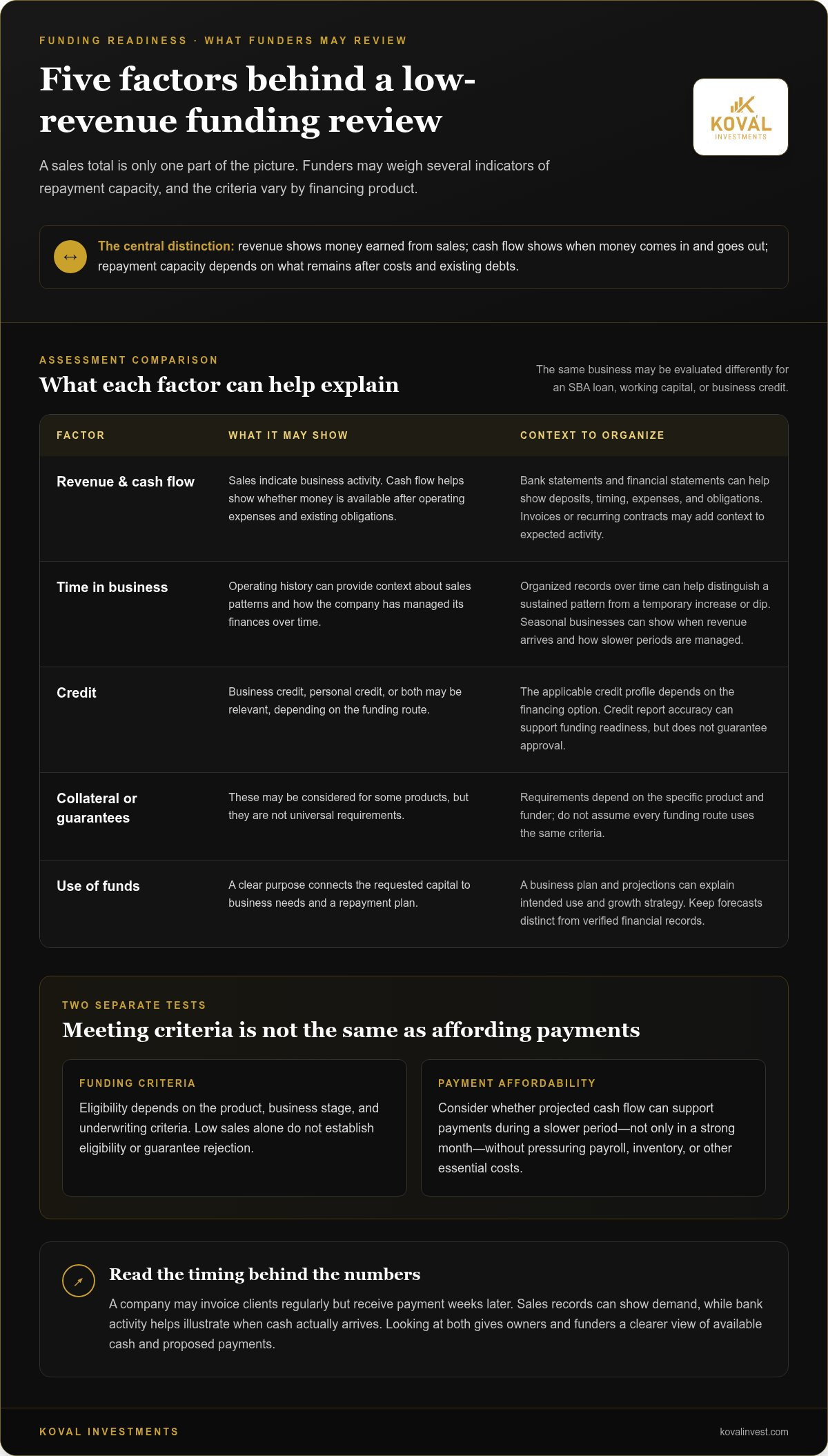
Low revenue describes limited sales volume; repayment capacity describes whether available cash can cover obligations as they come due. They’re related, but they aren’t the same. Revenue is the money earned from sales before expenses. Cash flow reflects when money comes in and goes out, while repayment capacity depends on what remains after operating costs and existing debts. A business can have modest sales and steady cash flow, or higher sales that arrive irregularly and leave little available for payments.
It also helps to distinguish low revenue from no revenue, inconsistent sales, and seasonal income. A pre-revenue startup may have a business plan and projected sales, but no track record of completed transactions. A business with uneven sales has generated revenue, though deposits may vary from month to month. A seasonal company may earn much of its annual revenue during a limited period. These patterns call for different evidence and a careful look at when funds will be available.
Small business loans are a broad category of capital, but their structures and evaluation criteria vary. Understanding Small Business Loans can provide general background. The specific product and funder determine how revenue and repayment are assessed.
Does low revenue automatically disqualify a business?
No. Requirements vary by product, business stage, and underwriting criteria. A low sales total alone doesn’t establish eligibility, and it doesn’t guarantee rejection. A newer company, an established firm with a temporary sales dip, and a seasonal business may each present a different financial picture. The relevant question is how a particular funding option evaluates that picture, not whether the business fits one universal definition of low revenue.
Qualification and affordability are separate tests. An application might meet a funder’s criteria, yet the resulting payment could still put pressure on payroll, inventory purchases, or other essential costs. Before seeking capital, consider whether the business could make repayments during a slower period, not only in a strong month.
What evidence can add context to limited sales?
Organized records help show how the business operates beyond its sales total. Recent bank statements can reveal deposit patterns and timing. Invoices, recurring contracts, and operating history may help explain expected business activity. These details don’t guarantee a funding outcome, but they can make the financial picture easier to understand.
Depending on the financing, a funder may also consider business credit or the owner’s personal credit. A business plan with projections can explain the intended use of funds and outline a growth strategy, but projections aren’t a substitute for verified financial records. Keep actual results and forecasts distinct so the application presents both the current position and the plan for moving forward.
How Funders Assess Low-Revenue Business Funding Applications
A funding review is rarely a judgment based on one sales figure. Funders may assess several indicators of repayment capacity, and criteria vary by financing product. The same business could be evaluated differently for an SBA loan, working capital, or business credit. For owners exploring business funding for low revenue companies, understanding these factors helps clarify what a funder may want to see and what the business can responsibly manage.
Common considerations include:
- Revenue and cash flow: Sales show business activity, while cash flow helps show whether money is available after operating expenses and existing obligations.
- Time in business: Operating history can provide context about sales patterns and how the company has managed its finances over time.
- Credit: Business credit, personal credit, or both may be relevant, depending on the funding route.
- Collateral or guarantees: These may be considered for some products, but aren’t universal requirements.
- Use of funds: A clear purpose connects the requested capital to business needs and a repayment plan.
How revenue, cash flow, and operating history work together
Gross sales don’t show how much cash remains after rent, payroll, inventory, taxes, and existing debt payments. A funder may review bank statements alongside financial statements to understand both deposits and obligations. Comparing records over time can help distinguish a sustained pattern from a temporary increase or dip. For seasonal businesses, records covering relevant business cycles can explain when revenue arrives and how the company handles slower periods.
For example, a company may invoice clients regularly but receive payment weeks later. Its sales records can show demand, while bank activity helps illustrate the timing gap between work completed and cash received. Consistent, organized documentation makes that distinction easier to understand. It also gives the owner a clearer basis for judging whether proposed payments fit expected cash availability.
How credit, collateral, and funding purpose may affect review
Credit history can offer information about how obligations have been managed, but its importance depends on the product and underwriting approach. Some financing may consider the owner’s personal credit as well as the business’s credit profile. Collateral or a guarantee may also be part of certain arrangements, while other options may assess risk differently. Avoid assuming one factor determines the outcome, since requirements are product-specific.
The purpose of the request matters, too. Explain what the funds will support, how that use fits the business’s operations, and where repayment is expected to come from. Capital for inventory, for instance, should be tied to a realistic sales and cash-flow plan rather than an optimistic assumption. The SBA Loan Programs for Small Businesses page outlines SBA financing categories, while eligibility and review depend on the relevant program and funder.
Matching a funding route to the company’s financial profile and intended use can make the decision process more deliberate. Koval Investments’ capital planning support helps business owners organize these considerations as they explore funding options.
Compare Funding Options for Low-Revenue Companies
The right funding route depends on what the business needs, what its financial records can support, and how it expects to repay or otherwise deliver value. A company with predictable contracts may have different options from one seeking capital to manage seasonal inventory. This comparison can help narrow business funding for low revenue companies, but it can’t determine eligibility or guarantee an outcome.
| Funding route | Potential fit and readiness signals | Trade-offs to consider |
|---|---|---|
| SBA financing | May suit an established business seeking capital for an eligible purpose, with organized records and a repayment plan. | Program rules and funder underwriting apply. Repayment obligations continue over the loan term, and review requirements may be more involved than some alternatives. |
| Working capital | May address a defined operating need, such as covering a timing gap between expenses and customer payments. A clear source of repayment is important. | Costs and repayment schedules vary by financing arrangement. Payments need to fit the business’s cash flow, including slower periods. |
| Business credit | May provide access to funds for planned expenses or short-term cash-flow needs. Credit history and the ability to manage balances may be relevant. | It isn’t automatic or cost-free capital. Review interest, fees, introductory terms, and what happens if a balance remains unpaid. |
| Equity | May fit a business with a growth plan that can attract an investor and a clear way to use new capital. | It generally doesn’t require scheduled loan repayments, but owners may give up a share of ownership or some decision-making influence. |
When SBA loans or microloans may be worth exploring
SBA-backed financing may be worth researching if the business fits a program’s eligibility rules and can document a responsible repayment plan. The SBA generally guarantees part of a loan made by a participating funder; it doesn’t directly lend the funds to the business. For program context, review SBA loan assistance guidance alongside the SBA’s loan program information. The funder’s decision and program-specific criteria determine suitability.
When working capital or business credit may fit better
Working capital may align with a specific operating expense when the business can identify a credible repayment source, such as expected customer receipts. Business credit can offer another financing route, but compare the full terms and plan for repayment rather than relying on a promotional rate alone. Learn more about 0% interest business funding, including why qualification, conditions, and costs matter.
Equity may be an alternative when scheduled debt payments would put too much pressure on cash flow, though ownership trade-offs deserve careful consideration. For a broader comparison of routes, explore alternative business funding solutions. Across every option, match the capital to a defined need and test repayment against realistic business conditions.
Prepare a Stronger Application Before Seeking Business Funding
A well-prepared application explains how the business operates, why it needs capital, and how it expects to manage repayment. This is especially useful for business funding for low revenue companies, where a sales figure alone may not show the full financial picture. Complete records help explain the business beyond its revenue total.
Use this sequence to get organized before applying:
- Step 1: Define the need. Identify the specific expense or opportunity the funds would support. Separate essential operating needs from optional growth plans.
- Step 2: Set a realistic request. Estimate the amount required for the stated purpose, using invoices, quotes, or a documented budget where available. Avoid requesting capital without a clear use.
- Step 3: Gather financial records. Organize recent profit and loss statements, balance sheets, bank records, and business tax records. Keep periods consistent so the information is easier to compare.
- Step 4: List existing obligations. Record outstanding debts, regular payments, fixed operating costs, and upcoming cash needs. Include payment timing, not just total balances.
- Step 5: Test repayment capacity. Estimate how payments would affect cash available for routine expenses, including during a slower sales period.
Build a clear picture of the business finances
Reconcile recorded sales with bank deposits. If invoice totals don’t match deposits in a particular period, note timing differences, refunds, or other relevant explanations. Summarize the business’s fixed obligations and expected cash needs so the records show what funds are already committed. Where relevant, review business credit reports for accuracy before applying. Correcting or documenting an error can help present a clearer profile, though it doesn’t guarantee a particular funding decision.
For seasonal or uneven sales, organize records to show the full operating pattern rather than relying on one unusually strong or weak month. Keep actual results distinct from forecasts. This makes it easier to explain changes without presenting projected revenue as money already earned.
Match the request to a realistic repayment plan
Connect the funding purpose to an observable business need. For example, specify which inventory purchase, equipment expense, or cash-flow gap the request addresses, then identify the expected source of repayment. Model payments using conservative assumptions, such as slower customer payments or a softer sales period, rather than relying only on the best-case forecast.
Before accepting an offer, compare payment timing and total repayment obligations with the business’s cash cycle. Review the consequences of a missed payment and consider whether a payment date could conflict with payroll, rent, or supplier expenses. If the plan works only when every projection comes true, reconsider the amount or timing before taking on the obligation.
Organizing these details can make the funding process more deliberate. Koval Investments provides funding and financial profile support to help prepare your business for a thoughtful capital discussion.
How Koval Investments Can Help Low-Revenue Companies Explore Capital
Limited revenue can make it harder to compare funding routes, but it doesn’t mean every possibility should be dismissed. Koval Investments helps businesses explore capital procurement options, including 0% interest funding solutions, SBA loans, and working capital. The goal is to connect the funding approach to the business’s circumstances and intended use, while keeping repayment capacity central to the discussion.
For owners researching business funding for low revenue companies, this process can help turn a general need for capital into a specific plan. Start by clarifying what the funds would support, which financial records are available, and how the business expects to meet repayment obligations. Eligibility, terms, and outcomes depend on the funding route and applicable review.
Connect funding goals with financial profile preparation
Funding readiness involves more than identifying a potential product. Koval Investments helps consider how the business’s purpose for seeking capital aligns with its financial profile. For example, a request tied to a defined operating need can be considered alongside current cash flow and existing obligations, rather than treated as an isolated dollar amount.
Credit profile preparation may also be relevant. Koval Investments’ credit repair services identify and dispute inaccuracies in credit reports, while financial profile optimization can support preparation before a funding application. This work doesn’t promise a particular credit score, approval, amount, or terms. Its value is in helping address the accuracy and presentation of financial information as part of a broader funding strategy.
0% interest funding solutions, SBA loans, and working capital each have different considerations. Understand any introductory-rate conditions, eligibility criteria, repayment requirements, and potential costs for the applicable option. A route that appears to fit the business’s immediate need still needs to align with cash flow and realistic repayment expectations.
Choose a practical next step for the business
Before a funding discussion, gather a concise picture of the business: its goals, the intended use of capital, recent financial information, current debt obligations, and cash flow available for repayment. You don’t need to have every answer settled. Clear records and specific questions can make it easier to identify what needs further review and which funding categories may be relevant to explore.
Koval Investments takes a collaborative approach to capital procurement and financial preparation. The discussion can center on the business’s objectives, financial circumstances, and the trade-offs involved in different funding routes. This gives owners a structured way to consider next steps without treating approval as a given.
Reviewing your funding goals and financial profile is a practical next step. A clear funding strategy starts with understanding what the business needs and what its cash flow can responsibly support.
Make Your Next Funding Decision with Confidence
The next step doesn’t have to be an immediate application. Decide whether to pursue capital now, strengthen your financial profile first, or wait until the business can support repayment more comfortably. That choice is part of responsible funding strategy, not a setback.
For business funding for low revenue companies, a focused plan can turn uncertainty into a practical decision: identify the business priority, know what information supports it, and set a repayment boundary the company can live with. If the numbers point to a mismatch, adjust the amount or timing rather than relying on best-case assumptions.
Koval Investments has supported businesses since 2018, bringing a collaborative perspective to capital planning and financial preparation. If you’re ready to discuss a funding strategy grounded in your business goals and circumstances, explore Koval Investments’ business funding and capital procurement support.
A clear, measured next step can help your business pursue growth while keeping its financial resilience in view.
Frequently Asked Questions
Can a business get funding with low revenue?
Yes, some businesses with low revenue may find funding options, but low sales don’t establish eligibility. A company with a small but steady customer base presents a different profile from one whose expenses consistently exceed incoming cash. Before applying, identify the amount the business could repay from ordinary operations, not just the amount it hopes to borrow. That distinction keeps the funding search grounded in affordability.
Can a startup get a business loan with no revenue?
Sometimes, but having no sales history can make it harder to show that the business can repay a loan. Depending on the financing route, a funder may consider factors such as the owner’s credit, available collateral, personal investment, or the strength of the startup plan. Projections can explain the business model, but they don’t prove that forecast sales will occur. Compare borrowing with equity or delaying a request until revenue begins.
What funding options are available to low-revenue businesses?
Potential routes include SBA financing, working capital, business credit, and equity. The best fit depends on the need: a temporary operating gap differs from a long-term growth investment. For example, a company planning a major expansion may weigh ownership trade-offs differently from a business covering a short cash-flow shortfall. Compare eligibility, payment structure, total obligations, and the effect on ownership before deciding which options merit further review.
How do lenders evaluate a business with low revenue?
Funders may review how the business earns and manages money, alongside its time in operation, credit profile, and proposed use of funds. Keep records clear about what counts as sales: owner contributions, transfers between accounts, and refunds aren’t customer revenue. Separating these transactions helps prevent deposits from overstating business activity. Criteria differ by product, so a strong showing in one area doesn’t guarantee approval.
Does low business revenue affect my personal credit?
Low business revenue alone doesn’t automatically lower an owner’s personal credit score. Personal credit may become relevant if the application includes a personal guarantee or the financing involves a personal credit check. Missed payments can also have personal consequences when the owner is personally responsible for the debt. Before accepting financing, understand who is obligated to repay and how the account’s payment history may be handled.
Is 0% interest business funding available to low-revenue companies?
It may be available to some businesses, but a 0% introductory rate isn’t the same as guaranteed, permanently cost-free funding. Qualification depends on the specific option and applicant profile. Review how long the introductory period lasts, what rate may apply afterward, whether fees apply, and how much must be paid each month. Make sure the repayment plan works even if revenue doesn’t grow as quickly as expected.
How can I improve my chances of business funding approval?
Present a consistent application: use figures that match across financial statements, tax records, and bank activity, and explain unusual transactions clearly. Check relevant business and personal credit reports for errors, then address inaccuracies before applying. Tie the request to a specific business objective and avoid relying on optimistic projections to justify repayment. These steps can strengthen your financial presentation, but no preparation can guarantee approval or particular terms.