
Business Valuation for Acquisition: The Strategic Consultant’s Guide for 2026
Would you still sign the Letter of Intent if you knew the target company's "stable" revenue was actually propped up by a single, expiring contract? With global M&A volume projected to hit a record $3.9 trillion in 2026, the pressure to move quickly often leads to expensive oversight. You likely recognize that nagging uncertainty when reviewing a seller's books, fearing you might overpay for a business with hidden liabilities. It's a valid concern that keeps many entrepreneurs from pulling the trigger on a deal that could otherwise transform their portfolio.
In this guide, you'll learn how to conduct a rigorous business valuation for acquisition that stands up to the toughest negotiations. We'll show you how to identify the real ROI potential of a target and leverage professional consulting to avoid common pitfalls. We will cover everything from industry-specific multiples to the strategic funding roadmap you need to close the deal with confidence, ensuring your next acquisition is a calculated step toward long-term growth rather than a financial risk.
Key Takeaways
- Understand how a professional valuation serves as the critical foundation for drafting a defensible Letter of Intent.
- Learn to apply the correct business valuation for acquisition method, whether using earnings multipliers for stability or discounted cash flow for growth.
- Identify how strategic consulting uncovers hidden risks by "normalizing" financials to reveal a company's true earning potential.
- Discover how to align your valuation with optimal funding structures, including the strategic use of SBA 7(a) loans.
- Master negotiation tactics by establishing a clear walk-away price and using due diligence data to secure price reductions.
Understanding Business Valuation for Acquisition in 2026
Business valuation for acquisition is the systematic process of calculating a target company's fair market value to ensure an investment aligns with its actual economic output. It's much more than a simple accounting exercise. It serves as the bedrock of your Letter of Intent (LOI), providing the data needed to justify your offer and set the stage for a transparent transaction. Without this foundation, you're essentially guessing at the price of your future success.
Many first-time buyers confuse price with value. Price is merely the dollar amount on the contract. Value is the business's ability to generate cash flow, sustain growth, and survive market shifts. For a detailed business valuation overview, one must look at income, assets, and market comparables simultaneously. We view this process through the lens of strategic business planning services. This holistic approach ensures that the valuation isn't just a static report but a roadmap for the deal itself.
The Buyer’s vs. Seller’s Perspective
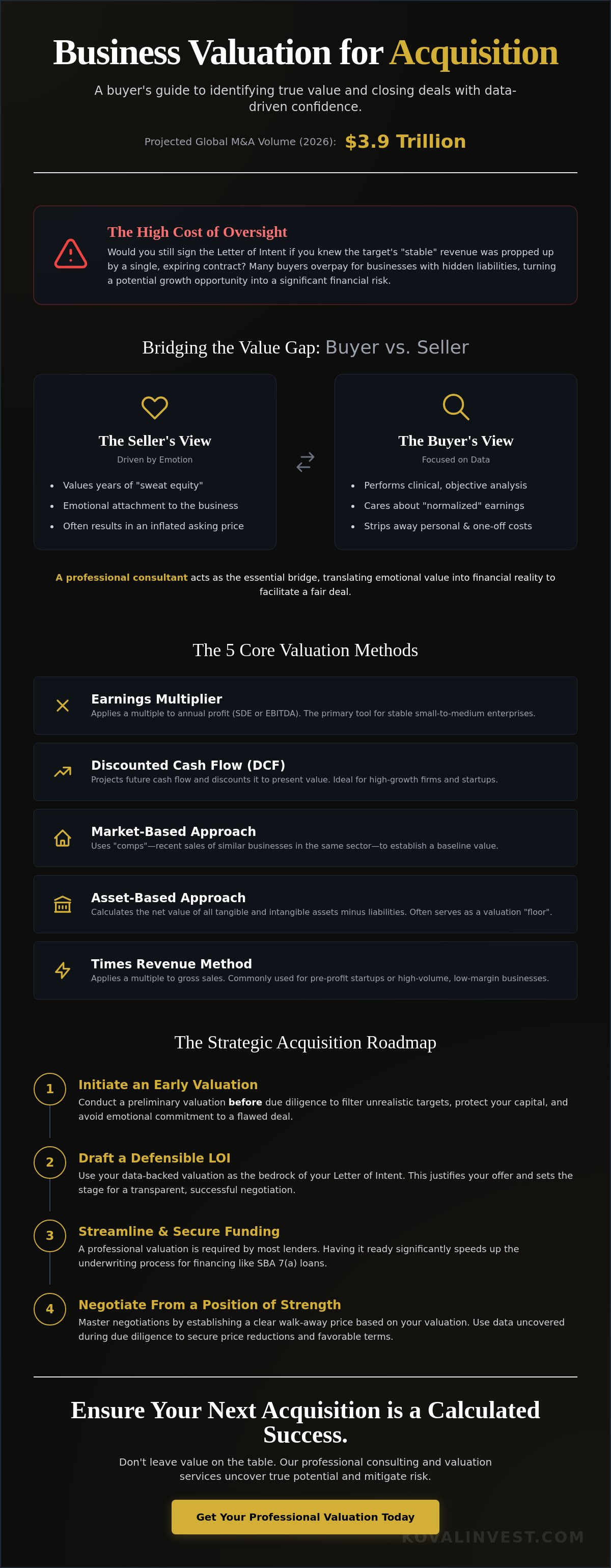
Sellers often struggle with emotional attachment. They view their business through years of "sweat equity" and personal sacrifice, which often leads to inflated asking prices. Buyers, conversely, are clinical. They don't care about the late nights the seller worked five years ago. They care about "normalized" earnings. This means stripping away personal expenses, one-time windfalls, or non-recurring costs to see the business's true performance. A consultant acts as a bridge here, translating emotional value into financial reality to keep the deal moving toward a close.
When to Initiate a Professional Valuation
Don't wait until the middle of due diligence to start your business valuation for acquisition. By then, you've already invested significant time and legal fees into a deal that might be fundamentally flawed. Initiating a preliminary valuation early allows you to filter out targets with unrealistic price expectations before you're emotionally or financially committed. It's a screening tool that protects your capital from the start.
Early valuation also streamlines your financing. Lenders require a defensible value to approve capital. If you're seeking SBA loan assistance, having a professional valuation ready can significantly speed up the underwriting process. It proves to the bank that the debt service coverage ratio is based on hard data rather than optimistic projections, making you a much more attractive borrower.
The 5 Core Methods of Business Valuation for Acquisition
Selecting the right mathematical framework is the first step in ensuring you don't overpay for a target. While there are dozens of ways to slice financial data, most successful deals rely on a few Common business valuation techniques to find a fair price. The goal isn't just to find a number, but to find a number that reflects the business's specific risk profile and industry standing.
Most business valuation for acquisition processes utilize one or more of these five core methods:
- Earnings Multiplier: This is the primary tool for small-to-medium enterprises, applying a multiple to the company's annual profit.
- Discounted Cash Flow (DCF): This method projects future earnings and "discounts" them back to their value today, which is ideal for high-growth firms.
- Market-Based Approach: This relies on "comps," or recent sales of similar businesses within the same sector to establish a baseline.
- Asset-Based Approach: This calculates the net value of all physical assets minus liabilities, often serving as a "floor" for the valuation.
- Times Revenue Method: This applies a multiple to gross sales, often used for pre-profit startups or high-volume, low-margin industries.
If you're unsure which approach fits your target, engaging professional business valuation services can provide the clarity needed to proceed with a defensible offer.
SDE vs. EBITDA: Which Multiple Matters?
For owner-operated businesses, we focus on Seller’s Discretionary Earnings (SDE). This includes the net profit plus the owner's salary, benefits, and any one-time expenses that a new owner wouldn't incur. Once a business scales beyond the owner's daily involvement, we shift to EBITDA (Earnings Before Interest, Taxes, Depreciation, and Amortization). This provides a cleaner look at the company's operational efficiency for institutional or corporate buyers. The multiple itself is a reflection of industry risk and growth potential.
The DCF Method for Long-Term Projections
The DCF method is particularly useful when valuing companies with significant intellectual property or volatile growth curves. In 2026, calculating the discount rate requires a careful look at the current cost of capital, as SBA 7(a) variable rates currently range from 9.0% to 11.5%. We also place heavy emphasis on the "terminal value," which represents the business's worth at the end of a five-year forecast. This methodical approach ensures that your business valuation for acquisition accounts for long-term sustainability rather than just a snapshot of today's performance.
The Role of Business Acquisition Consulting in Due Diligence
A valuation report provides the numbers, but consulting provides the context. While the math might suggest a certain price, a consultant looks "under the hood" to identify risks that spreadsheets often miss. This phase of due diligence is where we verify the integrity of the data used in your business valuation for acquisition. We don't just accept the seller's profit margins; we scrutinize the operational reality behind them to ensure your investment is sound.
One of the most critical steps in this process is "normalizing" financial statements. Business owners frequently mix personal and professional expenses, such as vehicle leases, family travel, or non-market salaries for relatives. We perform "add-backs" to remove these personal costs, revealing the true earning potential of the enterprise. This ensures you aren't paying a multiple on the seller's lifestyle choices. Achieving accurate acquisition valuations requires this level of forensic detail to strip away noise and reveal the core profit engine.
Consultants also hunt for operational debt. This isn't found on a standard balance sheet. It manifests as outdated technology, high employee turnover, or aging equipment that requires immediate replacement. If a company's software infrastructure hasn't been updated in years, you're inheriting a massive capital expenditure. Uncovering these red flags through a professional business valuation allows you to adjust your offer or request credits before the deal is finalized.
Qualitative Factors That Influence Value
In the 2026 digital landscape, a business's brand reputation and market positioning are as vital as its cash flow. We assess the strength of the middle management team to determine if the company can thrive without the founder's daily involvement. If the business relies entirely on the owner's personal relationships, the risk of "owner dependency" significantly devalues the asset. We also analyze customer concentration. If 80% of revenue is tied to a single client, the loss of that contract could bankrupt the business overnight. These qualitative insights are essential for a robust business valuation for acquisition.
Strategic Fit and Synergies
A strategic buyer often sees value that a financial buyer does not. We calculate "synergy value" to determine the extra worth a business brings specifically to your existing portfolio. This might come from cost-saving synergies, like merging back-office functions, or revenue-generating synergies, such as cross-selling products to a new customer base. Because of these potential gains, a strategic buyer can often justify a higher multiple than a purely financial investor. We help you quantify these benefits so you don't overpay for potential that might never materialize.
Funding Your Acquisition: Aligning Value with Capital
Once you've established a defensible business valuation for acquisition, the focus shifts to capital. The valuation report isn't just a negotiation tool; it's the blueprint for your funding structure. Lenders and investors need to see that the business's cash flow can comfortably support the debt service while still providing a healthy return on equity. If the valuation is too high, you'll struggle to find a bank willing to bridge the gap. If it's too low, you might be leaving equity on the table.
SBA 7(a) loans remain a cornerstone for financing small-to-medium acquisitions in 2026. These loans are specifically designed to fund deals based on the company's cash flow valuation rather than just hard assets. With variable rates currently between 9.0% and 11.5%, your valuation must demonstrate that the target can handle these interest costs. To cover the "soft costs" of a deal, many savvy buyers utilize 0% interest business funding. This allows you to preserve your cash for the down payment or initial operational expenses. Additionally, using working capital for business acquisition ensures you have the liquidity to maintain momentum during the critical first 90 days of ownership.
The Impact of Your Credit Profile on Deal Terms
Your personal and business credit scores are just as important as the company's valuation. A strong credit profile can lower your required down payment from 20% to as little as 10% in some cases. Optimizing your credit before you even enter negotiations can save you thousands in interest over the life of the loan. We often recommend success-based credit repair to our clients to ensure they're positioned for the best possible terms. If you're ready to see how your profile stacks up, speak with an acquisition consultant today to start your preparation.
Leveraging SBA Loan Assistance
Packaging your business valuation for acquisition for an SBA lender requires precision. In 2026, lenders are increasingly selective, often requiring an "equity injection" of at least 10% for most acquisition deals. A consultant helps you present the valuation data in a way that meets strict underwriting guidelines. For many deals, especially those exceeding specific lender thresholds, an independent third-party valuation is mandatory. We help you navigate these requirements to ensure your funding doesn't stall at the finish line.
Negotiation Strategy: Using Valuation to Close the Deal
Negotiation is where your preparation meets the seller's expectations. By this stage, your business valuation for acquisition has provided a range of values rather than a single, static number. This range allows you to establish a firm "Walk-Away" price. This limit should be based on the low-end valuation and the business's ability to maintain a healthy debt service coverage ratio. With SBA 7(a) variable rates currently reaching up to 11.5% in 2026, staying disciplined with your maximum offer is vital to ensuring the business remains profitable after the debt is paid.
You can use the findings from your financial normalization to justify price reductions. If your due diligence uncovered deferred maintenance, aging inventory, or high customer concentration risks, these become tactical leverage points. Rather than simply asking for a lower price, you're presenting data-backed reasons why the initial asking price doesn't align with the risk profile. This methodical approach keeps the conversation professional and focused on the tangible value of the asset.
The final stage of the negotiation involves drafting the Asset Purchase Agreement (APA). This document must include clear representations and warranties that protect you from undisclosed liabilities. It's the legal safety net that ensures the business you're buying is exactly the one described in the valuation reports. We focus on creating a "win-win" structure where the seller feels fairly compensated for their legacy while you're protected from overpaying for hidden risks.
Structuring the Earn-Out
An earn-out is a powerful mechanism to bridge the gap between a buyer’s and seller’s valuation. It involves paying a portion of the purchase price only after the business hits specific performance targets following the acquisition. This protects you if the company’s "future potential" doesn't materialize as the seller promised. Setting realistic, easily measurable targets is the key to a successful earn-out. An earn-out serves as a critical risk-mitigation tool for high-multiple acquisitions where the seller’s projections are particularly aggressive.
The Final Walk-Through and Closing
Before the funds are wired, a final walk-through is necessary to verify that the assets valued in the report are still present and in the expected condition. This includes everything from physical equipment to digital access and intellectual property. The transition period following the close is just as important as the deal itself. A consultant’s role during this phase is to ensure value retention by helping you integrate the new acquisition without disrupting existing cash flows or employee morale.
Ready to acquire? Consult with Koval Investments for a strategic valuation today.
Securing Your Path to a Successful Acquisition
Successful deal-making in 2026 requires a shift from viewing numbers as static data to seeing them as strategic levers. You've seen how a precise business valuation for acquisition serves as more than just a price tag; it's a comprehensive risk assessment and a funding roadmap. By normalizing financials and identifying operational debt early, you position yourself to negotiate from a place of strength and clarity. This methodical approach ensures that every dollar you invest is backed by tangible potential rather than optimistic projections.
Securing the right target is only half the battle. Aligning that value with a sophisticated capital structure ensures your new venture has the liquidity to thrive from day one. With over seven years of strategic advisory experience and a success-based consulting philosophy, we're committed to your growth as a dedicated partner. Expertise in both capital procurement and business valuation allows us to navigate these complex financial landscapes alongside you. Secure Your Acquisition Strategy with Koval Investments today to turn your vision of ownership into a profitable reality. You have the tools and the roadmap; now it's time to execute with confidence.
Frequently Asked Questions
What is the most common valuation method for small business acquisitions?
The Earnings Multiplier is the most frequent method used for small-to-medium enterprises. It calculates value by applying an industry-standard multiple to the company's Seller’s Discretionary Earnings (SDE) or EBITDA. This approach is favored because it focuses on the actual cash flow the business generates for its owners, providing a clear picture of the return on investment.
How much does a professional business acquisition consultant cost?
Consulting fees are typically structured to align with the client's success. Many firms operate on a success-based model where the primary compensation is tied to the successful closing of the deal. This approach minimizes financial risk for the buyer and ensures the consultant is fully invested in securing a favorable outcome rather than just billing hours.
Can I value a business based on its gross revenue alone?
Valuing a company on gross revenue is generally discouraged for established businesses. While the "Times Revenue" method exists for certain high-volume industries or pre-profit startups, it ignores the critical reality of operational expenses and profit margins. A business with high revenue but no profit is often worth far less than a smaller, more efficient competitor with healthy cash flows.
How do interest rates in 2026 affect business valuations?
High interest rates directly compress business valuations by increasing the cost of capital. With SBA 7(a) variable rates currently between 9.0% and 11.5%, buyers must allocate more cash flow to debt service. When the cost of borrowing rises, the amount a buyer can afford to pay for the business typically decreases to maintain a healthy debt service coverage ratio.
What is the difference between an asset sale and a stock sale in an acquisition?
An asset sale involves purchasing individual items like equipment, inventory, and customer lists, which allows the buyer to avoid the company's prior liabilities. A stock sale involves buying the entire legal entity, including all its history and potential legal risks. Most small business buyers prefer asset sales for the significant tax benefits and liability protection they provide.
How long does the business valuation process typically take?
A preliminary business valuation for acquisition can often be completed within two to four weeks. However, the comprehensive due diligence that follows can extend the timeline by several months. The speed of the process depends largely on the quality of the seller's financial records and the complexity of their operational structure.
Do I need a new valuation if the seller already provided one?
Yes, you should always commission an independent valuation. Seller-provided reports are frequently biased and may include "pro-forma" projections that don't reflect current realities. An independent consultant will normalize the financial statements to reveal the true earning potential and identify hidden risks that the seller might have overlooked during their own assessment.
How does my personal credit score affect my ability to acquire a business?
Your credit score is a primary factor in determining your loan terms and down payment requirements. A strong score can help you secure better rates on SBA loans, which currently feature an optional peg rate of 4.50% for certain fixed-rate caps. If your credit is less than ideal, utilizing credit repair services before starting the business valuation for acquisition can save you significant capital over the life of the deal.