
How to Increase Business Valuation Before Selling: A Strategic Guide for 2026
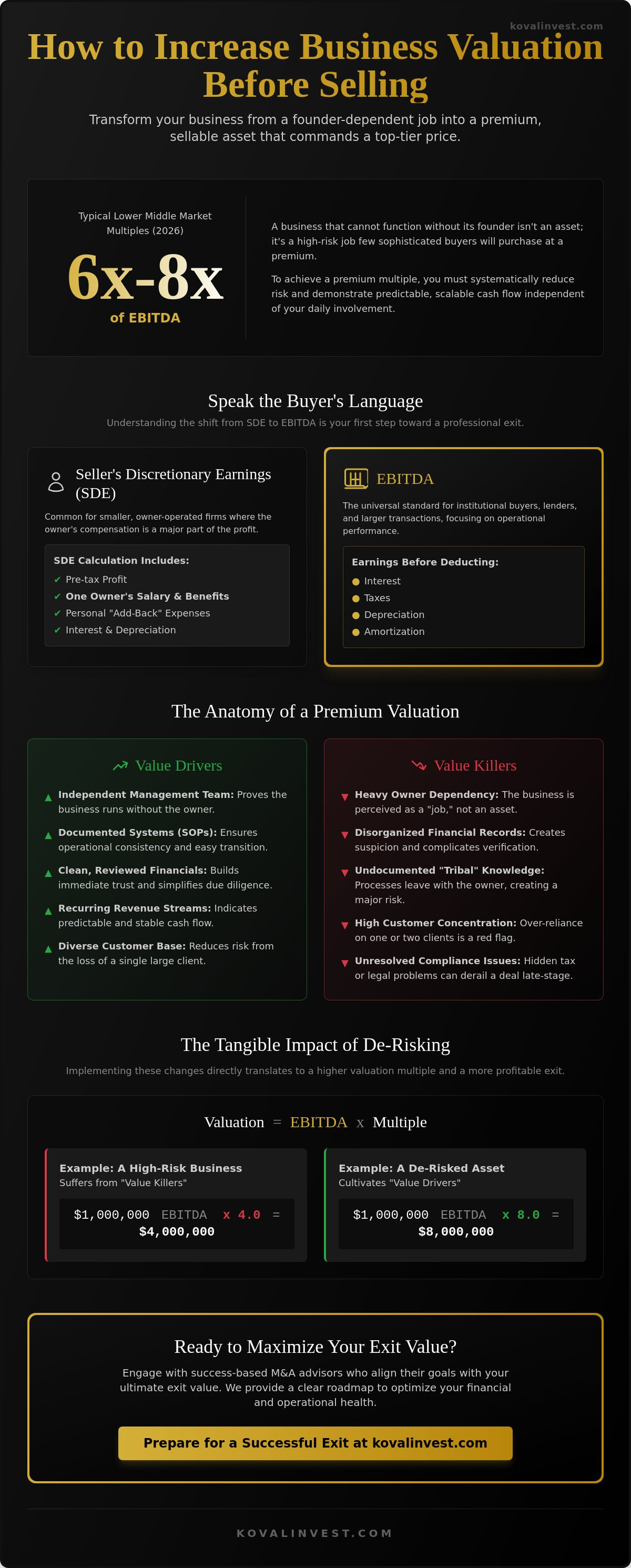
A business that cannot function without its founder isn't an asset; it's a job that very few sophisticated buyers are willing to purchase at a premium. If you're planning an exit, understanding how to increase business valuation before selling is the single most important step you can take to protect your legacy. Many owners spend years building a company only to face the fear of being lowballed because their financial records don't meet modern standards or their daily involvement creates a "key person" risk. In a 2026 market where lower middle market multiples often range between 6x and 8x EBITDA, leaving your valuation to chance is a risk you don't need to take.
We understand that preparing for a sale feels complex, especially when you're trying to manage growth simultaneously. You've worked hard to reach this point, and you deserve a transition that reflects the true value of your efforts. This guide provides a clear roadmap to optimize your financial and operational health, ensuring you command a premium price. You'll learn how to reduce owner dependency, clean up your books for due diligence, and implement the strategic changes necessary for a smoother, more profitable sale process.
Key Takeaways
- Learn the critical distinction between SDE and EBITDA to ensure you're speaking the same financial language as sophisticated institutional buyers.
- Discover how to increase business valuation before selling by implementing rigorous financial hygiene and removing personal expenses from your company's books.
- Understand why documented SOPs and a management team that functions independently of the owner are the primary drivers of higher valuation multiples.
- Explore how a robust business credit profile reduces risk for the buyer and makes the acquisition significantly easier to finance.
- Identify the strategic advantages of working with success-based M&A advisors who align their goals with your ultimate exit value.
Understanding Business Valuation: Moving Beyond Simple Multiples
A professional Business valuation is far more than a static figure on a balance sheet. It represents a buyer's perception of risk versus the probability of future earnings. When you're investigating how to increase business valuation before selling, you're essentially looking for ways to lower that perceived risk. Buyers in 2026 are particularly focused on the predictability of cash flow. They use "multiples" as a shorthand for how many years of current earnings they're willing to pay upfront. While lower middle market businesses currently see multiples between 6x and 8x EBITDA, these figures aren't guaranteed. They're heavily influenced by "Value Drivers," like recurring revenue, and "Value Killers," such as high customer concentration or heavy owner dependency.
It's vital to distinguish between Seller Discretionary Earnings (SDE) and EBITDA. SDE is common for smaller, owner-operated firms because it includes the owner's salary and benefits. EBITDA (Earnings Before Interest, Taxes, Depreciation, and Amortization) is the standard for larger transactions. Knowing which metric applies to your specific situation is the first step in a professional exit strategy. A clear understanding of these financial benchmarks prevents you from being lowballed by sophisticated buyers who understand these nuances better than the average entrepreneur.
Common Valuation Methodologies for Small Businesses
Most professionals use three primary approaches to determine a company's worth. The asset-based approach focuses on the net value of physical assets. This is common for struggling firms or those with heavy investments in machinery. The market approach compares your business to recent sales of similar companies in your industry. Finally, the income approach looks at the present value of expected future earnings. This is particularly relevant for growth-stage firms where past performance doesn't fully capture future potential.
The Role of EBITDA in Your Exit Strategy
EBITDA acts as a universal language in the M&A world. To accurately reflect your company's value, you must "normalize" these earnings through add-backs. These are one-time or personal expenses that won't continue under new ownership. Successfully identifying these add-backs is a core part of how to increase business valuation before selling. Beyond the raw numbers, buyers look for consistent year-over-year growth. This steady upward trend signals that the business is a stable, scalable engine rather than a stagnant operation that has already peaked.
Financial Hygiene: De-Risking the Acquisition for Buyers
Trust is the primary currency in any high-stakes transaction. When a buyer begins due diligence, your financial statements are the first place they look to verify your claims. If your records are disorganized or heavily laden with personal expenses, you're inadvertently signaling that the business is high-risk. A core part of how to increase business valuation before selling involves scrubbing these lifestyle costs from your profit and loss statements. While tax-minimization is a common goal for active owners, a successful exit requires a shift toward valuation-maximization. This means presenting a clean, transparent entity where every dollar of profit is clearly documented and defensible.
Ensuring all taxes, licenses, and compliance filings are current is equally vital. A missing permit or an unresolved tax dispute can derail a sale in its final stages. Buyers want to step into a turnkey operation, not a legal or administrative puzzle. Documenting your compliance history shows that you've managed the company with integrity and foresight. This level of preparation transforms the due diligence phase from a stressful interrogation into a straightforward verification of value.
The Importance of Audited or Reviewed Financial Statements
There's a significant difference between owner-prepared spreadsheets and statements reviewed by a qualified CPA. While owner-prepared books might suffice for daily operations, they rarely satisfy sophisticated buyers or their lenders. Professional business valuation typically requires at least three years of clean, consistent data to establish a trend. Reviewed or audited statements provide an external stamp of approval that reduces the buyer's perceived risk. This verification often leads to higher offers because the buyer can trust the numbers they're using to calculate their projected return on investment.
Optimizing Working Capital and Cash Flow
Managing your accounts receivable and inventory levels directly impacts your balance sheet's health. A healthy cash conversion cycle proves that your business is efficient and doesn't require constant infusions of capital to survive. Buyers look at these metrics to determine how much liquidity they'll need post-acquisition. Understanding the buyer's perspective on using working capital for business acquisition can help you position your own assets more effectively. If you're unsure where your current financials stand, engaging in professional business valuations now can help you identify and fix leaks before you go to market. Refining your inventory strategies and tightening credit terms are practical ways how to increase business valuation before selling while simultaneously improving your current monthly margins.
Operational Scalability: Increasing Multiples Through Strategic Planning
A buyer's biggest fear is that the business's success is tied solely to your personal expertise or relationships. If you're the primary salesperson, lead technician, and chief problem solver, the company effectively ceases to exist the day you walk away. This is why how to increase business valuation before selling often comes down to documenting your processes. By creating comprehensive Standard Operating Procedures (SOPs), you transform individual knowledge into a corporate asset. This ensures that a new owner can maintain operational continuity from day one without needing you on speed dial. It's about moving from a business that relies on your presence to one that relies on its own systems.
Beyond internal processes, you must address external risks like customer concentration. If a single client accounts for more than 15% of your revenue, a buyer will likely apply a "discount" to your valuation to account for the risk of that client leaving. Diversifying your base is a tangible way to protect your EBITDA multiples. In 2026, buyers also place a significant premium on businesses that have integrated AI and automation. Automating core functions like lead generation, inventory tracking, or customer support reduces labor dependency and increases the scalability of the firm. These technological efficiencies make your company a much more attractive prospect in a competitive M&A market.
Reducing Owner Dependency: The Hub and Spoke Model
Most small businesses operate as a "hub and spoke," where every decision travels through the owner at the center. To increase your exit value, you must break this cycle. This involves identifying every task you currently perform and delegating it to a capable middle-management layer. A buyer wants to see a team they can trust to lead the company into its next chapter. When key customer relationships are held by the company's account managers rather than the founder, the business becomes a much more attractive, low-risk acquisition. It's a fundamental shift that turns a "job" into a transferable investment.
Leveraging Strategic Business Planning Services
A clear roadmap for future growth is just as important as your historical performance. Utilizing strategic business planning services allows you to present a buyer with a "pre-packaged" future. This plan should identify "unlocked" growth opportunities, such as untapped market segments or new product lines, that you haven't yet exploited. By providing a 3-year growth forecast backed by market trends and historical data, you help the buyer visualize their return on investment. This proactive approach is a primary driver in how to increase business valuation before selling because it shifts the narrative from what you've already done to what the buyer can achieve under their own leadership.
The Impact of Credit Profiles and Capital Access on Business Value
A company's credit profile acts as a silent partner in every transaction. When you're strategizing how to increase business valuation before selling, optimizing your borrowing capacity is just as critical as increasing your EBITDA. Buyers often rely on external financing to close a deal. If your company already has a pristine credit history and pre-established lines of credit, you've essentially done half the buyer's work for them. A business that is "financeable" attracts a much larger pool of potential acquirers, which naturally drives up the final sale price through increased competition.
Access to capital procurement services makes your business "expansion-ready" in the eyes of an investor. They aren't just buying your past performance; they're buying the ability to leverage your existing infrastructure for future growth. By repairing business credit and disputing any inaccuracies on your reports before going to market, you lower the eventual cost of debt for the new owner. This financial foresight translates directly into a higher valuation multiple because it reduces the friction and risk associated with the acquisition's capital structure.
Optimizing Your Credit Profile for SBA Loan Eligibility
In the 2026 market, SBA-backed deals remain a cornerstone for small business exits. Utilizing professional SBA loan assistance helps position your business as a "pre-qualified" asset. When a business meets SBA eligibility requirements, it signals to the buyer that the company has passed a rigorous federal standard of financial health. There is a direct correlation between a high business credit score and the multiple a buyer is willing to pay. A flawless financial face allows you to stand firm on your asking price during negotiations, as you've removed one of the most common excuses for "price chipping."
Utilizing 0% Interest Funding to Fuel Pre-Sale Growth
Strategic owners use 0% interest business funding to finance high-ROI improvements, such as the technology automation or SOP documentation mentioned earlier. In an environment where interest rates have stabilized but remain at higher levels than in previous decades, accessing capital at zero cost is a massive competitive advantage. This low-cost capital improves your net margins by eliminating interest drag, which subsequently boosts your EBITDA. Presenting a debt-light balance sheet that still shows aggressive growth is a powerful way to attract conservative investors. If your credit profile needs a professional touch to reach these levels, our credit repair services can help ensure your business is positioned for a premium exit.
Engaging M&A Advisory: Preparing for a Successful Exit Strategy
The final stage of your exit journey requires a shift from operational management to strategic storytelling. While the previous steps focused on internal improvements, an M&A advisor's role is to translate those improvements into a compelling narrative for the market. Understanding how to increase business valuation before selling involves more than just fixing the books; it requires an advisor who operates with a success-based philosophy. Unlike a standard business broker who might focus on a high volume of small transactions, a strategic M&A advisor acts as a partner. They're incentivized to maximize your company's value because their success is directly tied to yours. This collaborative approach ensures that every detail, from your tax-efficient structure to your automated workflows, is positioned to attract premium offers.
Timing your market entry is a delicate science that balances industry trends with your internal performance. In early 2026, global M&A deal values reached record highs, but buyers remain selective. A professional advisor helps you prepare a Confidential Information Memorandum (CIM). This document is your primary marketing tool. It doesn't just list your equipment or past revenue; it tells the story of your future potential. A well-crafted CIM justifies your asking price by highlighting the scalability and de-risked nature of the entity you've built. It’s the difference between selling a "business for sale" and offering a high-yield investment opportunity.
The Value of a Professional Business Valuation
Securing a professional business valuation is the essential first step in this process. This report does more than provide a number; it acts as a benchmark for all subsequent performance improvements. It identifies the "Wealth Gap," which is the difference between your current company value and the amount you need to fund your post-exit goals. By identifying this gap early, you can focus your energy on the specific value drivers that will move the needle most effectively. It's a pragmatic tool that removes the guesswork from your exit strategy.
Assembling Your Deal Team
A successful exit is a team sport. Your deal team should include your M&A advisor, a CPA specializing in transaction tax, and legal counsel with experience in mergers and acquisitions. This collaborative partnership ensures that the deal structure protects your interests while remaining attractive to the buyer. When these professionals work in sync, the resulting sale is often faster and more profitable. If you're ready to see where your company stands in today's market, you should schedule a consultation to assess your current exit readiness. Taking this step now is the most effective way to learn how to increase business valuation before selling while you still have the time to implement meaningful changes.
Securing Your Legacy Through Strategic Preparation
Your business represents years of dedication, but its market value is determined by its future, not its past. By implementing rigorous financial hygiene and building operational systems that function independently of your daily involvement, you transform a company into a high-yield asset. We've explored how a robust credit profile and access to optimized capital structures can significantly lower buyer risk while driving up EBITDA multiples. Mastering how to increase business valuation before selling is ultimately about presenting a predictable, scalable cash-flow engine that sophisticated investors can't ignore.
At Koval Investments, we act as your steady hand in this complex financial landscape. Our success-based advisory philosophy ensures our goals are perfectly aligned with your own. Our expertise in credit-optimized capital procurement and comprehensive 0% interest funding solutions provides the leverage you need to maximize your company's worth. Don't leave your exit to chance. Maximize your exit value with a professional business valuation from Koval Investments. We're here to help you navigate every challenge and secure the premium price your hard work deserves.
Frequently Asked Questions
How long does it take to increase a business valuation before selling?
It typically takes 12 to 24 months to see a measurable impact on your exit price. This timeline allows you to establish a multi-year trend of clean financials and prove that your operational improvements are sustainable. Buyers look for consistency; showing two years of growth after implementing your valuation strategy is the gold standard for securing a premium sale.
Can I sell my business if I have a low business credit score?
You can sell with a low credit score, but you'll likely face a lower valuation and a limited buyer pool. Most buyers need to finance the purchase, and a weak credit profile makes the business a higher risk for lenders. Improving your score before the sale ensures the new owner can secure better debt terms, which directly supports a higher asking price.
What is the single most important factor in increasing business value?
The single most important factor is operational independence. A business that functions seamlessly without the owner's daily involvement is a transferable asset rather than a job. By documenting SOPs and empowering a management team, you address the primary "value killer" that leads to lowballed offers from sophisticated institutional buyers who fear owner dependency.
Is a professional business valuation necessary if I already have an offer?
A professional valuation is essential even with an offer on the table. Without an independent benchmark, you can't be certain if the offer reflects the true market value or if the buyer is exploiting gaps in your financial reporting. Having a formal report provides the objective evidence needed to negotiate from a position of strength and avoid leaving money on the table.
How do M&A advisory services for small business differ from traditional brokers?
Traditional brokers often focus on high-volume, transactional sales and may charge upfront fees regardless of the outcome. In contrast, strategic M&A advisors utilize a success-based philosophy. They act as partners who focus on how to increase business valuation before selling through long-term planning and capital optimization. This approach aligns the advisor's incentives with your goal of achieving the highest possible exit value.
What are "add-backs" and how do they help my valuation?
Add-backs are non-recurring or personal expenses that you "add back" to your net income to calculate the true earnings of the business. These might include your one-time legal fees, owner life insurance, or personal travel charged to the company. Properly identifying these add-backs "normalizes" your earnings, showing buyers the actual profitability they can expect under their own ownership.
Can strategic planning actually increase my EBITDA multiple?
Strategic planning increases your EBITDA multiple by reducing the perceived risk of the acquisition. When you present a clear roadmap for future growth and a diversified customer base, you move the business from a "standard" multiple to a "premium" one. Buyers are willing to pay more for a company that has already identified its next three years of growth opportunities and mitigated its operational risks.
How much does it cost to prepare a business for sale?
The cost of preparation depends on the current state of your operations and financials. Instead of viewing these as expenses, consider them investments in your final sale price. Focusing on high-ROI areas like credit repair, financial reviews, and process automation often pays for itself many times over through a higher multiple and a faster, more certain due diligence process.