
How to Increase Business Valuation Before Selling: The 2026 Founder’s Guide
What if the true value of your company isn't found in your current profit margins, but in the structural integrity of your balance sheet two years before you list? Most founders realize too late that a high-multiple exit is engineered, not discovered. You've likely felt the anxiety of messy financials or the fear that a buyer's due diligence will uncover flaws that devalue your life's work. It's a valid concern. With the 2026 CBV practice standards now requiring deeper scrutiny of every assumption, the margin for error has vanished. Learning how to increase business valuation before selling is no longer just about boosting sales; it's about professionalizing your entire financial ecosystem.
We're going to show you how to architect a premium exit by optimizing your financials, credit profile, and operational efficiency long before the first offer arrives. This guide provides a strategic roadmap to financial security post-exit. You'll discover how to leverage 0% interest funding to scale without debt and why credit restoration is a prerequisite for a clean due diligence process. We'll move from high-level strategy to the practical steps of engagement, ensuring you're positioned as a high-value target in a fragile 2026 economy.
Key Takeaways
- Adopt a "begin with the end in mind" philosophy by aligning your current operational decisions with your ultimate financial exit goals.
- Determine whether a high-liquidity M&A transition or a culture-focused management buyout is the most effective path for your legacy.
- Discover how to increase business valuation before selling by utilizing professional valuation methodologies to establish an accurate and defensible baseline.
- Strengthen your balance sheet by using 0% interest funding for high-ROI growth projects that boost EBITDA without adding traditional debt.
- Eliminate due diligence red flags through proactive credit restoration and financial auditing to ensure a smooth, high-value closing process.
What is an Exit Strategy & Why Plan for 2026?
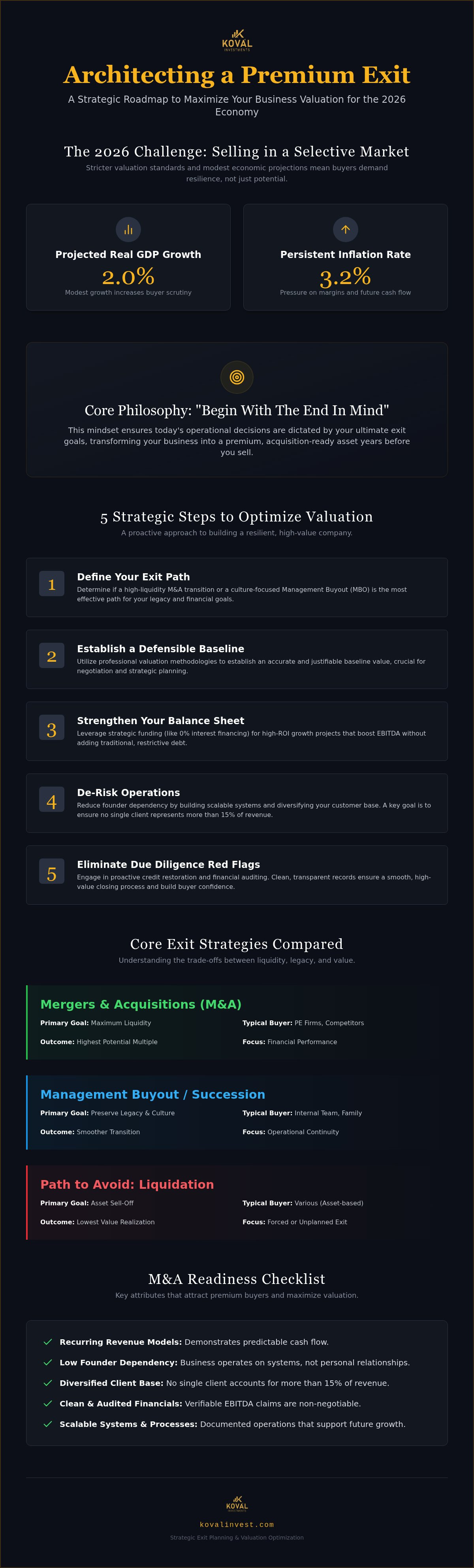
An exit strategy is far more than a simple departure date or a "for sale" sign. It's a comprehensive roadmap designed to transfer ownership while maximizing the financial return you've spent years building. In the current 2026 economic environment, where real GDP growth is projected at a modest 2.0% and inflation remains persistent at 3.2%, a passive approach to selling is a liability. Buyers are no longer paying premiums for potential alone. They're looking for resilience, documented systems, and predictable cash flows.
Effective founders adopt a "begin with the end in mind" philosophy. This mindset ensures that today's operational decisions are dictated by your ultimate exit goals. If your objective is a high-multiple sale to a private equity firm, you'll prioritize recurring revenue and leadership depth today. Learning how to increase business valuation before selling requires you to look at your company through the eyes of a professional auditor. With evolving professional valuation standards becoming more rigorous, especially as we approach January 1, 2026, the need for transparent documentation and robust business valuation methodologies has never been higher.
The Financial Benefits of Early Exit Planning
Strategic exit planning directly impacts your current bottom line. When your business is "exit-ready," it possesses a lower risk profile, which often translates to a lower cost of capital and better terms from lenders. Tier-1 investors and strategic acquirers look for a clear value trajectory rather than a founder-dependent operation. You'll find that a clean, well-structured business is simply easier to run. Additionally, long-term structural planning allows you to navigate the 2026 tax environment, specifically regarding capital gains and pass-through taxation. Addressing these factors early can significantly reduce your post-sale tax liabilities and protect your wealth.
Common Triggers for Small Business Exits
Exits aren't always sparked by a desire to stop working. Many founders move toward a sale due to lifestyle changes or the desire to fund a "second act" with total financial security. You might also find yourself facing unsolicited offers from competitors or strategic partners. By staying acquisition-ready, you can negotiate from a position of strength rather than desperation. This proactive stance is essential for burnout prevention. It ensures you can step away on your own terms without devaluing the asset. A comprehensive plan distinguishes itself from a simple exit by addressing succession-ensuring the leadership team is prepared to carry the torch without your daily involvement.
Core Exit Strategies: M&A vs. Succession
Choosing the right exit path is a decision that dictates both your final payout and your company's future. For many founders, Mergers and Acquisitions (M&A) represent the peak of liquidity. Selling to a competitor or a private equity firm often allows for a full exit at a premium multiple. Conversely, a Management Buyout (MBO) focuses on transitioning ownership to the people who helped build the brand. While MBOs might offer a lower immediate cash-out compared to a competitive auction, they preserve the company culture and ensure a smoother operational transition.
Family succession remains a common goal, yet it requires a delicate balance. You must secure your retirement funding without overleveraging the business for the next generation. The least desirable path is liquidation. Walking away and selling off assets rarely yields more than a fraction of the business's true value. Avoiding this "fire sale" scenario starts with understanding how to increase business valuation before selling years in advance. A structured approach ensures that you aren't forced into a low-value liquidation due to burnout or market shifts.
Positioning Your Small Business for M&A
Buyers in 2026 are highly selective. They prioritize companies with recurring revenue models and scalable systems that don't depend on the founder. If your business relies on your personal relationships to survive, its market value drops. Our M&A consulting services help you identify these "owner-dependency" risks early. We focus on diversifying your customer base to ensure no single client represents more than 15% of your revenue. This preparation makes the due diligence process far less daunting. Your financial history is your most important asset during a sale. Clean, audited records are the only way to prove your EBITDA claims and secure a top-tier multiple. Understanding how to increase business valuation before selling through operational depth is what separates a standard exit from a premium one.
Funding the Transition via SBA Loans
Internal transitions often face a common hurdle: capital. Your management team may have the expertise to lead but lacks the liquidity to buy you out. This is where SBA loan assistance becomes a critical tool. These government-backed loans allow internal buyers to secure funding with lower down payments and longer repayment terms. While internal transfers might use different valuation metrics than a third-party sale, maintaining operational stability is vital. Any dip in performance during the handoff can lead to a "valuation haircut" at the closing table. If you're unsure which path fits your goals, a professional business valuation can provide the clarity needed to choose the right strategy.
The Bridge to Your Exit: Professional Business Valuation
Relying on an informal estimate or a "gut feeling" about your company's worth is a high-risk strategy that often leads to stalled negotiations. When a founder enters the market with an unrealistic price tag, it signals a lack of preparation to sophisticated buyers. Conversely, accepting an undervalued offer can cost you years of retirement security. A professional business valuation provides the objective data necessary to anchor your expectations in current market realities. It moves the conversation from speculation to a defensible financial position based on industry standards.
Most valuations utilize one of three primary approaches. The asset-based approach focuses on the fair market value of your company's net assets. The market-based approach looks at comparable transactions within your sector. However, the income-based approach, specifically focusing on EBITDA multiples, is the most common for growing firms. We use these reports as diagnostic tools. By identifying "value gaps" between your current worth and your retirement goals, we can pinpoint exactly how to increase business valuation before selling. This gap analysis allows you to spend the next 12 to 24 months fixing specific operational weaknesses rather than guessing what buyers want.
Maximizing Your EBITDA and Valuation Multiples
EBITDA represents earnings before interest, taxes, depreciation, and amortization, serving as the standardized metric that allows buyers to compare the core profitability of different businesses regardless of their capital structure. To maximize this number, we perform a deep dive into "add-backs." These are legitimate business expenses that won't recur under new ownership, such as personal travel, non-essential company vehicles, or salaries for family members not active in the business. By adding these back to your net income, we present a more accurate picture of your true earning power. Reducing owner-dependency is equally critical. If the business cannot function without your daily input, buyers will apply a significant "valuation haircut" to account for the transition risk. Building a leadership team that can operate independently is one of the fastest ways to expand your multiple.
The Role of Intangible Assets in Sale Price
Your balance sheet rarely tells the whole story. Brand equity, proprietary technology, and established customer lists represent significant intangible value that can drive a higher sale price. However, these assets only hold value if they are "clean" and well-documented. Buyers look for ironclad intellectual property rights and transferable contracts during due diligence. Our strategic planning services focus on formalizing these assets. By documenting your workflows and securing your IP, you transform abstract value into tangible proof. This level of preparation ensures that your intangible strengths are recognized as core drivers of future growth, justifying a premium multiple at the closing table.
Strategic Steps to Optimize Valuation Before Selling
Engineering a high-value exit requires a systematic approach to financial hygiene and operational maturity. While previous sections detailed the "why" behind valuation, these steps focus on the "how." To secure a premium multiple in the 2026 market, you must treat your business as a product that needs polishing before it hits the shelf. Buyers are looking for reasons to discount your price; your job is to remove every possible objection before the first meeting. Learning how to increase business valuation before selling involves five critical tactical shifts:
- Step 1: Conduct a rigorous financial audit and initiate credit restoration to eliminate red flags that could stall a deal.
- Step 2: Utilize interest-free capital to invest in high-ROI growth projects that demonstrate recent momentum.
- Step 3: Diversify your customer base. Ensure no single client accounts for a disproportionate share of your revenue, which lowers the buyer's risk profile.
- Step 4: Restructure high-interest debt using SBA assistance to clean up the balance sheet and improve your debt-to-income ratio.
- Step 5: Document all internal processes. Prove that the company's success is tied to its systems, not just the founder's daily presence.
Credit Repair: A Prerequisite for Saleability
Many founders overlook the fact that a buyer's lender will scrutinize the seller's business credit report as part of the acquisition approval. If your business has inaccuracies or a low score, it can prevent the buyer from securing the necessary funding to complete the purchase. Utilizing business credit repair services allows you to remove these obstacles long before you enter negotiations. A clean credit profile not only speeds up the transaction but also improves your own eligibility for transition capital. This preparation ensures that the new owner can step into a financially healthy environment without immediate credit-related hurdles.
Leveraging 0% Interest Funding to Boost EBITDA
Financial engineering is a powerful way to expand your margins during the critical look-back period. By securing 0% interest business funding, you can modernize equipment or software without incurring interest expenses that would otherwise depress your EBITDA. This interest-free capital allows you to hit aggressive growth milestones or complete high-ROI projects that trigger higher valuation multiples. When you reinvest working capital strategically, you show potential buyers a trajectory of increasing efficiency and profitability. If you're ready to start this process, you can apply for a strategic planning consultation to align your funding with your exit goals.
Executing the Exit: How Koval Investments Facilitates Your Transition
Moving from preparation to execution requires a steady hand and a clear perspective. While you've learned how to increase business valuation before selling through financial optimization and operational cleanup, the final transaction involves complex layers of negotiation. We provide end-to-end advisory that bridges the gap between your current operations and a successful closing. This process isn't just about finding any buyer; it's about ensuring the deal structure protects your interests and your legacy. We combine capital procurement with strategic planning to ensure you don't leave money on the table.
We adopt an "A-Team" philosophy for every engagement. We don't replace your existing CPA or legal counsel; we collaborate with them. This partnership ensures that every tax implication and legal clause is vetted before you sign. Navigating buyer financing is another critical hurdle that we manage. Deals often fail at the last minute because the buyer's lender finds a discrepancy or the buyer's credit profile is insufficient. We proactively manage these complexities to ensure the transaction actually reaches the finish line. Our success-based approach means we're as invested in the outcome as you are.
M&A Advisory and Consulting Services
Our mergers and acquisitions consulting focuses on identifying the right buyer profile while maintaining total confidentiality. We move beyond just the sale price to look at the total value. We negotiate sophisticated deal terms, including earnout structures and non-competes, to ensure you receive the full value of your work. By managing the heavy lifting of the due diligence phase, we minimize founder stress. This allows you to focus on keeping the business running at peak performance until the day of transfer. A clean transition is essential for maintaining the valuation we've worked together to build.
Securing Your Post-Exit Financial Future
The sale is the beginning of your next chapter. We help you plan for your "second act," whether that's a quiet retirement or a new entrepreneurial venture. Maintaining a strong credit profile post-exit is essential if you plan to leverage capital for future investments. Our goal is a win-win outcome where you walk away with financial security and the freedom to pursue what's next. If you're ready to see the true potential of your company and implement strategies on how to increase business valuation before selling, the time to act is now. Schedule a professional business valuation with Koval Investments today.
Take Control of Your Company's Final Multiple
A successful exit in 2026 isn't a matter of luck; it's the result of deliberate financial engineering. You've seen how professional valuations serve as a diagnostic tool to bridge value gaps and how 0% interest funding can modernize operations without adding debt. By prioritizing credit restoration and documented systems now, you ensure that future due diligence is a formality rather than a hurdle. Understanding how to increase business valuation before selling is the difference between a standard transaction and a legacy-defining sale.
At Koval Investments, we provide success-based consulting for M&A and capital procurement, ensuring our goals are perfectly aligned with yours. Our team brings deep expertise in navigating SBA loan requirements to facilitate smooth business transitions for both buyers and sellers. We act as your strategic partner, managing the complexities of the market so you can focus on your next chapter. Secure your legacy; get a professional business valuation from Koval Investments today. Your years of hard work deserve a return that reflects the true value you've created.
Frequently Asked Questions
How far in advance should I start exit strategy planning for my small business?
Ideally, you should start planning 24 to 36 months before your target exit date. This timeframe allows you to implement operational changes that actually impact your EBITDA and valuation multiples. Short-term fixes often look superficial to sophisticated buyers. Starting early gives you the runway to professionalize your leadership team and clean up your balance sheet, ensuring you aren't forced to sell during a market downturn.
Does my business credit score really matter if I am selling the company?
Yes, your business credit score is a critical factor because the buyer's lender will scrutinize it during the acquisition financing process. A poor score or inaccuracies on your report can delay or even kill a deal if the buyer cannot secure an SBA loan or traditional funding. We prioritize credit restoration as a prerequisite for a clean due diligence process. It signals to the buyer that the company has been managed with financial discipline.
What is the most common exit strategy for a small business in 2026?
In 2026, the most common exit strategy remains a strategic sale to a competitor or a private equity firm, as these buyers often offer the highest valuation multiples. However, management buyouts are increasing in popularity for founders who want to preserve their company culture. The right choice depends on your personal liquidity needs and legacy goals. Understanding how to increase business valuation before selling ensures you have multiple attractive options when you're ready to list.
Can I use 0% interest funding to pay off debt before a business valuation?
You should use 0% interest funding to invest in growth rather than simply shifting debt. While you can use it to restructure high-interest liabilities, its primary value is in funding high-ROI projects that boost your EBITDA during the look-back period. Buyers want to see that capital is being used to drive future revenue. This approach allows you to scale your operations without increasing your interest expense, which directly improves your final sale price.
What is the difference between an asset sale and a stock sale in an exit?
An asset sale involves the buyer purchasing individual assets like equipment, customer lists, and inventory, while a stock sale involves the transfer of the entire legal entity. Buyers often prefer asset sales because they can "step up" the basis of the assets for tax depreciation. Sellers usually prefer stock sales to ensure a cleaner break from liabilities. We collaborate with your legal counsel to determine which structure minimizes your tax burden while maximizing your net proceeds.
How much does a professional business valuation cost and is it worth it?
The cost of a professional valuation varies based on the size and complexity of your business, but it's a necessary investment for a high-value exit. It provides an objective, defensible baseline that prevents you from leaving money on the table. Without one, you're essentially guessing your market worth. A formal report also serves as a diagnostic tool, showing you exactly how to increase business valuation before selling by identifying specific operational gaps.
What happens if my business isn’t ready to sell when I want to leave?
If your business isn't ready, you may have to accept a lower valuation or consider a structured earn-out where part of the price is paid based on future performance. Another option is to appoint an interim CEO to manage the transition while you step back from daily operations. This is why we emphasize the "begin with the end in mind" philosophy. It ensures your company remains acquisition-ready even if your personal timeline shifts unexpectedly.
How do I tell my employees that I am planning an exit strategy?
Confidentiality is vital during the early stages of planning to prevent turnover and maintain operational stability. You should generally only inform key leadership members who are essential to the transition process. Once a deal is firm, communicate with the broader team honestly, focusing on the growth opportunities the new ownership brings. We help you manage this confidential marketing process to ensure your staff stays focused on their roles until the transaction is finalized.