
How to Qualify for an SBA Loan: The 2026 Small Business Checklist
Most entrepreneurs view the federal application process as a rigid pass-fail test, but in 2026, the reality is far more nuanced. Understanding how to qualify for SBA loan programs is no longer about simply checking a box; it's about strategically positioning your financial profile to meet evolving lender standards. You've likely felt the weight of complex government documentation or worried that a personal credit score might derail your growth plans. It's a common frustration that can make low-interest capital feel out of reach when you need it most.
We've designed this guide to replace that uncertainty with a clear, actionable path to approval. You'll master the specific financial, legal, and credit benchmarks required to secure SBA funding for your business growth in 2026. We'll examine the updated 1.10:1 debt-service coverage ratio, the shift toward holistic borrower reviews, and the mandatory citizenship requirements that define the current lending landscape. By the end of this checklist, you'll know exactly how to optimize your profile and secure the capital your business deserves.
Key Takeaways
- Understand that the SBA acts as a guarantor rather than a direct lender, which means you'll need to demonstrate that traditional financing wasn't an option.
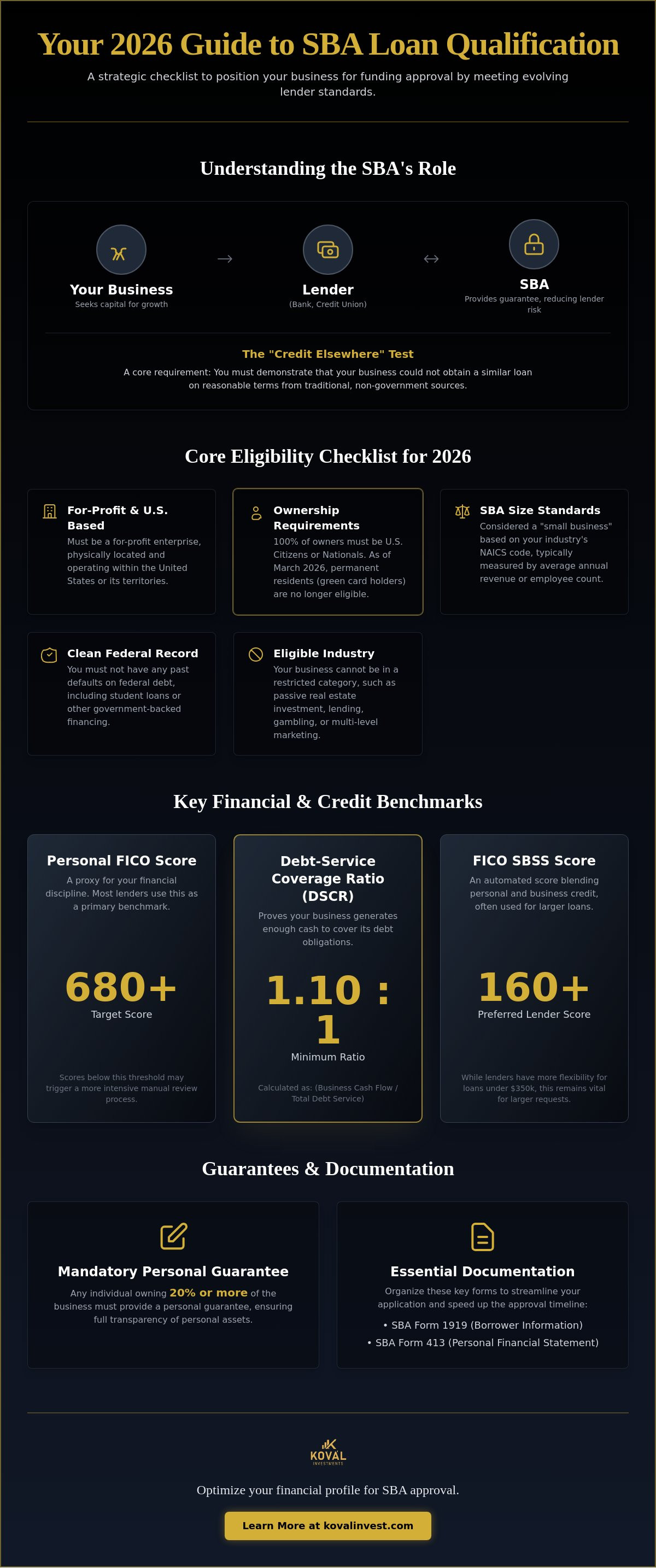
- Target a personal FICO score of 680 or higher to align with the primary credit benchmarks most lenders look for in 2026.
- Discover how to qualify for SBA loan programs by proactively cleaning up your balance sheet and optimizing your debt-service coverage ratio before you apply.
- Prepare for the mandatory personal guarantees required from any owner with a 20% stake or more, ensuring full transparency of personal assets.
- Master the documentation process by organizing essential forms like SBA Form 1919 and Form 413 to speed up the approval timeline.
Understanding the SBA Loan Framework and Basic Eligibility
The federal government doesn't write checks directly to your business. Instead, the Small Business Administration provides a federal guarantee to its lending partners, which include traditional banks, credit unions, and community lenders. This guarantee reduces the lender's risk, encouraging them to offer capital to firms that might not fit their standard institutional profile. To understand how to qualify for SBA loan programs, you must first grasp the "Credit Elsewhere" test. Lenders are required to certify that your business cannot secure the same loan on reasonable terms from non-government sources. This isn't a barrier; it's a strategic entry point for growing firms that haven't yet reached the scale required for traditional commercial paper.
Size standards are equally critical to your eligibility. The SBA uses North American Industry Classification System (NAICS) codes to define what constitutes a "small" business. These limits vary significantly by industry, typically based on either your average annual revenue or your total number of employees. For instance, a manufacturing firm might be considered small with 500 employees, while a retail business is judged by its gross receipts. Additionally, your company must operate for profit. This excludes all non-profits and companies that exist solely for passive investment, such as certain real estate holding firms that don't provide active services.
Core Eligibility Criteria for 2026
Your business must be physically located and operating within the United States or its territories. As of March 1, 2026, ownership requirements have become more stringent. 100% of the business owners must be U.S. Citizens or U.S. Nationals with their principal residence in the United States. Permanent residents, or green card holders, are no longer eligible for these specific programs. If you're wondering how to qualify for SBA loan funding, you must also clear the character requirement. Lenders and the SBA evaluate your past criminal history and any previous defaults on federal debt. This includes student loans, past disaster loans, or any other government-backed obligations. A clean federal track record is a non-negotiable prerequisite for approval.
Ineligible Industries and Restricted Activities
Certain business models are fundamentally incompatible with SBA objectives. Passive income ventures, such as apartment complexes or most real estate holding companies, don't qualify because they don't generate active economic activity through operations. The SBA also restricts speculative ventures, including commodity trading, oil wildcatting, and gambling establishments. You'll find similar exclusions for lending institutions, multi-level marketing (MLM) schemes, and businesses of a prurient nature. These restrictions ensure that federal support focuses on productive, active small businesses that drive local employment and community stability. Aligning your business model with these active-use standards is the first step toward a successful application.
Financial and Credit Thresholds for SBA Approval
Lenders view your personal credit history as a proxy for how you'll manage business debt. It's a reflection of financial discipline. While the government doesn't set a hard minimum score, most institutional partners look for a personal FICO score of 680 or higher to move forward without extensive manual justification. If your score falls below this mark, it doesn't necessarily mean a rejection, but it usually triggers a more intensive review of your global cash flow and secondary collateral. Understanding how to qualify for SBA loan programs requires a deep dive into these four financial pillars: personal credit, business credit, cash flow ratios, and equity commitment.
The FICO SBSS Score: The Gatekeeper of 7(a) Loans
The FICO Small Business Scoring Service (SBSS) has historically acted as the primary automated gatekeeper for the most popular lending programs. As of March 1, 2026, the SBA granted lenders more flexibility for 7(a) small loans under $350,000, meaning they are no longer strictly required to use this specific score for smaller amounts. However, for larger capital needs, the SBSS remains a vital metric. It blends your personal credit data with business credit reports from bureaus like Experian and Dun & Bradstreet. Passing the automated screen often requires a score of 155 or higher, though many lenders set their internal bar at 160 to ensure a higher quality of debt. You can boost this score by ensuring your business accounts are reporting to the major bureaus and by keeping your credit utilization low across all business lines.
Cash Flow and Debt-to-Income (DTI) Requirements
Your Debt Service Coverage Ratio (DSCR) is perhaps the most critical number on your application. It measures your business's ability to cover its debt obligations using its net operating income. To understand SBA loan eligibility requirements, you must calculate this ratio by dividing your annual net operating income by your total annual debt payments. For 7(a) small loans, the SBA officially requires a minimum DSCR of 1.10:1 as of early 2026. In practice, most lenders prefer a safer margin of 1.25:1 to account for market fluctuations. Lenders will scrutinize your business bank statements with the same intensity as your tax returns, looking for consistent deposits and a healthy average daily balance. If your current financial profile isn't quite meeting these benchmarks, exploring professional credit repair services can be a strategic first step toward optimizing your application.
Finally, consider the equity injection requirement. For startups or business acquisitions, the SBA typically mandates a 10% equity injection. This "skin in the game" reassures the lender that you're personally invested in the venture's success. This 10% must come from non-borrowed funds, such as personal savings or a gift from a family member, and you'll need to provide a clear paper trail for these assets. When you combine a strong personal score with a robust DSCR, you position your business as a low-risk, high-value partner for any lending institution.
The Essential SBA Documentation Checklist
Precision in your paperwork is often the difference between a swift approval and a prolonged request for information. While the financial benchmarks discussed previously establish your eligibility, the documentation phase proves your operational integrity. To understand how to qualify for SBA loan funding, you must treat your application as a professional consultation. You're presenting a comprehensive narrative of your business's past, present, and future.
SBA Form 1919 serves as the primary borrower information document. Every individual with at least a 20% ownership stake must complete this form to disclose their background and eligibility status. Alongside this, SBA Form 413, the Personal Financial Statement, provides a transparent view of your personal assets and liabilities. Lenders use this to assess your personal financial stability and the strength of the required personal guarantees. Accuracy here is paramount; even minor discrepancies can trigger a manual review that delays your funding for weeks.
Standard requirements include your profit and loss statements, balance sheets, and the last three years of federal income tax returns. Your business plan must accompany these figures, featuring a hyper-specific "Use of Proceeds" section. Generic requests for capital often lead to rejection. Instead, detail exactly how every dollar will be deployed, whether it's for equipment acquisition, debt refinancing, or specific payroll expansions. Mastering this level of detail is a core part of learning how to qualify for SBA loan approval.
Legal and Organizational Documents
Your lender needs to verify the legal structure of your entity. Be prepared to provide your Articles of Incorporation, Bylaws, and Operating Agreements. If your business operates under a franchise model, the franchise agreement is mandatory. For complex corporate structures, an organizational chart helps the lender understand the hierarchy of control and ownership. You should also include copies of commercial leases and any required business licenses to prove your right to operate in your specific jurisdiction.
Tax and Income Verification
Transparency is maintained through IRS Form 4506-C, which allows the lender to verify your tax transcripts directly with the IRS. You'll also need year-to-date (YTD) financial statements dated within 90 days of your application. To demonstrate operational health, include accounts receivable and accounts payable aging reports. These documents show how efficiently you manage your cash cycle and fulfill your obligations to vendors. This level of transparency builds the trust necessary for a successful partnership.
Collateral, Personal Guarantees, and the SBA Guarantee
Securing federal funding requires a commitment that extends beyond your business's balance sheet. When you're determining how to qualify for SBA loan programs, you must prepare for the personal and physical security requirements that lenders mandate to offset their risk. These requirements ensure that you, as the owner, remain fully aligned with the success of the venture. This alignment is established through personal guarantees and the pledging of available assets.
The SBA requires an unconditional personal guarantee from every individual who owns 20% or more of the business. This isn't a mere formality. It's a legally binding promise that makes you personally liable for the debt if the business cannot fulfill its obligations. For many owners, this also involves a junior lien on their personal residence. If the business assets don't fully secure the loan, the lender will look to your personal real estate equity to bridge the gap. Additionally, if the business's success is heavily dependent on your specific expertise, the lender may require a collateral assignment of a life insurance policy to protect the debt in the event of an untimely tragedy.
What Counts as Collateral in 2026?
Lenders evaluate a variety of assets to secure the loan, including commercial real estate, heavy equipment, and marketable inventory. They typically value these at liquidation rates rather than current market value, which means they may only credit you for 50% to 80% of an asset's appraised worth. However, the "Best Available Collateral" rule is a distinct advantage of the SBA framework. Unlike traditional commercial loans, the SBA prohibits lenders from rejecting a candidate solely because they lack enough collateral to fully secure the loan, provided the business demonstrates strong cash flow and character. If you've pledged everything you have, the lender can still move forward with the approval.
Understanding the SBA Guarantee vs. Your Liability
It's a common misconception that the SBA guarantee protects the borrower. In reality, the guarantee is a promise from the government to the lender, not to you. If your business defaults, the SBA pays the lender a portion of the loss, usually between 75% and 85%. This payment doesn't absolve you of your debt. The government will still pursue the liquidation of pledged assets and enforce personal guarantees to recover the funds. For a more detailed look at navigating these complexities, you can read our guide on SBA loan assistance. If you're concerned about your current asset position, our team can help you evaluate your options through strategic planning to ensure your application is as strong as possible.
Strategic Preparation: Optimizing Your Profile for Approval
Approval isn't a matter of luck; it's the result of deliberate financial engineering. Most entrepreneurs wait until they need capital to scrutinize their records, but the most successful applicants treat the months leading up to a filing as a period of intense optimization. Understanding how to qualify for SBA loan programs involves more than just gathering documents. It requires a proactive effort to align your business's financial narrative with the specific risk tolerances of federal lenders. By cleaning up your balance sheet and addressing credit inconsistencies early, you turn a complex application into a straightforward approval.
Professional valuations play a significant role in this preparation, especially for 504 loans or business acquisitions. Proving the tangible value of your enterprise through a certified valuation ensures that your loan request is grounded in reality. This transparency builds immediate credibility with underwriters. Additionally, debt restructuring can be a powerful tool. By consolidating high-interest short-term debt into more manageable structures, you'll naturally improve your debt-service coverage ratio (DSCR). This move signals to the lender that you're a disciplined steward of capital, which is a primary factor in their decision-making process.
Restoring Credit for SBA Approval
Even minor inaccuracies on a credit report can trigger an immediate SBA rejection. Lenders don't just look at the score; they look at the underlying data for signs of financial instability. You should begin the credit restoration process at least three to six months before you plan to apply. This lead time allows you to identify and dispute errors, settle old collections, and lower your credit utilization ratios. Balancing your personal debt is equally important, as it improves your global cash flow profile. A cleaner report doesn't just help you meet the minimum benchmarks; it gives the lender the confidence to offer more favorable terms.
Leveraging Professional SBA Consulting
The complexity of federal funding makes professional guidance a strategic asset rather than an optional expense. Partnering with a seasoned SBA loan consultant significantly increases your approval odds by ensuring your "Use of Proceeds" is packaged correctly. A consultant understands the subtle differences between 7(a) and 504 strategies and can help you navigate the nuances of the application without the stress of trial and error. This collaborative approach reduces your financial risk and ensures that your goals remain the priority throughout the process.
If you find that an SBA loan isn't the right fit for your current operational constraints, there are other paths to growth. Exploring 0% interest business funding can provide a flexible alternative for those who need capital without the rigid requirements of government-backed programs. Regardless of the path you choose, the key to learning how to qualify for SBA loan funding is starting with a clear, strategic plan. When your financial profile is optimized and your documentation is precise, you're no longer just an applicant; you're a prime candidate for investment.
Securing Your Business Future Through Strategic Funding
Securing federal capital in 2026 requires more than just a strong business idea; it demands a precise alignment with lender expectations. We've explored the critical importance of financial benchmarks, the necessity of meticulous documentation, and the role of personal guarantees in the application process. Mastering how to qualify for SBA loan programs is ultimately a process of refinement where you transform your operational data into a compelling case for investment. By proactively addressing credit restoration and optimizing your debt-service coverage, you position your firm as a low-risk partner for long-term growth.
At Koval Investments, we operate on a success-based philosophy. We only win when you do. Our expertise in both credit restoration and capital procurement allows us to act as your strategic partner throughout the entire lifecycle of your business expansion. We invite you to Schedule a Strategic Consultation with Koval Investments to begin your journey toward low-interest capital. With the right preparation and a steady hand to guide you, the funding you need to scale is well within reach.
Frequently Asked Questions
Is it hard to qualify for an SBA loan in 2026?
Qualifying is a methodical process that rewards thorough preparation rather than a simple pass-fail test. While the requirements are rigorous, the 2026 lending environment is more flexible for smaller loans under $350,000 due to the elimination of mandatory FICO SBSS scoring. If you maintain a debt-service coverage ratio of at least 1.10:1 and provide transparent documentation, the path to approval is very manageable.
Can I get an SBA loan with a 600 credit score?
It's challenging to secure approval with a 600 score because most lenders target a FICO of 680 or higher. While the SBA doesn't set a hard minimum, a score this low usually requires exceptional compensating factors, such as high collateral or significant cash flow. If your score is currently in this range, utilizing professional credit repair services to boost your profile before applying is a strategic necessity.
How much money can I borrow with an SBA 7(a) loan?
The maximum amount for a standard SBA 7(a) loan is $5 million. Other variations have different caps, such as the SBA Express loan which is limited to $500,000. Your specific borrowing limit depends on your business's ability to repay the debt, which lenders verify by looking for a DSCR between 1.15 and 1.25.
What happens if I don't have enough collateral for an SBA loan?
You won't be rejected solely for a lack of collateral if your business is otherwise strong. The SBA follows a "Best Available Collateral" rule, which means the lender will pledge what assets you have available but cannot deny the application just because those assets don't fully cover the loan amount. This is a primary reason why many firms choose this path when learning how to qualify for SBA loan programs.
How long does the SBA loan approval process take?
The timeline typically ranges from 30 to 90 days from the moment you submit a complete application. SBA Express loans are the exception, as the agency provides a response to the lender within 36 hours. However, the total time still depends on how quickly you can provide the required legal and financial documents during the lender's internal review.
Do I need a business plan to qualify for an SBA loan?
Yes, a comprehensive business plan is a mandatory requirement for almost all SBA lending partners. It must include a specific "Use of Proceeds" section and detailed financial projections. This document proves to the lender that you have a logical strategy for growth and a clear understanding of how the capital will generate the income necessary to service the debt.
Can I use an SBA loan to buy an existing business?
You can certainly use an SBA 7(a) loan for a business acquisition. This is one of the most common uses for the program in 2026. You'll typically need to provide a 10% equity injection and a professional business valuation to ensure the purchase price is fair and the business can support the new debt structure.
What are the SBA loan interest rates for 2026?
As of June 2026, variable interest rates for 7(a) loans generally range from 9% to 11.5% APR. These rates are based on the current Prime Rate of 6.75% plus a lender margin. For those seeking fixed-rate options, you can expect a range between 9.5% and 13.5% depending on the loan size and term length. Understanding these rates is a key part of knowing how to qualify for SBA loan funding that remains affordable.