
How to Remove Negative Items from Business Credit Report: A 2026 Strategic Guide
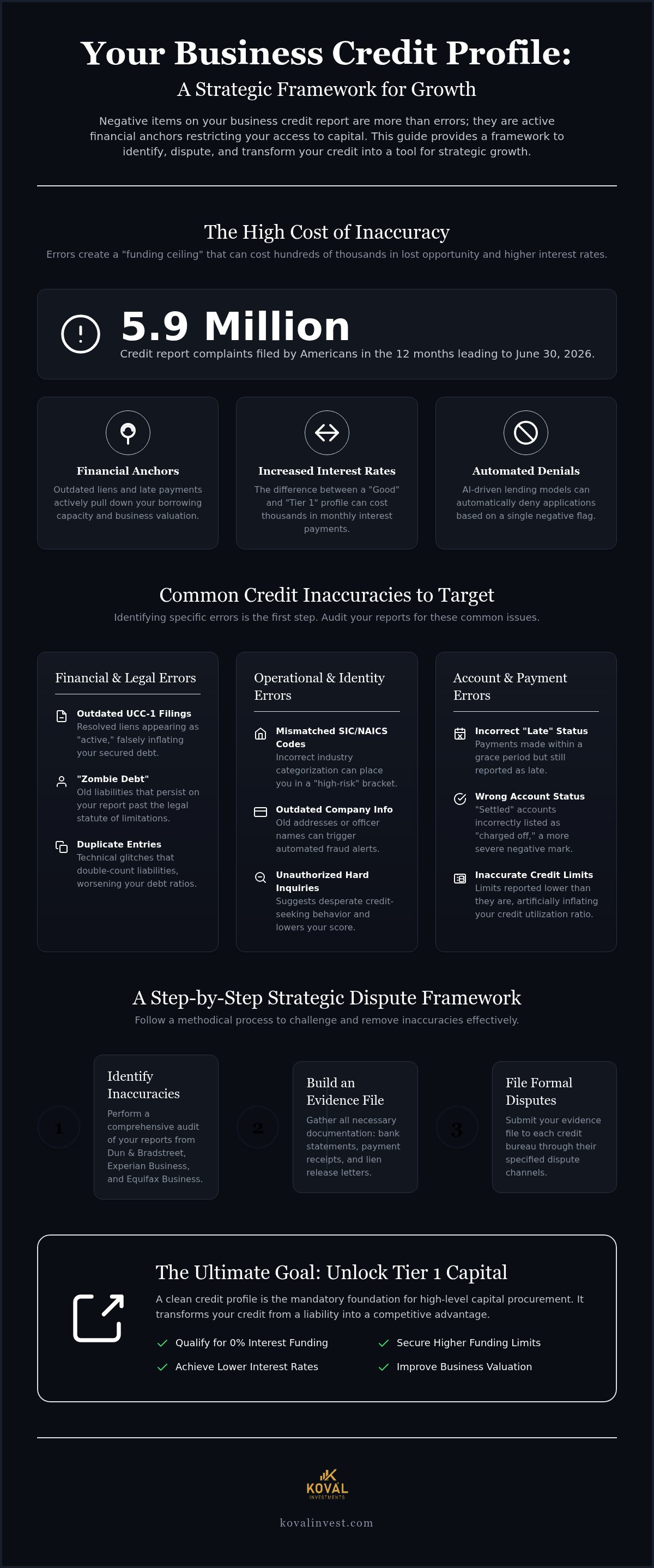
In the twelve months leading up to June 30, 2026, Americans filed approximately 5.9 million complaints regarding their credit reports. For an entrepreneur, even a minor reporting error can be the difference between securing an SBA loan and facing a flat denial. You likely already know that your business credit profile is the foundation of your company's growth, yet the persistent confusion between personal and business reporting often leads to costly oversights. Learning how to remove negative items from business credit report is not just about correcting the past; it's a strategic offensive move to lower your interest rates and reclaim your financial leverage.
We believe that credit restoration should be a collaborative partnership rather than a source of operational stress. This guide provides a professional framework to identify and dispute inaccuracies that are currently eating into your margins. You'll discover how to clean your profile to qualify for our 0% Interest Funding Solution and other high-limit capital options. We will walk through the 2026 regulatory environment, the nuances of bureau response times, and the exact steps to transform your credit into a tool for strategic capital procurement.
Key Takeaways
- Understand why correcting reporting errors is the essential first step to lifting your funding ceiling and securing high-limit capital.
- Learn exactly how to remove negative items from business credit report by targeting common inaccuracies like outdated UCC-1 filings.
- Build a robust evidence file with bank statements and release letters to streamline the dispute process with major bureaus.
- Discover how a clean credit profile serves as the mandatory foundation for our 0% Interest Funding Solution.
- Determine when it's time to leverage professional Credit Repair Services to resolve complex reporting issues like merged files or identity theft.
The Strategic Impact of Negative Items on Business Credit
Negative items on a business credit report are more than just administrative errors; they are active financial anchors. These marks range from standard late payments to more complex issues like fraudulent UCC filings or outdated tax liens that remain visible long after they've been resolved. These inaccuracies create a "funding ceiling" that can restrict your access to capital by hundreds of thousands of dollars. Unlike personal credit, where the Fair Credit Reporting Act provides a clear roadmap for consumers, business bureaus like Dun & Bradstreet, Experian Business, and Equifax Business operate under different reporting standards. This requires a specialized understanding of how to remove negative items from business credit report effectively.
Beyond immediate borrowing, your credit profile directly influences your company's professional Business Valuation. Inaccurate data suggests operational instability to potential investors or buyers. If you're involved in Mergers and Acquisitions Consulting, you know that a single reporting error can devalue your firm or derail a strategic exit. A clean report is a sign of operational excellence and a prerequisite for high-level capital procurement.
Opportunity Cost: The Real Price of Reporting Errors
The spread between a "Good" and a "Tier 1" credit profile represents a tangible difference in interest rates. This spread often costs a business thousands in monthly operational margins over the life of a loan. Modern lenders increasingly rely on high-speed algorithmic models that prioritize speed over nuance. These systems are designed to trigger automatic denials based on specific flags. A single error can disqualify you from premium rates before a human underwriter ever reviews your case. Maintaining a clean profile is a non-negotiable requirement for our 0% Interest Funding Solution.
The 2026 Credit Landscape for Entrepreneurs
In 2026, lenders have intensified their scrutiny of "character" and "reliability" metrics. SBA lenders now use AI-driven monitoring to track business profiles in real-time, making regular auditing a core operational duty. You can't treat your credit health as a secondary concern. Professional Credit Repair Services are often needed to address the complexities of modern reporting. Mastering how to remove negative items from business credit report ensures that your company remains positioned for long-term capital procurement and strategic growth. This proactive approach turns your credit profile from a liability into a competitive advantage.
Common Business Credit Inaccuracies to Identify and Target
Identifying inaccuracies is the first tactical step in understanding how to remove negative items from business credit report. Some errors are "low-hanging fruit," such as misspelled names or outdated addresses. Others are complex legal reporting issues that require a deeper audit. One of the most common and damaging errors involves outdated UCC-1 filings. Lenders often fail to file the necessary termination statements, leaving "released" liens appearing as "active" on your report. This suggests you have more secured debt than you actually do, which artificially lowers your borrowing capacity.
You should also watch for "zombie debt." This refers to old liabilities that have surpassed the legal statute of limitations for reporting but continue to haunt your profile. Technical glitches are equally problematic. Duplicate entries can double-count your liabilities, making your debt-to-income ratio look far worse than reality. Identifying these specific technicalities is essential for anyone researching how to remove negative items from business credit report to protect their operational margins.
Operational and Identity Errors
Mismatched SIC or NAICS codes are a subtle but devastating error. If your business is incorrectly categorized into a "high-risk" industry, such as trucking or real estate investment, you'll face tighter lending standards and higher rates. Old business addresses or outdated officer information can trigger fraud alerts in automated underwriting systems. Additionally, unauthorized hard inquiries suggest desperate credit-seeking behavior. Removing these identity-related errors is vital for maintaining a professional profile that attracts Tier 1 lenders.
Account Status and Payment History Inaccuracies
Payment history is the backbone of your score. It's common to find "late" statuses for payments that were actually made within the grace period. We also frequently see "settled" accounts erroneously listed as "charged off," which is a much more severe negative mark. Finally, ensure your credit limits are reported accurately. If a bureau shows a $0 limit on a card you've used, your profile reflects 100% utilization even if you've paid the balance in full. If these complexities feel overwhelming, engaging with professional Credit Repair Services can provide the expertise needed to navigate bureau-specific dispute requirements and ensure your data is precise.
A Step-by-Step Strategic Dispute Framework
Executing a successful dispute requires a methodical approach that prioritizes documentation over dialogue. The first step is procuring comprehensive reports from Dun & Bradstreet, Experian Business, and Equifax Business. You can't rely on third-party aggregators for this process; you need the raw data directly from the source to identify every reporting nuance. In 2026, response times vary significantly between bureaus. Dun & Bradstreet often processes updates within a different window than Experian, so tracking these timelines is a core part of your strategy. Once you've identified the errors, you must build an evidence file. This file should include bank statements, release letters, and court records that provide undeniable proof of the inaccuracy.
Drafting the formal dispute letter is where legal precision becomes vital. Your correspondence should cite specific reporting laws, such as the Fair Credit Reporting Act (FCRA) or the Fair Debt Collection Practices Act (FDCPA), to signal that you understand your rights. Always utilize certified mail with a return receipt. This creates a legally binding paper trail that prevents bureaus from claiming they never received your evidence. After mailing, you must manage the mandatory 30-day investigation window. If a bureau fails to comply or provides a generic response, you'll have the documentation necessary to escalate the matter. This disciplined process is the most reliable way to learn how to remove negative items from business credit report effectively.
The Superiority of Physical Correspondence
Online "dispute buttons" are designed for the bureau's convenience, not your protection. These portals often force you to choose from a limited list of generic reasons for a dispute, which can strip away the nuance of your case. More importantly, using these portals can sometimes waive your right to future litigation if a bureau refuses to correct a proven error. Physical letters allow you to maintain legal leverage. To avoid being flagged by automated "frivolous" filters, structure your letter professionally. Use clear, declarative sentences and avoid emotional language. This ensures your dispute reaches a human reviewer who can evaluate your evidence fairly.
Simultaneous Furnisher and Bureau Disputes
You shouldn't limit your efforts to the credit bureaus alone. To master how to remove negative items from business credit report, you must also contact the original creditor, often called the furnisher. Send a "Validation of Debt" request to force the creditor to prove the accuracy of the entry. If they can't produce the original signed contracts or payment ledgers, they are legally required to stop reporting the information. Synchronizing your efforts between the bureau and the furnisher ensures the error is removed from all databases simultaneously. This double-pronged attack prevents "zombie" entries from reappearing on your profile later.
Unlocking 0% Interest Funding through Credit Optimization
Restoring your business credit is not a defensive measure; it's a strategic prerequisite for high-limit capital access. A clean report is the mandatory "Tier 1" requirement for our 0% Interest Funding Solution. Lenders providing interest-free capital have zero tolerance for reporting errors or unresolved collections. By mastering how to remove negative items from business credit report, you effectively lift your funding ceiling. This allows your business to move from small, high-interest merchant cash advances to substantial, unsecured credit lines that preserve your operational margins.
The synergy between professional business credit repair services and working capital procurement is undeniable. When your profile is optimized, you aren't just "fixing" a score; you're positioning your company for rapid expansion. This optimization is also a critical step in preparing for SBA loan assistance. Clearing old collections and liens ensures that your application meets the stringent requirements of federal lenders who prioritize long-term stability.
Strategic Credit Stacking for Growth
A pristine credit report enables a strategy known as credit stacking. This involves securing multiple 0% APR business credit approvals simultaneously across different banking institutions. Without negative marks, your perceived risk is low enough for banks to extend high limits without requiring collateral. This liquid capital can be used to fund rapid business acquisitions or real estate investments. For entrepreneurs looking to scale, understanding how to remove negative items from business credit report is the primary lever for securing the capital needed for portfolio growth.
Meeting Federal Lending Standards
SBA lenders often view negative items as "character" red flags, regardless of your current revenue or cash flow. They look for patterns of reliability. If an error is truly unavoidable and cannot be removed through the dispute process, you must be prepared to provide a professional letter of explanation. However, your goal should always be a clean slate. It's also important to remember that most small business funding still requires a personal guarantee. In 2026, a personal FICO score of at least 680 is typically required for premium cards, with a score of 720 or higher being the ideal target for maximum approvals. If you are ready to align your credit profile with your growth objectives, our team offers expert strategic capital procurement consulting to help you reach your goals.
When to Engage Professional Credit Repair Services
While the framework for how to remove negative items from business credit report is accessible, the execution often reveals complexities that demand expert intervention. Issues like "merged files," where your business data is incorrectly combined with another entity, or sophisticated identity theft require more than a standard dispute letter. These scenarios often involve deep-rooted database errors that only a seasoned consultant can navigate. Engaging professional Credit Repair Services allows you to delegate the administrative burden while ensuring your case is handled with a "straight-talk" mentality. We provide a pragmatic assessment of what can be fixed, ensuring you don't waste time on impossible entries while aggressively pursuing valid removals.
At Koval Investments, we utilize a success-based model. This philosophy ensures our goals are perfectly aligned with your funding results. We don't view credit restoration as a standalone task; it's the foundation of an integrated strategy designed to secure your future capital. By fixing the errors of the past, we simultaneously prepare your profile for our 0% Interest Funding Solution. This collaborative approach turns a complex financial challenge into a streamlined path toward capital procurement.
The ROI of Professional Restoration
The real value of professional services is measured by the opportunity cost of your time. An entrepreneur spending dozens of hours on administrative disputes is time taken away from strategic growth and operational efficiency. When you compare the investment in professional restoration to the significant interest savings of a 0% interest loan, the ROI becomes clear. Expert consultants use a deep knowledge of reporting laws to expedite the removal process and avoid common DIY mistakes. A frequent error in self-managed disputes is accidentally providing information that leads to a permanent "verified" status for an error, making future removal nearly impossible.
Your Strategic Partnership for Expansion
A trusted advisor does more than fix a score; they help maintain your credit profile during periods of rapid business scaling. As you engage in credit stacking or pursue SBA loans, your profile needs constant vigilance to ensure new inquiries or utilization shifts don't trigger automatic denials. Our "Win-Win" philosophy ensures your financial profile is ready for every growth opportunity that comes your way. We act as an extension of your team, providing the steady hand needed in complex financial landscapes. To begin optimizing your profile for high-limit capital, partner with Koval Investments for a strategic credit and funding consultation.
Securing Your Financial Future Through Strategic Credit Management
Your business credit profile is the most significant asset you possess when seeking expansion capital. As we've explored, identifying technical errors like outdated UCC-1 filings and utilizing a methodical dispute framework are essential steps for any entrepreneur. Mastering how to remove negative items from business credit report is not just a cleaning exercise; it's the fundamental bridge to our 0% Interest Funding Solution and long-term capital procurement. By aligning your reporting with the stringent standards of SBA and Tier 1 lenders, you unlock the ability to scale without the burden of high interest rates eating into your margins.
At Koval Investments, we operate on a success-based philosophy. Our deep expertise in 0% interest strategies and working capital advisory means we're equally invested in your growth. We provide a steady hand in complex financial landscapes, ensuring your profile is ready for every strategic opportunity. It's time to move past the limitations of reporting errors and step into a position of true financial leverage. Optimize your business credit for 0% interest funding with Koval Investments and take the first step toward securing high-limit capital today. Your company's next phase of growth is ready to begin.
Frequently Asked Questions
How long does it take to remove an error from my business credit report?
Investigations are generally completed within 30 days once a bureau receives your formal dispute. However, the total timeline for how to remove negative items from business credit report depends on the complexity of the evidence and the specific bureau's backlog. Dun & Bradstreet and Experian Business may have slightly different processing speeds in 2026. It's vital to track each submission via certified mail to ensure the 30-day window is respected and follow up promptly.
Can I remove a legitimate late payment if I have a good reason?
Legally, credit bureaus are only required to remove information that is inaccurate, incomplete, or unverifiable. If a late payment is legitimate, the bureau will likely verify it as correct. In these cases, your best strategy is to contact the original creditor directly to request a goodwill deletion. While not guaranteed, creditors may agree to remove the mark if you have a strong payment history and a valid explanation for the single oversight.
Is it better to dispute business credit errors online or through certified mail?
We recommend using certified mail with a return receipt for all business credit disputes. While online portals offer convenience, they often limit your ability to submit complex evidence and may require you to waive certain legal rights. Physical correspondence creates a verifiable paper trail that is essential for legal leverage. This methodical approach ensures your evidence reaches a human reviewer and protects your ability to escalate the matter if the initial investigation fails.
What happens if a bureau 'verifies' an error that I know is incorrect?
If a bureau verifies an incorrect item, you should immediately request a method of verification and send a Validation of Debt request to the original furnisher. This forces the creditor to provide the actual documentation supporting the entry. If they cannot produce signed contracts or ledgers, the item must be removed. This is often the point where entrepreneurs seek professional Credit Repair Services to navigate the more technical legal requirements of the dispute process.
Does disputing a negative item on my credit report lower my score further?
No, the act of disputing an item does not lower your business credit score. In fact, a dispute can only help or have a neutral effect. If the item is removed or updated to a more positive status, your score will likely increase. If the bureau verifies the item as correct, your score simply remains where it was. Understanding how to remove negative items from business credit report is a risk-free strategy for improving your capital access.
What is the difference between personal and business credit report disputes?
The primary difference lies in the regulatory environment. Personal credit is strictly governed by the Fair Credit Reporting Act (FCRA), providing consumers with clear legal protections. Business credit reporting is less regulated, meaning bureaus have more latitude in how they handle data. This makes a professional, evidence-based approach even more critical for business owners. You must provide undeniable proof of inaccuracies because business bureaus aren't always held to the same investigation standards as personal ones.
Will removing negative items automatically qualify me for a 0% interest loan?
Removing negative items is a critical prerequisite, but it's not the only factor for qualification. While a clean report is mandatory for our 0% Interest Funding Solution, lenders also evaluate your time in business, revenue, and personal FICO scores. Most premium 0% interest cards in 2026 require a personal score of at least 680. Clearing your report simply removes the automatic character denials, allowing lenders to view your business's actual financial health and operational stability.
Can a professional credit repair service remove items faster than I can?
No service can legally force a credit bureau to bypass the standard 30-day investigation window. However, professionals often achieve results faster by avoiding common DIY mistakes that lead to automatic denials or requests for more information. Expert consultants understand the specific language and evidence required by each bureau to ensure a dispute is processed correctly the first time. This precision prevents the months of back-and-forth correspondence that typically plague inexperienced business owners.