
How to Secure an SBA Loan for Commercial Real Estate: A Strategic Guide for 2026
Why are you still paying rent when you could own your facility for as little as 10% down? Most business owners feel stuck between the high down payment requirements of traditional lenders and the complex, slow-moving federal application process. It's frustrating to watch your capital get tied up in a lease while interest rates and credit eligibility requirements seem to shift every quarter. We understand that you need a steady hand to help you manage these financial complexities without the typical institutional detachment.
This guide will show you how to master the step-by-step process of securing an SBA loan for commercial real estate. You'll learn how to leverage the 7(a) and 504 programs to lock in fixed, long-term rates while keeping your capital available for growth. We'll provide a clear roadmap from application to closing, covering the latest 2026 updates like the $10 million combined loan limit and the new 1.10:1 debt service coverage ratio requirement. By the end, you'll have the strategic tools to optimize your financial profile and turn your property goals into a tangible win-win for your business.
Key Takeaways
- Distinguish between the SBA 7(a) and 504 programs to select the capital strategy that best supports your long-term growth and asset acquisition goals.
- Navigate the 2026 underwriting environment for an SBA loan for commercial real estate, focusing on the latest debt service coverage ratio (DSCR) requirements.
- Learn how to leverage 0% interest funding solutions to bridge the gap for closing costs and equity injections without depleting your cash reserves.
- Adopt a "Credit-First" methodology to strengthen your financial profile and secure approval for favorable, long-term fixed interest rates.
- Understand how a results-oriented partnership can simplify the complex CDC and lender network, providing a clear and steady path to closing.
The Strategic Value of SBA Loans for Commercial Real Estate in 2026
2026 marks a significant shift in how small business owners view their physical footprint. As commercial lease rates continue to fluctuate, an SBA loan for commercial real estate serves as more than just a financing vehicle. It's a sophisticated wealth-building tool designed to move you from the volatility of the rental market into the stability of ownership. By transitioning from tenant to landlord, you stop paying for someone else's equity and start building your own corporate balance sheet.
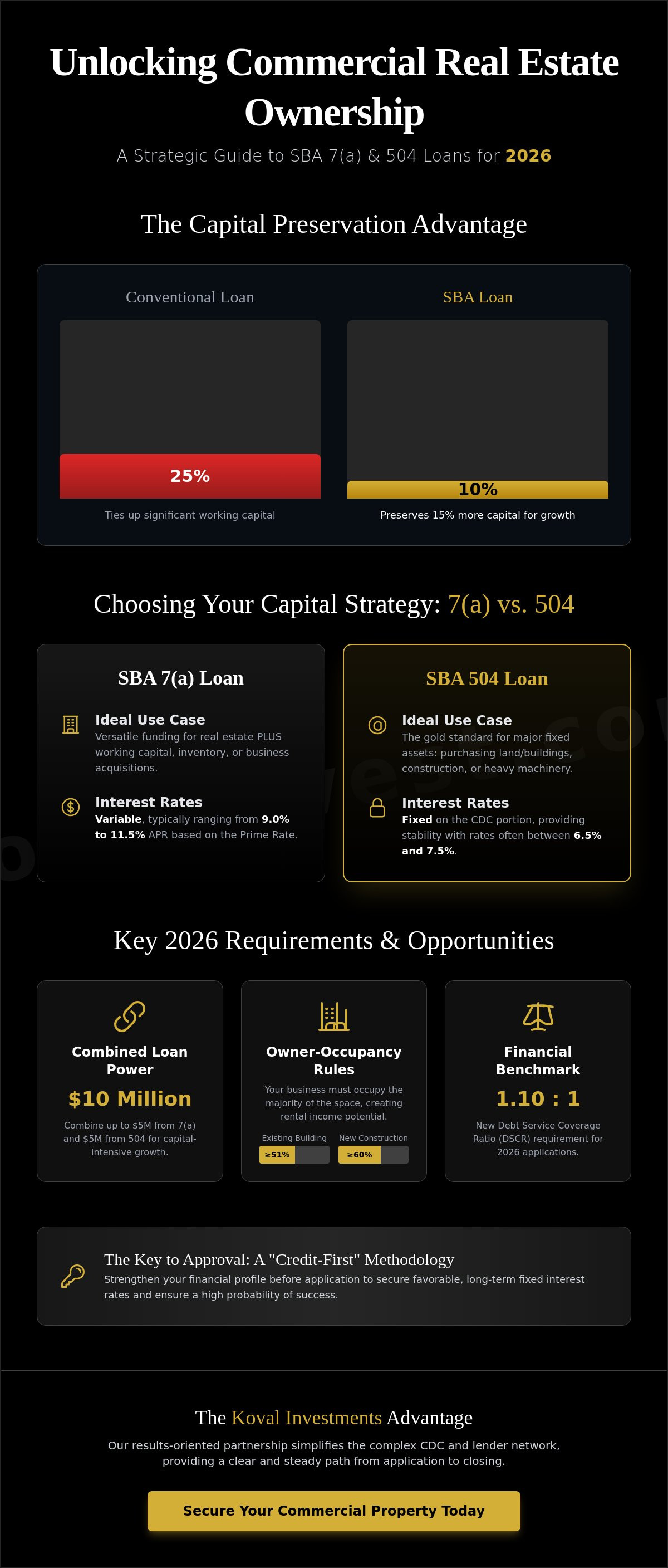
The argument for capital preservation is the primary driver for many entrepreneurs this year. Conventional lenders typically demand a 25% down payment, which can drain a company's liquidity and stall growth initiatives. By contrast, SBA programs allow for a 10% equity injection. This 15% difference represents vital capital you can reinvest in inventory, talent, or operational scaling. Additionally, ownership creates a fixed cost structure that acts as a natural hedge against inflationary rent hikes. While your competitors face annual lease escalations and triple-net cost increases, your primary occupancy cost remains predictable for decades.
Owner-Occupied vs. Investment Properties
The SBA's mission is to support active business growth rather than passive real estate speculation. To qualify, your business must meet specific occupancy requirements. For existing buildings, your company must occupy at least 51% of the total square footage. If you're pursuing a new construction project in 2026, the threshold is higher, requiring you to occupy 60% of the space immediately. A strategic benefit of this rule is the ability to lease out the remaining 40% to 49% of the facility. This creates an additional revenue stream that can effectively subsidize your mortgage payments while providing room for your future expansion.
Fixed Assets and Long-Term Stability
Planning for the next two decades requires removing as many financial variables as possible. The SBA 504 Loan program is particularly effective for this, offering fixed-rate structures for up to 25 years. This stability is essential as businesses integrate specialized assets, such as AI-supported equipment or advanced manufacturing machinery, which often require specific facility layouts and heavy power requirements. SBA loans stabilize cash flow for scaling SMBs. By fixing your largest monthly expense and including project-related equipment into the financing, you gain the financial clarity needed to make aggressive, long-term growth decisions without the fear of sudden overhead spikes.
SBA 7(a) vs. 504: Choosing the Right Capital Strategy
Selecting the right SBA loan for commercial real estate depends on your immediate operational needs and long-term financial objectives. While both programs offer 25-year terms for real estate, they function differently regarding rate structures and use of funds. The 7(a) program is widely regarded for its versatility, allowing you to bundle property costs with other business expenses. In contrast, the 504 program serves as the gold standard for long-term, fixed-rate asset financing, particularly for larger construction or renovation projects.
In the June 2026 market, interest rate structures are a primary differentiator. The 7(a) program typically utilizes variable rates, which currently range from 9.0% to 11.5% APR based on the Prime Rate of 6.75% plus a lender margin. For those seeking absolute predictability, the 504 program offers fixed rates on the CDC portion, often holding steady between 6.5% and 7.5%. Both programs have seen an expansion in utility; a new rule effective July 4, 2026, allows qualified borrowers to combine up to $5 million from the 7(a) program and $5 million from the 504 program for a $10 million total limit. This combined approach offers a powerful way to manage capital-intensive growth.
When to Choose the SBA 7(a) Loan
The 7(a) program is the ideal choice when your real estate purchase is part of a larger strategic move, such as a business acquisition. It allows for a holistic approach to funding, where you can acquire the property while also using working capital for business acquisition to ensure day-one operational success. This flexibility makes it a popular choice for an SBA loan for commercial real estate when the project involves mixed-use funding. It also offers greater flexibility in collateral requirements, as the SBA guarantee often offsets the need for the exhaustive collateralization required by traditional commercial debt.
When the 504 Program is Superior
If your goal is large-scale facility construction or purchasing a high-value asset, the 504 program is often the more efficient path. It features a unique three-part structure:
- A conventional bank funds 50% of the project.
- A Certified Development Company (CDC) covers 40% with a fixed-rate debenture.
- The borrower provides a 10% down payment.
This structure minimizes the bank's risk, making it easier to secure approval for significant projects. Reviewing the Official SBA 504 loan requirements can help you determine if your project meets the specific job creation or public policy goals required by the CDC. Deciding between these options requires a deep understanding of your current cash flow and future growth projections. If you're unsure which path aligns with your goals, comparing SBA 7(a) vs 504 loan frameworks can provide much-needed clarity. At Koval Investments, we act as a steady hand to help you navigate these choices, ensuring you select a strategy that maximizes your long-term success.
How to Qualify: Building a High-Probability SBA Application
Securing an SBA loan for commercial real estate requires a shift from reactive application to proactive financial optimization. Lenders in 2026 aren't just checking boxes; they're looking for proof of operational resilience. A high-probability application starts with a "Credit-First" mentality. Since the SBA discontinued the use of the FICO SBSS score on March 1, 2026, for smaller loans, individual lenders now have more discretion. This means your personal credit history and the narrative of your business's financial health carry more weight than ever before.
One of the most critical metrics in the current underwriting environment is the Debt Service Coverage Ratio (DSCR). As of March 1, 2026, the SBA requires a minimum DSCR of 1.10:1 for 7(a) small loans. This ratio demonstrates that your business generates enough cash flow to cover its debt obligations with a 10% buffer. Beyond the numbers, documentation mastery is essential. You'll need three years of tax returns, current P&L statements, and a comprehensive "Business Resume" that details your industry experience. Including a professional business valuation early in the process can also prevent surprises during the bank's appraisal phase.
Credit Repair as a Pre-Qualification Tool
Many entrepreneurs discover "SBA-killing" errors on their credit reports only after a rejection. These mistakes, such as incorrectly reported late payments or outdated tax liens, can lead to immediate disqualification or significantly higher interest rates. At Koval Investments, we treat credit repair as a strategic pre-qualification tool. By optimizing your credit profile before you approach a lender, we help you secure the lowest possible rates. Consider the long-term impact: a 50-point score increase could lower your APR by 1% or more. Over a 25-year amortization period on a multi-million dollar property, that single percentage point translates into hundreds of thousands of dollars in saved interest expense.
Navigating Eligibility Standards
Eligibility for an SBA loan for commercial real estate narrowed on March 1, 2026, to U.S. citizens and U.S. nationals. You must also ensure your company meets the SBA's size standards, which generally define a small business as having a tangible net worth under $20 million and an average net income under $6.5 million. When comparing SBA 7(a) and 504 loans, remember that both programs require the property to be owner-occupied. Lenders also evaluate "Character," looking for a history of integrity and reliable management. Speculative real estate investments or passive rental properties remain strictly prohibited, as the program is designed to support the operational facilities of active business owners.
Strategic Implementation: Bridging the Capital Gap
Closing the deal on an SBA loan for commercial real estate often reveals a common hurdle: the capital gap between your current liquid reserves and the total project cost. While the 10% down payment is significantly lower than traditional bank requirements, closing costs and initial operational adjustments can still strain your balance sheet. To maintain your company's momentum, you can utilize 0% interest business funding to cover these immediate expenses. This "stacking" strategy allows you to combine government-backed debt with unsecured working capital, ensuring you have the necessary liquidity to navigate the process without stalling your daily operations.
Managing your cash flow during the 60 to 120 day SBA approval window is a critical component of a successful acquisition. During this period, lenders closely monitor your financial activity to ensure your debt service coverage remains stable. Avoid making large, uncoordinated capital expenditures that could alter your profile. Instead, focus on maintaining a steady operational rhythm. Once the property is secured, the equity you build becomes a powerful tool for future expansion. As the property value appreciates and you pay down the principal, this equity can serve as collateral for future growth initiatives or equipment upgrades, creating a cycle of reinvestment that fuels long-term success.
Optimizing the Down Payment
Sourcing that initial 10% equity injection shouldn't require you to deplete your emergency funds or stop your current growth projects. By engaging capital procurement services early in your search, you can identify diverse funding streams to satisfy lender requirements. This proactive approach ensures that your down payment is structured in a way that preserves your operational flexibility. The strategic use of interest-free capital to satisfy short-term liquidity needs creates a powerful synergy with the long-term, low-cost structure of an SBA loan for commercial real estate.
Post-Closing Strategic Planning
Once the keys are in your hand, the property becomes a dynamic asset on your balance sheet. You gain immediate access to significant tax advantages, such as depreciation and interest deductions, which effectively lower your net tax liability. This strengthened financial position is also the perfect time to review your broader debt portfolio. Many owners find success by refinancing existing high-interest debt into their new, more stable SBA structure, further reducing monthly overhead. Additionally, owning your facility makes your business a much more attractive target for future M&A activity, as it provides a tangible asset that secures the company's future. If you're ready to explore how these funding layers can work for your specific project, connect with our strategic advisory team for a tailored consultation.
The Koval Advantage: Partnership-Based SBA Assistance
Navigating the federal lending landscape requires more than just a strong balance sheet; it requires an insider's perspective. Securing an SBA loan for commercial real estate involves coordinating with Certified Development Companies (CDCs), private lenders, and federal guidelines that are subject to frequent updates. Our success-based philosophy ensures that our interests are perfectly aligned with yours. We don't view our engagement as a traditional expense but as a collaborative venture where our results dictate our success. This approach removes the financial risk from the business owner and places the focus squarely on achieving a positive outcome.
Our process begins with a comprehensive financial profile audit. We examine your current debt structure, cash flow metrics, and credit health to identify any potential hurdles before they reach a lender's desk. Beyond the loan itself, we provide long-term strategic planning and business valuations to ensure your property acquisition fits into your broader corporate narrative. By acting as a steady hand in a complex financial landscape, we help you manage the nuances of the application while you remain focused on running your daily operations.
Why You Need an SBA Loan Consultant
Many business owners face frustrating "declines" due to avoidable technicalities, such as misinterpreting the recent eligibility changes or failing to optimize their debt service coverage before submission. Professional SBA loan assistance significantly shortens the approval timeline by ensuring your package is lender-ready on the first submission. We understand the specific appetites of different lenders within the network, allowing us to pair your project with the institution most likely to provide favorable terms. The value of a partner who understands both the intricacies of credit repair and the mechanics of capital procurement cannot be overstated when millions of dollars in long-term interest are at stake.
Your 2026 Growth Roadmap
A property acquisition is a major milestone, but it's not the finish line. We help you align your SBA loan for commercial real estate with your five-year growth targets, ensuring your new facility supports future scaling, equipment integration, or potential M&A activity. Our "win-win" engagement model means we are equally invested in your success, projecting a sense of quiet confidence and forward-thinking expertise throughout the partnership. Koval Investments remains committed to providing the clarity and momentum needed to move beyond the uncertainty of traditional institutional finance. Schedule your strategic funding consultation with Koval Investments today to begin your financial profile audit and secure the foundation for your company's future.
Securing Your Corporate Future through Strategic Ownership
Transitioning from a tenant to an owner is a transformative step that provides your business with long-term stability and a predictable cost structure. By selecting the right capital strategy and optimizing your financial profile before submission, you position your company for a high-probability approval. We've explored how the 2026 lending environment rewards those who prioritize cash flow management and credit health. Leveraging an SBA loan for commercial real estate remains one of the most effective ways to preserve your liquidity while building tangible corporate wealth.
Since 2018, Koval Investments has acted as a trusted advisor for entrepreneurs navigating these complex financial waters. Our success-based philosophy ensures there is no upfront risk to you, as we only succeed when your funding is secured. As specialists in 0% interest bridge funding and credit optimization, we provide the steady hand needed to bridge the gap between your current position and your ownership goals. It's time to stop paying for someone else's equity and start investing in your own.
Optimize your credit and secure your SBA funding with Koval Investments today. We're ready to help you turn your property ambitions into a lasting win-win for your business.
Frequently Asked Questions
Can I use an SBA loan to buy a property for my business and rent out part of it?
You can rent out a portion of the property as long as your business occupies the majority of the space. For existing buildings, the SBA requires your company to occupy at least 51% of the total square footage. If you're building a new facility, that requirement increases to 60%. This structure allows you to generate additional income from tenants while securing an SBA loan for commercial real estate to build your own equity.
What is the minimum credit score required for an SBA commercial real estate loan in 2026?
The SBA doesn't set a hard minimum credit score, but most lenders prefer a score of 680 or higher. Since the SBA discontinued the FICO SBSS score in March 2026, lenders now place a much heavier emphasis on your business's cash flow and the 1.10:1 debt service coverage ratio. Optimizing your credit profile before applying is a strategic move that can help you secure more favorable interest rates and terms.
How long does the SBA 504 loan process typically take from application to closing?
The timeline for an SBA 504 loan generally ranges from 60 to 120 days. This process takes longer than traditional financing because it involves coordination between a private lender, a Certified Development Company, and the SBA itself. Being prepared with all necessary documentation, including three years of tax returns and a professional business valuation, can help prevent delays and ensure a smoother path to closing.
Is a down payment always required for an SBA commercial real estate loan?
Yes, a down payment is required, but it's significantly lower than traditional commercial mortgages. Most borrowers only need a 10% equity injection, compared to the 25% or 30% typically demanded by conventional banks. This lower entry point is a primary reason why an SBA loan for commercial real estate is considered a powerful capital preservation tool. It allows you to keep more cash available for day-to-day operations and growth.
Can SBA 7(a) loans be used for both property purchase and working capital?
The 7(a) program is specifically designed for versatility. You can use a single 7(a) loan to purchase a property and provide your business with essential working capital. This is particularly useful during a business acquisition where you're buying both the company and its real estate. The maximum amount for a 7(a) loan is $5 million, providing substantial flexibility for entrepreneurs looking to consolidate their debt and expansion costs.
What happens if my business credit report has errors during the SBA application?
Errors on your credit report can lead to immediate application declines or significantly higher interest rates. Lenders view these errors as red flags regarding your financial management or character. Identifying and resolving these issues before submission is critical. At Koval Investments, we use credit repair services as a pre-qualification tool to ensure your financial profile is optimized, reducing the risk of a "decline" based on inaccurate data.
Are SBA loan interest rates fixed or variable for real estate?
Interest rates vary depending on which SBA program you choose. SBA 7(a) loans typically feature variable rates, which currently range between 9.0% and 11.5% APR based on the Prime Rate. Conversely, the CDC portion of an SBA 504 loan offers a fixed rate, often between 6.5% and 7.5%. Choosing between fixed and variable options depends on your tolerance for market fluctuations and your long-term cash flow projections.
Can I refinance an existing commercial mortgage into an SBA 504 loan?
You can refinance an existing commercial mortgage into an SBA 504 loan provided the project meets specific eligibility requirements. This strategy is often used to lower monthly debt payments or to transition from a variable-rate conventional loan into a fixed-rate SBA structure. Refinancing can improve your business's debt service coverage ratio and free up capital, making it a sound strategic move for companies looking to stabilize their long-term overhead.