
Improve Credit Score for Business Loans: 2026 Guide
A credit score isn't a static number you wait for; it's a financial asset you build through intentional restructuring. If you've recently faced high interest rate offers or the frustration of a loan denial due to reporting errors, you're not alone. Many business owners find themselves stuck in a cycle of confusion regarding how personal and business credit scores interact, especially as SBA loan limits have reached a historic $10 million in 2026. You deserve a clear path to the capital your expansion requires without the burden of predatory rates.
In this guide, we'll show you exactly how to improve credit score for business loan approval by aligning your profile with modern lender algorithms. We'll explore the specific financial steps needed to reach the 165 FICO SBSS benchmark often required for SBA 7(a) loans and how to position your firm for 0% interest funding solutions. This methodical approach moves beyond basic repair, providing a strategic roadmap to lower your cost of capital and secure the high-leverage funding your business deserves.
Key Takeaways
- Understand why your credit profile is the primary gatekeeper for capital in the 2026 economy and how it directly influences your overall business valuation.
- Learn why lenders continue to evaluate personal FICO scores alongside business metrics and how to effectively manage the interplay between these two distinct profiles.
- Master a systematic five-step framework on how to improve credit score for business loan applications by auditing major bureaus and strategically disputing inaccuracies.
- Discover the specific 2026 credit benchmarks required to qualify for SBA loan assistance and exclusive 0% interest funding solutions.
- Explore the advantages of a success-based consulting partnership that aligns financial optimization with your long-term capital procurement goals.
The Strategic Importance of Credit Optimization in 2026
In the 2026 economy, a founder's credit profile acts as the primary gatekeeper for scaling operations. It's no longer just about fixing old mistakes; it's about strategic positioning. When you understand how to improve credit score for business loan applications, you shift from a defensive posture to an offensive one. This transition from basic "repair" to intentional "optimization" ensures that your business is viewed as a low-risk, high-reward investment by institutional lenders. A strong profile isn't just a number. It's a tool that signals operational discipline and financial maturity to every partner you encounter.
Credit as a Lever for Capital Procurement
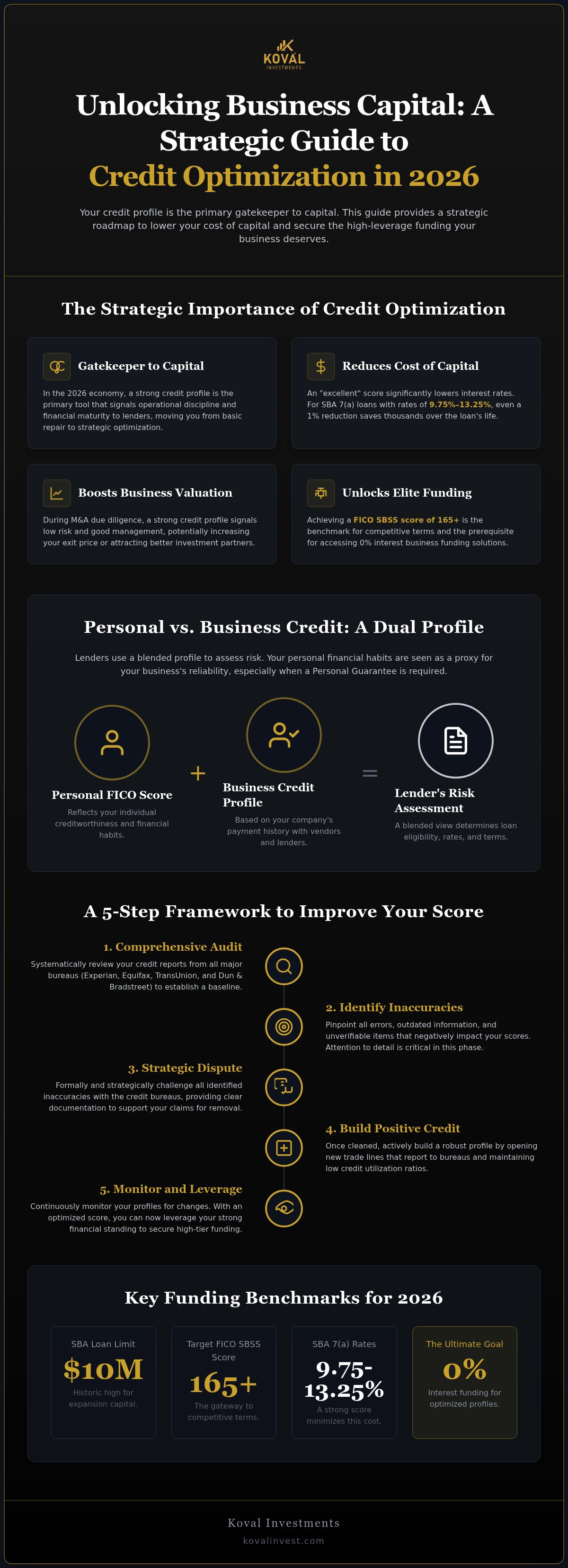
Modern lenders rely heavily on automated algorithms to pre-screen for SBA loans and working capital. In 2026, the standards for a "funding-ready" profile have tightened. While a "good" score might get you in the door, an "excellent" score significantly reduces your cost of capital over the life of a loan. For instance, with SBA 7(a) variable rates currently capped between 9.75% and 13.25%, even a 1% difference in your credit score tier can result in tens of thousands of dollars in interest savings. Achieving a FICO SBSS score of 165 or higher is now the benchmark for those seeking the most competitive terms. This level of optimization is often the prerequisite for accessing a 0% interest business funding solution, which remains the gold standard for expansion capital.
The Role of Credit in Strategic Planning
Beyond immediate cash flow, credit health plays a vital role in your professional business valuation. M&A consultants and private equity firms review business credit during due diligence to assess the risk profile of the leadership. A neglected credit profile can signal deeper management issues, potentially lowering your exit price or complicating a merger. Strategic restoration acts as a foundation for long-term corporate development. By aligning your personal financial health with your corporate growth objectives, you create a robust financial identity. This synergy makes your company more attractive for future acquisitions or major capital rounds. We view this process as a collaborative venture. Mastering the nuances of how to improve credit score for business loan procurement is a core competency for any serious entrepreneur. It's about building a steady hand in a complex financial landscape, ensuring you have the leverage needed when the right opportunity appears.
Personal vs. Business Credit: Navigating the Dual Profile
Many founders operate under the myth that their personal and business credit exist in entirely separate vacuums. In the 2026 lending environment, this is simply not the case. While they are distinct entities, they're intrinsically linked by the algorithms lenders use to assess risk. Most institutional lenders, including those offering SBA 7(a) loans, utilize a blended profile to determine eligibility. This means your personal financial habits act as a proxy for your business's reliability. Understanding foundational business credit terms is the first step in managing this dual identity effectively. Strategies on how to improve credit score for business loan approval must address both sides of the coin to be successful.
The 2026 market has seen a rise in the importance of "Personal Guarantees" for unsecured funding. Even as you scale, lenders often require your personal credit to back the business's debt. This requirement makes your personal FICO score a vital component of your corporate borrowing power. You don't have to sacrifice personal liquidity to build a business profile, but you must ensure both profiles are optimized in tandem to unlock the most competitive capital.
Building Your Business Credit Identity
Establishing a distinct corporate identity starts with the basics. You must register for an Employer Identification Number (EIN) and secure a DUNS number from Dun & Bradstreet. These identifiers allow you to start reporting trade references from vendors who actually share data with the bureaus. Opening a dedicated business bank account early is also non-negotiable. It creates a clear paper trail of your company's cash flow, which is essential for business credit scoring models like the D&B Paydex. Consistency here builds the "straight-talk" credibility that lenders value during the underwriting process.
The Personal Credit Bridge
Your personal credit acts as the bridge to high-leverage business funding. Lenders specifically look at the FICO Small Business Scoring Service (SBSS) score, which incorporates your personal credit data to pre-screen SBA applications. While the SBA sets a minimum score of 155, preferred lenders in 2026 typically require 165 or higher. Managing your personal debt-to-income ratio is a key part of this process. If your personal profile is dragging down your blended score, our credit restoration services can help fast-track your path to approval. We focus on a success-based approach to ensure your personal health supports your corporate growth objectives without unnecessary financial risk.
A 5-Step Framework to Improve Your Score for Funding
Improving your financial profile requires more than just paying bills on time. It is a systematic restructuring designed to satisfy lender algorithms. By following a structured framework, you can transform your credit from a liability into a high-leverage asset. This process is essential for anyone researching how to improve credit score for business loan approval in the competitive 2026 market. We use a methodical approach to ensure your profile meets the specific demands of modern underwriters.
- Step 1: Audit the Major Bureaus. Request comprehensive reports from Experian, Equifax, and Dun & Bradstreet to get a full view of your standing.
- Step 2: Strategic Disputes. Identify inaccuracies and challenge them using a documented, evidence-based approach rather than generic letters.
- Step 3: Utilization Optimization. Focus on the 30% rule. In 2026, lenders look for businesses that maintain credit usage below this threshold to signal stability.
- Step 4: Diversify the Debt Mix. Create a healthy blend of revolving credit lines and term debt to demonstrate versatile financial management.
- Step 5: Success-Based Monitoring. Implement a system to catch new errors or score decay before they interfere with a funding round.
The Art of the Credit Dispute
Inaccuracies are surprisingly common in business reporting. Reports often contain outdated tax liens, incorrect Standard Industrial Classification (SIC) codes, or mismatched physical addresses. These small discrepancies can trigger automatic rejections from lender software. While some founders attempt a DIY approach, professional business credit repair services are typically more effective. We use a strategic method to challenge these red flags without causing further friction with the bureaus. This ensures your profile remains clean and accurately reflects your company's strength.
Managing Utilization and Trade Lines
Utilization is a heavy-weight factor in your total score. For the fastest boost, prioritize pay-downs on accounts that exceed the 30% threshold. You can also lower this ratio instantly by requesting credit limit increases on existing lines, provided you don't add new debt. Understanding how to improve your business credit score also involves "credit seasoning." Lenders offering 0% APR funding often look for accounts that have been open and active for at least two years. Age of accounts signals stability, which is a core requirement for unsecured capital. By focusing on these high-impact variables, you position your firm as a reliable partner. This methodical approach is the most direct way to master how to improve credit score for business loan eligibility and secure the expansion capital you need.
Qualifying for SBA Loans and 0% Interest Solutions
Securing high-leverage capital in 2026 requires more than just a passing score; it requires a profile that matches the specific risk appetites of federal and private lenders. While the framework for improvement remains consistent, the application of that credit health varies significantly between an SBA-backed loan and a 0% interest credit line. Understanding how to improve credit score for business loan approval means tailoring your financial profile to meet these distinct benchmarks. This isn't just about the numbers on the report. It's about the narrative those numbers tell about your reliability as a partner.
SBA 7(a) and 504 Credit Readiness
The Small Business Administration has recently expanded its reach, with combined loan limits for 7(a) and 504 programs reaching $10 million as of July 2026. However, accessing this historic level of capital requires meeting stringent credit hurdles. While the SBA's technical minimum FICO SBSS score for prescreen approval is 155, most preferred lenders in today's market expect a 165 or higher. To fix your credit specifically for SBA loan assistance, you must prioritize the removal of any public records, such as old liens or judgments, which are automatic disqualifiers for many underwriters.
Lenders also evaluate "Character and Credit." This means your financial narrative matters. If you've had past challenges, be prepared to provide a professional explanation that demonstrates how you've restructured your operations. In 2026, lenders are looking for resilience. Having liquid assets or collateral can often bridge the gap if your score is hovering near the minimum, providing the additional security needed for a steady hand in the underwriting process.
Unlocking 0% APR Business Credit
Accessing 0% interest funding solutions is the ultimate goal of credit optimization. These interest-free tools are ideal for managing working capital or funding rapid expansion without the weight of the current 6.75% prime rate. To qualify, you typically need a "Tier 1" profile, which generally requires a personal credit score above 720 and a business file with several established trade lines.
A common mistake is applying for these cards too early. Excessive "Credit Inquiries" can temporarily depress your score and signal desperation to lenders. Instead, use a methodical approach: optimize your utilization first, then apply for high-limit, 0% APR cards strategically. This ensures you maintain your leverage while accessing the cheapest capital available. If you're ready to see which interest-free options your current profile supports, our 0% Interest Funding Solution provides the strategic roadmap needed to secure this capital without the typical hurdles of traditional banking.
Partnering with Koval Investments for Financial Optimization
While the steps to optimize your financial profile are clear, the execution requires precision and a deep understanding of lender psychology. Generic credit repair services often focus on high-volume, automated disputes that can inadvertently trigger red flags with major bureaus. We offer an "insider" advantage. As your strategic partner, we move beyond simple deletions to perform a comprehensive financial restructuring. This methodical approach is the most effective way to address how to improve credit score for business loan eligibility while protecting your long-term reputation with institutional lenders. We don't just act as a service provider; we act as a mentor who navigates these complex landscapes alongside you.
Our success-based philosophy is a defining characteristic of our firm. We believe in a collaborative venture where our goals are perfectly aligned with your funding results. This means we focus on the practicalities of business advancement rather than just moving numbers on a screen. By removing the traditional financial risk to the client, we create a low-pressure environment focused entirely on tangible progress. This "straight-talk" mentality ensures you receive honest assessments of your profile's current standing and a realistic roadmap to reaching your capital goals.
Comprehensive Credit Restoration
Effective restoration begins with identifying the root causes of profile weaknesses. Whether it's an outdated SIC code or a legacy lien that should've been released years ago, we find the friction points that automated systems miss. We then execute a customized strategy designed specifically for those researching how to improve credit score for business loan procurement in the 2026 economy. Our advisory doesn't end once the score rises. We provide ongoing guidance to help you maintain a "funding-ready" status indefinitely, ensuring you're always prepared to seize a growth opportunity or a 0% interest offer when it appears.
Strategic Capital Solutions
The ultimate objective of credit optimization is the procurement of high-leverage capital. We bridge the gap between restoration and funding by providing direct access to our network for SBA support and 0% interest funding solutions. This integrated approach ensures that your improved credit health is immediately put to work. By aligning your credit profile with your broader corporate objectives, we help you lower your cost of capital and increase your professional valuation. It's a pragmatic, forward-thinking strategy designed for entrepreneurs who value quality and results over high-volume transactions. You can schedule a consultation with Koval Investments to start your financial restructuring today and secure the capital your expansion requires.
Securing Your Financial Future Through Strategic Credit Management
Optimizing your credit profile is the most direct path to reducing your cost of capital. This process directly increases your business's overall valuation. In the current economic climate, understanding how to improve credit score for business loan applications is a core competency for any serious founder. By auditing your reports and managing utilization tiers, you position your firm to capture high-leverage opportunities. You're no longer just reactive; you're prepared.
Koval Investments has been a trusted partner in this space since 2018. We provide expert SBA loan and 0% APR advisory through a unique, success-based credit restoration philosophy. We don't just fix errors. We align your financial health with your long-term expansion goals. Our collaborative approach ensures you have the steady hand needed to navigate modern lending algorithms without unnecessary risk. We're invested in your success.
If you're ready to move beyond generic repair and start an intentional financial restructuring, we're here to help. Secure Your 0% Interest Funding with Koval Investments today. Your business's next chapter of growth is within reach.
Frequently Asked Questions
How long does it take to improve a business credit score for a loan?
Significant improvements typically manifest within three to six months of active restructuring. While small updates can occur in 30 days, a full profile optimization designed for institutional lending requires time for trade lines to age and disputes to process. If you are researching how to improve credit score for business loan approval, starting at least two quarters before your application is the most strategic approach. This window allows for multiple reporting cycles to reflect your new status.
What is a good credit score for a small business loan in 2026?
In the 2026 economy, a good personal credit score for business lending is generally 700 or higher. For business-specific bureaus, a Dun & Bradstreet PAYDEX score of 80 or an Experian Intelliscore of 76 is considered excellent. These benchmarks signal to lenders that your company manages its trade obligations with precision. Meeting these standards ensures you qualify for the most competitive interest rates and high-leverage capital options currently available in the national market.
Can I get a business loan with a 500 credit score?
Securing a traditional business loan with a 500 credit score is extremely challenging in the current credit environment. Most institutional lenders and SBA-preferred partners require significantly higher benchmarks to mitigate risk. While some alternative lenders offer high-interest working capital to lower-tier profiles, the cost of that capital can be predatory. We recommend a success-based credit restoration process to raise your score before applying, ensuring you don't get trapped in high-interest debt cycles.
How do I fix errors on my business credit report?
Fixing errors requires a methodical audit of your reports from Experian, Equifax, and Dun & Bradstreet. Once you identify inaccuracies, such as incorrect SIC codes or outdated liens, you must file formal disputes supported by concrete evidence. Generic dispute letters are often ignored by bureau algorithms; instead, a professional, evidence-based challenge is necessary. This precision is a core part of how to improve credit score for business loan eligibility, as even small reporting errors can trigger automatic denials.
Does personal credit repair help with business loan approval?
Personal credit repair is a vital component of business loan approval because most lenders use a blended scoring model. The FICO Small Business Scoring Service (SBSS) incorporates your personal credit history to assess the overall risk of the business. Since many expansion loans require a personal guarantee, a high personal score acts as a bridge to corporate capital. Optimizing your personal profile ensures that your business isn't penalized for individual financial data points that don't reflect your corporate strength.
What is the minimum FICO SBSS score for an SBA loan?
The official SBA minimum FICO SBSS score for prescreen approval is 155 as of 2026. However, it's important to understand that individual lenders often set their own higher internal benchmarks. Most preferred SBA lenders now require a score of 165 or higher to move forward with 7(a) or Express loan applications. Reaching this higher tier is a strategic necessity for founders who want to access the full $5 million limit available for 7(a) programs without unnecessary delays.
How does 0% interest business funding work?
Our 0% interest funding solution works by leveraging high-limit business credit lines that offer introductory interest-free periods, often lasting 12 to 22 months. This capital is unsecured, meaning it doesn't require collateral, but it does require a Tier 1 credit profile. It's an ideal tool for funding working capital or rapid expansion projects without the weight of the current prime rate. This strategy allows you to use the bank's money to grow your revenue interest-free for a significant duration.
Is business credit repair worth the investment for a startup?
For a startup, strategic credit restoration is a high-yield investment rather than a traditional expense. Building a strong foundation early allows you to access larger pools of capital at significantly lower rates. This proactive approach prevents the common trap of relying on high-interest personal cards to fund business operations. By investing in your credit profile now, you ensure your startup has the financial leverage needed to scale quickly when market opportunities arise across the country throughout 2026.