
Minimum Credit Score for SBA 7(a) Loan: 2026 Requirements & Approval Strategies
What if the most important number for your SBA loan approval isn't actually set by the SBA itself? You've likely spent weeks worrying if a single hard inquiry will derail your application or if your personal FICO score meets the threshold for federal support. It's exhausting to feel like your growth is held hostage by a number that seems to shift depending on who you ask. Many entrepreneurs search for a fixed minimum credit score for SBA 7a loan, only to find that the 2026 lending environment has moved toward a more nuanced, lender-specific model.
This guide clarifies the real thresholds active lenders demand today and provides a strategic roadmap to optimize your profile for consideration. We'll break down the shift away from standardized SBSS scores and the rising importance of your Debt Service Coverage Ratio. You'll also learn how to use credit repair as a primary step for readiness and how 0% interest funding solutions can serve as a tactical bridge while you're strengthening your financial standing. Our goal is to replace your uncertainty with a clear, actionable path toward securing the capital your business requires.
Key Takeaways
- Understand the distinction between SBA guidelines and "lender overlays" to determine the actual minimum credit score for SBA 7a loan approval in today's market.
- Learn why the FICO SBSS score remains a critical gatekeeper for loans under $500,000 and how to meet the 155 threshold for expedited processing.
- Identify the "Global Cash Flow" and character requirements that cause lenders to deny applications even when personal credit scores appear strong.
- Discover a five-step optimization strategy to audit your credit reports and dispute inaccuracies before submitting your formal application.
- Explore how 0% interest funding solutions can serve as a strategic bridge to provide immediate working capital while you strengthen your long-term SBA eligibility.
The SBA 7(a) Credit Score Myth: What the Government Actually Requires
The SBA 7(a) loan is frequently misunderstood as a direct government handout. In reality, the Small Business Administration acts as a strategic partner rather than a direct lender. They provide a partial guarantee to the bank, which reduces the institution's risk but doesn't eliminate the need for a rigorous credit review. This guarantee is why the program remains the gold standard for long-term working capital, offering terms and rates that are typically unavailable through traditional commercial channels.
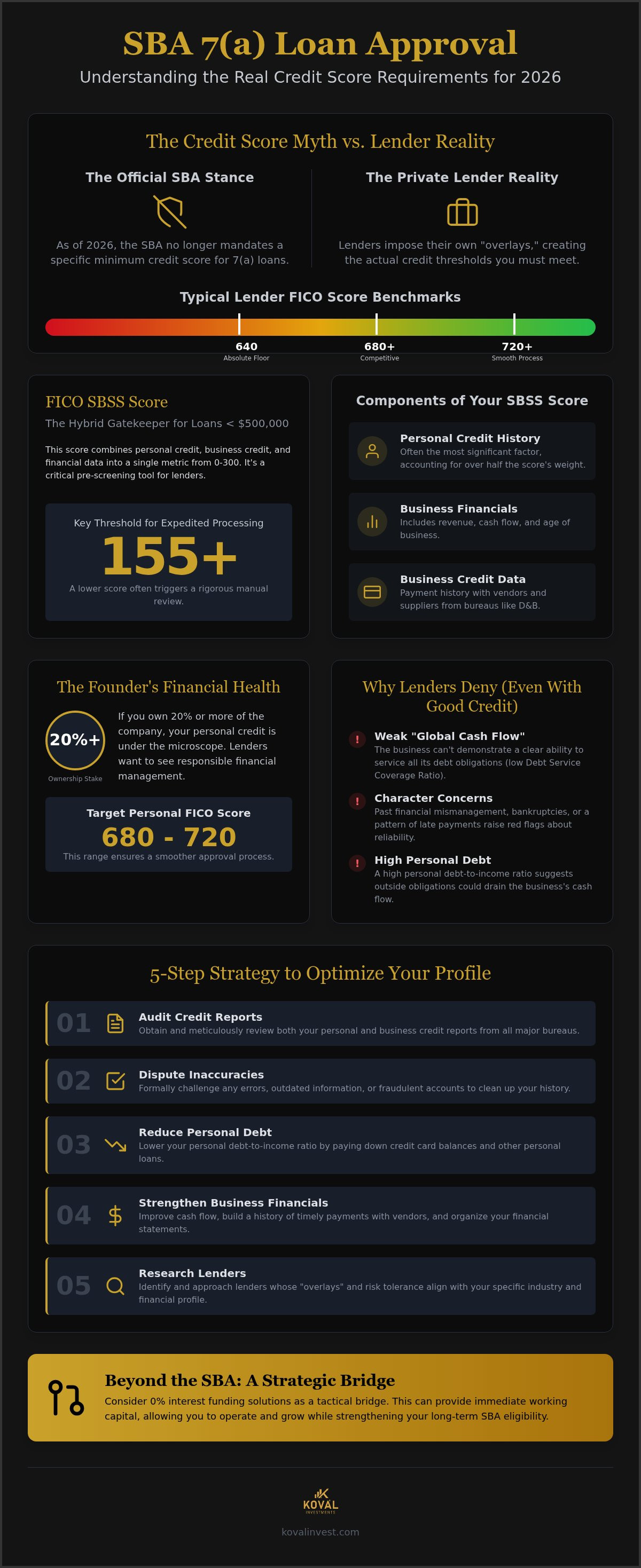
While the SBA no longer mandates a specific FICO SBSS score for small loans as of March 2026, the market has established its own benchmarks. Finding a minimum credit score for SBA 7a loan approval depends largely on "lender overlays." These are internal bank policies that sit on top of the SBA's broad requirements. For most applicants in 2026, a score of 640 is considered the absolute floor for consideration, but a 680 or higher is usually required to get through the door with competitive terms.
Official SBA Guidelines vs. Private Lender Reality
Lenders use the SBA guarantee to protect their capital, not to excuse poor credit history. Preferred lenders, who have the authority to approve loans without waiting for SBA review, often maintain stricter standards to protect their status. In the 2026 economic climate, banks have become more selective. They prioritize applicants who demonstrate stability and a clear ability to manage debt, even with the government's backing. This means your choice of lender is just as important as your credit profile itself.
Personal FICO Scores: The Starting Point for Every Founder
If you own 20% or more of your company, your personal credit is under the microscope. Lenders look at your personal debt-to-income ratio to ensure your outside obligations won't drain the business's cash flow. They want to see that you manage your own finances with the same discipline you apply to your operations. This scrutiny ensures that the founder's financial health aligns with the business's growth objectives. Meeting the minimum credit score for SBA 7a loan expectations of a private bank requires more than just meeting federal minimums; it requires a clean personal history.
For 2026, successful 7(a) applicants typically maintain a personal FICO score between 680 and 720 to ensure a smooth approval process.
At Koval Investments, we view this initial credit review as a baseline. If your score doesn't currently meet these thresholds, it isn't the end of the road. We focus on a success-based philosophy, helping you identify and dispute inaccuracies to build a stronger profile before you approach a lender.
The FICO SBSS Score: The Hybrid Metric for Loans Under $500,000
For loans under $500,000, the SBA utilizes the FICO Small Business Scoring Service (SBSS) to expedite the decision making process. This hybrid model doesn't just look at one aspect of your financial life. Instead, it aggregates personal credit history, business credit data, and financial performance into a single number ranging from 0 to 300. While the SBA no longer mandates a specific score as of March 2026, the 155 threshold remains a vital benchmark for the minimum credit score for SBA 7a loan pre-screening among most traditional banks. Scoring above this number often allows your application to bypass lengthy manual reviews, while a lower score typically leads to a much more rigorous inspection of your books.
The importance of this score fades as the loan amount increases. For requests exceeding $500,000, lenders move away from automated scoring and focus heavily on full cash flow analysis and debt service coverage. Understanding lender credit score requirements is vital because the SBSS serves as the primary gatekeeper for the SBA's "Small Loan" category. If you can't clear the SBSS hurdle, the rest of your application may never see a human underwriter's desk. It's a binary filter that can stop a deal before it even starts.
Components of Your SBSS Score
Your SBSS score is a complex calculation that weights several variables simultaneously. Personal credit history is often the most significant contributor, frequently accounting for more than half of the total weight. Lenders also look at your business's age and the inherent risk of your industry, categorized by NAICS codes. Data from major bureaus like Dun & Bradstreet and Experian Business are integrated to see if your company pays its vendors on time. If your business is young or in a high risk sector, your personal credit must work twice as hard to maintain a strong score.
Personal Score vs. SBSS: Which Matters More?
A common mistake founders make is assuming a profitable business can mask a low personal FICO score. It's nearly impossible to achieve a high SBSS if your personal credit is struggling. Since personal data is such a large part of the algorithm, improving your individual profile is the fastest way to boost your SBSS. You can't easily check this score through standard consumer portals, which makes it even more important to have your personal reports in order before applying. If you're unsure where your profile stands, engaging in strategic planning for your credit profile can help you identify gaps before a lender pulls your report.
Why Lenders Deny SBA Applications (Even with Decent Credit)
A high credit score is a strong signal, but it isn't a guarantee of capital. Even if you meet the minimum credit score for SBA 7a loan expectations of your bank, underwriters look far beyond your FICO score. They prioritize Global Cash Flow analysis, which evaluates whether the business and its owners can comfortably service the debt. In 2026, the SBA requires a minimum Debt Service Coverage Ratio (DSCR) of 1.10 to 1 for small loans. However, most private lenders prefer to see a 1.15 or even 1.25 ratio to account for potential economic shifts. If your personal expenses or existing business debts eat too far into your revenue, a 750 credit score won't save the application.
Character and industry experience also carry significant weight. Lenders view your resume as a risk management tool. If you're seeking funding for a specialized manufacturing plant but your background is exclusively in retail, the bank may perceive a management risk. Similarly, while the SBA often allows for "best efforts" regarding collateral, many lenders in 2026 have tightened their requirements. They may insist on specific lien positions on business assets or personal real estate to bridge the gap between "approvable" and "funded."
The Danger of Credit Report Inaccuracies
Your credit report is the primary document used to judge your financial integrity. Small errors like outdated late payments, incorrect credit limits, or identity fragments can trigger automatic red flags in a lender's software. A single 30-day late payment within the last twelve months can derail an entire 7(a) application, as it suggests a recent lapse in financial discipline. We recommend a thorough audit of your reports at least six months before applying. For those dealing with complex errors, Mastering Business Credit Repair Services provides a strategic framework for cleaning your profile to ensure you aren't denied over a clerical mistake.
Industry-Specific Hurdles
Certain sectors are labeled "high-risk" by traditional banks, regardless of the individual's creditworthiness. Industries like hospitality, construction, and certain retail niches often face higher minimum credit score for SBA 7a loan benchmarks because the lender's internal risk models are more conservative. Navigating these biases requires a sophisticated presentation of your financial narrative. Utilizing professional SBA Loan Assistance can help you frame your application in a way that addresses industry-specific concerns before the underwriter has a chance to object.
5 Strategic Steps to Optimize Your Profile for SBA Approval
Securing federal funding requires more than just meeting a checklist; it requires a methodical engineering of your financial profile. While you may be focused on hitting the minimum credit score for SBA 7a loan approval, lenders look for a pattern of financial responsibility. Start by reducing your revolving debt. High credit card utilization is a primary reason for lower scores, and paying these balances down is the fastest way to see an immediate lift in your FICO score. Next, establish business tradelines. Working with vendors who report to business credit bureaus will strengthen the business component of your SBSS score, which we explored earlier. If you have past financial hiccups, prepare a proactive "Credit Explanation Letter." This document allows you to humanize the data, explaining one-time events like medical emergencies or legal disputes that don't reflect your current management capability.
Finally, work with a professional consultant to pre-qualify your profile. This step prevents unnecessary hard inquiries that can temporarily dip your score right when you need it to be at its peak. At Koval Investments, we act as your strategic partner to audit these variables before you ever step into a bank. If your current profile isn't ready, we help you schedule a strategic planning session to map out a clear path to eligibility.
Restoring Your Credit Foundation
Start early. You should ideally begin the credit restoration process at least six months before you intend to apply. Professional disputing differs significantly from DIY methods because it utilizes specific legal frameworks to challenge the accuracy and validity of reporting. We focus on high-impact items that underwriters find particularly concerning, such as tax liens, judgments, and collections. Removing these "character" red flags is often more important than the numerical score itself.
Crafting a Compelling Financial Narrative
Lenders want to see that you understand the value of the assets you're acquiring. Utilizing professional business valuations proves to the bank that the deal makes sense on paper. Strategic planning also plays a vital role; it shows the lender that you have a roadmap for growth that can offset a slightly lower credit score. Accurately aligning business valuations with loan requests ensures that the lender views the acquisition as a sound investment rather than a speculative risk. This alignment builds the confidence necessary for an underwriter to approve a loan that might otherwise be on the fence.
Beyond the SBA: 0% Interest Funding and Alternative Solutions
If your current profile doesn't yet meet the minimum credit score for SBA 7a loan standards, you don't have to pause your growth. Many founders find themselves in a "catch-22" where they need capital to scale operations but lack the seasoned credit profile banks demand. In these scenarios, alternative funding isn't just a backup plan; it's a strategic bridge. By securing unsecured, low-cost capital now, you can fund immediate inventory needs or marketing pushes while simultaneously executing a credit restoration plan. This dual-track approach ensures that your business gains momentum while you work toward the long-term, low-interest stability of an SBA 7(a) loan.
Transitioning from alternative capital to a traditional SBA loan is a methodical process. As you utilize bridge funding, your consistent repayment history builds the business credit depth that lenders look for during manual underwrites. Our success-based philosophy ensures our interests are perfectly aligned with your own. We don't believe you should pay for failure, which is why we focus on delivering tangible results before you face significant financial commitments. This results-oriented stance provides a low-pressure environment where you can explore your options with a trusted advisor who is equally invested in your success.
The 0% Interest Funding Solution
One of the most effective tools for modern entrepreneurs is the 0% interest business funding model. This solution provides access to business credit lines with introductory 0% APR periods, often lasting between 6 and 18 months. Using this interest-free capital allows you to preserve your cash flow and reinvest profits directly back into the company rather than losing them to high-interest debt. For a deeper look at how this works, The Ultimate Guide to 0% Interest Business Funding outlines the specific mechanics of these unsecured lines. Strategically using this capital to pay down existing high-interest balances can also help you reach the minimum credit score for SBA 7a loan eligibility much faster by improving your debt-to-income ratio.
Partnering with Koval Investments for Capital Procurement
Founders often struggle to navigate the complex financial landscape because they lack the "insider" knowledge of how lenders actually view risk. We act as your strategic partner, providing the expertise needed to position your company for maximum leverage. Our collaborative approach moves at a pace that allows for thorough comprehension, ensuring you feel confident in every financial decision. Whether you're repairing your credit foundation or seeking immediate working capital, we provide the steady hand and methodical guidance required for long-term success. You can secure your business funding with Koval Investments today and take the first step toward a more stable financial future.
Securing Your Business Future Beyond the Score
Navigating the 2026 lending landscape requires more than just meeting a static number. While the minimum credit score for SBA 7a loan approval remains a moving target dictated by individual lenders, your success depends on a holistic financial narrative. We've explored how the 155 SBSS benchmark and your debt service coverage ratio work together to determine your eligibility. By focusing on expert credit restoration and strategic debt management, you can transform your profile into one that lenders prioritize rather than merely review.
At Koval Investments, we provide an insider advantage through our success-based funding model and strategic M&A and valuation expertise. Whether you need a tactical bridge through 0% interest solutions or expert credit restoration for SBA readiness, our team acts as your dedicated partner. We bridge the gap between your current financial state and your long-term expansion goals. Request a strategic funding consultation with Koval Investments today to begin your journey toward sustainable growth. Your business has the potential; let's ensure your financial profile matches your ambition.
Frequently Asked Questions
Can I get an SBA 7(a) loan with a 600 credit score?
It is extremely difficult to secure approval with a 600 score because most banks set their internal floor at 640. While the SBA doesn't forbid it, lenders view scores in this range as high risk. You'll likely need significant mitigating factors, such as high collateral or strong cash flow. Alternatively, you might consider a 0% interest funding solution as a bridge while you work to improve your score.
What is the minimum SBSS score for SBA 7(a) loans in 2026?
The SBA no longer mandates a specific SBSS minimum for small loans as of March 2026, but the historical benchmark of 155 remains the industry standard for automated approval. Scoring below this doesn't mean an automatic denial, but it does trigger a manual underwrite. This manual process involves a much deeper inspection of your financial history, which can significantly extend the time it takes to reach a final decision.
Does the SBA check my personal credit or business credit?
Lenders review both to get a complete picture of your financial integrity. For loans under $500,000, they utilize the FICO SBSS score, which merges your personal FICO data with business credit reports. Any owner with a 20% stake or more faces a personal credit review. This ensures that your individual financial habits don't pose a threat to the business's ability to remain stable and repay the debt.
How long does it take to fix my credit for an SBA loan?
A strategic credit restoration plan typically takes three to six months to yield meaningful results. This window allows for the legal dispute process and the time required for credit bureaus to update your records. Starting this process early is essential because rushing an application right before you need capital can lead to missed opportunities. A cleaner profile often results in better interest rates and higher funding limits.
What happens if I'm denied an SBA loan due to credit?
A denial isn't the end of your expansion plans. You should request a specific reason for the denial to identify if the issue was your minimum credit score for SBA 7a loan eligibility or a metric like your debt service coverage ratio. Once identified, you can pivot to alternative capital sources. Engaging in professional credit repair can address the specific red flags that caused the initial rejection from the bank.
Are there SBA loans for startups with no business credit history?
Yes, the SBA Microloan program and SBA Express loans are designed for businesses with limited operating history. In these cases, lenders lean much more heavily on your personal credit score and relevant management experience. Startups often use these smaller vehicles to build the necessary business credit foundation. This foundation is required to access larger 7(a) funding amounts as the company matures and demonstrates consistent revenue growth.
How much working capital can I get with a 680 credit score?
A 680 score is generally sufficient to access the maximum 7(a) loan amount of $5 million, provided your cash flow supports the debt. The score itself doesn't limit the dollar amount you can receive. Instead, it determines the lender's willingness to approve the deal and the interest rate you're offered. Your Debt Service Coverage Ratio is the primary factor that dictates the actual capital limit for your specific business.
Can professional credit repair really help with SBA approval?
Professional services are highly effective because they address the underlying inaccuracies that traditional methods often miss. By disputing tax liens, outdated collections, and incorrect balances, you can achieve a higher minimum credit score for SBA 7a loan consideration. This process builds a cleaner financial narrative that gives underwriters the confidence to approve your application. It removes the "character" red flags that lead to automatic denials in many bank systems.