
Professional Business Valuation: A Strategic Guide for Owners in 2026
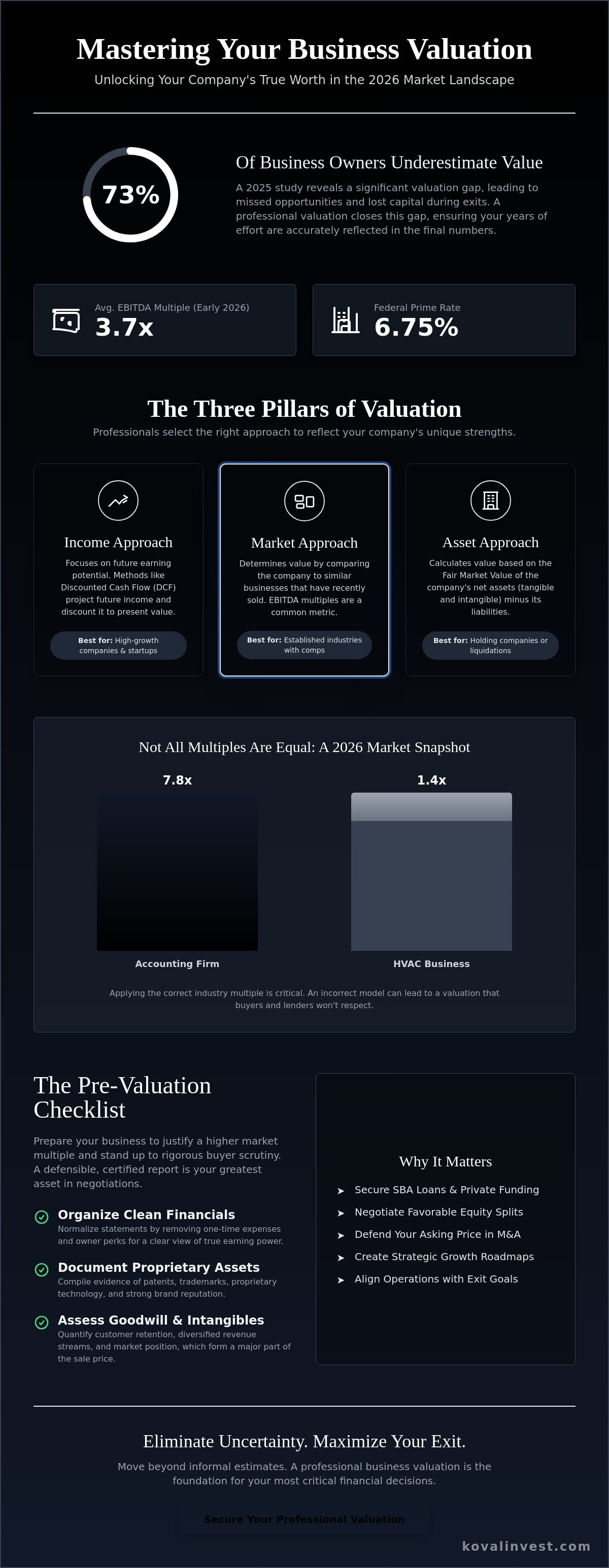
A 2025 study revealed that 73% of business owners significantly underestimate their company’s market value. This gap often leads to missed opportunities or leaving substantial money on the table during an exit. It is a frustrating reality for many entrepreneurs. Between shifting EBITDA multiples, which averaged 3.7x in early 2026, and the complexity of calculating intangible assets like goodwill, determining a fair price often feels like hitting a moving target. You’ve put years of effort into your operations, and you want to ensure the final numbers reflect that dedication, especially as buyers today apply more rigorous scrutiny to every financial forecast.
Securing a professional business valuation is the most effective way to eliminate this uncertainty and regain your leverage. This guide will help you master current methodologies and strategic applications to maximize your company’s worth while securing the best possible funding terms. We will examine how to navigate the latest 2026 valuation standards, leverage favorable tax changes like the permanent QBI deduction, and create a clear roadmap for increasing your business value before you ever reach the negotiating table.
Key Takeaways
- Understand the three pillars of valuation—Asset, Market, and Income-based—to determine which approach best highlights your company’s unique economic strengths.
- Learn how a professional business valuation serves as a critical asset for securing SBA loans and negotiating more favorable equity splits with new partners or investors.
- Discover the essential pre-valuation checklist, including how to organize clean financials and document proprietary technology to justify a higher market multiple.
- Distinguish your company from the competition by moving beyond informal estimates to a defensible, certified report that stands up to rigorous buyer scrutiny.
- Explore how integrating valuation into a broader strategic growth plan can align your current operations with your ultimate exit and capital milestones.
What is a Professional Business Valuation and Why Does it Matter?
A professional business valuation is a comprehensive analysis that determines the true economic worth of a company. It isn't a casual estimate or a guess based on industry rumors; it's a formal process that synthesizes financial data, market trends, and risk assessments into a defensible report. In the United States, high-level appraisals typically adhere to the Uniform Standards of Professional Appraisal Practice (USPAP). These standards ensure that your company's value is based on hard evidence rather than speculation. This baseline is essential for mergers, acquisitions, and internal restructuring. Without a certified report, you lack the leverage needed to defend your asking price during high-stakes negotiations.
The 2026 economic landscape makes a formal report more critical than ever. With the Federal Prime Rate holding at 6.75%, buyers are testing financial forecasts more aggressively than they did in the early 2020s. A professional business valuation provides an accurate risk assessment that accounts for these higher capital costs. It also helps you navigate the complexities of the One, Big, Beautiful Bill Act (OBBBA), which has made certain tax deductions permanent while shifting thresholds for others. Understanding how these Business valuation methodologies apply to your specific tax situation is vital for protecting your wealth during a transition.
The Distinction Between Price and Value
Fair Market Value is a technical standard, not a flexible starting point for a deal. It represents the price at which a property would change hands between a willing buyer and a willing seller. Professional standards protect both parties from emotional pricing by grounding the conclusion in objective data. In 2026, market liquidity significantly impacts these figures. If your specific sector is experiencing a slowdown, the lack of ready buyers can create a liquidity discount. An appraiser must account for this to ensure the final number reflects the reality of the current US market.
Key Components of a Valuation Report
A robust report analyzes the balance sheet by separating tangible assets, like equipment and real estate, from intangible ones, like brand reputation and proprietary technology. While historical performance provides a foundation, modern buyers are far more interested in future earnings potential and predictable cash flow. They want to see that your margins can withstand inflationary pressures. Goodwill is the premium paid over a company’s net asset value. This component often represents the most significant portion of a sale price, especially for service-based businesses with high customer retention and diversified revenue streams.
Core Methodologies: How Professionals Value a Business
Determining a company's worth requires more than a simple formula. A professional business valuation relies on three primary pillars: the Income Approach, the Market Approach, and the Asset Approach. A seasoned appraiser doesn't just pick one at random. They select the methodology that best reflects your specific industry's dynamics and your company's stage of growth. For example, an accounting firm might achieve a 7.8x EBITDA multiple in the 2026 market, while an HVAC business might see closer to 1.4x. These discrepancies mean that applying the wrong model can lead to a valuation that buyers simply won't respect.
Before applying these models, financials must undergo normalization. This process involves adjusting your statements to remove one-time expenses or owner-specific perks, such as personal vehicle leases or non-market salaries. It provides a clean view of the business's actual earning power. If you're unsure how your current books will look to an appraiser, reviewing the steps for calculating your business's value can help you identify which adjustments are standard. This preparation ensures your strategic planning is based on reality rather than inflated or deflated figures.
The Income Approach: DCF and Capitalization
The Income Approach focuses on future wealth. Discounted Cash Flow (DCF) is the gold standard for high-growth companies because it forecasts future earnings and discounts them back to today's value. In 2026, the discount rate is a critical factor. With the Federal Prime Rate at 6.75%, the cost of capital is higher than in previous years, which increases the perceived risk for buyers. For stable, mature businesses, the Capitalization of Earnings method is more common. It uses a single representative benefit level and divides it by a capitalization rate to find the value based on consistent performance.
The Market and Asset Approaches
The Market Approach looks outward. It compares your business to recent private transaction multiples and guideline public company data. This is where industry-specific trends, like the 1.5 to 2.0x premium for recurring revenue models, become apparent. Conversely, the Asset-Based Approach is often a floor for value. It's used primarily for asset-heavy businesses or in liquidation scenarios. However, for a healthy Going Concern, the value usually exceeds the sum of its physical parts. Professionals often use at least two of these methods to cross-check their conclusions, ensuring the final figure is defensible during a sale or funding round.
Strategic Use Cases: Funding, M&A, and Growth
A professional business valuation is more than a historical record of what your company was worth yesterday. It's a forward-looking instrument that defines your capacity for growth and your leverage in high-stakes negotiations. When you enter the mergers and acquisitions arena, a certified report acts as a catalyst for speed. Buyers in 2026 are performing deeper due diligence than ever before, focusing heavily on quality of earnings and revenue proof. Having a defensible valuation ready accelerates this process, showing potential acquirers that your financials are transparent and your asking price is grounded in market reality.
Beyond exits, these reports are foundational for internal growth. Using valuation data within strategic business planning services allows you to identify which areas of your operation generate the highest return on equity. It also provides a neutral ground for negotiating equity splits. Whether you're bringing on a new partner or rewarding a key executive with ownership, an independent valuation prevents the friction and emotional bias that often stall these transitions.
Valuation for Capital Procurement
Lenders and investors require certainty before they commit capital. For loans exceeding specific thresholds, particularly those involving SBA loan assistance, a professional appraisal is often a mandatory requirement to prove the collateral's value. A strong report also bolsters your application for 0% interest business funding by demonstrating a low risk profile and stable cash flows. If you're looking to expand through purchase, having an accurate figure is vital when securing working capital for business acquisition, ensuring you don't overpay for a target company's goodwill.
Succession and Exit Planning
Preparing for a management buyout or an external sale requires a defensible number that all parties can trust. A formal report identifies specific value drivers, such as recurring revenue models or reduced owner dependency, which command a 1.5 to 2.0x multiple premium in the current market. By identifying these drivers 12 to 24 months before an exit, you can optimize your operations to hit a specific valuation target. This proactive approach is also critical for Buy-Sell agreements. It ensures that if a partner leaves, the remaining owners have a pre-established, fair method for calculating the buyout price, preventing costly legal disputes.
Preparing Your Financials: The Pre-Valuation Checklist
Preparing for a professional business valuation is a rigorous process that demands more than just a basic balance sheet. You need to assemble three to five years of clean, CPA-reviewed financial statements to establish a credible history of performance. This documentation proves your revenue isn't a fluke but a repeatable result of your business model. Beyond the numbers, you must identify and document all proprietary technology, trademarks, and intellectual property. These intangible assets often provide the competitive moat that justifies a higher valuation multiple. In a 2026 environment where buyers test financial forecasts more aggressively, having a clear IP audit makes your future earnings projections much more defensible.
Appraisers also look closely at your customer concentration. If a single client accounts for more than 10% to 15% of your total revenue, buyers will perceive a higher risk of collapse if that relationship ends. Diversifying your client base before the valuation process begins is one of the most effective ways to protect your company's worth. A diverse portfolio suggests stability and reduces the "risk premium" an appraiser might otherwise apply to your capitalization rate.
Financial Optimization and Credit Health
Your business credit profile plays a surprisingly large role in reducing operational risk. Identifying and disputing inaccuracies on your credit report can immediately lower your risk profile. There is a direct correlation between a high credit score and a lower discount rate in DCF models; a safer business is simply worth more today. Maintaining strict financial hygiene prevents valuation discounts during due diligence by eliminating the uncertainty tax buyers apply to unorganized records. If your credit profile needs attention before you seek funding, our Credit Repair Services can help position your business for a more favorable appraisal.
Operational Documentation
Buyers in 2026 are wary of key-person risk. You must prove the business can thrive without your daily involvement by presenting detailed Standard Operating Procedures (SOPs). These should cover every critical function, from lead generation to fulfillment. When a buyer sees that your business is a turnkey operation, they're often willing to pay a premium because the transition risk is significantly lower. Ensure all contracts with vendors and key employees are current and, more importantly, transferable upon sale. Finally, preparing a Quality of Earnings report provides an extra layer of validation for your valuation conclusion, showing that your cash flow is both sustainable and verifiable.
The Koval Investments Approach to Strategic Advisory
Koval Investments doesn't treat a professional business valuation as a static document to be filed away. Instead, we view it as the foundational element of a total growth strategy. Many firms provide a report and then step away, leaving you to interpret the data on your own. We bridge the gap between high-level financial strategy and your day-to-day operational reality. By analyzing the specific value drivers identified in your report, we help you implement changes that move the needle on your company's worth. This approach ensures you aren't just looking at a historical snapshot but are actively building a more valuable, future-ready enterprise.
Our success-based philosophy defines every engagement. We align our consulting with your specific capital and exit goals, creating a collaborative environment where our incentives match yours. This alignment is especially critical during complex M&A transitions. When you have a defensible, professional business valuation backed by strategic advisory, you enter negotiations with a level of confidence that distant service providers simply can't offer. You're no longer guessing your worth; you're leading the conversation with data-backed integrity and a clear vision for your company's future.
A Partnership for Long-Term Expansion
We operate as strategic partners rather than transactional consultants. This "win-win" nature of our engagements means we're equally invested in your success, whether you're seeking to scale operations or preparing for a final exit. Our role is that of a mentor who shares insider knowledge to help you navigate the 2026 financial landscape with calm reliability. We value the quality of our relationships over high-volume transactions, ensuring that every client receives personalized attention. You can get started with a professional consultation to assess your current standing and identify the most direct path toward your capital and growth objectives.
Comprehensive Growth Solutions
We provide a single, logical roadmap that integrates credit repair, funding procurement, and valuation. This holistic view is a hallmark of our boutique firm. We understand the nuances of SMB and real estate funding that larger, detached institutions often overlook. By combining these services, we ensure your credit health supports your valuation, and your valuation justifies your funding requests. It's a methodical process designed for long-term comprehension and sustainable success. Secure your business’s future today through data-driven strategic planning and a partnership built on tangible progress and mutual benefit.
Securing Your Company’s Future and Legacy
A professional business valuation is the bridge between your current operations and your ultimate financial goals. By moving beyond informal estimates, you gain a defensible report that stands up to the rigorous due diligence of 2026 buyers and lenders. This process identifies the specific value drivers, such as recurring revenue and operational independence, that command a premium in today’s selective market. It also ensures your financial hygiene and credit health are optimized to reduce risk premiums during your next capital milestone.
Founded in 2018, Koval Investments provides a success-based approach to boutique financial advisory. We specialize in credit optimization and 0% interest funding solutions designed for national SMB growth. Our team is ready to act as your strategic partner, ensuring your valuation is integrated into a comprehensive roadmap for expansion or exit. Partner with Koval Investments for your professional business valuation and strategic growth needs. We're committed to helping you maximize your company's worth and secure your professional legacy.
Frequently Asked Questions
How long does a professional business valuation typically take to complete?
A professional business valuation typically takes between two and four weeks to complete once all necessary documents are received. This timeline depends on the complexity of your operations and the depth of the analysis required. If your business involves multiple entities or diverse international assets, the process may extend further to ensure every assumption is thoroughly documented and defensible under current standards.
Can I use a business valuation for tax purposes and for selling my company?
You can use a valuation for both purposes, but the appraiser must define the specific standard of value for each use case. Tax reporting generally requires Fair Market Value as defined by regulatory bodies. However, selling your company might involve calculating Investment Value, which accounts for the specific synergies a buyer brings to the table. A certified report will clearly state its intended purpose to ensure legal and financial compliance.
What is the difference between a "Conclusion of Value" and a "Calculation of Value"?
A Conclusion of Value is a comprehensive appraisal that considers all relevant methodologies and provides a high level of assurance. In contrast, a Calculation of Value is a more limited engagement where the appraiser and client agree on specific methods to use. While a calculation is often more cost-effective for internal planning, most lenders and M&A buyers in 2026 require a full professional business valuation to proceed with a transaction.
How often should a business owner update their professional valuation?
Most experts recommend updating your valuation annually or whenever your business undergoes a major structural change. In the volatile 2026 market, a report older than twelve months is often considered obsolete by buyers and lenders. Regular updates allow you to track your progress against specific value drivers and adjust your strategic planning to maximize your company’s worth before an eventual exit.
Will my business credit score affect the outcome of a professional valuation?
Yes, your credit health directly influences the risk profile used to determine your company’s worth. A lower credit score suggests higher operational risk, which often leads to a higher discount rate in Income-based valuation models. By maintaining a strong credit profile, you reduce the perceived risk for investors and lenders, which can lead to a significantly higher final valuation conclusion.
What documents do I need to provide for a professional valuation in 2026?
You should prepare three to five years of CPA-reviewed financial statements, federal tax returns, and current year-to-date reports. Additionally, you will need to provide documentation for all proprietary technology, trademarks, and Standard Operating Procedures. In 2026, appraisers place a higher emphasis on Quality of Earnings reports to verify that your cash flow is sustainable and free from one-time distortions.
Is a professional valuation required for all SBA loan applications?
A professional business valuation is not required for every SBA loan, but it is mandatory for most change-of-ownership transactions exceeding $250,000. Lenders use these reports to ensure the purchase price is supported by the company’s actual economic value. Even when not strictly required by the SBA, having an independent appraisal can provide the leverage needed to secure more favorable terms during funding negotiations.
How does market volatility in 2026 impact the valuation of a small business?
Market volatility in 2026 has widened the valuation gap between high-quality, future-ready companies and average performers. With the Federal Prime Rate at 6.75%, buyers are far more selective and apply rigorous stress tests to financial forecasts. Businesses with predictable, recurring revenue and low owner dependency are maintaining high multiples, while those in high-risk sectors are facing increased downward pressure on their market value.