
SBA 7(a) Loan Process: A Strategic Guide for 2026
Securing a $5 million expansion loan shouldn't feel like a gamble, yet many entrepreneurs treat the SBA 7a loan application process as a simple matter of paperwork rather than a strategic campaign. In 2026, the margin for error has narrowed, and a single credit blemish or a missing document can stall your growth for months. You've likely felt overwhelmed by the sheer volume of requirements or worried that your current credit profile might lead to an immediate rejection. It's a common concern, especially when the timing of your capital procurement is critical to your success.
We understand that you need more than just a list of forms; you need a reliable roadmap. This guide provides a comprehensive framework to help you master the complexities of the application journey and maximize your approval odds. We'll break down the 2026 underwriting shifts, including the new $350,000 small loan cap and the elimination of the SBSS score. By the end of this article, you'll have the strategies necessary to improve your eligibility and secure the funding required to scale your operations with confidence. We're here to ensure you navigate this financial landscape with a steady hand and a clear path forward.
Key Takeaways
- Learn why approaching the SBA 7a loan application process as a strategic campaign rather than a simple filing significantly increases your approval odds.
- Discover how proactive credit restoration and financial profile optimization serve as the essential first steps to meeting 2026 underwriting standards.
- Identify the critical documentation requirements, including SBA Form 1919 and tax filings, to ensure your loan package is audit-ready and error-free.
- Understand the impact of 2026 policy shifts, such as the new debt-service coverage ratio requirements and the decoupling of program limits for larger capital needs.
- Explore a success-based approach to capital procurement that aligns your funding goals with expert strategic planning to navigate the journey with minimal friction.
Understanding the SBA 7(a) Program and Application Landscape
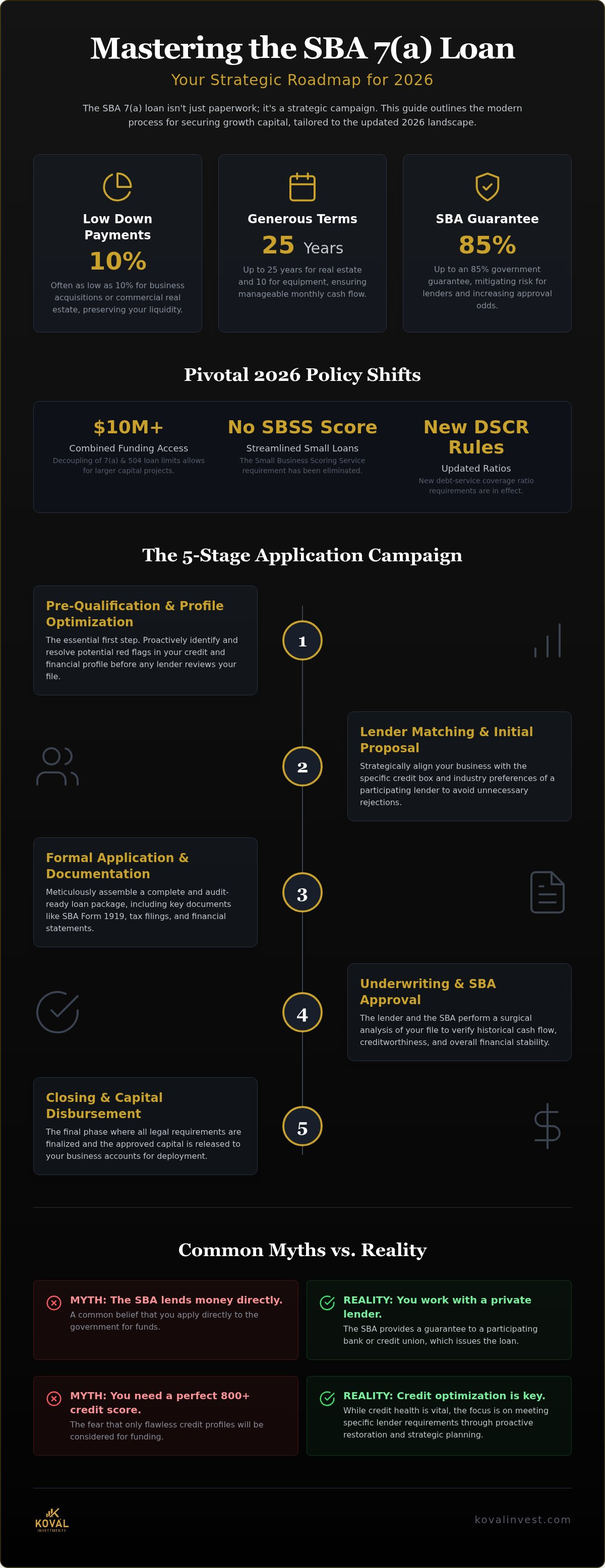
The SBA 7(a) program serves as the flagship financial vehicle for American small businesses seeking sustainable growth. It isn't a direct grant or a government handout; rather, it's a government-guaranteed capital tool designed to mitigate risk for private lenders. This guarantee encourages banks to extend credit to businesses that might not qualify under traditional conventional standards. For a deep dive into the program’s history and structure, you can review this SBA 7(a) Loan Program Overview. In 2026, this program has become even more vital. Recent policy shifts, such as the decoupling of 7(a) and 504 loan limits in July 2026, now allow ambitious owners to access up to $10 million in combined funding. This change makes 2026 a pivotal year for those looking to scale through significant real estate acquisitions or massive operational expansions.
Successfully navigating the SBA 7a loan application process requires a clear understanding of how these funds can be deployed. Most owners utilize this capital for three primary purposes: purchasing commercial real estate, securing working capital for daily operations, or refinancing high-interest debt to improve cash flow. The process is inherently collaborative. It requires a synchronized effort between the borrower, a participating lender, and strategic advisors who can help prepare the necessary financial narratives. When these parties align, the path to procurement becomes much smoother.
The Strategic Benefits of SBA 7(a) Funding
Choosing this path offers distinct advantages over conventional commercial financing. Most traditional loans require substantial down payments that can drain a company's liquidity. The SBA 7(a) program often allows for down payments as low as 10% for business acquisitions or commercial real estate. Additionally, the repayment terms are exceptionally generous, often reaching 25 years for real estate and 10 years for equipment or working capital. These longer horizons preserve your monthly operational cash flow. Because interest rates are capped based on the WSJ Prime Rate, currently at 6.75% as of August 2026, you gain long-term financial predictability that is hard to find in the private market.
Common Misconceptions About the SBA Process
Many entrepreneurs hesitate to begin the SBA 7a loan application process because of lingering myths. First, the SBA doesn't lend money directly. You work with a private lender, and the SBA provides a guarantee of up to 75% or 85% of the loan amount. Another common fallacy is that you need a perfect 800 credit score to be considered. While credit health is vital, we focus on credit optimization to help you meet lender requirements through proactive restoration. Finally, don't assume this funding is only for businesses in financial distress. On the contrary, the most successful applicants use these funds as a strategic lever for growth. It's a tool for the proactive, not just the desperate.
The 5 Key Stages of the SBA 7(a) Loan Application Process
The SBA 7a loan application process is a structured, five-stage campaign that requires precision at every turn. Stage 1 focuses on Pre-Qualification and Financial Profile Optimization, where we identify and resolve potential red flags before any lender sees your file. Stage 2 involves Lender Matching and Initial Proposal Review, ensuring your business aligns with the specific credit box and industry preferences of a participating bank. This early alignment is vital to avoid unnecessary rejections that can damage your momentum.
Stage 3 moves into Formal Application and Intensive Documentation, requiring a meticulous assembly of records as outlined in this SBA 7(a) Loan Application Guide. Stage 4 consists of Underwriting and SBA Guaranty Approval, where the lender and the SBA verify your eligibility and financial stability. Finally, Stage 5 covers Closing and Capital Disbursement, the phase where legal requirements are finalized and funds are released to your business accounts. Each stage represents a critical hurdle that must be cleared with expert preparation.
Navigating the Underwriting Phase
During underwriting, lenders perform a surgical analysis of your business tax returns to verify historical cash flow and debt obligations. In 2026, the SBA continues to enforce the "Credit Elsewhere" test, which requires you to demonstrate that the requested capital is not available from non-government sources on reasonable terms. This ensures the program supports those who truly need the government guarantee to secure fair financing. The Debt-Service Coverage Ratio (DSCR) is a mathematical comparison of your company's annual net operating income to its total annual debt payments, and lenders generally look for a benchmark of 1.25x to ensure you can comfortably cover the new loan obligations.
The Closing Process: From Approval to Funding
Approval is a major milestone, but it doesn't mean immediate funding. Typical timelines for closing a 7(a) loan in the current market range from 30 to 90 days, depending on the complexity of the deal and the efficiency of the lender. Last-minute hurdles often arise, such as delayed environmental reports for real estate or unexpected lien search results that require resolution. Utilizing professional SBA loan assistance can significantly accelerate this timeline by anticipating these roadblocks before they stall the transaction. If you're ready to begin, our team can help you prepare your financial profile for a successful submission.
Overcoming Eligibility Hurdles: Credit Scores and Financial Health
Many business owners begin the SBA 7a loan application process only to be stopped by a low credit score. This is a common hurdle, but it doesn't have to be a permanent roadblock. In 2026, the landscape has shifted significantly. The SBA officially discontinued the mandatory use of the FICO Small Business Scoring Service (SBSS) for 7(a) small loans on March 1, 2026. This change gives lenders more discretion in their credit analysis, but it also means they'll scrutinize your personal credit and internal debt-service coverage more closely than ever. Your personal financial history remains the foundation of your business's perceived reliability.
We often hear the question: "Can I get an SBA loan with a 620 score?" While it isn't a hard "no," a 620 score makes the journey difficult. Most lenders look for a personal score of at least 680 to feel confident in the guarantee. If your score is currently on the lower end, the most effective strategy is to combine credit restoration with your capital procurement efforts. This synergy ensures you aren't just applying, but applying when your profile is at its peak strength. It's about positioning yourself as a low-risk partner for the bank.
Strategic Credit Repair for SBA Approval
Before you approach a lender, you should master business credit repair services to ensure your profile is pristine. Even minor inaccuracies in your reports can trigger an automatic rejection. We help identify errors in payment history, high credit utilization ratios, and issues with the "seasoning" of your accounts. A well-seasoned account with a low balance-to-limit ratio signals stability to an underwriter. Addressing these issues early creates a much smoother path through the SBA 7a loan application process and prevents avoidable delays.
Financial Statement Readiness
Your credit score is only half of the story. Underwriters need to see that your business has the capacity to repay the debt. This requires organizing your Profit & Loss statements to reflect your true debt-repayment capacity. We emphasize the importance of "add-backs," which are non-recurring or non-cash expenses, like depreciation or one-time equipment repairs, that can be added back to your net income. This adjustment maximizes your potential loan amount by showing a healthier debt-service coverage ratio. Additionally, ensure your personal financial statements, specifically SBA Form 413, are accurate. Any discrepancies between your personal records and your business filings can raise red flags that stall your funding.
Compiling Your Loan Package: Documentation for Maximum Approval Odds
Compiling your file is the most labor-intensive phase of the SBA 7a loan application process, but it's where you truly build your case. SBA Form 1919 serves as the foundation. This Borrower Information Form requires absolute precision; even a slight discrepancy in ownership percentages compared to your tax returns can trigger a manual review. You must provide the last three years of federal business tax returns. Lenders use these to verify the historical cash flow we discussed earlier. If you've had a down year, your Business Overview and History section is your opportunity to explain the context and build confidence in your future trajectory.
A detailed Use of Proceeds is more than a simple list. It's a strategic breakdown showing how every dollar of capital will drive growth, whether through equipment, inventory, or debt refinancing. Because 100% of the business owners must be U.S. citizens or U.S. nationals as of March 1, 2026, your package must include clear proof of status for every stakeholder. Providing this information in a structured, professional format signals to the underwriter that you are a prepared and low-risk borrower.
The Essential SBA Documentation Checklist
Your lender will require a specific set of records to satisfy SBA audit requirements. This checklist includes personal resumes for all owners with a 20% or more stake, which helps the lender evaluate management's experience. You'll also need to provide current business leases or real estate purchase agreements. If your goal is property acquisition, it's vital to weigh the strategic benefits of an SBA 7(a) vs 504 loan to ensure your documentation aligns with the correct program requirements.
Strategic Business Valuations in Ownership Changes
For business acquisitions exceeding $250,000, a professional business valuation is a non-negotiable requirement. You should use this valuation data to justify the requested loan amount to the SBA, showing that the purchase price aligns with market realities. A third-party valuation reduces lender risk and ensures equitable financing for both the buyer and the seller. If you're unsure if your documentation meets 2026 standards, our team can provide a comprehensive documentation review to ensure your package is audit-ready and positioned for success.
Strategic Procurement: How Koval Investments Navigates the SBA Path
Navigating the SBA 7a loan application process alone often leads to the very delays and rejections that stall business growth. We act as your strategic procurement partner, moving beyond the role of a traditional consultant to provide a steady hand in a complex financial landscape. Our success-based philosophy ensures our objectives are perfectly aligned with yours; we only succeed when you secure the capital your business requires. This collaborative model removes the financial risk often associated with high-level financial advisory services, creating a transparent and low-pressure environment for our clients. We believe in a straight-talk approach that prioritizes tangible value over empty promises.
As we noted in previous sections, the time between your initial application and final disbursement can span several months. To maintain your operational momentum during this period, we often leverage 0% interest business funding as a strategic bridge. This allows you to execute on immediate opportunities or cover equipment costs while the SBA process moves toward the finish line. By bridging this gap, we ensure that the wait for capital doesn't become a bottleneck for your expansion plans.
Why a Strategic Advisor Beats a Direct Application
Applying directly to a local bank often limits your options to a single, narrow credit box. We provide access to a national network of SBA-preferred lenders (PLP) who have delegated authority to make credit decisions. This access significantly streamlines the timeline and increases the likelihood of a positive outcome. By professionally presenting your financial file, we minimize the number of underwriting "touches" and requests for clarification that often lead to application fatigue. We also negotiate terms that protect your long-term operational flexibility. You shouldn't just accept the first offer a lender puts on the table; you need a structure that supports your future growth.
Next Steps: Securing Your Business Future
The path to successful capital procurement begins with a clear understanding of your current standing. We start every engagement with an intensive "Deep Dive" audit of your credit and financial profile. This audit identifies the specific optimization steps needed to meet the rigorous 2026 underwriting standards we have detailed throughout this guide. Our methodical approach reinforces our role as a careful and deliberate partner. If you're ready to move from uncertainty to a clear, actionable roadmap, it's time to Partner with Koval Investments for your SBA 7(a) journey and secure the capital your business deserves.
Mastering Your Financial Trajectory in 2026
Navigating the SBA 7a loan application process requires more than just filling out forms; it demands a comprehensive strategy that begins long before you submit your file. We've explored how proactive credit restoration and meticulous financial statement preparation serve as the bedrock of a successful approval. By treating your application as a strategic campaign, you ensure that your business narrative aligns perfectly with lender expectations and current regulatory standards. Precision in your documentation and a clear use of proceeds are what separate a funded project from a stalled one.
Koval Investments offers national expertise in capital procurement, providing integrated credit restoration solutions designed to bridge the gap between your current profile and high-tier funding. Our success-based results mean we're as invested in your growth as you are, acting as a steady partner in a complex financial landscape. Your expansion goals are within reach when you have the right roadmap and a dedicated advisor by your side. Secure your strategic capital consultation with Koval Investments and take the first step toward securing the capital your business deserves today.
Frequently Asked Questions
How long does the SBA 7(a) loan application process take in 2026?
The SBA 7a loan application process typically takes between 30 and 90 days from initial submission to final funding. This timeline varies based on the complexity of your deal and the efficiency of the lender's closing department. Working with a Preferred Lender Program bank can often shave weeks off this duration. Ensuring your documentation is audit-ready before submission is the most effective way to prevent delays during the underwriting phase.
What is the minimum credit score required for an SBA 7(a) loan?
While the SBA doesn't mandate a specific minimum score, most participating lenders look for a personal credit score of at least 680. Effective March 1, 2026, the SBA discontinued the mandatory SBSS score for small loans, giving lenders more discretion. However, a higher score remains a critical factor in securing favorable terms. We recommend pursuing credit restoration before applying if your current score falls below this benchmark to ensure a smoother path.
Can I apply for an SBA loan if I have a recent bankruptcy on my credit report?
You can apply for an SBA loan after a bankruptcy, but it generally requires a waiting period of at least three years since the discharge date. You must provide a thorough explanation of the circumstances and demonstrate impeccable financial behavior since that time. Lenders will scrutinize your current debt-service coverage ratio to ensure the past issues won't recur. Strategic credit repair is often necessary to rebuild your profile for a successful approval.
What is the difference between an SBA 7(a) loan and a traditional bank loan?
The primary difference lies in the government guarantee, which covers up to 75% or 85% of the loan amount for the lender. This reduces the bank's risk, allowing for longer repayment terms of up to 25 years and lower down payments compared to traditional commercial loans. Additionally, SBA interest rates are capped, providing more predictability than many conventional products that may have shorter balloons or significantly higher variable spreads for small businesses.
Do I need collateral to qualify for an SBA 7(a) loan?
Collateral requirements depend on the loan amount and lender policy. The SBA does not require collateral for loans of $25,000 or less. For loans between $25,001 and $350,000, lenders generally follow the same collateral policies they use for their non-SBA products. For any loan exceeding $350,000, the SBA requires the lender to take a lien on all available business assets and potentially personal real estate to secure the debt to the maximum extent.
What are the typical interest rates for SBA 7(a) loans in 2026?
As of August 2026, interest rates are calculated using a base rate like the WSJ Prime Rate, currently 6.75%, plus a lender spread. Maximum allowable rates for loans over $350,000 are capped at Prime plus 3.0%, totaling 9.75%. Smaller loans carry higher maximum spreads, reaching up to Prime plus 6.5% for amounts under $50,000. These caps ensure that the SBA 7a loan application process remains accessible and fair for all qualified entrepreneurs.
Can I use an SBA 7(a) loan to buy an existing business?
Buying an existing business is a very common use for these funds. You'll typically need a 10% down payment and must prove the target business has sufficient cash flow to cover the new debt obligations. For any acquisition over $250,000, the SBA requires a professional third-party business valuation to justify the purchase price. This ensures the loan amount is supported by the actual value of the assets and goodwill being acquired during the transaction.
How does Koval Investments help with the SBA application process?
Koval Investments serves as your strategic procurement partner by managing the entire application journey from start to finish. We provide integrated credit repair services to optimize your eligibility and prepare a professional loan package that minimizes underwriting friction. Our success-based philosophy means our goals are aligned with your capital access. We leverage a national network of preferred lenders to find the best fit for your specific industry and long-term expansion goals.