
Steps After Business Loan Rejection: A Strategic Guide
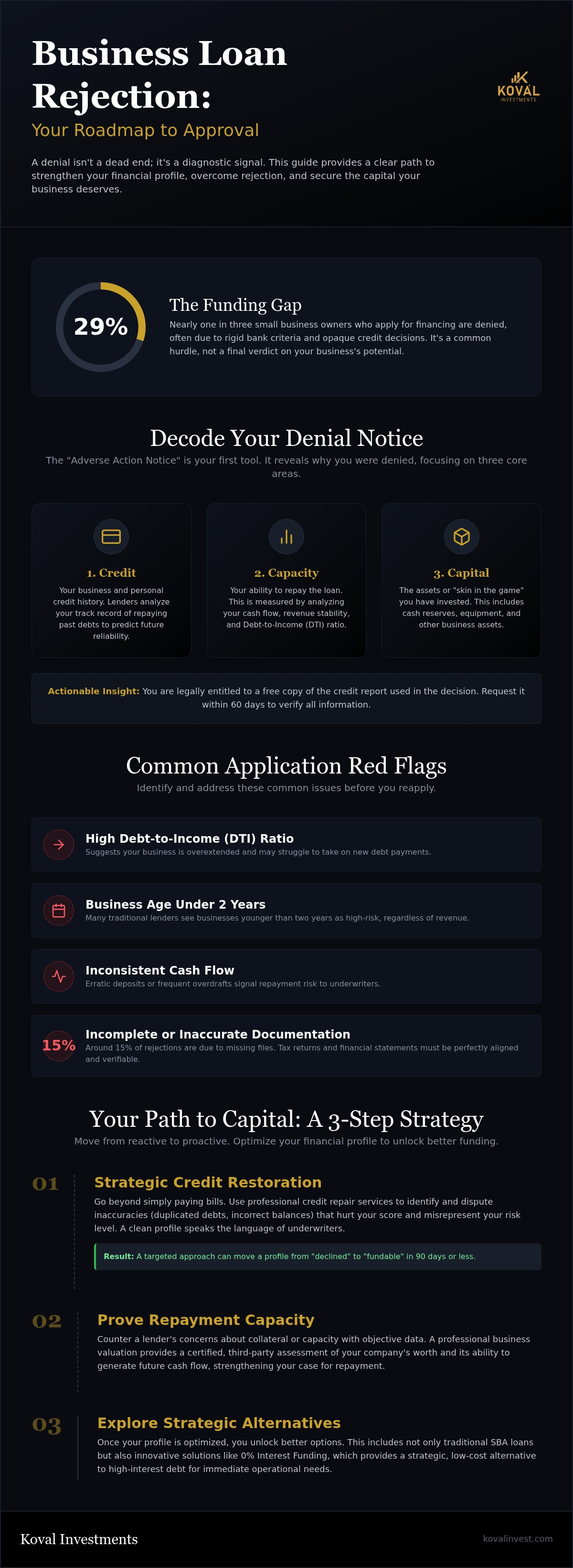
Nearly 29% of small business owners who apply for financing walk away with nothing, often leaving them frustrated by rigid bank criteria and opaque credit decisions. If you've recently received a denial letter, understanding exactly what to do after business loan rejection is the first step toward securing the capital your business deserves. It's natural to feel uncertain about your company's future when a traditional lender closes the door, especially when credit report inaccuracies or shifting SBA regulations complicate the process.
We believe a rejection isn't a dead end; it's a diagnostic signal that your financial profile needs professional optimization to unlock better terms. You can transform a denial into a successful funding strategy by focusing on the right levers of growth and credit health. This guide provides a clear roadmap to identify financial red flags, utilize Credit Repair Services to strengthen your profile, and transition toward successful outcomes like SBA funding or our 0% Interest Funding Solution.
Key Takeaways
- Learn to decode your Adverse Action Notice to identify whether credit, capacity, or capital issues triggered the lender's decision.
- Discover why professional Credit Repair Services are essential for correcting report inaccuracies that often lead to higher interest rates or outright denials.
- Understand exactly what to do after business loan rejection by using professional Business Valuations to counter collateral concerns and prove repayment capacity.
- Explore the 0% Interest Funding Solution as a strategic, low-cost alternative to traditional high-interest debt for your immediate operational needs.
- Shift from a transactional mindset to a success-based partnership that aligns your financial profile with long-term capital goals and SBA requirements.
Decoding the Denial: How to Analyze Your Adverse Action Notice
Receiving a rejection letter is a pivotal moment for any entrepreneur. Under the Equal Credit Opportunity Act (ECOA), lenders are legally required to provide you with an Adverse Action Notice. This document isn't just a formality; it's a specific breakdown of the reasons for your denial. Instead of viewing it as a setback, use it as a diagnostic tool. Understanding the logic behind the bank's decision is the first step in knowing what to do after business loan rejection. This notice ensures transparency and prevents lenders from hiding behind vague excuses.
Most rejections stem from three core areas: credit, capacity, and capital. Credit refers to your historical track record; capacity measures your current ability to repay; and capital looks at your existing assets or "skin in the game." When a bank denies your application, you're entitled to a free copy of the credit report they used to make that decision. You must request this within 60 days to verify the data for yourself. It's vital to distinguish between your personal FICO score and your business credit profile, as lenders often weigh both differently depending on the loan type. Gaining a deeper level of understanding business loans helps you see that these pillars are the foundation of any institutional risk assessment.
Common Red Flags in Business Loan Applications
Lenders look for stability and predictability. One frequent trigger for an automatic rejection is a high Debt-to-Income (DTI) ratio. This metric suggests you're already overextended and lack the breathing room to handle new debt obligations. Banks also prioritize longevity. Most traditional institutions consider the two-year mark as a critical threshold for business viability. If your business is younger than this, you may face disqualification regardless of your current revenue. Additionally, inconsistent cash flow signals high repayment risk. If your bank statements show erratic deposits or frequent overdrafts, underwriters will likely view your business as a gamble rather than a strategic investment.
The Role of Documentation in Approval Odds
Missing or disorganized financial statements can derail even the strongest applications. Research shows that approximately 15% of loan rejections occur simply because the file was incomplete or documentation was missing. Your tax returns must align perfectly with the figures presented in your loan request. Any discrepancy, no matter how small, creates a red flag for fraud or financial mismanagement. Defined simply, the Adverse Action Notice is a roadmap for financial improvement that highlights exactly where your profile fell short of the lender's requirements. By organizing your records and ensuring every line item is verifiable, you're no longer guessing at what the bank wants. Determining what to do after business loan rejection starts with this granular analysis of your denial notice.
Strategic Credit Restoration: Optimizing Your Profile for Capital Access
Many entrepreneurs believe that simply paying bills on time is enough to maintain a healthy financial standing. However, a denial often reveals that a passive approach to credit isn't sufficient for high-level capital access. When considering what to do after business loan rejection, you must transition from basic maintenance to active optimization. This process involves more than just a high personal score; it requires a robust, independent business credit profile that speaks the language of bank underwriters. A strategic plan for what to do after business loan rejection must include a dedicated window for profile restoration to ensure your next application meets the mark.
Credit report inaccuracies are a silent killer of loan applications. These errors often lead to higher interest rates or outright denials, as they misrepresent your business's risk level. Utilizing professional business credit repair services allows you to address these systemic issues with precision. Unlike DIY methods, professional restoration focuses on the legal nuances of credit reporting to ensure your profile accurately reflects your operational success. This targeted approach can often move a profile from "declined" to "fundable" in 90 days or less.
Identifying and Disputing Credit Report Inaccuracies
Common errors on business reports include duplicated debts, incorrect account balances, and outdated public records that should have been purged. These discrepancies create a distorted view of your capacity to handle new debt. A professional dispute process is often necessary because credit bureaus frequently ignore informal or poorly documented challenges from business owners. By systematically removing these "red flags," you can rapidly lift your scores to meet the eligibility requirements for SBA 7(a) loans. This methodical cleanup ensures that your financial history works for you rather than against you.
Building a Stronger Business Credit Score
In 2026, the strategic use of trade lines and vendor credit is more critical than ever. Establishing net-30 or net-60 terms with suppliers who report to major bureaus helps build your score without requiring traditional bank approval. It's also essential to separate your personal and business credit completely. This separation protects your personal assets and ensures that your business stands on its own merit during the underwriting process. If you want to improve business credit profile metrics, you must proactively manage these reporting channels before you reapply. If you're ready to start this transition, our team can help you optimize your credit profile for future success.
Proving Repayment Capacity Through Business Valuations
When a bank cites "insufficient collateral" or "weak capacity" as a reason for denial, they're often evaluating your company through a narrow, liquidation-based lens. They see what your equipment or inventory is worth at a fire sale, not what your business is worth as a thriving entity. Understanding what to do after business loan rejection involves shifting this perspective by providing a professional Business Valuation. This document serves as a definitive, third-party audit of your company's operational strength and market position. It counters the bank's conservative estimates with hard data, positioning your business as a high-value, low-risk asset rather than a liability.
A strategic approach to capital procurement requires you to demonstrate that your business has the "legs" to carry additional debt. By integrating valuation data into your updated loan application, you provide a roadmap of your company's potential. This isn't just about showing what you have today; it's about using Strategic Planning to project future cash flows that prove your ability to handle larger loan amounts or secure more favorable interest rates. When you align your internal data with professional valuation standards, you bridge the gap between a lender's uncertainty and your business's reality.
The Importance of Professional Business Valuations
A professional valuation provides an objective look at your company's intangible assets, such as brand equity, customer contracts, and proprietary processes. Lenders often overlook these elements during a standard underwriting process. By presenting a formal valuation, you justify your request for capital based on the enterprise's total worth. This data allows you to negotiate from a position of strength, often leading to better terms than a traditional credit-only assessment would allow. It's a critical component of what to do after business loan rejection if you want to challenge the lender's initial perception of your risk profile.
Strengthening Your Debt Service Coverage Ratio (DSCR)
The Debt Service Coverage Ratio (DSCR) is a primary metric lenders use to determine if your business generates enough income to cover its debt obligations. Most traditional banks look for a 1.25 benchmark, meaning your net operating income is 25% higher than your debt payments. To improve this ratio, you must clean up operational expenses and ensure your reported income is accurate and optimized. We recommend the following steps to boost your DSCR:
- Identify and remove non-recurring personal expenses that may be artificially lowering your reported profit.
- Provide historical data that shows cash flow stability over at least 24 months.
- Use projected data supported by signed contracts or letters of intent to prove future repayment capacity.
Proving cash flow stability is often more persuasive to an underwriter than a high credit score alone. When you demonstrate a clear, consistent ability to service debt, the perceived risk of your application drops significantly.
Exploring Alternatives: From SBA Loans to 0% Interest Funding
Traditional banks often leave entrepreneurs with limited options after a denial. If you're wondering what to do after business loan rejection, the answer lies in identifying capital sources that don't rely on the same rigid benchmarks. While online lenders might offer quick cash, their interest rates frequently range from 14% to 36% for term loans. This creates a significant burden on your cash flow. A more strategic path involves utilizing 0% interest business funding as a bridge to scale without the weight of immediate interest payments. This unsecured approach provides the flexibility to invest in high-ROI activities like marketing or inventory acquisition while you continue to optimize your long-term credit profile.
Comparing traditional term loans with unsecured funding options reveals a clear advantage for businesses in a growth phase. Traditional loans often require collateral and have strict repayment schedules that don't account for the ebbs and flows of a scaling company. By integrating alternative business funding solutions into your strategy, you can access capital based on your credit strength rather than just your existing assets. This shift allows you to maintain control over your equity while securing the working capital necessary to execute your business plan.
The Strategic Advantage of 0% Interest Funding
Leveraging 0% APR capital allows you to bypass the "debt trap" often associated with high-interest Merchant Cash Advances (MCAs) or personal loans. These high-cost options can quickly erode your margins. Instead, using a restored credit profile to qualify for 0% interest solutions gives you a window of 6 to 18 months to deploy capital and generate returns before any interest accrues. This is a smart alternative to high-interest debt that aligns with a success-based philosophy. Once your credit restoration is complete, these lines of credit become a powerful tool for operational efficiency.
Navigating SBA Loan Assistance
A "No" from a traditional bank doesn't necessarily mean a "No" from the Small Business Administration. In many cases, a bank rejection occurs because the institution doesn't want to hold the full risk of the loan. This is where SBA loan assistance becomes vital. SBA-guaranteed loans, such as the 7(a) program, reduce the lender's risk, making them more likely to approve your application. Currently, variable-rate SBA 7(a) loans have rates between 9.75% and 13.25%, which is often more favorable than online alternatives. An SBA loan consultant can help you bypass traditional hurdles by ensuring your application meets specific government criteria that local bank managers might overlook. If you're ready to explore these paths, you can partner with our team to build a customized capital strategy.
Your Path to Capital: Partnering for Strategic Growth
A loan denial is often the catalyst for a more sophisticated financial approach. Navigating what to do after business loan rejection requires moving beyond the frustration of a single "no" and toward a partnership that values long-term stability. At Koval Investments, we operate on a success-based philosophy. This means our objectives are perfectly aligned with your funding outcomes. We view our engagements as collaborative ventures rather than traditional expenses. This model ensures that the burden of financial risk doesn't rest solely on your shoulders while you restructure your business for growth.
Strategic advisory bridges the gap between a lender's denial and your eventual funding. It's not enough to simply reapply with the same documents and hope for a different result. You need a roadmap that accounts for the shifting financial landscape of 2026. By developing a proactive capital procurement strategy, you can identify which funding vehicles, from SBA Loans to working capital lines, are most likely to approve your specific profile. This methodical approach reduces uncertainty and positions you as a prepared, low-risk borrower in the eyes of any institution.
Success-Based Capital Procurement
Our collaborative approach begins with a comprehensive financial profile audit. We examine your credit health, cash flow patterns, and existing debt structures to find the "win-win" scenarios that lenders look for. Because our model is success-based, we're highly selective and intentional about the clients we partner with. This ensures that every strategy we develop is grounded in the practical reality of your business's potential. We don't just offer advice; we navigate the challenges alongside you, acting as a steady hand in complex financial environments. This partnership allows you to focus on daily operations while we optimize your path to capital.
Securing the Future of Your Business
Proactive capital strategy is about more than just surviving a rejection; it's about preparing for the next phase of your company's life cycle. This might include Mergers and Acquisitions Consulting to identify expansion opportunities or Strategic Planning to ensure your internal processes support larger debt obligations. By resolving underlying credit issues and optimizing your financial story, you can successfully transition from the sting of a bank rejection to the competitive edge of 0% interest funding. This shift transforms your business from a reactive borrower into a proactive market player. You'll have the confidence to pursue high-value opportunities knowing your financial foundation is secure. Start this journey today by auditing your current standing and identifying the specific levers that will unlock your next round of funding.
From Denial to Strategic Capital Growth
A loan rejection is a diagnostic tool, not a final verdict on your company's potential. By analyzing your Adverse Action Notice and correcting credit inaccuracies, you can rebuild a profile that meets the most stringent lending criteria. Whether you're proving repayment capacity through a professional Business Valuation or pivoting toward SBA funding, the path forward requires a methodical and proactive strategy. Understanding exactly what to do after business loan rejection allows you to stop reacting to bank decisions and start dictating your own financial future.
Koval Investments serves as your trusted strategic advisor, offering expert SBA loan assistance for complex cases and success-based credit restoration with no upfront risk to your company. We specialize in bridging the gap between a lender's "no" and a sustainable "yes" through our results-oriented approach. Secure your 0% interest funding solution with Koval Investments today to unlock the capital necessary for your next phase of expansion. Your business deserves a partner that's just as invested in your success as you are. Let's build a roadmap that turns today's challenges into tomorrow's growth opportunities.
Frequently Asked Questions
How long should I wait to reapply after a business loan rejection?
It's generally recommended to wait between 3 and 6 months before reapplying for a loan. This window provides the necessary time to address the specific issues identified in your Adverse Action Notice, such as improving cash flow or reducing debt. Rushing into a new application without making tangible changes often leads to a cycle of denials. Use this period to implement a strategic plan that strengthens your financial profile.
Can I get a business loan with a 600 credit score in 2026?
Securing a traditional bank loan with a 600 score is extremely difficult in 2026, as most lenders now require a minimum FICO of 680. With the benchmark Prime Rate currently at 6.75%, banks have tightened their standards significantly. However, you can qualify for alternative options or SBA programs once you optimize your profile. We focus on moving your score toward the 680 threshold to unlock more favorable terms and lower interest rates.
What is the most common reason for SBA loan denial?
An incomplete application, including missing documentation, accounts for approximately 15% of all loan rejections. Other frequent hurdles include a weak Debt Service Coverage Ratio (DSCR) or insufficient collateral. When determining what to do after business loan rejection, you must ensure your tax returns and financial statements align perfectly. Professional SBA loan assistance can help you bypass these common clerical and financial errors before you submit your next application package.
How does credit repair help me qualify for 0% interest funding?
Professional Credit Repair Services identify and dispute inaccuracies, such as duplicated debts or outdated public records, that artificially suppress your score. Lenders offering 0% APR introductory periods require a clean, high-scoring credit profile to offset their risk. By removing these red flags, you position your business to access low-cost capital. This optimization is the foundation for securing interest-free lines of credit that can be used for rapid scaling and operational growth.
Do I need to provide collateral for alternative business funding?
Many alternative options, such as our 0% Interest Funding Solution, are unsecured and don't require physical collateral like real estate or equipment. While traditional bank loans often demand a guarantee against your assets, unsecured funding relies on your credit strength and historical cash flow. This approach is ideal for businesses that want to maintain control over their assets while securing the working capital necessary to execute their strategic growth plans.
Will a loan rejection hurt my credit score further?
The rejection itself doesn't lower your score, but the "hard inquiry" performed during the application process can cause a small, temporary dip. The real risk comes from "stacking" multiple applications in a short period, which signals financial distress to underwriters. When deciding what to do after business loan rejection, it's better to pause and repair your profile. This methodical approach protects your score while you build a stronger case for future approval.
How can a professional business valuation help my loan application?
A professional valuation provides an objective audit of your company's total worth, including intangible assets like proprietary processes or customer contracts. This counters a lender's "insufficient collateral" claim by proving your enterprise has significant market value. It allows you to negotiate from a position of strength, often justifying larger loan amounts. By integrating this data, you help the bank see your business as a high-value, low-risk investment rather than a liability.
Is 0% interest business funding real or just a marketing tactic?
It's a legitimate financial strategy that leverages introductory 0% APR periods on business lines of credit. This isn't a marketing gimmick; it's a strategic tool for entrepreneurs with optimized credit profiles. These solutions typically offer between 6 and 18 months of interest-free capital. It allows you to deploy funds into high-ROI projects, such as marketing or inventory, without the immediate burden of interest payments, making it a smart alternative to high-interest debt.