
Strategic Alternatives to High Interest Business Loans in 2026
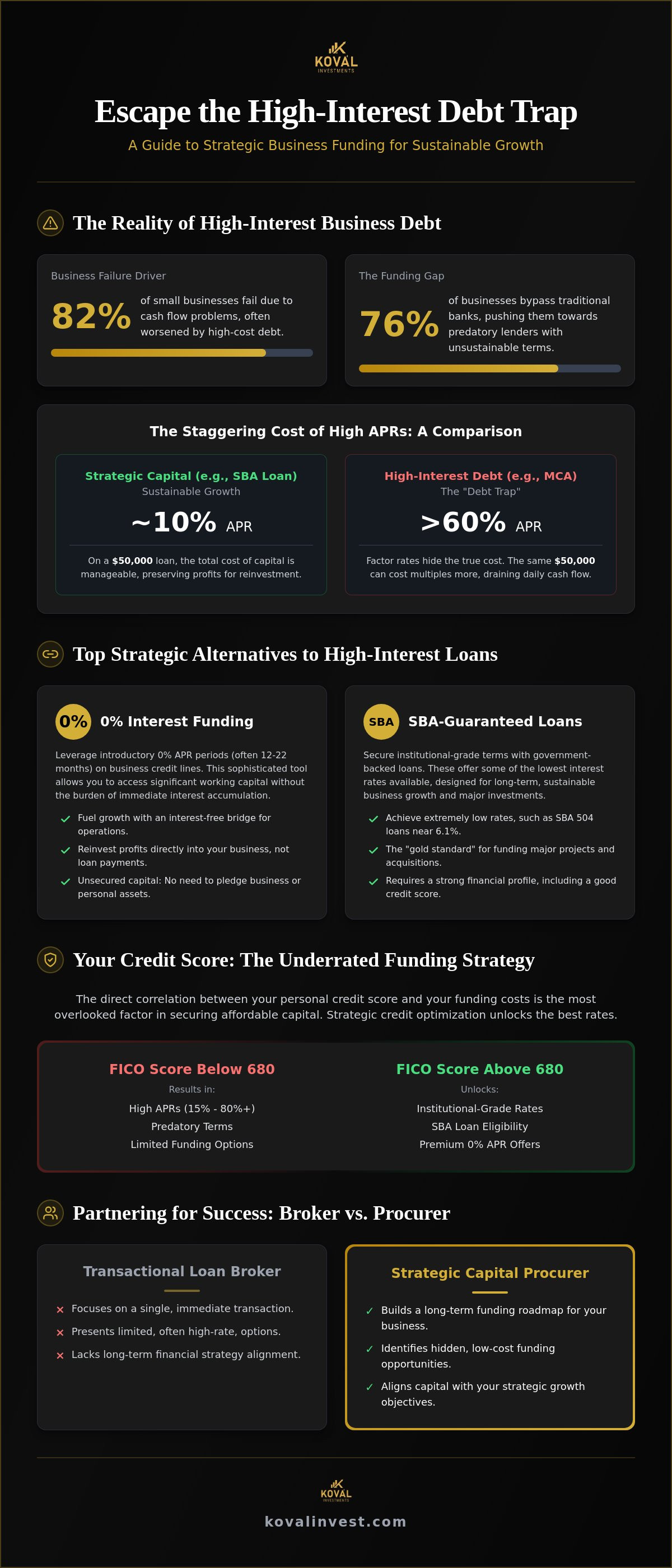
Research shows that 82% of small businesses fail because of cash flow struggles, and in 2026, interest payments are often the primary culprit. If you feel like your monthly debt service is consuming your profits before you can reinvest them, you aren't alone. Many entrepreneurs believe that predatory rates are the only way to secure capital when traditional banks offer a rejection. However, accepting a high-cost loan is often a choice made out of a lack of visibility into the market. There are several strategic alternatives to high interest business loans that can protect your margins and fuel your growth without the weight of expensive debt.
We believe that capital should be a tool for progress, not a burden on your operations. This guide will show you how to bypass high-interest traps by leveraging 0% interest funding solutions and optimizing your credit profile to meet the 680 FICO threshold required for institutional-grade terms. We'll explore the current SBA environment, including 504 loans with rates near 6.1%, and explain how strategic planning can help you secure the lowest possible cost of capital. You'll gain a clear understanding of how to align your funding needs with your long-term business objectives while maintaining a healthy, sustainable bottom line.
Key Takeaways
- Identify the mechanics of high-interest debt traps and learn why APRs reaching 80% are often unsustainable for long-term growth.
- Discover how to leverage 0% interest funding solutions and SBA programs as effective alternatives to high interest business loans to preserve your cash flow.
- Explore non-traditional avenues like peer-to-peer lending and equity crowdfunding to secure capital without traditional bank constraints.
- Understand the direct correlation between your personal credit score and your funding costs, and how strategic credit repair unlocks institutional-grade rates.
- Learn the difference between a transactional loan broker and a strategic capital procurer in identifying hidden funding opportunities.
Understanding the Real Cost of High-Interest Business Debt
High-interest debt is rarely a sustainable strategy for growth. In the current 2026 lending environment, high-interest business loans are generally classified as those with an Annual Percentage Rate (APR) ranging from 15% to 80%. While these products offer rapid access to capital, they often come at the expense of your company's long-term health. The most aggressive forms, such as Merchant Cash Advances, utilize daily or weekly withdrawals directly from your business bank account. This structure creates a "Debt Trap" where your operational cash flow is constantly depleted. When your daily revenue is diverted to debt service, you lose the ability to manage payroll, purchase inventory, or handle emergency repairs without taking on even more debt.
Traditional banks currently reject a significant majority of small business applicants. Research indicates that over 76% of small businesses report bypassing traditional banks entirely because the barriers to entry are too high or the approval process is too slow. This high rejection rate often pushes entrepreneurs toward predatory lenders out of sheer necessity. The psychological toll of this cycle is heavy. Constant debt service creates a state of perpetual crisis management. This mental burden distracts you from the strategic thinking required to scale your enterprise, turning you from a visionary leader into a professional debt manager.
The Math of High-APR Lending
The difference between a 10% SBA loan and a 40% alternative product is staggering when calculated over the life of the funding. Many alternative lenders use "factor rates" rather than APR to make the cost seem lower than it actually is. For example, a 1.3 factor rate might sound like a simple 30% fee, but because the fee is calculated on the total principal and paid back through frequent installments, the effective APR can easily exceed 60%. This creates a massive drag on your business valuation. If you plan to sell your company in the future, a balance sheet loaded with high-interest debt will significantly lower your exit price or stop a potential acquisition in its tracks.
Why Business Owners Get Stuck with High Rates
Most entrepreneurs don't choose high rates; they feel forced into them. A primary driver is the "funding gap" where the demand for capital outpaces the supply of affordable credit. Many owners also suffer from incomplete financial profiles or inaccuracies on their credit reports that they haven't yet addressed. Without a clear understanding of entrepreneurial finance, it's easy to overlook better alternatives to high interest business loans. Often, the most effective solution isn't just finding a new lender, but repairing the underlying credit issues that triggered the high-rate offers in the first place. By aligning your financial profile with lender requirements, you can move from predatory debt to strategic capital.
Top Strategic Alternatives: 0% Interest Funding and SBA Loans
Many business owners overlook credit-based capital because they associate it with personal debt. In reality, 0% interest funding is a sophisticated revolving capital tool. It allows you to access significant working capital without the burden of immediate interest accumulation. By utilizing introductory APR periods, which often last 12 to 22 months, you can purchase inventory or equipment today and pay it back using future revenue. This effectively creates an interest-free bridge for your operations, allowing you to reinvest profits back into the business rather than sending them to a lender.
Unsecured business funding has become a cornerstone of entrepreneurial finance in 2026. Unlike traditional term loans, these solutions don't require you to pledge your home or business assets as collateral. This lack of financial risk makes it a collaborative venture between you and the lender. If you're looking for the most efficient way to scale, exploring a 0% Interest Funding Solution can provide the momentum you need without the friction of high-cost debt.
Leveraging 0% Interest Business Credit
One of the most effective strategies involves credit stacking. This is the process of applying for multiple 0% APR business credit lines simultaneously to maximize your total available capital. When executed correctly, this approach provides a substantial cushion for growth. It's particularly useful for businesses that need to scale quickly but want to avoid the high cost of traditional term loans. 0% interest funding is a revolving capital tool.
In 2026, SBA-guaranteed loans remain the gold standard for long-term, low-rate debt. The SBA 504 program, for instance, offers rates around 6.1% to 6.2% for 20 and 25-year terms. These are among the most attractive alternatives to high interest business loans available today. While variable rates for 7(a) loans can range from 9.75% to 13.25%, they still significantly outperform the 15% to 80% APRs found in the alternative lending market. These programs provide the stability needed for major expansions or real estate acquisitions.
SBA Loan Assistance: Navigating the Complexities
The application process is notoriously complex and requires a methodical approach. Lenders often require extensive documentation, including tax returns, business valuations, and detailed strategic plans. As of March 1, 2026, the SBA retired the requirement for the FICO SBSS score for smaller applications, yet a strong personal credit score remains vital for approval. If you find the paperwork overwhelming, seeking professional SBA loan assistance can ensure your file is presented correctly to the right lenders, increasing your chances of a successful outcome.
Non-Traditional Funding: Equity, Grants, and Peer-to-Peer
When debt becomes a burden on your operational agility, looking beyond the balance sheet of a traditional bank is a necessary step. Peer-to-Peer (P2P) lending has emerged as a powerful alternative by connecting business owners directly with individual investors. This model bypasses the rigid overhead of institutional banking, often resulting in more flexible terms. In 2026, P2P platforms offer APRs ranging from 8.99% to 35.99%, which can be significantly more manageable than the predatory rates found in the high-risk lending market. These platforms prioritize your business's potential and current revenue over a perfect credit history, making them viable alternatives to high interest business loans for growing companies.
Equity crowdfunding is another interest-free avenue that trades a portion of ownership for growth capital. Unlike a loan, you aren't required to make monthly payments, which preserves your cash flow for day-to-day operations. This approach is particularly effective for businesses with a strong community following or a disruptive product. For capital-intensive needs, equipment leasing provides a way to acquire essential tools without the heavy upfront cost of financing. Leasing keeps your debt-to-income ratio healthy, ensuring you remain attractive to prime lenders in the future.
The Pros and Cons of Equity vs. Debt
Deciding between equity and debt is a fundamental strategic choice. Equity capital doesn't require repayment if the business hits a rough patch, but it does mean sharing your future profits. It's often the right move when you need a massive injection of capital to capture market share quickly. However, before you dilute your ownership, it's wise to utilize business valuation services to understand the true worth of what you're trading. Maintaining a majority stake ensures you keep control over the company's direction while you scale.
Finding and Winning Business Grants
Grants represent the only truly free capital available to entrepreneurs. While they don't require repayment or equity, they're highly competitive and require a methodical application process. In 2026, several opportunities are active, such as the Verizon Small Business Digital Ready Grant, which selects 10 businesses monthly through December. There's also the Shophand $5k Small Business Boost Grant with a deadline of August 1, 2026. Small business grants are often targeted toward specific sectors like green energy or minority-owned enterprises, so aligning your mission with the grantor's goals is the key to success.
Credit Repair: The Most Underrated Funding Strategy
Many business owners treat their personal credit score as a concern separate from their corporate finances. This is a costly mistake. In 2026, your personal FICO score remains the single most influential factor in determining the interest rate on your business capital. If your score sits below 650, you're often relegated to subprime lenders who charge the 15% to 80% APRs that stifle growth. By proactively identifying and disputing inaccuracies on your reports, you can shift your profile into the prime category. A score above 700 transforms your options, allowing you to access the most competitive alternatives to high interest business loans.
The return on investment for professional credit optimization is substantial. While you might spend a few hundred dollars on specialized services, the long-term savings are measured in the thousands. For instance, moving from a subprime rate to a prime rate of 8% to 12% on a $250,000 term loan can save your business over $50,000 in interest over five years. This is capital that stays in your bank account, ready to be deployed for payroll or expansion. Professional repair is a methodical process that addresses the root causes of high-cost debt rather than just treating the symptoms.
Fixing Your Credit for SBA Loan Approval
SBA 7(a) and 504 loans generally require a minimum personal credit score of 680. While some lenders may consider scores as low as 650, the terms are significantly less favorable. Professional intervention can help you fix credit for SBA loan approval by removing outdated or incorrect negative marks that drag down your score. You should expect a timeline of 6 to 12 months for full optimization. This period allows for the steady removal of disputes and the seasoning of new, positive credit history, ensuring your application is bulletproof when it reaches the underwriter's desk.
Building a Robust Business Credit Profile
Establishing a separate business credit identity is equally vital for long-term capital procurement. You must intentionally open tradelines with vendors who report your payment history to major bureaus like Dun & Bradstreet. A high Paydex score signals to lenders that your business is an independent, reliable entity. Lenders also scrutinize your debt-to-income (DTI) ratio to ensure your monthly revenue can comfortably support new debt. Strategic credit repair acts as the primary bridge to 0% interest funding by proving to lenders that your business is a low-risk partner. If you're ready to lower your cost of capital, our team can help you implement Credit Repair Services to unlock better funding terms.
Partnering for Professional Capital Procurement
Securing capital is often viewed as a transactional necessity, but the methodology you choose determines your company's trajectory. Many business owners mistakenly rely on loan brokers who operate on a volume-based model. These brokers often prioritize the speed of a transaction over its long-term cost, frequently steering clients toward high-commission products like Merchant Cash Advances. In contrast, a strategic capital procurer acts as an insider who navigates the financial landscape alongside you. These professionals specialize in uncovering alternatives to high interest business loans that traditional brokers might overlook due to complexity, such as structured 0% interest credit lines or specific SBA programs.
Our approach is rooted in a "win-win" philosophy. We believe that professional advisory should be a collaborative venture rather than a traditional expense. This success-based model aligns our objectives with yours, ensuring that we only succeed when you secure the capital necessary for your growth. By removing the financial risk from the procurement process, we create a low-pressure environment where the focus remains entirely on identifying the most efficient capital stack for your specific operational needs. Preparing your business for a successful injection of funds requires more than just a balance sheet; it requires a partner who understands the day-to-day realities of ownership.
The Value of Strategic Advisory
A capital procurer doesn't just find money; they ensure that money serves a specific purpose within your five-year strategic plan. This might involve using alternative business funding solutions to avoid the dilution of your ownership during a rapid expansion phase. If you're looking at growth through acquisition, professional consulting can help you secure the funding needed for a merger while maintaining healthy debt-to-income ratios. This level of foresight prevents the "funding gap" that often stalls mid-market companies after their initial growth spurt.
Ready to Secure Capital Without the High Interest?
The journey to lower-cost capital begins with an honest assessment of your current financial health. You must evaluate your personal credit standing and business tradelines to determine which programs are currently within reach. Often, the first step toward qualifying for 0% interest funding is a targeted credit optimization phase to ensure your profile meets the 680 to 700 FICO threshold. Identifying sustainable alternatives to high interest business loans is about more than just finding a lower rate; it's about structural alignment with your goals. If you're ready to explore how strategic planning can lower your cost of capital, Schedule a consultation with Koval Investments to explore your interest-free options.
Securing Your Business's Financial Future
Transitioning away from predatory debt is a strategic necessity for any business owner aiming for long-term stability. You've seen how high APRs can erode your cash flow and how credit restoration acts as a vital bridge to prime lending. By focusing on 0% interest introductory periods and SBA-guaranteed programs, you can effectively bypass the high-cost debt traps that stifle innovation. These alternatives to high interest business loans aren't just theoretical; they're accessible tools that protect your margins and fuel sustainable growth.
Since 2018, Koval Investments has operated as a dedicated partner for entrepreneurs seeking results-oriented capital procurement. We are specialists in 0% interest capital procurement and offer comprehensive credit restoration alongside SBA assistance. Our success-based philosophy ensures that our objectives are perfectly aligned with your growth, providing a steady hand in today's complex financial landscape. Your vision deserves a foundation of affordable, strategic capital. Access 0% Interest Funding Solutions Today and build the future your business deserves.
Frequently Asked Questions
What are the best alternatives to high-interest merchant cash advances?
The most effective alternatives to high interest business loans like MCAs are 0% interest business credit lines and SBA 7(a) loans. While Merchant Cash Advances often carry factor rates that equate to effective APRs between 40% and 80%, 0% interest solutions allow you to utilize revolving capital without any interest for up to 22 months. This approach preserves your daily cash flow and prevents the aggressive debt cycle common with daily or weekly MCA withdrawals.
Can I get 0% interest business funding with a 600 credit score?
Securing 0% interest funding typically requires a personal credit score of at least 680 to 700. Lenders offer these interest-free periods to borrowers they perceive as low-risk, so a 600 score is generally insufficient for approval. If your score is currently in that range, your most strategic move is to prioritize professional credit repair. This process can help you reach the necessary threshold to unlock interest-free capital within a few months.
How long does it take to repair credit for a business loan?
Full credit optimization generally takes between 6 and 12 months to achieve the best results for capital procurement. This timeline allows for the methodical removal of inaccuracies and the seasoning of new, positive tradelines on your report. While some improvements can be seen sooner, most institutional lenders and SBA programs require a stable, high-quality profile that demonstrates long-term financial responsibility before granting their most competitive rates.
Are business grants actually available for established companies?
Grants are available for established companies, though they're highly competitive and often require a mission-specific alignment. In 2026, programs like the Verizon Small Business Digital Ready Grant and the FedEx Small Business Grant provide non-repayable capital to businesses that meet their criteria. Unlike loans, these funds don't require repayment or equity, making them an excellent supplement for companies in tech, green energy, or minority-owned sectors looking to expand.
What is the difference between an SBA loan and a traditional bank loan?
The primary difference is the government guarantee provided by the Small Business Administration, which reduces the lender's risk. This guarantee allows banks to offer longer repayment terms and lower interest rates than traditional commercial products. For example, SBA 504 loans currently offer rates around 6.1%, making them excellent alternatives to high interest business loans from traditional banks, which can range from 8% to 17.25% APR.
How does credit repair impact my ability to get unsecured funding?
Credit repair directly increases your borrowing power by lowering your perceived risk to potential lenders. A higher personal credit score is often the primary key to securing unsecured business funding, which doesn't require you to pledge personal assets like your home as collateral. By moving your score above the 700 threshold, you gain access to larger credit limits and longer 0% interest introductory periods, significantly reducing your total cost of capital.
Is equity crowdfunding better than a high-interest loan?
Equity crowdfunding is often better for cash flow because it doesn't require monthly interest or principal payments. You trade a portion of ownership for growth capital, which is ideal for companies that need to reinvest every dollar into scaling. However, it does involve the dilution of your control and future profits. It's a collaborative venture that should be weighed against the benefits of low-interest debt before you commit to sharing ownership.
What should I look for in a capital procurement consultant?
You should look for a consultant who operates on a success-based, "win-win" model rather than one who requires high upfront fees. A quality partner acts as a strategic advisor, helping you align your funding with a long-term growth plan and identifying hidden opportunities in 0% interest markets. They should prioritize your business's financial health and valuation over the speed of a high-commission loan transaction, ensuring a steady hand in complex landscapes.