
Strategic Business Valuation in 2026: The Founder’s Guide to Growth and Capital
What if your company's valuation wasn't just a static reflection of the past, but a strategic lever for your future? Most founders feel a justified sense of uncertainty when they look at their balance sheets, worrying that different methods yield conflicting results or that they're leaving money on the table during M&A talks. It's frustrating to feel like the true value of your life's work is hidden behind complex jargon. This is especially true when you need a business valuation for loan application purposes, where the difference between an informational number and a certified report can determine your eligibility for critical capital.
We're here to help you turn that uncertainty into a clear, actionable roadmap. You'll discover how a professional valuation transforms from a cold audit into a tool for maximizing your exit value and securing the funding you need to scale. We'll explore the 2026 market, including the impact of the One Big Beautiful Bill Act and updated SBA requirements. By the end of this guide, you'll understand how to align your company's worth with strategic goals like 0% interest funding and long-term expansion.
Key Takeaways
- Learn how to transform a standard business valuation from a static financial figure into a strategic roadmap for scaling and capital procurement.
- Discover the six core methodologies experts use to calculate worth and how to select the right approach for your specific business goals.
- Identify the primary value drivers, such as recurring revenue and documented systems, that minimize lender risk and increase your market multiple.
- Master the documentation process required for a professional business valuation for loan application to ensure your company meets strict 2026 lending standards.
- Use your valuation data to strategically position your firm for 0% interest funding or a high-value exit during M&A consultations.
What is Business Valuation and Why Does it Matter in 2026?
Business valuation is the formal process of determining the total economic worth of a business entity. It's far more than a simple calculation of assets minus liabilities. In the 2026 market, this process has evolved into a tool for strategic agility. With the implementation of the One Big Beautiful Bill Act affecting depreciation and interest deductions, your company's value can shift rapidly. Founders who maintain an up-to-date understanding of their worth can pivot quickly, accessing capital or pursuing acquisitions while competitors are still gathering data.
It's vital to distinguish between fair market value and strategic value. Fair market value is a standard often used for tax or legal compliance, adhering to established benchmarks like IRS Revenue Ruling 59-60. Strategic value, however, looks at the worth of your company to a specific investor or lender. When you prepare a business valuation for loan application, you're focusing on the strategic value that proves your company's stability and growth potential to a creditor. This distinction creates a valuation-to-capital pipeline that serves as a primary growth engine for modern entrepreneurs.
The Strategic Importance of Knowing Your Worth
A precise appraisal acts as a gateway to high-level growth opportunities. It directly impacts your ability to secure SBA loan assistance by providing the objective data lenders need to verify your debt service coverage ratio. Beyond government-backed funding, a professional valuation is essential for attracting private equity or angel investors who require a clear ROI roadmap. It serves as the foundation for all strategic business planning, ensuring your long-term corporate development goals are grounded in financial reality rather than guesswork.
Common Triggers for a Professional Appraisal
Most founders initiate a professional appraisal during pivotal business transitions. If you're preparing for mergers and acquisitions (M&A) or a partnership buyout, an objective valuation ensures you don't leave money on the table. It's also a critical step for founders seeking 0% interest funding, as it helps establish the credit optimization baseline needed for eligibility. By utilizing standardized business valuation methodologies, you create a defensible report that can resolve shareholder disputes or satisfy lender-mandated collateral requirements. This collaborative diagnostic approach ensures that every stakeholder has a clear, shared understanding of the company's trajectory.
The 6 Core Methodologies: How Experts Calculate Business Value
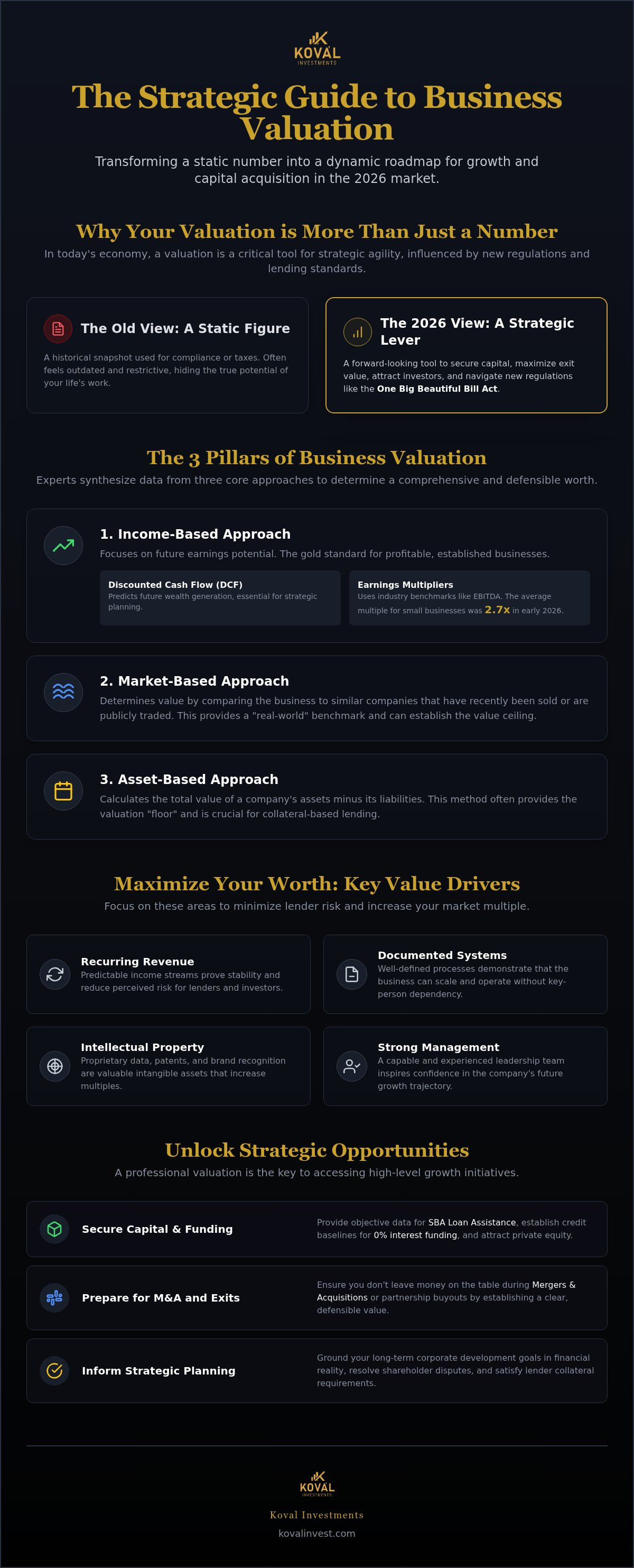
Understanding how experts arrive at a specific number is the first step in positioning your firm for capital. Professionals don't rely on a single calculation. Instead, they synthesize data from Asset-Based, Income-Based, and Market-Based approaches. While a sale might focus on blue-sky potential, a business valuation for loan application leans heavily on stability and debt coverage. In the 2026 economy, experts also account for intangible assets like proprietary data and intellectual property. These elements often follow IRS business valuation guidelines to ensure the final report is defensible and credible. Using multiple methods allows an appraiser to find a weighted average, providing a more accurate valuation range that accounts for both your physical assets and your future potential.
Income-Based Approaches: DCF and Earnings Multipliers
The Income Approach is often the gold standard for established companies. Discounted Cash Flow (DCF) models are particularly powerful because they predict future wealth generation rather than just looking at the past. In 2026, these models must integrate the 100% bonus depreciation and interest deduction rules established by the One Big Beautiful Bill Act. Earnings Multipliers offer a different lens, using industry benchmarks to determine value. For example, the average cash flow multiple for small businesses sat at 2.7x in early 2026. EBITDA, or Earnings Before Interest, Taxes, Depreciation, and Amortization, serves as the universal language of business value, allowing lenders to compare your performance against global standards.
Market and Asset-Based Approaches
Market and Asset-Based methods provide the "floor" and "ceiling" for your worth. Market Capitalization is the most straightforward public metric, though it's often used as a comparison point for private entities through "comps." Lenders pay close attention to Liquidation Value versus Book Value. While Book Value reflects your historical costs, Liquidation Value estimates what assets would fetch in a rapid sale, representing the lender's ultimate safety net. For high-growth startups or tech firms, the Times Revenue method remains a popular way to value future scale before profits fully materialize. This method is particularly useful when historical earnings don't yet reflect the company's true trajectory. Establishing these metrics through expert strategic planning ensures your application is backed by data that lenders trust.
Maximizing Your Business Value: Drivers and Strategic Preparation
Lenders prioritize predictability above all else. When you're seeking a business valuation for loan application, the most significant factor is your recurring revenue. These steady streams prove that your company can service debt even during market fluctuations. Operational efficiency is equally vital. Documented systems and clear SOPs suggest that the business is a turnkey operation, which naturally increases your valuation multiple. Many founders believe their company is too small to attract high multiples, but a small, well-oiled machine with a healthy business credit profile is highly attractive to modern capital providers. A strong credit history signals to an appraiser that your company is a mature financial entity, demonstrating a history of reliability that lowers the perceived risk of your future cash flows.
Critical Value Drivers for 2026
Diversifying your customer base is a non-negotiable requirement for stability in 2026. If a single client accounts for more than 15% of your total revenue, lenders often perceive a concentration risk that can depress your valuation. Building a management team that functions independently of the owner is another key multiplier. If the business relies entirely on your daily involvement, it's a job, not an asset. Investors and lenders want to see that the company can thrive without your constant oversight. Understanding what makes a company valuable also involves identifying proprietary technology, trademarks, or unique IP. These assets create a competitive moat around your earnings, protecting your market share from competitors.
Pre-Valuation Checklist for Founders
Before the appraiser arrives, you must clean up your financial statements. This means strictly separating personal expenses from business operations to present a transparent view of your cash flow. Founders often run personal costs through the business for tax purposes, but this can muddy the waters during a professional review. Perform a mini-internal audit of your contracts and compliance records to resolve any lingering legal issues. Most importantly, identify your add-backs. These are one-time expenses, such as a major equipment purchase or a legal settlement, that should be added back to your net income to show your true operational capacity. This strategic preparation ensures your business valuation for loan application results in a number that accurately reflects your hard work and future potential. By focusing on these drivers months before you apply for funding, you transform the valuation from a simple report into a powerful diagnostic tool for growth.
The Professional Valuation Process: A Roadmap for Loan Readiness
A professional valuation is a collaborative journey that transforms raw data into a compelling narrative for lenders. The process begins with an initial consultation where we align the appraisal's purpose with your specific growth objectives. If your primary goal is a business valuation for loan application, the focus shifts toward demonstrating consistent cash flow and debt serviceability. This alignment ensures the final report speaks the language your creditors expect to hear, positioning your company as a reliable partner rather than a high-risk gamble.
Phase 1: Discovery and Documentation
During the data collection phase, you'll need to gather three to five years of detailed financial statements, federal tax returns, and legal documentation. In 2026, certified appraisals also require non-negotiable items like current aging reports for accounts receivable and proof of ownership for all tangible assets. We look beyond the balance sheet to find hidden value through qualitative interviews with your leadership team. These conversations often reveal proprietary processes or customer loyalty metrics that a standard audit might overlook. We also identify non-operating assets, such as excess cash or real estate not essential to daily functions. These items can significantly bolster your company's total worth when properly documented and presented to a lender.
Phase 2: Synthesis and Reporting
The analysis phase involves benchmarking your performance against industry peers using the methodologies discussed in previous sections. Professional appraisers don't just pick one number. Instead, they reconcile various values to reach a Conclusion of Value. This synthesis accounts for market volatility and specific industry risks, ensuring the final figure is both realistic and defensible. You'll have the opportunity to review a draft report to ensure it captures the full context of your operations and strategic positioning. Once finalized, this document serves as much more than a compliance requirement. It becomes a sophisticated pitch deck for alternative business funding, providing the transparency needed to secure favorable terms. If you're ready to define your company's true worth, you can schedule a business valuation consultation today to ensure your financial future is built on a foundation of verified data.
This methodical approach builds trust with financial institutions by showing that your numbers are backed by rigorous analysis. By the time you submit your application, you'll have a clear understanding of your value drivers and any potential red flags that a lender might flag. This proactive stance is often the difference between a quick approval and a lengthy, frustrating denial. A well-prepared report acts as a steady hand, guiding your business through the complexities of the 2026 capital market.
Beyond the Number: Leveraging Valuation for Capital and M&A
A professional valuation report does more than sit in a drawer. It's the primary engine for your next stage of growth. When you finalize a business valuation for loan application, you're creating a bridge between your current operations and the capital required for expansion. At Koval Investments, we don't treat this as a cold audit. We integrate valuation data with execution strategies to ensure your numbers lead directly to results. This approach allows you to move beyond the limitations of a DIY calculator, which often misses the nuances of market demand and strategic positioning that a human expert identifies.
Valuation as a Funding Catalyst
Your report is a key qualifier for our 0% interest business funding solution. By proving your company's economic worth through a certified process, you satisfy the rigorous collateral and equity requirements set by SBA lenders. This data is particularly valuable when you're looking for working capital. Instead of relying solely on past performance, a strategic valuation highlights future-looking growth projections. This forward-thinking perspective gives lenders the confidence to approve higher funding amounts, as it demonstrates a clear path to debt repayment through increased operational capacity and market capture.
Transition and Exit Strategy
Knowing your worth also dictates the timing of your exit. Industry multiples fluctuate based on peak valuation cycles, and having a professional appraisal allows you to choose the most lucrative moment to transition. Our Mergers and Acquisitions Consulting services turn a static valuation into a successful, closed transaction by finding win-win deal structures that reward your years of hard work. We focus on a success-based philosophy, meaning our interests are perfectly aligned with yours. This partnership is essential for long-term corporate development and wealth protection, ensuring you don't leave value on the table when you decide to step away from the helm.
High-stakes financial decisions require more than a spreadsheet. They require a seasoned strategic partner who understands the 2026 landscape. By leveraging our expertise in both valuation and capital procurement, you ensure your business is positioned for its highest possible worth. Whether you're seeking immediate funding or planning a five-year exit, a professional business valuation for loan application is the first step toward a secure and prosperous future. We work alongside you to navigate these complexities, turning a complex financial requirement into a steady roadmap for success.
Securing Your Company's Future Through Strategic Clarity
A professional valuation is the definitive starting point for any founder aiming to scale or exit. It transforms your company's history into a credible projection of future potential, ensuring you aren't leaving money on the table during critical negotiations. By mastering the drivers of value, such as recurring revenue and operational independence, you position yourself for the best possible terms.
When you prepare a business valuation for loan application, you're doing more than checking a box for a lender. You're building a foundation for 0% interest funding and long-term expansion. Our success-based philosophy ensures that our goals are perfectly aligned with yours, as we integrate expert M&A consulting with capital procurement.
Don't let uncertainty dictate the value of your life's work. Take the first step toward a confidential national advisory partnership that prioritizes your growth. Schedule a Strategic Consultation with Koval Investments today. Your company's highest potential is within reach.
Frequently Asked Questions
How often should a small business perform a formal valuation?
Small businesses should generally perform a formal valuation every two years or whenever a significant strategic shift occurs. Market conditions in 2026, such as those influenced by the One Big Beautiful Bill Act, make regular updates essential for maintaining agility. Frequent assessments ensure your financial data remains current for potential capital procurement or unexpected M&A opportunities. This proactive habit allows you to identify value eroding issues before they become permanent fixtures on your balance sheet.
What is the difference between a business valuation and a business appraisal?
While the terms are often used interchangeably, a business valuation is typically a broader strategic analysis of economic worth, whereas an appraisal is often a formal, point in time report for legal or tax purposes. Valuations often incorporate forward looking growth projections and industry multiples. Appraisals frequently focus on historical data and tangible assets. Both are essential tools, but a strategic valuation provides the roadmap needed for long term corporate development and securing complex funding.
Can I use a business valuation to help me get an SBA loan?
Yes, you must provide a professional business valuation for loan application purposes when applying for SBA 7(a) loans exceeding $250,000. Lenders require an independent, qualified source to verify that the purchase price or loan amount is supported by the company's actual economic value. This report ensures the debt service coverage ratio meets the standard 1.25 requirement. Having this data ready accelerates the approval process and demonstrates your company's financial maturity to the lender.
How long does the professional valuation process typically take?
A professional business valuation typically takes between two and four weeks to complete, depending on the complexity of the entity and the availability of data. The initial discovery phase involves gathering several years of tax returns and financial statements. Once the analysis begins, the appraiser benchmarks your performance against industry peers. Rushing this process can lead to overlooked value drivers, so we prioritize thoroughness to ensure the final Conclusion of Value is defensible and accurate.
Will my business credit score affect my company’s valuation?
Your business credit score significantly influences the risk profile used during a business valuation for loan application. While the score itself isn't a direct line item on the valuation report, it affects the discount rate applied to your future cash flows. A strong credit profile suggests lower operational risk, which can lead to a higher overall valuation. We often integrate credit repair services with our valuation consulting to ensure your company presents the strongest possible financial front.
What are the most common mistakes owners make before a valuation?
The most common mistake owners make is failing to separate personal expenses from business operations before the analysis begins. This commingling of funds muddies your true earnings and can lead to a lower appraisal. Other errors include neglecting to document internal processes or ignoring customer concentration risks. Addressing these issues months in advance allows you to present a clean, optimized financial history that reflects the true growth potential of your enterprise.
How does a success-based consulting model work for valuations?
Our success-based philosophy means our strategic advisory services are focused on delivering tangible results for our clients. We align our objectives with your growth goals, whether that involves securing an SBA loan or preparing for a merger. This model reduces the financial risk to the founder and fosters a collaborative environment where both parties are equally invested in a high value outcome. It emphasizes partnership over traditional, high volume transactional relationships found in institutional finance.
Is a DIY online business valuation calculator accurate enough for M&A?
DIY online calculators are generally insufficient for high stakes decisions like M&A or securing significant working capital. These tools rely on generic algorithms that cannot account for your unique intellectual property, management strength, or proprietary technology. A professional consultant provides the qualitative analysis needed to find hidden value that a spreadsheet might miss. For a successful, closed transaction, you need a defensible report that stands up to the scrutiny of sophisticated buyers and lenders.