
The 2026 Due Diligence Checklist for Selling a Business: Maximize Your Exit Value
What if the most dangerous threat to your business exit isn't a low offer, but the "risk premiums" a buyer applies during the final audit? It's a frustrating reality that many entrepreneurs face; you agree on a price, only to watch it erode as the buyer's team digs through your records. We understand the anxiety that comes with potential "skeletons in the closet" or the sheer exhaustion of managing a massive data room. Using a structured due diligence checklist for selling a business is the most effective way to ensure your valuation remains defensible all the way through closing.
In a 2026 market where mega-deals dominate but overall deal volume has tightened, buyers are more selective and cautious than ever. You've worked too hard to let deal fatigue or a disorganized filing system collapse your sale at the finish line. This guide will walk you through the rigorous documentation process while showing you how strategic financial optimization can protect your hard-earned equity. We'll explore the essential steps to streamline your records, manage credit expectations, and present a transparent business case that leaves no room for buyer hesitation.
Key Takeaways
- Learn why the Quality of Earnings (QofE) report has become the 2026 gold standard for proving financial health to sophisticated buyers.
- Use a comprehensive due diligence checklist for selling a business to organize 36 months of financial and legal records before opening a virtual data room.
- Discover how correcting business credit errors early can prevent your buyer’s SBA loan approval from collapsing during the audit phase.
- Explore how strategic 0% interest funding can optimize working capital and eliminate high-interest debt that lowers your final net valuation.
- Understand how professional M&A consulting and business valuations provide the defensible anchor needed to maintain your price through closing.
Understanding the 2026 Due Diligence Landscape for Sellers
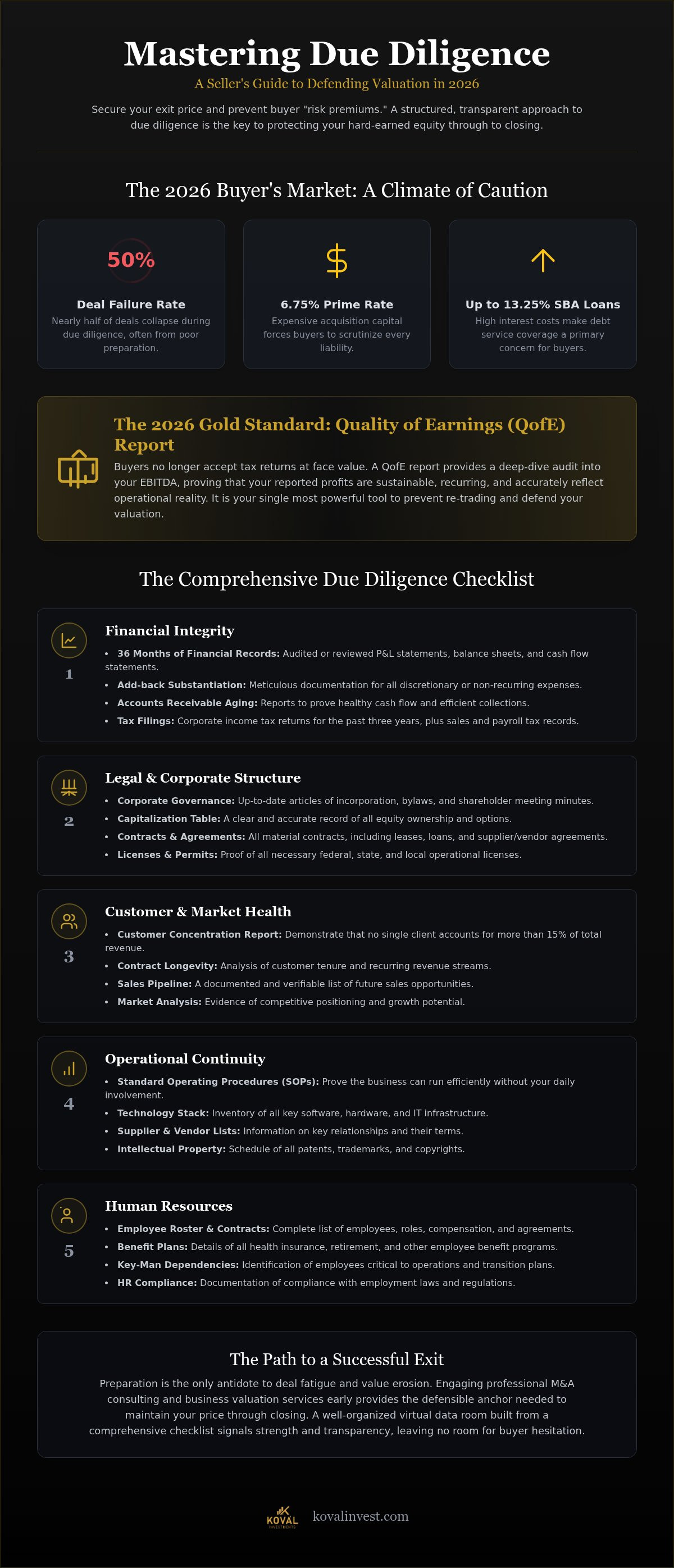
Due diligence is far more than a simple background check; it's a comprehensive, high-stakes audit of your company's financial, legal, and operational health. For most owners, Understanding Due Diligence is the first step in shifting from a sales mindset to an evidentiary one. In 2026, the "Quality of Earnings" (QofE) report has emerged as the gold standard for high-value transactions. Buyers no longer accept tax returns at face value. They want a deep dive into your EBITDA to ensure that the profits you've reported are sustainable, recurring, and accurately reflect operational reality.
This process requires a significant psychological shift. You're moving from "selling the dream" of what the business could be to "proving the reality" of what it actually is. When you utilize a comprehensive due diligence checklist for selling a business, you're doing more than just gathering files. You're building a defensible narrative that prevents "re-trading." Re-trading occurs when a buyer discovers a discrepancy and uses it as leverage to drop the purchase price just weeks before closing. By being prepared, you maintain the upper hand in negotiations.
The Consequences of Poor Preparation
Preparation is the only antidote to deal fatigue. Many industry professionals report that nearly 50% of deals fail during the due diligence phase, often because the seller cannot provide documents fast enough. Sophisticated buyers view unorganized records as a sign of "management risk." If your financials are messy, they'll assume your operations are too. This lack of clarity leads to "risk discounts," where the buyer lowers the valuation to compensate for the uncertainty they've uncovered during the audit.
The 2026 Economic Influence on Buyer Scrutiny
The current economic climate has intensified buyer caution. With the prime rate sitting at 6.75% as of August 2026, acquisition capital is expensive. SBA 7(a) loan interest rates can reach as high as 13.25% for smaller transactions, making debt service coverage a primary concern for buyers. They'll scrutinize every liability on your balance sheet to ensure the business can handle these higher interest costs. In this high-interest environment, transparency isn't just a courtesy; it's the most valuable currency you have. A seller who proactively identifies and explains financial red flags is a seller who closes deals without last-minute price erosion.
The Comprehensive Due Diligence Checklist for Business Sellers
A structured due diligence checklist for selling a business serves as the roadmap for your transaction team. While the buyer will request a mountain of data, your preparation should focus on five core pillars: financial integrity, legal compliance, customer health, operational continuity, and human capital. Using a Comprehensive Due Diligence Checklist helps you categorize these requirements so you can populate your virtual data room (VDR) efficiently.
- Financial Records: Buyers expect 36 months of audited financial statements. They'll look for consistency between your P&L and balance sheets to verify that your cash flow is as robust as you claim.
- Legal and Corporate Structure: Your corporate house must be in order. This includes up-to-date articles of incorporation, bylaws, and a clear cap table that accounts for every share of equity.
- Customer and Market Data: Customer concentration reports are vital. If one client represents more than 15% of revenue, buyers see a risk. Longevity of contracts is also a key metric.
- Operational Documentation: Standard Operating Procedures (SOPs) and technology stacks should prove the business can run without your daily involvement.
- Human Resources: Organize employee contracts, benefit plans, and identify any key-man dependencies that could threaten the transition.
Preparation is a collaborative effort. Engaging in professional business valuations early helps you identify documentation gaps before a buyer does, ensuring your price stays firm during the audit.
Financial Deep Dive: Beyond the Tax Return
Proving "Add-backs" is one of the most critical steps in maximizing your exit value. You must justify discretionary expenses, such as personal travel or non-recurring legal fees, to boost your EBITDA. Buyers will also scrutinize your Accounts Receivable aging reports. If your collections are sluggish, it impacts working capital adjustments at closing. For mid-market acquisitions, GAAP-compliant reporting is no longer optional; it's a requirement for a successful exit.
Legal and Intellectual Property Safeguards
Verify ownership of all trademarks, patents, and proprietary software. It's common for owners to discover that intellectual property is still held in an individual's name rather than the corporation's. Review "Change of Control" clauses in existing vendor contracts to ensure they won't trigger a termination upon sale. Finally, ensure all regulatory filings and licenses are current for 2026. This level of detail removes the "management risk" that often leads to price drops.
The Hidden Deal-Killers: Business Credit and Debt Structure
Many sellers view debt as a simple subtraction from the purchase price. However, in a sophisticated audit, your credit profile is an active indicator of operational stability. Errors on your business credit report can silently derail a buyer's SBA loan approval, especially when lenders are already cautious about high interest rates. It's essential to include a credit health check in your due diligence checklist for selling a business. Buyers often perform deep background checks on the founders' financial history to ensure no systemic risks exist. Utilizing professional business credit repair services to clean up your profile before signing a Letter of Intent (LOI) protects your valuation from last-minute collapses. This proactive step ensures that no legacy issues interfere with the buyer's capital procurement process.
Optimizing the Debt-to-Income Ratio
Cleaning up your balance sheet directly increases your final EBITDA multiple. Buyers distinguish between "good debt" used for strategic growth and "bad debt," such as high-interest merchant cash advances, that signals cash flow distress. If your business carries debt with rates significantly higher than the current 6.75% prime rate, it creates a "risk premium" that buyers use to lower their offers. Red flags that buyers look for include high credit utilization across business lines and frequent inquiries from alternative lenders. Be prepared for detailed questions regarding historical credit disputes. Proactive resolution of these issues shows you are a disciplined manager who values transparency and operational integrity.
Ensuring Buyer Financing Success
Your business credit health often dictates the terms of the buyer's acquisition loan. If your profile is weak, the buyer may face interest rates at the top of the SBA 7(a) range, which currently hits 13.25% for smaller loans as of August 2026. This increased cost of capital reduces the amount the buyer can afford to pay you. Credit optimization makes your business "bankable," ensuring the lender sees a stable transition rather than a liability. Credit-readiness is the state where a business profile meets all institutional lending criteria for 2026. By reaching this state early, you remove the primary friction point that prevents deals from reaching the finish line. When your business is bankable, you aren't just selling a company; you're selling a secure investment.
Strategic Pre-Sale Cleanup: Boosting Value Before the Audit
Strategic cleanup is the phase where you actively remove the risk premiums a buyer's audit would otherwise exploit. By the time you finalize your due diligence checklist for selling a business, every operational red flag should already have a documented solution. Correcting inefficiencies that drain cash flow is the most direct way to increase your bottom line before a buyer applies their valuation multiplier. This proactive approach ensures that you aren't just presenting a list of documents, but a polished, high-performance asset that justifies a premium price.
Securing 0% interest business funding is a powerful tool for optimizing your working capital during this window. It allows you to address deferred maintenance or upgrade essential systems without adding interest-bearing debt to your balance sheet. Additionally, you should focus on diversifying your customer base. Eliminating high-concentration risk premiums is essential; if one client represents a large portion of your revenue, buyers will discount your value. Formalizing all handshake deals into written, assignable contracts is another non-negotiable step to protect your equity.
Leveraging Capital to Enhance Valuation
Interest-free capital serves as a strategic bridge during the long due diligence window. You can use these funds to finance high-ROI projects that immediately boost your EBITDA, such as automating a manual process or launching a proven marketing campaign. This capital procurement must be balanced carefully with your debt-to-equity targets to ensure your balance sheet remains attractive. If you're looking to optimize your capital structure before a sale, our strategic planning services can help you align your funding with your exit goals.
Operational Scalability and the "Owner Exit" Test
The owner exit test determines if your business can thrive without your daily involvement. Documenting comprehensive Standard Operating Procedures (SOPs) proves to a buyer that the company is a scalable machine rather than a personality-driven job. It's also vital to clean up lifestyle expenses. Personal travel, memberships, or non-business vehicles should be removed from the books to present a transparent and professional financial picture. Consider how alternative business funding solutions can stabilize operations and provide the liquidity needed to maintain momentum during the transition period.
The Deal Team: Why Professional M&A Consulting is Essential
Assembling a deal team is the final, most critical step in executing your due diligence checklist for selling a business. While previous sections focused on identifying risks and optimizing financials, the advisor focuses on process management. They act as a strategic shield, managing the buyer's "request list" to prevent over-disclosure and preserve your leverage. By controlling the flow of information in the virtual data room (VDR), your advisor ensures that sensitive data is only shared after the buyer has proven their intent. This methodical approach prevents the "information fatigue" that often leads sellers to make concessions just to end the process.
This coordination extends beyond document management. Your advisor harmonizes the efforts of your legal, tax, and financial teams to ensure a unified front. Without this alignment, conflicting advice can create "deal friction" that scares off buyers. Professional business valuation services are central to this effort. They provide a defensible anchor for your asking price, making it much harder for a buyer to justify a low-ball offer based on perceived risks. When your valuation is backed by a rigorous, evidence-based report, you maintain the upper hand in negotiations.
Selecting Your Strategic Partners
You should look for a consultant who understands the intersection of capital procurement and exit strategy. A success-based philosophy in professional M&A advisory is a hallmark of a true partnership; it means your advisor is as invested in the outcome as you are. Koval Investments bridges the gap between pre-sale financial cleanup and the final closing. We act as a seasoned strategic partner, navigating the nuances of 2026 market conditions alongside you. This collaborative stance ensures that your objectives remain the priority throughout the engagement.
The Final Countdown: From LOI to Closing
Signing the Letter of Intent (LOI) is only the beginning of the end. You'll then enter the "confirmatory" due diligence phase, where the buyer verifies the math behind the agreed price. This is where many deals fail due to poor preparation or unexpected "Working Capital Adjustments" at the closing table. You must also prepare for post-closing obligations, such as earn-outs, transition periods, and escrow holdbacks. These structures are frequently used to bridge valuation gaps in the current market. Having a partner who can negotiate these terms ensures you don't just sell your business, but you successfully exit with your valuation intact.
Securing Your Legacy and Maximizing Your Exit
Mastering the due diligence process is the final hurdle in your entrepreneurial journey. By utilizing a comprehensive due diligence checklist for selling a business, you transform a potentially chaotic audit into a structured, authoritative demonstration of value. We've explored how proactive credit repair and strategic capital procurement remove the risk premiums that buyers use to lower their offers. When you identify and resolve financial red flags early, you maintain the upper hand throughout the negotiation.
A successful exit requires more than just clean books; it demands a defensive strategy that protects your hard-earned equity from last-minute re-trading. Koval Investments provides the steady hand you need to navigate these complex financial landscapes with confidence. Our success-based M&A consulting and expertise in 0% interest capital procurement ensure your business is optimized for the highest possible valuation before the audit begins.
Get a Professional Business Valuation and Exit Strategy from Koval Investments today to ensure your transition is as profitable as it is seamless. Your hard work deserves a reward that truly reflects the value of what you've built, and we're ready to help you secure it.
Frequently Asked Questions
How long does the due diligence process typically take in 2026?
The process usually spans 60 to 90 days, though complex mega-deals or cross-border transactions can extend this to 120 days. This timeline is heavily influenced by how quickly you can populate your virtual data room. If your due diligence checklist for selling a business is complete before the Letter of Intent is signed, you can significantly reduce this window. Delays often occur when buyers request additional financial clarity regarding current debt service coverage.
What is the most common reason deals fall through during due diligence?
Financial discrepancies discovered during the audit are the primary cause of deal failure. When a buyer's Quality of Earnings report reveals that reported EBITDA was inflated by non-recurring revenue or undocumented lifestyle expenses, trust evaporates. This often leads to re-trading, where the buyer drastically lowers the offer to compensate for the perceived risk. If the seller cannot justify the gap, the deal usually collapses due to deal fatigue or a loss of confidence.
Can I perform my own business valuation before starting due diligence?
While you can estimate your company's worth, a professional valuation is necessary to provide a defensible anchor for negotiations. Self-valuations often rely on emotional bias or outdated multiples that don't reflect the 2026 market. Professional business valuations use standardized methodologies that sophisticated buyers and lenders respect. Having a certified report ready before you start the due diligence checklist for selling a business prevents buyers from undervaluing your company during the high-stakes audit phase.
How many years of financial statements do I need to provide to a buyer?
Standard practice requires at least 36 months of detailed financial records to establish a reliable performance trend. This includes audited profit and loss statements, balance sheets, and tax returns for the last three years. Buyers look for consistency in revenue growth and expense management over this period to ensure the business is stable. Providing a full three-year history allows you to prove that your cash flow is recurring and not just a temporary spike.
Does my personal credit score matter when I am selling a business?
Your personal credit history matters because many buyers rely on SBA 7(a) loans, which require the seller's cooperation and financial transparency. Lenders often perform background checks on founders to ensure no systemic financial risks exist. If your personal or business credit has inaccuracies, it can increase the buyer's cost of capital. Improving your profile through credit repair services before the sale makes the business more bankable for the next owner and protects your final valuation.
What is a virtual data room (VDR) and do I really need one?
A virtual data room is a secure online repository used to store and share the sensitive documents required during a corporate audit. You absolutely need one for a professional transaction in 2026. A VDR allows your M&A advisor to track which documents the buyer has viewed and maintain strict version control. This organization prevents information leaks and ensures the buyer's team has everything they need without overwhelming your internal staff or disrupting daily operations.
How does 0% interest funding affect my company’s sellability?
Strategic use of 0% interest funding improves sellability by allowing you to optimize working capital without adding interest-bearing debt. Buyers prefer businesses with clean balance sheets and strong cash flow metrics. By using interest-free capital to fund pre-sale improvements or bridge operational gaps, you present a more efficient financial profile. This reduces the risk premiums buyers apply, ultimately protecting your final valuation and making the acquisition more attractive to institutional lenders and private equity groups.
What happens if a buyer finds a mistake in my financial records?
If a buyer discovers an error, they will typically request a working capital adjustment or lower their overall offer to account for the perceived risk. Transparency is your best defense in this situation. If you find the mistake first, disclose it immediately alongside a clear plan for correction. Handling discrepancies with integrity can preserve the deal, whereas hiding them usually leads to a complete loss of leverage and a collapsed transaction at the finish line.